

How to Journal Live Trades Accurately: what to record and why
How to Journal Live Trades Accurately starts with a simple principle: capture the facts you will need for objective review, not a running narrative. A complete live trade entry should include a time-stamped entry and exit, the instrument, position size, the trade rationale or setup, risk parameters such as initial stop and risk in dollars, the outcome notes, and a short post-trade reflection to record lessons learned - this set of fields is the minimum required for useful analysis and later aggregation Investopedia trading journal guide.
Short example, one-sentence definitions: timestamp, the exact market time you entered or exited; position size, the number of units and the cash at risk; rationale, the concise setup trigger; post-trade reflection, one short note about what matched or deviated from the plan. Treat the journal as a risk-management and learning tool, not as a prediction of guaranteed results.
What a complete live trade entry looks like
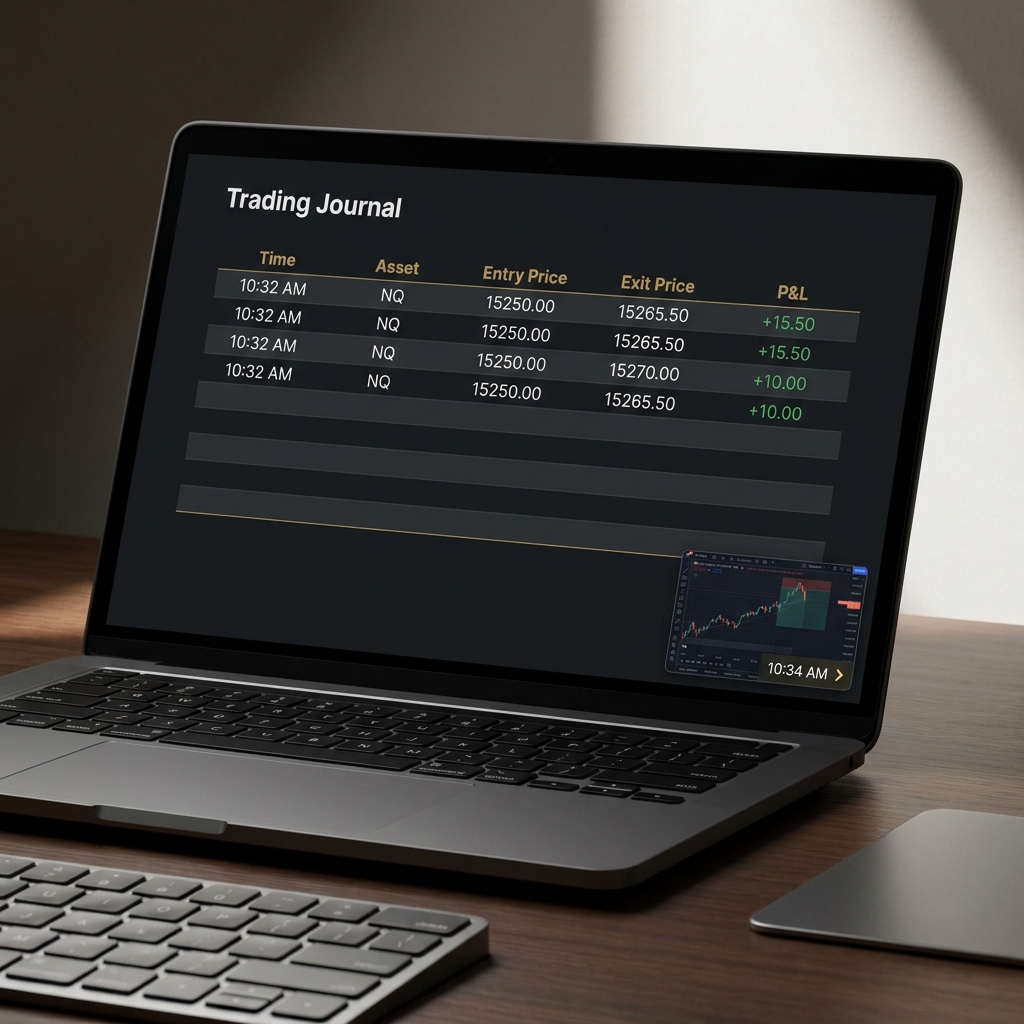
A practical live trade entry is a single row or record with fixed fields: entry timestamp, exit timestamp, instrument, entry price, exit price, size, initial stop, risk in dollars, rationale tag, outcome, and a one-line reflection. That structure ensures each record can be filtered and measured consistently across sessions CME Group guidance on journal contents.
Keep rationale notes short and standardized by using tags or brief templates: for example, "breakout, setup A, momentum" or "fade, setup B, support test". Using consistent tags makes later filtering and setup-level analysis practical.

How journaling supports risk control and learning
Journals document adherence to pre-trade risk rules and create an audit trail for drawdown decisions; written records align with investor-protection advice to keep clear plans and records so governance and risk oversight are straightforward SEC Investor.gov keeping good records.
Use the journal to separate process from luck by focusing reviews on rule adherence and measurable inputs rather than only on profits and losses.
Core elements of a complete live trade journal
Design your template around pre-trade, in-trade, and post-trade fields. At minimum, include instrument, exact entry price, entry timestamp, size, initial stop loss, planned target, trade rationale, and tags for setup and rule adherence. These columns let you calculate per-trade risk and later compute aggregate metrics Investopedia trading journal guide.
Practical example of concise field text: entry price as a numeric value, timestamp in local exchange time, stop loss recorded as price and dollars at risk, rationale as one short sentence or a tag. Avoid verbose notes during live capture; richer explanations can be added in the post-session review.
Pre-trade fields and checklists
Pre-trade fields are the items you must record before clicking enter: planned size, entry price or trigger, initial stop, maximum risk in dollars and percent, and the specific rule you are following. A pre-trade checklist can be a single column that you tick to confirm the plan is in place.
For faster capture, keep the checklist binary: yes/no for plan present, and a short required rationale tag so every open has a minimal, analyzable reason.

In-trade fields and rapid capture
In-trade fields should focus on verifiable facts: the actual filled price, the timestamp for fills, adjustments to stops, and whether the trade was scaled up or down. Record these items immediately to avoid reconstruction later CME Group guidance on journal contents.
When markets move fast, capture a minimal viable record: timestamp, price, size change, and one short note. Add fuller commentary during the post-session review.
How to Journal Live Trades Accurately: real-time logging techniques and tools
Real-time capture reduces recall error. Use hotkeys, quick-entry forms, or a minimal mobile template to log entries and exits the moment they occur. Immediate logging improves the quality of your data because it prevents memory-based reconstruction and hindsight bias SEC Investor.gov keeping good records.
Keep two quick-entry options ready: one ultra-minimal record for high-speed markets and one expanded form for calmer conditions. The ultra-minimal record should take under 20 seconds to complete and include timestamp, price, size, and a one-word rationale tag.
Use minimal live-entry fields, hotkeys or quick forms, timestamped screenshots for context, and expand notes during a brief post-session review so facts are preserved and learning is recorded.
Screenshots are a low-effort complement to form entries; a timestamped screenshot of the order blotter or the chart gives visual context that plain text sometimes misses. Use screenshots sparingly and store them with a consistent filename or ID so they are easy to match to a journal row CME Group guidance on journal contents.
Balance speed with accuracy by limiting live fields and expanding notes after the session. When you must choose, record facts first and opinions later.
How to set and record risk parameters before each trade
Record position sizing and initial risk per trade as discrete, pre-trade fields: risk in dollars, risk as a percent of the account, and the initial stop price. Make these numeric fields mandatory so every record contains the same risk context Investopedia trading journal guide.
Example calculation: if your account equity is 10,000 and you allow 1 percent risk per trade, then risk per trade is 100; if your stop is 2 points away, then position size = 100 divided by 2, rounded to instrument lot rules. Put the numeric results into the journal so sizing decisions are auditable.
Calculating position size and initial risk
Use a fixed formula for sizing and record both the formula inputs and the final computed size. That keeps your method consistent and lets you see when inputs changed between trades.
Record allowed drawdown and per-session limits as account-level fields and confirm adherence before you trade; these governance fields belong to the journal so post-session reviews can confirm rule adherence.
A step-by-step framework: pre-trade, in-trade, and post-trade workflow
Implement a three-stage workflow: pre-trade checklist and recorded fields, immediate in-trade capture that logs facts only, and a structured post-trade reflection that turns observations into lessons. Repeat this sequence every session to create a reliable habit CMT Association guidance on maintaining a journal.
Pre-trade: confirm plan, record size and stop, tag setup. In-trade: record fills and any rule-authorized adjustments. Post-trade: add the one-line reflection, tag rule adherence, and flag outliers for deeper review.
Use a quick-entry form or hotkey utility to capture essential fields in seconds
Keep entries under 20 seconds
Keep the live capture minimal and standardize the post-trade reflection to one sentence. For tagging, use a small controlled vocabulary so later filtering is clean.
Limit live entries to essential fields and expand during the review; this preserves speed without losing analysis quality.
Pre-trade checklist and entry record
Use a short pre-trade checklist that requires a yes/no confirmation and a rationale tag. Store the checklist state with the trade record so you can later measure how often you skipped or altered steps.
Make the checklist non-optional: require it to be checked before the trade moves from planned to active in your workflow.
In-trade logging and exit capture
During the trade, record fills with exact timestamps and note any authorized stop moves or scaling events. These changes are key signals when you analyse execution quality and rule adherence Investopedia trading journal guide.
Keep rapid notes about why an adjustment happened and tag whether it was rule-based or discretionary; that distinction helps separate disciplined decisions from emotional reactions.
Post-trade reflection and tagging
Write a single-sentence reflection that answers two prompts: what went as planned, and what I would do differently next time. That short form keeps the ritual quick and focused on learning.
Tag each trade for setup, timeframe, and rule adherence so you can filter later and compute metrics by strategy segment.
Key metrics to track and how to calculate them
Track core aggregated metrics: win rate, average R multiple, expectancy, and drawdown. Win rate is percent wins; average R is average profit or loss divided by the per-trade risk; expectancy is (win rate times average win) minus (loss rate times average loss) expressed in R or dollars. These metrics show whether a process is structurally positive over time Investopedia trading journal guide.
Compute drawdown as peak-to-trough decline in equity over a chosen window; track both session drawdown and cumulative drawdown to spot worsening risk behavior.
Win rate, average R, and expectancy
Keep calculations simple and consistent: use the same definition of a win across the dataset, and calculate average R by dividing each trade's PnL by its recorded risk, then averaging those ratios. Expectancy expressed in R is a concise way to judge whether your plan has a positive edge.
Tag trades by setup so you can compute these metrics per strategy rather than only at the account level.
Drawdown and rule-adherence metrics
Measure drawdown in dollars and percent and record whether drawdown breaches coincided with documented rule deviations. That connection helps diagnose whether losses stem from normal variance or from process erosion SSRN paper on day-trader performance.
Track a simple rule-adherence score per session, for example the percent of trades in which the pre-trade checklist was completed and the initial stop kept unless rule-authorized.
Decision criteria and evaluation: when your journal should change your process
Set conservative, objective thresholds that trigger a formal review: a sustained negative expectancy across a minimum sample, a rising drawdown beyond your allowed limit, or a drop in rule-adherence below a pre-set percentage. Use these thresholds as prompts to pause or test changes rather than as automatic guarantees of outcome Evidence on distinguishing skill from variance.
See how structured challenges use virtual funded accounts to test consistency and disciplined decision-making
Commit to a fixed short review cadence: a quick daily check and one weekly metrics review to keep the journal actionable without overwhelming your workflow.
Document any decision to change sizing, rules, or setups as an experiment in the journal with clear start and end dates and success criteria so you can evaluate outcomes cleanly.
Use the journal to decide conservatively: prefer small, instrumented experiments and clear stop conditions rather than sweeping rule changes after a short losing run.
Using journal metrics to decide rule changes
When metrics cross your review thresholds, interrogate whether the signal is structural by checking sample size, consistency across setups, and changes in market regime; avoid reacting to short-term variance or anecdotal losses.
Record each rule change as an experiment with a hypothesis, a sample target, and a stop condition so the outcome is measurable.
When to pause a strategy or run an experiment
Pause a strategy if expectancy has been negative across your pre-defined minimum sample and rule-adherence is high; if the process fails even when followed, the problem is likely structural rather than behavioral.
Run small controlled experiments by changing one variable at a time and logging the modification in the journal so results are attributable and reproducible.
Common mistakes that undermine accurate live journaling
End-of-day fill-in is the most common failure: reconstructing trades from memory introduces hindsight bias and reduces the signal quality of your data. Real-time capture and automated timestamps mitigate this risk CME Group guidance on journal contents.
Other common mistakes include inconsistent fields, ambiguous rationale notes, and skipping post-session reviews. Those habits make later analysis noisy and undermine your ability to learn.
End-of-day fill-in and hindsight bias
When you complete entries after the fact, you tend to fit narratives to outcomes. Prevent that by forcing mandatory timestamped entries and keeping live rationale notes deliberately short and factual.
If you must reconstruct, mark entries as reconstructed so later filtering can exclude them from performance calculations.
Excess detail or inconsistent fields
Too much free-text makes the dataset hard to filter. Use concise tags and a small controlled vocabulary for rationale and setup fields, and keep required columns consistent across records.
A single review ritual after each session is an effective corrective: it enforces consistency and makes missing fields obvious quickly.
Templates and examples: a sample spreadsheet and three live entries
Minimal spreadsheet template columns: Entry Timestamp, Exit Timestamp, Instrument, Entry Price, Exit Price, Size, Risk (dollars), Initial Stop, Rationale Tag, Outcome, Post-Trade Reflection, Setup Tag. These columns map directly to the fields discussed earlier and make it straightforward to compute the metrics you need Investopedia trading journal guide.
Store each trade as one row and use the setup tag to filter by strategy. Keep the spreadsheet schema stable; avoid adding ad-hoc columns that confuse long-term analysis.
Minimal spreadsheet template fields
Keep column headers short and canonical: timestamp_in, timestamp_out, instrument, entry_px, exit_px, size, risk_usd, stop_px, tag_rationale, result, note. Use consistent time zone notation for timestamps so merges or API sync remain accurate.
Include a small lookup table for tags so you do not accidentally create duplicates in the vocabulary during fast entry.
Three annotated sample trade entries
Sample entry 1, minimal: 09:31:05, 10:15:20, ABC, 101.50, 105.00, 100 shares, 200, stop 99.50, tag "breakout", outcome +350, reflection "left partial at target, trail stop worked".
Sample entry 2, minimal: 11:05:00, 11:45:30, XYZ, 50.00, 49.00, 200 shares, 200, stop 51.00, tag "mean-reversion", outcome -200, reflection "entered early on weak signal; wait for confirmation".
Sample entry 3, minimal: 13:12:10, 13:45:00, DEF, 25.00, 27.50, 400 shares, 100, stop 24.75, tag "support-test", outcome +1000, reflection "good execution and size management".
Adapt the template for API sync by reserving column IDs that map to external fields and keep human notes in a single column to avoid schema drift.
Automating timestamps and records: APIs, broker sync, and practical limits
Automation reliably captures timestamps, fills, and basic order details; however, human rationale, context, and rule-adherence judgments still need to be recorded manually. Combine automated logs with short human notes to preserve context Investopedia trading journal guide.
When syncing with brokers or using APIs, ensure you maintain an auditable trail: store raw fills, timezones, and unique IDs so later reconciliation is straightforward.
What automation can capture and what it cannot
Automation excels at timestamps, trade IDs, price fills, and quantity; it cannot reliably capture a concise human rationale or a discipline judgement. Keep a required free-text field for one-line reflections so context remains with the automated record.
Use automation to reduce manual error but do not let it replace the learning ritual of writing a short reflection.
Privacy, accuracy, and auditability considerations
Ensure API sync adheres to your privacy preferences and retains raw data for audits. Keep backups and export routines so you can run independent analyses if needed.
When relying on third-party sync, periodically validate that timestamps and fills match your broker records to avoid undetected discrepancies.
How to run an effective post-session review
Daily review checklist: confirm all trades have timestamps, check rule adherence for each trade, flag outliers, and add context to brief reflections. A short daily ritual keeps the dataset usable and surfaces immediate lessons CME Group guidance on journal contents.
Weekly and monthly analyses should compute win rate, average R, expectancy, and drawdown and compare these metrics across setups and timeframes to find structural signals.
Daily checklist for review
Keep the daily checklist under five items: all entries complete, rule-adherence tagged, top two lessons noted, and any unresolved execution issues flagged for deeper analysis.
Keep the ritual short so it becomes automatic; long reviews reduce compliance.
Weekly and monthly aggregated analyses
On a weekly cadence, compute per-setup metrics and look for persistent underperformance. Monthly reviews should include a review of drawdown trajectories and a short plan to address recurring weaknesses.
Convert recurring mistakes into a single concrete change and document that change as an experiment in the journal.
Using your journal to test strategy and control risk over time
Log experiments as discrete modifications: record the hypothesis, the exact change, the start date, the sample size target, and end conditions. This keeps testing evidence-based and prevents cherry-picking results SSRN research on separating skill from variance.
Distinguish signals from noise by checking whether changes persist across multiple setups and by using reasonable sample sizes before drawing conclusions.
Designing clean experiments with journal data
Test one variable at a time and use tagging to separate experiment trades from baseline trades. That approach makes the comparison straightforward when you aggregate metrics.
Keep experimental samples modest but sufficient to detect meaningful shifts in expectancy and rule adherence.
Interpreting signals versus noise
Short-term losing stretches are common; use your pre-defined thresholds and sample rules to avoid overreacting. Journals help you see whether losses occur despite correct rule adherence, which suggests structural issues rather than behavioral lapses.
Governance matters: keeping written plans and records follows investor-protection guidance and creates a clearer basis for decisions.
Conclusion: building a durable journaling habit and next steps
Make a simple habit checklist: mandatory minimal live capture, an immediate daily five-item review, and one weekly aggregated metrics session. These small rituals sustain data quality and make the journal actionable over time SEC Investor.gov keeping good records.
Remember that a journal helps learning and risk control but does not guarantee outcomes; use it to improve process consistency and to make disciplined, evidence-based decisions.
At minimum record timestamped entry and exit, instrument, position size, initial stop or risk, rationale tag, outcome, and a short post-trade reflection.
Log trades in real time when possible; immediate capture reduces recall errors and hindsight bias, while end-of-day notes can supplement but not replace live entries.
Automation can capture timestamps and fills reliably, but human rationale and rule-adherence judgments still need short manual notes to preserve context.
References
- https://www.investopedia.com/trading-journal-what-it-is-how-it-works-and-how-to-create-one-4582653
- https://www.cmegroup.com/education/articles-and-reports/what-to-include-in-a-trading-journal.html
- https://www.fundedplays.com/challenges
- https://www.investor.gov/introduction-investing/investing-basics/keeping-good-records
- https://www.fundedplays.com/
- https://www.fundedplays.com/blogs
- https://www.fundedplays.com/blogs/how-fundedplays-evaluations-work
- https://cmtassociation.org/2024/03/15/developing-and-maintaining-a-trading-journal/
- https://papers.ssrn.com/sol3/papers.cfm?abstract_id=3434023
- https://tradersync.com/
- https://www.tradesviz.com/
- https://www.tradervue.com/blog/best-trading-journal