
What odds movement means and why it matters
Basic definitions: odds, implied probability, and line movement
The phrase How to Distinguish Signal from Noise in Odds Changes captures the core question many analysts and bettors face: when does a change in the posted price reflect new, actionable information rather than routine market fluctuation? Odds movement describes the shift in a bookmaker's posted price or implied probability for an outcome over time, and implied probability is simply the conversion of those odds to a percentage chance, adjusted for the bookmaker's margin or overround.
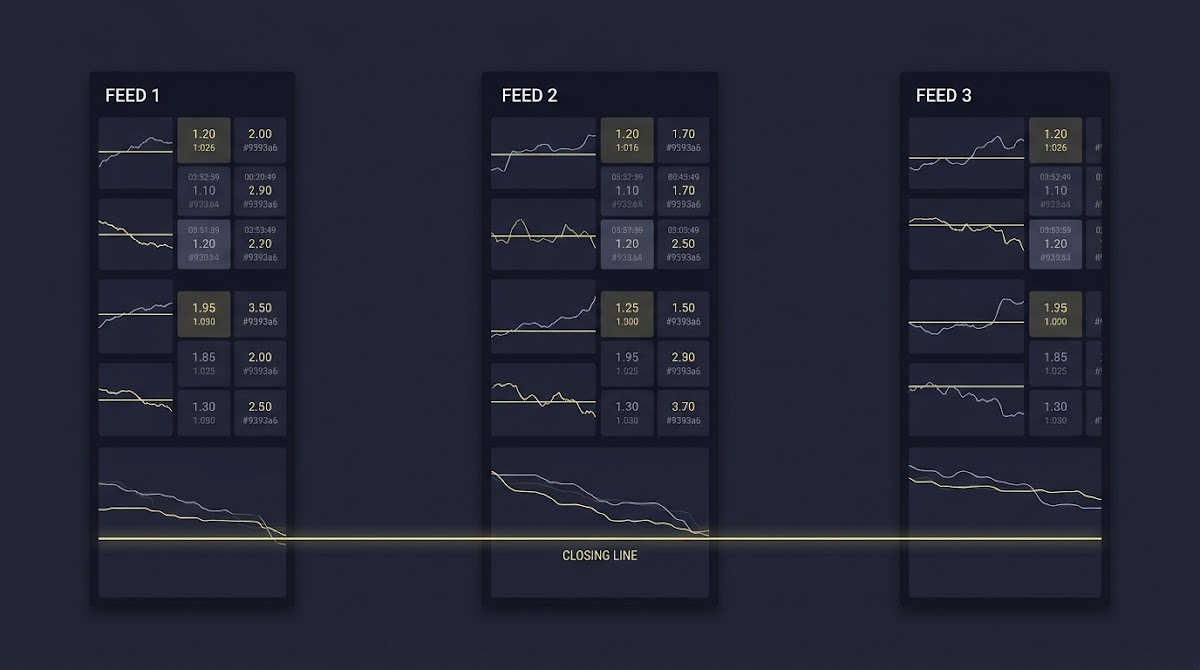
Traders and analysts often use the closing line as a practical benchmark because closing prices in regulated markets tend to aggregate the most public information and liquidity, making them useful for comparing earlier entries to a market-consensus price Pinnacle article on closing line value.


It is important to remember that odds change for several reasons beyond new public information. Liquidity shifts, book balancing actions by trading teams, margin adjustments, and routine pricing updates all drive movement that is not necessarily a signal of material new information. Treating every move as a signal leads to overreaction; a disciplined approach prioritizes verification and context.
Small moves can embed real edge in deep, liquid markets where even modest changes reflect substantial money or sharp activity; in thin markets, the same nominal change can be noise caused by low liquidity or a single balancing stake. Evaluating magnitude relative to baseline volatility, and normalizing for bookmaker margin, helps distinguish meaningful shifts from expected microstructure churn.
Closing-line comparisons remain useful but are not a guarantee of predictive success; they are a benchmark for informational completeness rather than a ticket to profit.

How betting markets aggregate information: market microstructure basics
Who moves lines and why: bettors, market makers, risk teams
Line moves are driven by interactions between customer bets, market makers or algorithmic pricing engines, and trading desks that manage exposure. Large or sharp wagers can force a bookmaker to rebalance positions, while a trading desk might adjust prices proactively to reflect observed money flows or risk limits. Understanding who moved a line matters because it shapes whether the move likely encodes new information or internal risk management.
Market structure also affects the interpretability of moves. In larger markets with many participants and regulated liquidity, prices adjust smoothly; in smaller or regional markets, a single substantial bet can produce a pronounced but idiosyncratic shift that carries little external informational content.
Markets go through liquidity cycles: early windows are often thin and price-sensitive, midday may see sporadic activity, and late windows near start or closing receive concentrated liquidity and information.

Recognizing the market phase helps set expectations for how much movement is normal and whether early moves should be stress-tested against later, more liquid prices before acting.
Step 1: set a baseline for typical volatility
Start with a simple baseline: measure historical short-window volatility for the same market and timeframe, using several recent similar events as reference. That baseline becomes the yardstick for what counts as ordinary fluctuation versus an outlier worthy of further checks.
Keep the baseline sport-specific and time-of-day aware, because volatility patterns differ by league, contest type, and region.
Step 2: apply significance thresholds and event windows
Use short event windows to limit the influence of unrelated information and set a statistically meaningful threshold for flagging moves. An event-study style approach that compares a move to short-window volatility estimates helps identify outsized reactions while limiting false positives Journal guidance on event-study methods.
Pair thresholds with straightforward rules of thumb: if a change exceeds the baseline-adjusted threshold and coincides with an unusual liquidity pattern, it should progress to the verification stage rather than immediate action.
Step 3: verify with news and integrity sources
Once a move is flagged, the next step is verification: check contemporaneous official announcements such as injury reports, lineup confirmations, or competition statements, and review integrity alerts from watchdogs. This multi-step check reduces false positives by combining statistical detection with reality checks.
Industry practice emphasizes combining statistical thresholds with speed checks against integrity reporting to avoid mistaking manipulation or thin-liquidity noise for real information IBIA 2024 Annual Integrity Report.
Explore FundedPlays Challenges for disciplined practice
Adopt the checklist above: measure your baseline, flag outsized moves, then verify with news and cross-market checks before deciding.
Below is a compact checklist you can use as an operational sequence when an odds move looks unusual: first confirm baseline exceedance, then seek news confirmation, check liquidity, look for cross-market confirmation, and consult integrity alerts when relevant.
Setting baselines and significance: applying event-study style tests
Choosing the event window and volatility estimator
Pick an event window that matches the expected speed of information flow for the sport and market. Short windows reduce contamination by unrelated updates, but they require robust volatility estimates to avoid overflagging normal churn. Use a rolling short-window volatility measure derived from recent comparable events for the sport.
Older event-study methods remain conceptually valid but need adaptation to betting microstructure; the core idea is still to compare observed movement against an empirical distribution of short-window changes Journal guidance on event-study methods.
Translating odds changes into statistically meaningful moves
Convert raw odds into implied probabilities and, where possible, normalize for overround to get net implied probabilities. Compare the delta in net implied probability to the baseline volatility metric to compute a standardized deviation; values beyond your preset threshold merit verification. This approach keeps the analysis in probability space where interpretability is clearer.
When in doubt, document assumptions about volatility estimators and event windows and run sensitivity checks on threshold choices before relying on automated alerts.
Verify contemporaneous news and integrity alerts
Fast checks for injuries, lineups, and official announcements
Effective verification prioritizes official and fast sources: federation statements, team injury updates, and verified lineup releases. These sources help confirm whether a move coincides with verifiable new information rather than speculation or thin liquidity.
If you find a credible announcement that aligns with the timing of the move, the probability that the move reflects real information increases; if not, proceed cautiously and favor waiting for cross-market confirmation.
Compare the move to a sport-specific baseline, apply an event-window significance test, verify contemporaneous news and integrity alerts, and seek cross-market confirmation before acting.
Remember that timing matters: some announcements are regionally delayed, and the relevance of a news item depends on whether it arrived before the line move.
Integrity watchdogs report concentrated clusters of suspicious betting activity by sport and region, and these reports show that moves around known risk windows deserve extra scrutiny and possible escalation Sportradar Integrity Services report.
Using integrity reports and alerts to spot unusual activity
Maintain a short list of integrity sources and set alerts for events or competitions with a known history of suspicious clusters. When an event falls into a high-risk pocket, increase the verification rigor and consider delaying action until multiple checks are satisfied.
Escalation to formal reporting is appropriate when a move lacks verifiable news, shows unusual concentration in bets, or coincides with patterns the watchdogs highlight as suspicious IBIA integrity coverage.
Adjusting for liquidity and bookmaker margin: implied probability net of overround
Calculating implied probability adjusted for overround
Bookmaker prices embed an overround that inflates aggregate implied probability beyond 100 percent. To compare prices across books and time, normalize posted odds into probabilities and then adjust each side by the proportional overround so you are comparing net implied probabilities rather than raw posted prices.
This normalization reduces false signals that arise from margin-only adjustments and helps make cross-market confirmation more meaningful Pinnacle article on closing line value.
Interpreting moves in thin markets vs. deep markets
In thin markets, even modest nominal changes can reflect individual large bets or balancing behavior rather than new public information. In deep markets, the same nominal change is more likely to reflect distributed new information from multiple participants. Adjust your action thresholds accordingly.
When monitoring many markets, flag thin-book idiosyncrasies as lower-confidence signals and prioritize cross-market confirmation before acting.
Cross-market confirmation and the role of the closing line
Why seeing the same directional shift across books matters
Cross-market confirmation reduces false positives because independent books and exchanges are unlikely to move in the same direction for the same magnitude absent a shared information shock. When multiple regulated books shift similarly, the chance the move encodes public information rises.
Use regulated exchanges and multiple books as comparators; convergence across them lends confidence to treating the move as signal rather than noise Pinnacle discussion on closing line value.
Quick cross-market confirmation checklist
Use this checklist when checking early line moves
The closing line is useful as a final benchmark because it typically reflects the most complete set of public information and liquidity; comparing an early move to the closing line helps establish whether the market held the directional change through to the most liquid moment of pricing.
Keep in mind that closing-line convergence helps validate an informational move but does not by itself prove future profitability; closing-line comparisons are a validation tool, not a guarantee.
Sport-specific timing windows and integrity risk pockets
How sport and region change the interpretation of moves
Different sports and regions have distinct information flows and market participants, so baseline volatility and the timing of meaningful news vary. For example, international competitions may see cross-timezone delays in official announcements, while domestic leagues often have predictable pregame announcement windows.
Adjust baseline windows and verification checks to the sport and region you monitor to avoid misreading routine volatility as signal or missing late-breaking meaningful updates.
Known risk windows where integrity alerts spike
Integrity reports document concentrated spikes in suspicious activity for particular sports, competitions, and regional markets, often clustering around specific transactional windows or tournaments. Treat moves during these pockets with heightened caution and consider escalating checks or reporting when corroborating evidence is lacking IBIA 2024 Annual Integrity Report.
When an event sits in a known risk pocket, prioritize cross-market checks and formal integrity alerts before treating a move as an actionable signal.
Common pitfalls and how analysts get fooled
False positives from thin liquidity and balancing bets
One frequent trap is interpreting a thin-book adjustment or a trader balancing action as an information-driven signal. Single-book idiosyncrasies often produce moves that evaporate when seen across multiple books or by the time the market closes.
To avoid this pitfall, require cross-book confirmation and normalize odds into net implied probabilities before assigning high confidence to any early move.
Overfitting to past moves and confirmation bias
Another common error is overfitting models to past flagged moves or selectively remembering hits while ignoring false positives. Maintain rigorous recordkeeping and run post-event reviews to refine baselines rather than chasing recent apparent successes.
Behavioral discipline and documented escalation rules help reduce the influence of confirmation bias when interpreting odds movement; institutionalizing the checklist keeps judgment consistent.
Practical scenarios and non-numeric worked examples
Scenario: early injury report and multi-book confirmation
Imagine you see an early move against a key player minutes after a social-media rumor. Your baseline test flags the move as outsized. First, seek official confirmation from team or league sources; if a verified injury report appears and multiple regulated books move in the same direction, the move likely reflects real new information and warrants action per your risk rules.
Document the timeline: when the rumor appeared, when official confirmation arrived, which books moved and how the closing line evolved. This record will be useful in post-event review and to calibrate your baseline windows.
Scenario: late liquidity shock with no supporting news
Alternatively, suppose a late odds shock occurs with no credible news and only a single book shows the change. Your baseline check flags the move, but verification finds no official announcement and integrity sources show no alert. In this case, standing aside or placing a lower-confidence action while waiting for cross-market confirmation is typically the prudent choice.
If the move remains isolated and the closing line reverts, the initial shock was likely thin-liquidity noise or a balancing activity rather than a true information edge.
Decision criteria, monitoring checklist and escalation rules
A simple checklist to take action or defer
Use a yes/no sequence: did the move exceed your baseline threshold? Is there corroborating news from a reliable source? Is the move visible across multiple regulated books? Are liquidity indicators normal? Are there integrity alerts or reasons to suspect manipulation? A yes to most items supports higher confidence; multiple no answers suggest waiting or escalating to review.
Keep the checklist short and binary to facilitate rapid decisions during busy market windows.
When to escalate to formal integrity reporting
Escalate to watchdogs or an internal integrity team when a move lacks verifiable news, shows concentrated betting patterns inconsistent with normal flows, or matches patterns highlighted in integrity reports. Formal reporting is appropriate when the move raises plausible suspicion rather than mere curiosity Sportradar Integrity Services report.
Maintain clear internal thresholds for escalation so that analysts act consistently and quickly when required.
Integrating checks into a repeatable workflow and risk controls
Automating baseline alerts and cross-book feeds
Automate the parts of the workflow that are amenable to programmatic monitoring: baseline exceedance alerts, cross-book price watchers, and liquidity indicators. Reserve human review for verification steps that require judgment, such as interpreting a nuanced announcement or suspicious betting patterns. See our blog for related posts and implementation notes.
Automation increases consistency and frees analysts to focus on verification and escalation when alerts occur Kambi state of industry white paper.
Recordkeeping and post-event review
Log the sequence of signals, decisions, and outcomes for each flagged move. Post-event review of closed events helps you refine baselines, thresholds, and escalation rules, and provides defensible documentation if integrity questions arise.
Tracking performance relative to the closing line can be a useful long-run proxy for skill, while acknowledging that closing-line advantage does not guarantee profitability and should be interpreted cautiously Pinnacle closing line discussion.
Conclusion: how to put signal detection into practice
Key takeaways and quick reference
Separating signal from noise requires combining a statistical baseline with fast verification and cross-market checks. Rely on closing line comparisons as a validation tool, use integrity alerts to identify risk pockets, and demand cross-book confirmation for higher-confidence actions.
These steps reduce false positives and support disciplined decision-making, but they do not remove risk or guarantee successful outcomes.
Next steps for building your own checks
Begin by measuring baseline volatility for the markets you follow on Funded Plays, implement a short-window event detection routine, and add rapid news and integrity checks. Layer in cross-book feeds and logging, and run monthly post-event reviews to tune thresholds and procedures.
Consistent application of the workflow and careful recordkeeping are the best ways to improve judgement over time.
Use the checklist: flag based on baseline exceedance, verify with reliable news and cross-market confirmation, and then decide. Faster action requires stronger verification.
No. Closing-line comparisons are a useful validation of informational completeness but do not guarantee future profits.
Report when a move lacks verifiable news, shows concentrated or unusual betting patterns, or matches integrity watchdog indicators.
References
- https://www.pinnacle.com/en/betting-articles/betting-strategy/closing-line-value/7DJ2G9QWB9Q2KTYG
- https://www.fundedplays.com/challenges
- https://www.gamblingcommission.gov.uk/statistics-and-research/publication/industry-statistics-to-year-end-march-2024
- https://www.jstor.org/stable/272969
- https://ibia.bet/news-details/73
- https://sportradar.com/integrity-regulatory/integrity/?lang=en-us
- https://sports.yahoo.com/articles/ibia-reports-11-increase-suspicious-145700750.html
- https://www.kambi.com/white-papers/state-of-the-industry-2024/
- https://www.fundedplays.com/blogs/how-fundedplays-evaluations-work
- https://www.fundedplays.com/blogs
- https://www.fundedplays.com