
Why converting odds formats matters
When you will need conversions
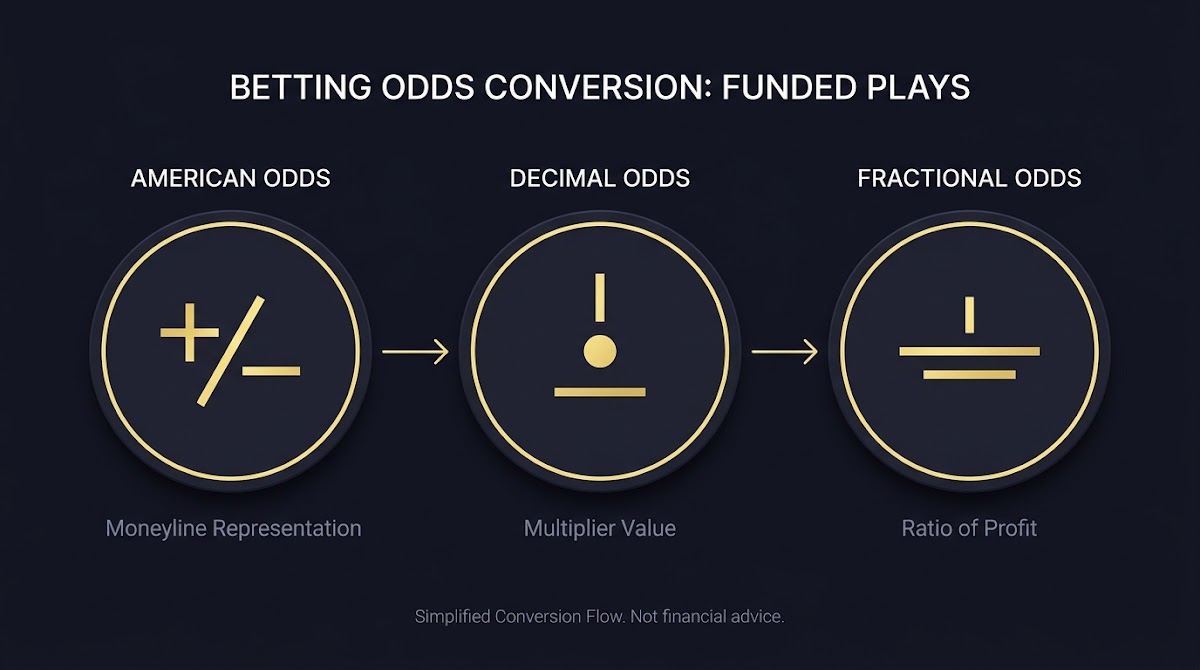
Sports fans and analysts often encounter American, decimal, and fractional presentations of the same market, and being able to switch between them quickly helps compare offers, feed analytic tools, and communicate picks across regions. Decimal odds include the stake in the total return and fractional and American formats present profit and stake relationships differently, so converting is not just cosmetic but affects how you read potential returns and implied chance Smarkets Help Centre.
In practice, you might need conversions when comparing books that use different formats, when exporting lines into a model that expects decimal input, or when reviewing a shared tip that uses a different convention. These routines are stable and well documented through 2026, so learning the formulas is a one-time effort that pays off in clearer comparisons and fewer sign errors Investopedia moneyline guide.
How different formats change how returns appear
Decimal odds show the total you receive per unit staked, including your original stake. Fractional and American formats express profit and stake relationships differently, which can change how you mentally evaluate offers and build models Smarkets Help Centre.
Practice conversions while working on structured prediction challenges
Try a free converter or sign up for a short newsletter to get clear conversion examples and practice problems; no purchase required, just helpful examples and reminders.
At a glance: what each odds format shows
Decimal odds: total return including stake
Decimal odds express how much you receive for each unit staked, including your original stake. For instance, a decimal 2.50 means you get 2.50 units back for each unit risked, which includes the original unit and 1.50 units of profit, making arithmetic in analytics straightforward Pinnacle odds explainer.
Because decimal odds include the stake, they are convenient for calculating total return across multiple legs or for quickly computing expected return from a model that already uses unit stakes.
Fractional odds: profit relative to stake
Fractional odds show profit-to-stake as a reduced ratio, so 5/2 means 2.5 units profit for every 1 unit staked; to find total return you add the stake to the profit, which is why the fractional to decimal mapping includes a plus one in the formula Smarkets Help Centre.
Fractional style is common in traditional UK markets and can be useful when communicating profit-focused value to others who expect a ratio rather than a total return.
American odds: moneyline convention for $100
American or moneyline odds use a 100-unit convention: positive odds show the profit on a 100 unit stake, while negative odds show how much you must stake to win 100 units. That convention makes quick mental comparisons easy in markets where the 100 unit reference is standard Investopedia moneyline guide.
When converting, remember the sign matters: a plus sign indicates how much profit a 100 unit stake returns, and a minus sign indicates the stake needed to secure a 100 unit profit.
Quick conversion cheat sheet (core formulas)
Core formulas summary
Set labels first: D for decimal, A for American, and N/Dn for fractional numerator and denominator. The main conversion lines you will use are direct and easy to remember for practical work AceOdds odds converter or see another converter option TheRundown.
Key formulas to keep at hand include the American-to-decimal formulas D = 1 + A/100 for positive A and D = 1 + 100/|A| for negative A, and the decimal-to-American formulas A = (D - 1) × 100 when D >= 2.0 and A = -100/(D - 1) when D < 2.0 AceOdds odds converter.

When to use each formula
Use American-to-decimal when you see a moneyline and need a direct return multiplier for a model, use decimal-to-American when you want to communicate a decimal line as a US-style moneyline, and convert fractional to decimal by computing D = 1 + N/Dn when you need total return inputs for analytics Pinnacle odds explainer.
Keep a small cheat sheet of these formulas handy until they become second nature; they are stable and widely used in industry resources.
Step-by-step: converting American odds to decimal odds
Positive American odds example
Start with a positive American moneyline and apply D = 1 + A/100. For example, A = +150 becomes D = 1 + 150/100 = 2.50, meaning a 1 unit stake returns 2.50 units including stake, and the profit portion is 1.50 units Smarkets Help Centre.
Write the steps so they are repeatable: identify sign, if positive divide by 100, add 1, and interpret the decimal as total return including stake.
Negative American odds example
For negative moneyline, use D = 1 + 100/|A|. For instance, A = -200 gives D = 1 + 100/200 = 1.50, which means a 1 unit stake returns 1.50 units including the stake; the profit is 0.50 units AceOdds odds converter.
Negative moneylines compress returns because the favorite requires a larger stake to yield the fixed 100 unit profit base, so the decimal tends to be closer to 1.0 for strong favorites.
Quick mental checks
After converting, convert back using the inverse formula or compute implied probability to sanity-check the conversion; if results disagree, re-check the sign and arithmetic Pinnacle odds explainer.

Keep two small checks: decimal near 2.0 is even implied odds, and positive American above 100 will map to decimal above 2.0, which can help detect sign or formula mistakes.
Step-by-step: converting decimal odds to American odds
Decimal >= 2.0 case
When D is 2.0 or greater, compute A = (D - 1) × 100. For example, D = 3.25 becomes A = (3.25 - 1) × 100 = 225, usually displayed as +225 on moneyline displays Pinnacle odds explainer.
This rule follows because decimal greater than or equal to 2.0 indicates a potential profit equal to or larger than the stake, which corresponds to a positive moneyline on the 100 unit profit base.
Decimal < 2.0 case
When D is less than 2.0, use A = -100/(D - 1). For example, D = 1.40 gives A = -100/(0.40) = -250, meaning the favorite is priced at -250 in American terms AceOdds odds converter.
Note that the formula yields a negative number and that rounding conventions may vary; many platforms round American values to the nearest whole unit, while some may present them in a condensed display manner.
Convert decimal odds to American moneyline
Paste formula into a spreadsheet using field names
Rounding and sign conventions
When you compute American odds from decimals, expect common display behavior: many sites round to the nearest whole number and show a plus sign for positive results; check the platform's display rules if exact cents or fractional moneyline presentation matters AceOdds odds converter.
Because American odds use a 100 unit reference, small decimal rounding differences can slightly change the implied probability, so use implied-probability checks to confirm nearby values are reasonable.
Converting between decimal and fractional odds
Formula relation and intuition
Decimal and fractional odds are closely related because fractional odds express profit relative to stake and decimal includes stake; the direct relation is D = 1 + N/Dn, so if you know a fraction, add one to get the decimal total return Smarkets Help Centre.
This +1 term is the key intuition: fractional shows profit only, while decimal bundles profit plus the original stake, hence D equals one plus the fractional ratio.
How to reduce fractions cleanly
To convert decimal D to a fractional string, compute F = D - 1 to get the profit ratio, then express that ratio as a simplified numerator/denominator pair. For D = 2.75, F = 1.75 and you can convert 1.75 to 7/4 by multiplying numerator and denominator to clear decimals and then reducing AceOdds odds converter.
Explicit reduction steps: write F as a fraction with integer numerator and denominator (1.75 = 175/100), divide both by common factors (175/100 divided by 25 gives 7/4), and present the result as 7/4. When F yields awkward long denominators, consider rounding to a nearby simple fraction for communication and verify with implied probability.
Mapping American odds to fractional odds and back
Positive moneyline to fraction
For positive American odds, the mapping A:100 gives the profit ratio before simplification. For example, +150 maps to 150:100 which simplifies to 3:2 as a fractional profit, and that fractional form converts back to decimal by adding one to get 2.50 Action Network odds converter.
Carrying out the simplification is straightforward: divide both parts of the A:100 ratio by their greatest common divisor to yield the reduced fractional odds readers expect.
Use the standard formulas-American-to-decimal, decimal-to-American, and decimal-fractional mappings-and verify every result by computing implied probability; practice with worked examples and a small spreadsheet to remove rounding errors.
Negative moneyline to fraction
Negative American odds convert as 100:|A|; for example, -200 becomes 100:200 which reduces to 1:2 fractional odds, meaning a 1 unit profit on a 2 unit stake, and that maps to decimal 1.50 when you add the stake back in Action Network odds converter.
Use decimal as an intermediate check: after simplifying the fraction, convert to decimal and compute implied probability to verify the transformation is correct.
Simplify and verify
Always reduce the fraction and then convert back to decimal as a verification step; disagreement usually signals a rounding or sign error rather than a formula mistake Pinnacle odds explainer.
Keeping a short two-step check-reduce, then convert to decimal-catches most errors before you record or share odds converted across formats.
Implied probability: converting odds into chance estimates
Formulas for each format
Implied probability gives a quick reality check: for decimal use P = 1/D, for fractional use denominator/(numerator + denominator), and for American use 100/(A + 100) for positive A or |A|/(|A| + 100) for negative A; these standard mappings let you compare converted odds on the same scale Pinnacle odds explainer.
Because implied probability abstracts to a percent chance, it is a useful cross-format sanity check: convert odds to implied probability and compare across formats to ensure consistency before acting on them.
Using implied probability as a sanity check
Compute implied probability after converting to confirm the number is in the expected range; for example, decimal 1.50 implies P = 1 / 1.50 = 0.6667 or about 66.7 percent, which should match the fractional and American derived probabilities if you performed conversions correctly Investopedia moneyline guide.
As a practical habit, calculating implied probability is quick and often catches sign, stake-inclusion, or rounding mistakes that otherwise slip through when you focus only on dollar or unit return.
Worked examples: common scenarios you will convert
Converting a favorite and an underdog between formats
Example 1, favorite: start with American -250. Convert to decimal with D = 1 + 100/250 = 1.40, then fractional from D by F = D - 1 = 0.40 which equals 2/5 when simplified, so the fractional is 2/5 and the implied probability is 250/(250 + 100) = 0.7143 or about 71.4 percent AceOdds odds converter.
Example 2, underdog: start with American +300. Convert to decimal D = 1 + 300/100 = 4.00, fractional from D is 4.00 - 1 = 3/1 so fractional 3/1, and implied probability is 100/(100 + 300) = 0.25 or 25 percent Action Network odds converter.
Live example: simple parlay leg conversion
Suppose a two-leg parlay gives decimal legs 1.80 and 2.20. Multiply decimals to get total parlay decimal 3.96, which indicates total return per unit staked; convert each leg to implied probability to assess whether the combination aligns with your expected value assumptions before combining them Pinnacle odds explainer.
When evaluating parlays across formats, convert individual legs into decimals first so multiplication is straightforward, then convert the parlay result to American or fractional if you need to communicate the combined line in a different format.
Checking your math with implied probability
After any worked example, compute implied probability for each format and ensure the figures match. If implied probabilities differ, re-check sign conventions, stake inclusion, and reduction steps to find the mismatch Investopedia moneyline guide.
This verification step is quick and prevents cascading errors when outputs feed further analysis or model inputs.
Common mistakes, rounding pitfalls, and verification tips
Forgetting decimal includes stake
A frequent error is treating decimal odds as profit-only; forgetting that decimal includes your stake leads to overstated profit calculations. Always remember decimal equals stake plus profit when converting or reporting returns Smarkets Help Centre.
When in doubt, subtract one from decimal to get the profit proportion, then proceed to express that profit as a fraction or moneyline.
Sign errors with American odds
Mixing up the sign on American odds reverses the entire interpretation; read the sign carefully and use the 100 unit rule as a mnemonic: positive shows profit on 100, negative shows stake to win 100 AceOdds odds converter.
If you spot an unusually large decimal after conversion from a negative American value, re-check whether you applied the correct formula for negative versus positive moneyline numbers.
Fraction simplification and rounding traps
When decimals produce messy fractions, rounding to the nearest simple fraction is often reasonable for communication, but always verify the rounded fraction by converting back to decimal and checking implied probability to avoid introducing meaningful error AceOdds odds converter.
Keep a short list of commonly used simple fractions to round to, such as quarters and common thirds, and prefer exact reductions whenever possible when precision matters.
Which odds format should you use: decision criteria
When decimal is most useful
Decimal is efficient for analytics, spreadsheet work, and parlay calculations because it directly represents total return per unit staked, making multiplication and expected value work straightforward Betfair help.
If you feed odds into a model or combine legs, choose decimal as the canonical internal representation to avoid repeated stake-addition and subtraction steps.
When fractional helps communication
Fractional odds remain useful in markets and communities that prefer profit-to-stake phrasing, and they can make value discussions intuitive when partners think in terms of profit per stake rather than total return Smarkets Help Centre.
Use fractional where traditional phrasing is expected, and convert back to decimal for calculations to keep arithmetic simple.
When American is preferred
American odds are the norm in many US contexts because the 100 unit convention simplifies quick mental comparisons; use American for communication with audiences who expect moneyline notation but convert to decimal internally for analytics Investopedia moneyline guide.
Pick the format that suits your audience and toolchain, but keep verification routines consistent across formats to avoid translation errors.

Quick calculators and mental shortcuts
Two-line mental checks
Simple mental rules: decimal near 2.0 approximates even odds, and a positive American greater than 100 maps to decimal above 2.0. These two quick checks spot many sign or range errors before you dig into detailed maths AceOdds odds converter.
Another quick check is converting suspect results into implied probability; if a computed probability is outside sensible bounds for the market, re-check the arithmetic.
When to use a calculator versus mental math
Mental math is fine for quick sanity checks or when inputs are simple, but use a calculator or a spreadsheet for multi-leg parlays or when decimals produce nontrivial fractions to avoid rounding traps and transcription errors Pinnacle odds explainer.
If you work regularly with conversions, create a simple spreadsheet that implements the core formulas to save time and remove manual rounding mistakes.
Run through the worked examples in this guide, paste the provided calculator formula into a spreadsheet, and perform conversions in both directions to build confidence. Verify by computing implied probabilities and simplify fractions cleanly as you go Pinnacle odds explainer.

With consistent checks and a small toolkit, converting between American, decimal, and fractional formats becomes a routine skill useful for international communication and precise analytics.
For positive American odds divide by 100 and add 1. For negative odds divide 100 by the absolute value and add 1; then interpret the result as total return per unit staked.
Subtract 1 from the decimal to get the profit ratio, express that ratio as an integer fraction, then reduce to lowest terms to produce the fractional odds.
Implied probability gives a single, comparable measure across formats and reveals sign errors, stake-inclusion mistakes, and rounding issues quickly.
References
- https://help.smarkets.com/hc/en-gb/articles/115003405925-Odds-formats-explained
- https://www.investopedia.com/moneyline-bet-5211382
- https://www.pinnacle.com/en/betting-articles/educational/decimal-fractional-and-american-odds-explained/KMQJY8QK9PC9C88M
- https://www.aceodds.com/bet-calculator/odds-converter.html
- https://www.fundedplays.com/challenges
- https://www.actionnetwork.com/education/odds-converter-calculator
- https://support.betfair.com/app/answers/detail/a_id/372/~/understanding-betting-odds
- https://www.fundedplays.com
- https://www.fundedplays.com/blogs
- https://www.fundedplays.com/blogs/how-fundedplays-evaluations-work
- https://www.covers.com/tools/odds-converter
- https://therundown.io/betting-calculators/odds-converter-calculator