
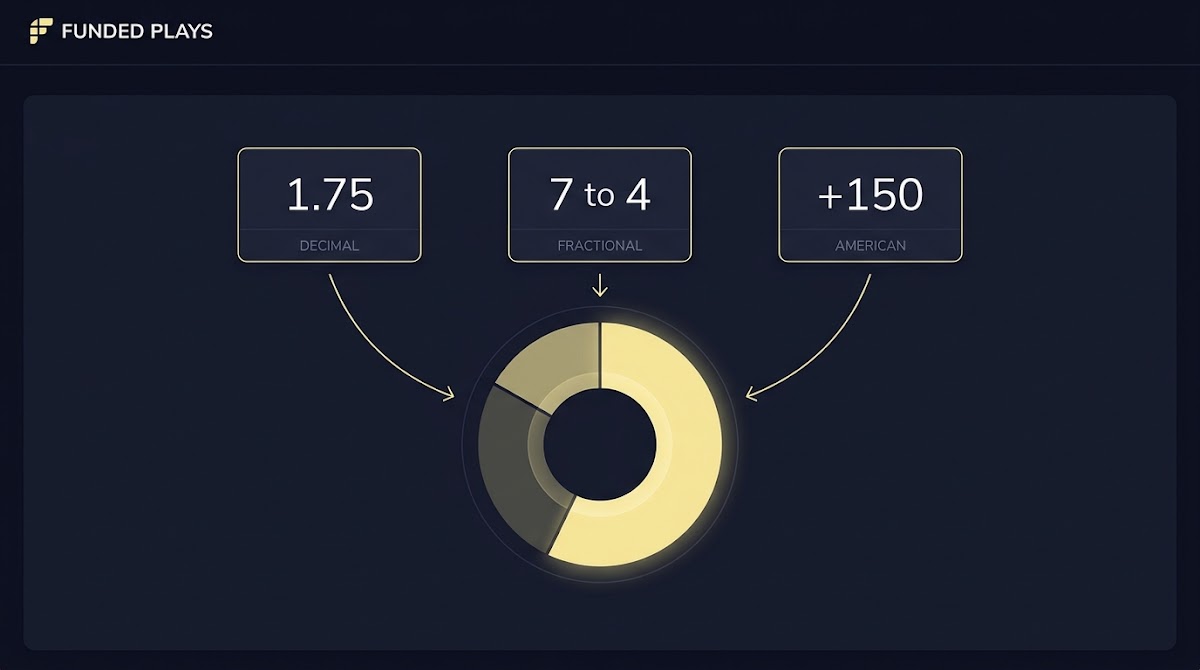
How to Calculate Expected Value from Odds: definition and why EV matters
Expected value, often abbreviated EV, is the probability-weighted average of net outcomes for a wager and is the central long-run metric bettors and prediction professionals use to assess choices. A bet is positive EV when the expectation is greater than zero, which means that over many repetitions the average net result favors the bettor Investopedia expected value guide.
EV depends on two things: the probabilities you believe apply to an outcome and the net profit available if that outcome occurs. That distinction matters because posted odds alone do not determine EV; your own assessed probability is the input that decides whether an opportunity is favorable.
Think of EV like testing a tool across many uses. A single outcome can be unfavorable, but a tool that is favorable on average will help you over time if you use it consistently and document results. This long-run perspective is why EV, rather than single events, guides disciplined decision making StatLect expected value glossary.

In structured prediction challenges, such as evaluation programs that use virtual funded bankrolls, EV helps prioritize which forecast opportunities to enter and how to document the rationale for each choice. Treat EV as a decision filter, not a guarantee, and always follow the challenge rules and drawdown limits when staking simulated bankrolls.
Quick overview: odds formats and how implied probability links to EV
Odds come in three common formats: decimal, fractional and American. Decimal odds present the total return per unit staked, fractional odds show the ratio of profit to stake, and American odds express prices relative to a 100-unit base in either positive or negative form Wikipedia odds overview.
To compare offers and compute EV you first translate odds into implied probability, which is the common language across formats. Once each market price is expressed as an implied probability, you can combine it with your assessed p_est to calculate EV Investopedia implied probability definition.
Conversions are algebraically consistent: for example, an American price of negative 150 converts to about 1.67 in decimal and corresponds to an implied probability near 60 percent, which makes it straightforward to compare across markets using the same probability scale Odds conversions on Wikipedia.

Step-by-step: convert odds to implied probability
Decimal conversion is the simplest: implied probability equals 1 divided by the decimal odds. For example, decimal 2.50 implies a probability of 1/2.50, which yields 0.40 or 40 percent Investopedia implied probability guide.
Fractional odds a/b convert to implied probability with the expression b divided by a plus b. If an event is quoted at 3/1, the implied probability is 1 divided by 4, or 25 percent. That expression is algebraically equivalent to the decimal conversion once you translate the fraction into total return Wikipedia odds.
American odds require two formulas depending on sign. For a positive American price A, implied probability is 100 divided by A plus 100. For a negative American price negative A, use A divided by A plus 100 where A is the absolute value. These forms assume no margin and match decimal and fractional results under consistent math therundown implied probability calculator.
If you want to practice these conversions, copy the expression for each format into a spreadsheet and check that converting the same market across formats returns the same implied probability; this is a quick sanity check that your formulas are correct. Try an implied probability calculator for hands-on examples.
Practice EV calculations with a simple checklist
Try the spreadsheet checklist in this article to practice converting odds and computing EV on a few examples before you risk real capital or enter a challenge submission.
Adjusting for bookmaker margin and how to normalize probabilities
Bookmakers embed a margin in posted prices, commonly called vigorish or overround, which causes the sum of implied probabilities across competing outcomes to exceed 100 percent. This margin is how markets recover costs and ensure a built-in edge for the provider Wikipedia vigorish explanation.
To make fair comparisons, normalize the posted implied probabilities by dividing each implied probability by the total implied probability sum. That rescales the vector of implied probabilities so they add to 100 percent and provides a simple market-fair baseline for EV analysis Wikipedia implied probability.
For a quick worked normalization, compute each market implied probability, sum them, then for each outcome compute implied_prob_normalized = implied_prob_posted / sum_posted. Use these normalized probabilities as the market's fair estimate when you want to compare your p_est to market prices, while remembering that normalization is an estimate and does not replace your own assessed probability.
EV formula and worked two-outcome examples
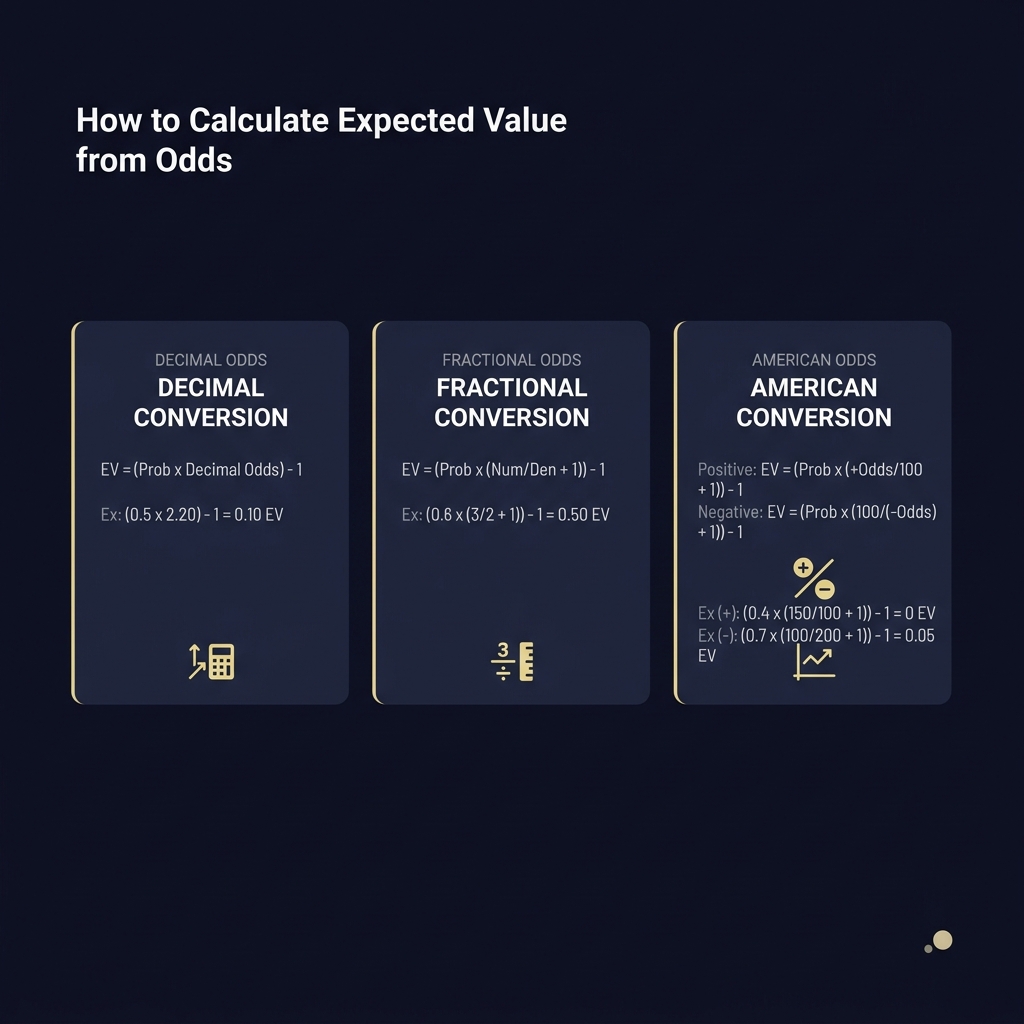
The standard two-outcome EV expression is EV = p_est × net_win − (1 − p_est) × stake, where p_est is your estimated win probability, net_win is profit excluding stake, and stake is the amount risked. This formula frames EV as the expected net profit per bet and is the basis for positive EV decisions Investopedia expected value formula.
Net_win differs from payout because net_win excludes the stake. For example, if decimal odds pay 2.50 on a 1 unit stake, the payout is 2.50 but the net_win is 1.50. Using net_win in the EV formula keeps the arithmetic consistent when comparing profit per outcome to the stake risked.
Worked example: calculate EV using normalized market odds and an independent p_est. First, convert the offered odds to implied probability and normalize if needed. Second, decide your p_est for the outcome, based on analysis and documented rationale. Third, compute net_win from the quoted odds and apply the formula step by step to find EV. Investopedia expected value guide
Quick EV calculator for a two-outcome wager
Paste into a spreadsheet cell to compute EV
Copy the EV formula into your calculator or spreadsheet and use it to record each decision alongside the odds conversion and normalization steps. That simple discipline makes it easier to review and calibrate your p_est over many bets rather than relying on single outcomes.
Practical walkthroughs: American, decimal and fractional examples
Example 1, American positive: an American price of +200 converts via 100 divided by 200 plus 100 to an implied probability of 33.33 percent. Translate that to decimal 3.00 for net_win calculation, and then use your p_est to compute EV, remembering to use net_win without the stake Implied probability resource.
Example 2, decimal with normalization: take decimal odds of 1.67 and 2.20 on two competing outcomes. Convert each to implied probability, sum the implied probabilities to find the overround, normalize each implied probability by dividing by the sum, and then compare your independent p_est to the normalized market probability when computing EV Investopedia implied probability.
Example 3, fractional example: for 5/2 fractional odds, convert implied probability as 2 divided by 7, or about 28.6 percent, then compute net_win from the fractional profit and plug values into the EV formula to see whether the result is positive. These conversions deliver the same implied probability across representations when calculated correctly Odds conversions illustrated.
Final interpretation: if your calculated EV is greater than zero after normalization and you have a documented rationale for p_est, the bet qualifies as positive EV in your analysis, subject to your bankroll and challenge rules.
Common mistakes when calculating EV and how to avoid them
A frequent error is ignoring bookmaker margin and treating posted implied probabilities as fair. Without normalization you can overstate the market chance and misclassify marginal opportunities as positive EV Implied probability reference.
Convert odds to implied probability, adjust for bookmaker margin via normalization, estimate your own win probability, apply the EV formula using net profit and stake, and accept bets only when EV is positive and stake rules permit.
Another common mistake is confusing net_win with payout. If you include the stake in net_win you inflate the expected profit and will calculate EV incorrectly. Always compute net_win as profit excluding stake and double check the arithmetic on both conversions and the final formula Expected value formula.
Practical fixes include normalizing implied probabilities before market comparison, keeping a written rationale for each p_est, and logging outcomes so you can test whether your probability estimates are calibrated over many events. Record keeping turns abstract EV decisions into verifiable performance metrics.
Using calculators and spreadsheets safely
Good calculators automate odds conversion, normalization, and the EV computation, but they cannot supply a justified p_est. Use tools to avoid arithmetic errors, not to replace your analysis betting odds calculator.

Minimal spreadsheet column headings should include: Date, Market, Odds (format), Decimal Odds, Implied Prob, Normalized Prob, p_est, Stake, Net_Win, EV, Rationale. That checklist ensures every entry captures both the math and the reasoning behind your estimate.
Always validate a calculator by comparing a few manual conversions to its output, and avoid adding unnecessary complexity such as hidden commissions or nonstandard transformations without documenting them for later review.
Incorporating EV into bankroll and challenge rules
EV helps prioritize where to allocate stakes: favor larger stakes on higher EV opportunities and smaller stakes on marginal EV, but always within defined risk limits. Do not let EV alone justify oversized wagers that violate drawdown or staking rules.
When participating in evaluation challenges and virtual funded accounts, ensure every stake respects the platform rules and stated drawdown limits. The goal in structured challenges is consistent, rule-compliant performance rather than short-term upside that risks disqualification.
Keep an EV log aligned with challenge milestones and periodically review whether your p_est calibration is improving. Over time, this record is more informative than anecdotal wins or losses.
Interpreting positive EV: decision criteria and risk management
The core decision rule is simple: accept bets where your estimated EV is positive after normalization and where stake sizing fits your bankroll and any platform rules. Document why you accepted or declined each opportunity to avoid hindsight bias Expected value reference.
Variance matters. Positive EV does not guarantee a short winning streak, and you can expect losing runs. Use practical filters such as a minimum EV threshold and a maximum fraction of bankroll per bet to limit the chance that variance disrupts your progress.
If an opportunity is positive EV but requires a stake that would breach a drawdown limit or evaluation rule, defer the bet. Performance in challenges depends on disciplined execution as much as on the theoretical edge.
Applying EV thinking on skill-based platforms like FundedPlays
EV calculations are a useful input to prioritize forecasts and manage virtual bankrolls in skill-based evaluation programs. Use EV to decide which predictions to submit in a challenge, but always align choices with the challenge rules and documented staking limits.
Keep language neutral and avoid treating EV as a promise of funding or payouts. Outcomes on platforms depend on individual performance, rule compliance and long-term consistency, not on any single calculation.
As you track outcomes, report results in terms of calibration and decision quality rather than short-term profit claims. That approach maintains compliance and supports steady improvement while participating in skill-based challenges.
Advanced considerations: multi-leg bets and correlated outcomes
Calculating EV for parlays or multi-leg bets requires joint probability estimates rather than treating legs as independent. Naive multiplication of single-leg probabilities assumes independence and can overstate parlay EV when legs are correlated Odds and dependence.
When outcomes are correlated, adjust your joint p_est to reflect the relationship. For example, two player props tied to the same in-game event are likely correlated and demand careful joint probability work; otherwise avoid multi-leg EV attempts.
Practical rule: use multi-leg EV only if you can credibly estimate joint probabilities or you have a transparent model that captures correlation. Otherwise, prioritize single-leg positive EV opportunities where estimation is clearer.
Summary: practical next steps to use EV reliably
Five steps to calculate EV: convert odds to implied probability, normalize for bookmaker margin, estimate p_est with documented rationale, compute EV using the standard formula, and apply stake rules while logging the decision. Keep this checklist near your spreadsheet or tool.
Track many bets and evaluate whether your p_est calibrates to observed frequency. Adjust your models and rationale over time; consistent record keeping and disciplined staking are the best paths to make EV a reliable decision framework.
Final thought: learning how to calculate expected value from odds is a skill that combines arithmetic, probability judgment and disciplined record keeping. Use calculators to reduce errors, but rely on documented reasoning and rule compliance to guide real choices.
Expected value is the probability‑weighted average net outcome of a wager; positive EV means the expected net result is greater than zero.
For positive American odds use 100 divided by (A plus 100); for negative use absolute A divided by (absolute A plus 100), where A is the odds value.
Use normalized market implied probabilities as a fair baseline, but always compare them to your own justified probability estimate and document your rationale.
References
- https://www.investopedia.com/terms/e/expectedvalue.asp
- https://www.statlect.com/glossary/expected-value
- https://en.wikipedia.org/wiki/Odds
- https://www.investopedia.com/terms/i/implied-probability.asp
- https://en.wikipedia.org/wiki/Vigorish
- https://en.wikipedia.org/wiki/Implied_probability
- https://www.fundedplays.com/challenges
- https://oddsjam.com/betting-calculators/implied-probability
- https://therundown.io/betting-calculators/implied-probability-calculator
- https://www.actionnetwork.com/betting-calculators/betting-odds-calculator
- https://www.fundedplays.com
- https://www.fundedplays.com/blogs
- https://www.fundedplays.com/blogs/how-fundedplays-evaluations-work