
What overfitting looks like in sports models
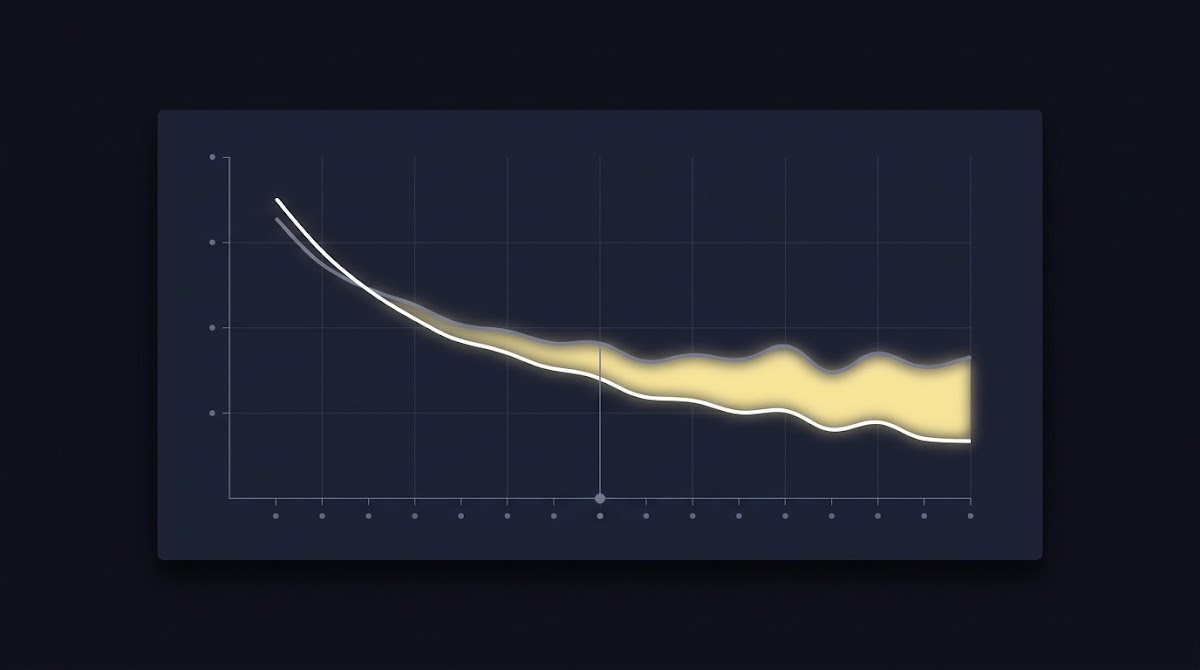
Overfitting occurs when a model learns patterns that are specific to the training data but do not hold on new, unseen contests. In sports modeling this typically means the model captures season-specific noise rather than the underlying signal, so it performs well on training games but performs worse on later matches; this core definition follows standard guidance on estimator evaluation scikit-learn User Guide.
A simple, concrete example helps make this real. Imagine training a high-capacity model on one season of soccer matches that includes a few anomalous streaks, then testing it on the next season: the model can memorize those streaks and appear excellent in-sample while failing to predict the next season where the streaks did not repeat.
Training metrics can lie because they measure how well a model fits the data it saw during optimization, not how well it will generalize. Relying on accuracy, logloss, or other training-set numbers without a proper validation or test split can give a false sense of confidence and hide poor generalization.
Test your validation approach with FundedPlays Challenges
Download the checklist later in this article to run a quick overfitting audit on your current sports models.
Practical recognition hinges on comparing training and validation behavior rather than any single metric. Use held-out seasons or time-aware cross-validation to reveal gaps between fitted performance and out-of-sample performance before you trust a model for live use.
When working with common tools, keep preprocessing and evaluation inside disciplined pipelines so that reported metrics reflect the true generalization ability rather than data-handling artifacts. If you use scikit-learn for model building, prefer pipeline objects and time-aware splitters when applicable.
Why time order matters: avoid look-ahead bias
Sports data are ordered in time, and treating observations as exchangeable can introduce look-ahead bias by letting future information influence training. Look-ahead bias or temporal leakage occurs when features or aggregates include information that would not have been available at prediction time, which invalidates test results and inflates apparent performance; this type of leakage is well documented in time-series cross-validation guidance OTexts forward-chaining guidance.
Random k-fold cross-validation assumes independent, identically distributed samples and therefore mixes past and future events across folds. For time-ordered problems, that mixing permits temporal leakage and creates optimistic estimates that will not hold in deployment.
Common sources of leakage in sports workflows include using end-of-season aggregates as features, including metrics computed after the target event, or using proxy features that implicitly encode future outcomes. Examples include season-end ratings, label-derived indicators, or rolling averages that are computed without strict alignment to the prediction timestamp.
To reduce risk, audit your feature set for any item that could not have been computed at the decision moment. Any suspect feature should be held out and recomputed in a time-safe manner or removed.
Validation strategies for sports models: forward-chaining and rolling-origin CV
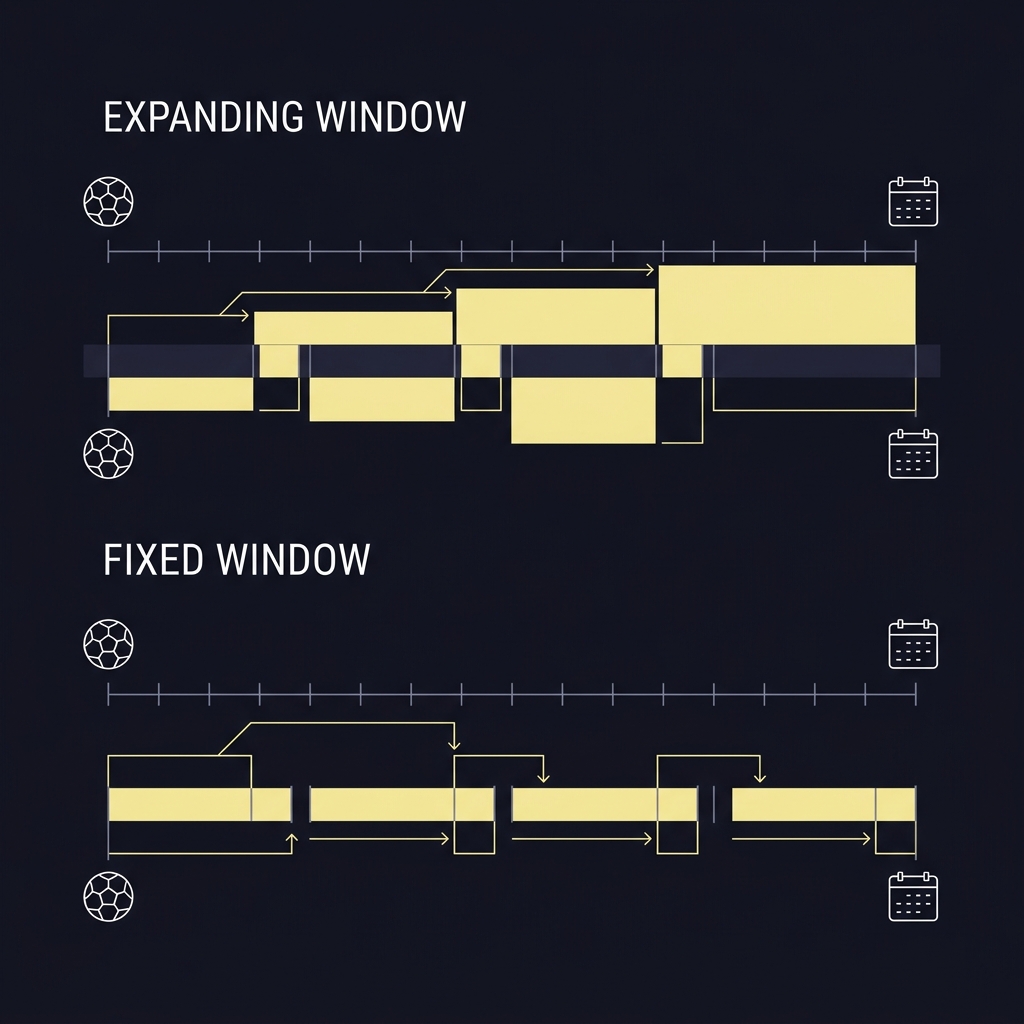
Forward-chaining, also known as rolling-origin cross-validation, respects temporal order by training on earlier periods and validating on later periods. Each fold advances the origin so the model always learns from the past and predicts the future, which prevents look-ahead bias and gives an honest estimate of out-of-sample performance OTexts forward-chaining guidance. Practitioner writeup
Implementation options include expanding-window folds, where the training window grows while the test window moves forward, and fixed-window folds, where both train and test windows advance with constant size. Choose expanding windows when you want the model to leverage the maximum available history and fixed windows when stationarity is a concern. See a forward-chaining guide and a walk-forward practical guide.
Use time-aware validation such as forward-chaining or rolling-origin cross-validation, enforce train-only preprocessing inside pipelines, and reserve a never-touched holdout or use nested cross-validation for unbiased hyperparameter selection.
For many sports problems, a simple held-out season or seasons is still appropriate when seasonality or rule changes make older data less relevant. However, rolling-origin CV better measures stability when you expect gradual changes in strategy, roster, or competition level.
Practical settings: start with three to five rolling folds that reflect realistic deployment timing, for example training on seasons 1 to N and validating on season N+1, then repeat with the origin rolled forward. Keep the validation windows aligned to natural decision times such as matchdays or weekly updates.
Preventing data leakage in practice
Train-only preprocessing and strict pipeline discipline are the simplest, highest-impact protections against leakage. Fit scalers, encoders, and imputation only on training folds and apply them to validation or test sets inside a pipeline so no information from future data informs transformations; this train-only rule is a widely recommended best practice Google Developers data leakage guide.
Some features are common accidental proxies for the target. Examples include labels transformed into aggregated signals, indicators derived from future injury reports, or features that rely on delayed data feeds. When in doubt, ask whether the feature could have been computed at prediction time.

Use explicit leakage checks as a standard step in your workflow. For example, shuffle the time axis and confirm performance drops, test models on intentionally truncated feature sets that only include time-safe inputs, and run feature-importance analyses with time-aware splits to see whether suspicious features dominate explanations.
Checklist items you can copy into pipelines include: mark timestamps clearly, implement time-based splitters, wrap preprocessors in train-only pipeline stages, and log the exact code and parameters used to create each feature so you can replay how a value was computed.

Diagnosing overfitting with learning curves
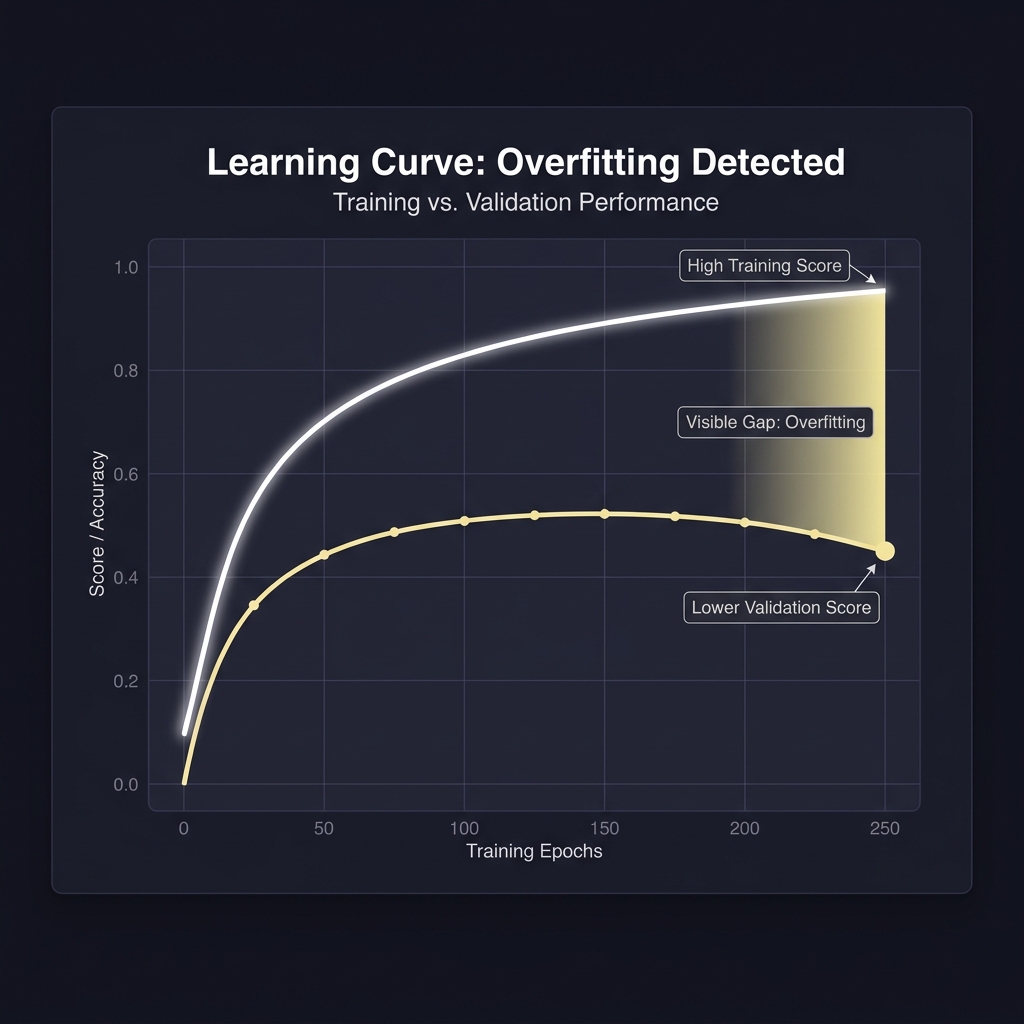
Learning curves plot training and validation performance as a function of training set size. They are useful to distinguish high variance from high bias: a large gap where training performance is strong and validation is weak points to variance-driven overfitting, while both low training and validation performance suggests underfitting scikit-learn learning curve guide.
To plot useful curves, measure a chosen metric across a range of increasing training set sizes using time-safe splits so that each point reflects a realistic past-to-future evaluation. Plot at least five points and include error bands or fold-by-fold variability to understand stability.
quick learning-curve setup for sports prediction projects
use time-aware splits
Interpreting the curves leads directly to action. If training accuracy is near perfect while validation accuracy lags, introduce stronger regularization, simplify the model, or gather more data. If both curves are low, increase capacity or engineer better features.
Start with simple remedies: reduce model complexity via L1 or L2 penalties, prune features that add variance, or apply early stopping during gradient-based training. Track changes with the same learning-curve setup so you can compare before and after reliably.
Core techniques to prevent overfitting
L1 and L2 regularization provide targeted controls on model complexity. L1 encourages sparsity and can help with feature selection, while L2 shrinks coefficients toward zero and works well when many correlated features exist; both approaches are standard ways to limit variance and are described in foundational texts ISLR.
Parsimonious feature selection-favoring a smaller, time-safe feature set-reduces the chance of finding spurious correlations. Use domain knowledge to prefer features that would have been available at prediction time and apply regularized models to identify weak contributors.
Early stopping monitors validation performance during training and halts optimization when out-of-sample performance stops improving. Variance-reducing ensembling, such as bagging or model averaging, typically improves stability while keeping single-model bias in check when ensembles are constructed with time-safe folds.
Hyperparameter tuning without optimistic bias
Tuning hyperparameters on validation folds that later become test data induces selection-induced bias and over-optimistic performance. Nested cross-validation isolates model selection in inner folds and evaluation in outer folds so reported results reflect the selection process without leaking test information BMC Bioinformatics nested CV.
When nested CV is too costly, use a strict time-aware holdout set that is never touched during hyperparameter search and report results on that holdout. Another practical approach is to restrict the search space, use fewer inner folds, or apply sequential model-based optimization inside inner folds to reduce compute while limiting bias.
Whatever approach you choose, document the tuning procedure, the search space, and how many times the holdout was queried. If you reuse a holdout frequently, refresh it or move to nested CV to avoid selection overfitting.
Feature engineering and selection: keep it parsimonious
Domain-driven features often help, but only when they respect the time boundary. Prefer features that could plausibly be computed at prediction time; avoid post-outcome aggregates or engineered items that summarize future-only information. Aggressive automated generation can create proxies for target information and should be checked carefully Google Developers data leakage guide.
Apply univariate checks with time-aware splits to screen candidates, then use regularized models to refine the set. Manual curation based on domain knowledge is often the safest first pass, followed by controlled automated selection that is constrained by interpretability and time safety.
Example: instead of using an end-of-season ranking as a feature, use a rolling ranking computed up to the prediction date with a clear rule for how past data are included. This preserves useful signal while preventing leakage.
Practical pipeline checklist for sports prediction projects
Below is an end-to-end checklist you can adopt. Include these items in your project README and CI scripts to keep evaluation honest scikit-learn cross-validation guide.
- Use time-aware splits aligned to deployment cadence
- Fit preprocessors only on training data inside pipelines
- Reserve a never-touched holdout for final evaluation
- Run rolling-origin CV to measure temporal stability
- Plot learning curves to diagnose bias vs variance
- Log feature construction code and timestamps
- Run explicit leakage checks and proxy searches
- Monitor live predictions for drift and revalidate periodically
To instrument experiments, record fold-by-fold results, store trained artifacts with versioning, and attach the exact data periods used for each experiment so you can reproduce and audit outcomes later.
For monitoring after deployment, set thresholds for drift detection on covariates and prediction distributions, and schedule regular revalidation at sensible cadences such as monthly or per season depending on the sport.
Common mistakes and how to avoid them
Top pitfalls include applying random k-fold to time series, leaking features computed with future data, tuning on the final test set, and ignoring learning-curve signals. Each of these mistakes leads to overly optimistic internal reports and painful surprises in deployment Google Developers data leakage guide.
To audit a suspicious report, reproduce the split method, verify that preprocessors were fit inside training folds, rerun experiments with rolling-origin CV, and check whether reported gains vanish when time order is enforced.
Corrective actions are typically straightforward: switch to time-aware cross-validation, remove or recompute leaking features, nest hyperparameter tuning, and rerun learning-curve diagnostics to confirm whether variance has been reduced.
Worked scenarios: small-sample league vs long-season data
Limited historical data requires conservative choices. For small-sample leagues prefer simple, interpretable models with strong regularization, use blocked folds to preserve season structure, and consider pooling similar competitions only if time-safety can be established ISLR.
When you have long seasonal datasets with many games, rolling-origin CV becomes feasible and valuable. Use windowing strategies to test whether older data remain relevant and monitor temporal drift so you can adapt the window size as the competition evolves.
Trade-offs: small samples push you toward bias-reducing simplicity, while abundant data let you explore more complex models but still require time-aware validation to avoid inflated performance estimates.
Reproducibility and reporting: what to publish and how
Publishable experiment metadata should include the exact periods used for training and testing, the split method, preprocessing order, and hyperparameter search details. Transparent reporting prevents accidental selection bias and helps peers reproduce your analysis BMC Bioinformatics nested CV.
When presenting results, include fold-by-fold scores, learning curves, and a description of leakage checks you ran. If you used a holdout, state how it was chosen and whether it was ever accessed during tuning.
A short experiment note template: data periods, split method, features and construction code, model family and hyperparameter ranges, validation strategy, final holdout score, and known limitations. This minimal set helps reviewers spot selection or leakage issues quickly.
When to accept model limits and when to gather more data
If regularization, simpler models, and feature pruning do not close the validation gap, data scarcity is likely the primary bottleneck. Persistent high training scores alongside low validation scores after these remedies indicate the need for more or better data scikit-learn learning curve guide.
Options to increase effective sample size include pooling time-safe data from similar competitions, engineering additional time-safe covariates, or targeted labeling efforts for under-represented cases. Always weigh the cost of data collection against the expected reduction in variance.
Sometimes the pragmatic choice is to accept a simpler model that generalizes reliably rather than chase marginal in-sample gains that do not translate to future matches.
Quick reference: checklist to run before releasing a model
30-second pre-release checklist: time-aware validation passed, no leakage detected, nested tuning accounted for, learning curves inspected, monitoring in place. Treat any failed item as a gate to delay release until resolved scikit-learn cross-validation guide.
If validation performance or monitoring readiness is unstable, delay release until you can demonstrate consistent fold-level results and a plan for drift detection. Small, repeatable wins are preferable to a single impressive but fragile result.
Final thoughts: disciplined evaluation beats impressive noise-fitting
Prioritize generalization with time-aware validation, strict train-only pipelines, and reproducible reporting. Disciplined evaluation is the safest path to models that help decision making rather than models that fit past noise.
No single method guarantees success; good outcomes depend on data quality, careful implementation, and ongoing monitoring. Use the checklists and diagnostics in this article to keep modeling grounded in realistic performance estimates and responsible practices. Funded Plays
The most common cause is leakage and improper handling of time order, such as using future-derived features or fitting transformers on the full dataset.
Not always; nested CV is ideal for unbiased tuning but a strict time-aware holdout can be an acceptable, lower-cost alternative if documented carefully.
If learning curves still show a large train-validation gap after regularization and pruning, prefer simplification unless additional time-safe data is affordable.
References
- https://scikit-learn.org/1.5/modules/cross_validation.html
- https://otexts.com/fpp3/tscv.html
- https://developers.google.com/machine-learning/data-prep/construct/data-leakage
- https://www.fundedplays.com/challenges
- https://scikit-learn.org/1.5/modules/learning_curve.html
- https://link.springer.com/book/10.1007/978-1-0716-1418-1
- https://bmcbioinformatics.biomedcentral.com/articles/10.1186/1471-2105-7-91
- https://www.fundedplays.com
- https://www.fundedplays.com/blogs
- https://www.fundedplays.com/blogs/how-fundedplays-evaluations-work
- https://medium.com/@pacosun/respect-the-order-cross-validation-in-time-series-7d12beab79a1
- https://www.scaler.com/topics/machine-learning/validation-using-forward-chaining/
- https://www.dndlab.org/2024/10/28/understanding-walk-forward-validation-in-time-series-analysis-a-practical-guide/