
What matchup styles are and why they matter, How to Analyze NBA Matchup Styles
Matchup styles are recurring offensive and defensive tendencies that shape individual possessions and the interactions between lineups. Identifying those tendencies helps an analyst or coach anticipate where mismatches will appear and what actions are likely to produce value. This article treats matchup styles as observable patterns you can measure and verify, not as guarantees of a specific result. NBA stats glossary
Use a structured matrix to record pillar scores, attach short film checks, and assign confidence ratings; prioritize changes that have consistent multi-game support and verify any single-game outlier on film.
Practically, style analysis combines baseline rates from public tracking and hustle definitions with targeted film checks to confirm intent and timing. Metrics give you a reliable starting point; video tells you whether a metric reflects a stable habit or a one-off alignment. PLOS ONE spatiotemporal review
The four style pillars you should always check
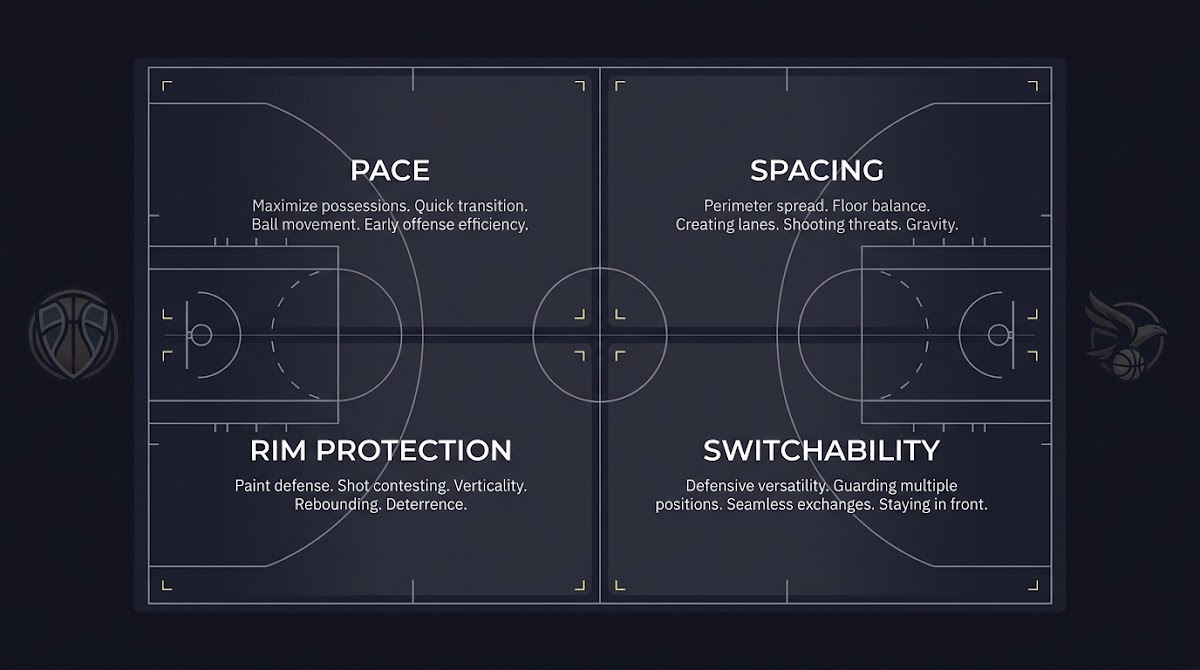
Use four pillars to organize every matchup read: pace, spacing, rim protection, and switchability. Pace measures possessions per 48 minutes, spacing captures how a team creates and maintains floor geometry, rim protection covers contesting and limiting shots at the basket, and switchability describes how often and how cleanly a defense exchanges assignments on screens. These pillars map directly to public tracking outputs and film cues you can verify. NBA stats glossary
The pillars overlap in predictable ways. High spacing stresses rim protection because kickouts and drive-and-kick actions create more open perimeter shots, while a high-pace game magnifies any existing edge by creating more possessions. Treat the pillars as complementary lenses: a weakness in one often invites pressure in another. PLOS ONE spatiotemporal review
Pace: measuring tempo and what to watch for
Pace is defined as possessions per 48 minutes and is the canonical tempo baseline for matchup comparisons. Use the league glossary definition to keep your measures consistent and comparable across teams and time windows. NBA stats glossary
Compare team pace to opponent pace to set expectations for substitution patterns and lineup stress. When one team runs notably faster than its opponent, bench groups may face amplified exposure as possessions accumulate faster than usual, and coaches often adjust rotations to match tempo. This is a practical signal you can read directly from public pace numbers. NBA stats glossary
In prep, consider how pace interacts with the other pillars: a faster tempo increases the value of spacing and rim protection edges because more possessions inflate the expected return to an exploitative action. Use pace to prioritize which matchup edges are worth pursuing in the short term. PLOS ONE spatiotemporal review

Spacing: quantifying floor geometry with shots and tracking
Spacing can be operationalized with shot-distribution proxies like team three-point attempt rate, corner-3 share, and average shot distance, plus player-tracking spatial measures that capture where players live on the court. These combined measures help quantify how often a team creates driving lanes and kickout opportunities. PLOS ONE spatiotemporal review
Practical spacing proxies to check quickly are team 3PA rate, corner-3 share, and average distance from the basket for primary shooters; tracking measures refine those proxies by showing actual player positions and movement patterns. When metrics and film agree, you have a high-confidence read; when they disagree, prioritize film for lineup-level questions. NBA stats glossary
Watch film cues such as five-out alignments, weak-side tag coverage, and how defenders respect drives-these actions reveal gravity that raw shot rates may miss. Give special attention to late-season scheme shifts or lineup tweaks, where spatial metrics can lag the true alignment until more possessions accumulate. PLOS ONE spatiotemporal review
Rim protection: contests, blocks, and opponent rim percentage
Rim protection is commonly quantified by opponent field-goal percentage allowed at the rim plus contest frequency and block rates. The hustle definitions and contest measures in public glossaries provide the baseline metrics you should check. NBA hustle glossary

Look beyond team averages and inspect lineup-level rim defense: some starters may protect the rim effectively while bench groups concede more high-percentage shots. Combine opponent rim-percentage figures with contest timing on film to understand whether help rotations are arriving early enough to alter shot trajectory. NBA hustle glossary
When sample sizes are small, cross-check rim metrics with video: contest timing, help paths, and positional discipline matter more than raw block totals. Foul avoidance is another useful lens-teams that foul to contest will show different matchup trade-offs than disciplined rotation-based rim protectors. NBA hustle glossary
Switchability: scheme frequency versus personnel versatility
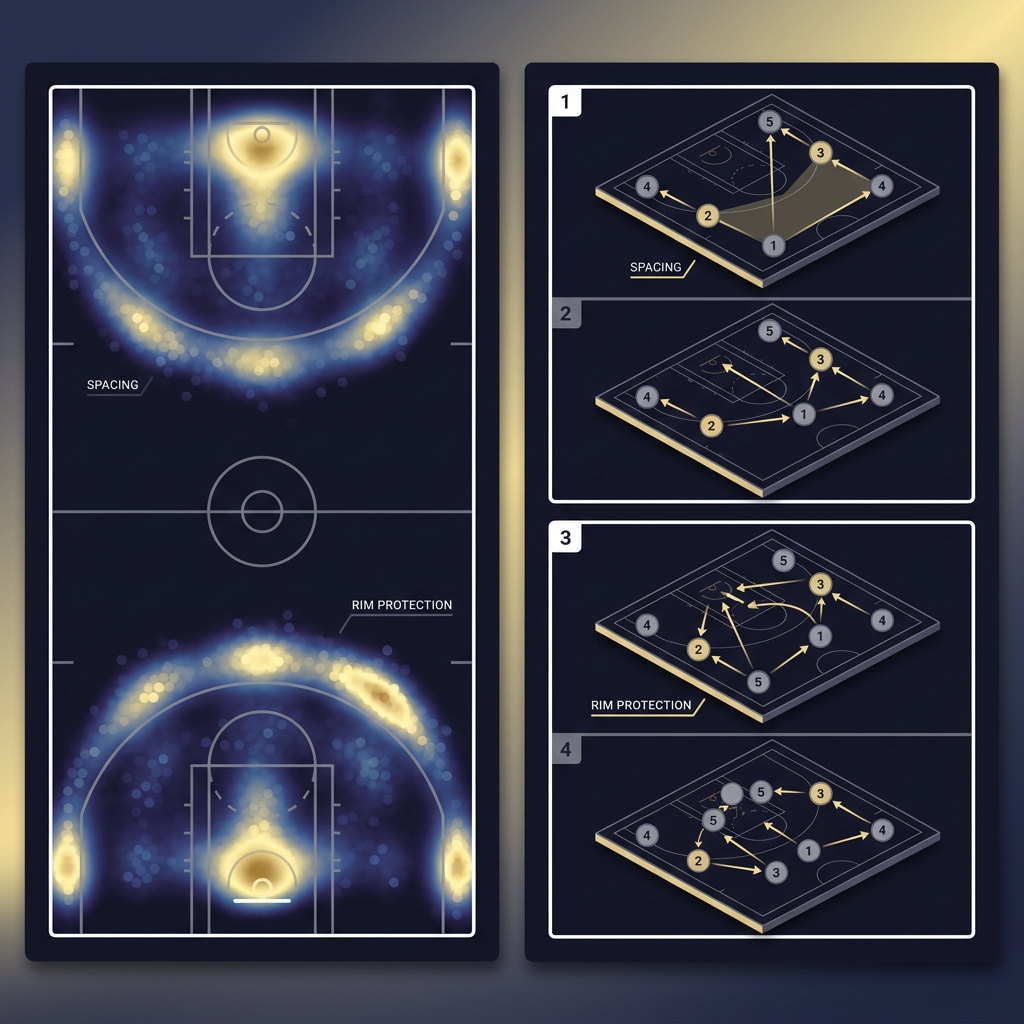
Switchability blends the schematic frequency of switching on screens with the true versatility of personnel to defend multiple matchups. Second Spectrum tracking now provides measures of screen events and switching that you can use as a starting point, but always verify matchups on film. Second Spectrum Second Spectrum switching notes overview video
Distinguish teams that switch by design from teams that have defenders capable of handling diverse matchups. A high switching frequency is only valuable if it does not create exploitable size or skill mismatches on the other end; pair the switching metric with matchup diversity checks to avoid false confidence. PLOS ONE spatiotemporal review
How to build a matchup matrix step-by-step
Start with a two-row template: Team A versus Team B, and create four pillar columns: pace, spacing, rim protection, and switchability. For each cell record a short score or qualitative note, a supporting metric source, and one film cue that confirms or contradicts the metric. This structure turns raw metrics into a decision-ready artifact. PLOS ONE spatiotemporal review
Try the matchup matrix in your next pre-game routine and review results on the FundedPlays Challenges page
Copy the matrix template into a spreadsheet, fill the four pillar cells using public team stats and one film note per cell, and try it on the next scheduled game.
Populate each cell from these sources: NBA.com team stats for pace and shot-distribution proxies, hustle metrics for rim contests, and Second Spectrum outputs for switching frequency. Add a confidence rating for every cell and flag any low-confidence items for immediate film review. NBA stats glossary For a practical walkthrough of evaluation steps see our guide to evaluations.
Weight pillars by context: in playoff series or with thin rotations, lineup-level rim protection and switchability may get higher weight than season-average spacing. Note injuries, minutes restrictions, or recent role shifts in a matrix header so your weights reflect actual game conditions. PLOS ONE spatiotemporal review
Using film and lineup availability to refine metric-led reads
When tracking metrics appear as outliers, use quick film checks to reconcile the difference: look at contest timing, help rotations, and whether a team tags or hedges screens consistently. Film often explains why a metric deviates from a multi-game baseline. PLOS ONE spatiotemporal review
Always adjust pillar scores for lineup availability. Injuries, rest decisions, and minute restrictions can change which players are on the floor and therefore which pillar values apply. When lineup samples are small, defer to how coaches have used those groups in prior games rather than trusting a single-game stat. NBA stats glossary Read more on similar topics on our blog.
Rules, officiating and their matchup effects
Certain rules commonly affect matchup dynamics, including screening-contact definitions and defensive three seconds; consult the official NBA rulebook for definitive definitions and infractions when these issues are relevant. NBA rulebook
Officiating emphasis can change effective spacing and isolation rates even if metrics look stable. Note recent crew tendencies where possible and treat officiating observations as an additional contextual layer rather than a primary metric input. NBA hustle glossary
Decision criteria: selecting lineup and play-call adjustments
Prioritize pillars based on game context. If your matrix shows a clear rim-protection deficit for the opponent, prioritize attacking the paint with drives and kickouts. If spacing is thin on one side, favor isolation or post-up actions where you can create driving lanes. NBA stats glossary
Translate pillar reads into quick play-call adjustments: versus weak rim protection, call actions that create interior entries or pick-and-rolls designed to force help; versus a heavy-switch defense, use spacing and lift mismatches through off-ball motion and secondary actions. When signals conflict, choose lower-variance plays that protect efficiency. PLOS ONE spatiotemporal review
Common mistakes and how to avoid them
Overfitting to single-game stats is a frequent error. Use multi-game baselines and record uncertainty in your matrix so you do not overweight noisy samples. When a tracked measure looks extreme, verify with film before adjusting lineups. PLOS ONE spatiotemporal review
Another trap is treating switching frequency alone as proof of defensive effectiveness. Pair switching counts with matchup diversity checks and film verification to ensure switches are not creating exploitable mismatches. Second Spectrum switching notes See community tools on GitHub.
Three practical safeguards: use multi-game baselines, cross-check with targeted film, and mark every pillar with a confidence level in your matrix. These steps reduce the risk of acting on artifacts or outliers. PLOS ONE spatiotemporal review
Practical examples and short scenarios
Scenario A, attacking weak rim protection: identify a target lineup that allows a high opponent rim FG% and pair that with a ball-handler who can draw help and kick. Use pick-and-rolls that force the rim protector to commit, then hit corner or wing kickouts. Confirm the target with contest timing on film. NBA hustle glossary
Scenario B, surviving a high-switch defense: when an opponent switches extensively, use spacing and delayed actions to generate lift mismatches. Run actions that free up a bigger defender on the perimeter or trigger post-ups where your size advantage matters more than perimeter skill. Verify with screen-event video to see how clean the switches are. Second Spectrum switching notes
Template notes to paste in your matrix: data source for each pillar, top two film checks, and recommended two play-calls. Keep these notes short so they serve as operational prompts during pre-game adjustments. NBA stats glossary
Advanced adjustments and tracking limitations
Use model-based impact metrics as an escalation when systematic trends are needed; methodologies such as EPM can offer a complementary lens on player and lineup influence, but they require careful interpretation and transparency about assumptions. EPM methodology
Public tracking has known limitations: updates to tracking dimensions, small-sample volatility, and the imperfect transferability of spacing proxies to sudden lineup changes. Treat models as tools for identifying patterns, not as definitive prescriptions. PLOS ONE spatiotemporal review
Wrap-up: a compact checklist to use before game time
Four quick checks: confirm expected pace, validate spacing with recent shot maps, inspect the defender sets that protect the rim, and verify switching tendencies against recent screen-event video. These checks take under an hour if you focus on the highest-impact lineups. NBA stats glossary
Record confidence levels for each pillar and schedule follow-up film reviews for any item marked low-confidence. Keep your matrix as a living file so you can track whether your reads paid off and refine pillar weights over time. PLOS ONE spatiotemporal review
Further reading and next steps
Monitor these authoritative sources: the NBA stats glossary, the hustle glossary for contest definitions, Second Spectrum methodological notes for switching metrics, and the official NBA rulebook for legal definitions of screens and defensive positioning. NBA stats glossary and additional resources at Funded Plays.
Two practice drills: build weekly matrices for one team and perform a five-game pillar trend study for one pillar you want to improve at reading. Track outcomes so you can adjust your weighting and decision rules empirically. Second Spectrum switching notes
You can populate a basic matchup matrix in under an hour using public team stats and a single targeted film check; reserve deeper film work for low-confidence cells.
It depends on context: rim protection often dictates attack plans in short series, while spacing and pace can be decisive in open-season games; record confidence to decide.
No. Public tracking gives a baseline, but film verifies timing, intent, and lineup-specific details that tracking alone can miss.
References
- https://www.nba.com/stats/help/glossary/
- https://journals.plos.org/plosone/article?id=10.1371/journal.pone.0290000
- https://www.nba.com/stats/help/glossary/hustle/
- https://www.fundedplays.com/challenges
- https://www.statsperform.com/resource/how-second-spectrum-measures-switching-and-defensive-versatility/
- https://ak-static.cms.nba.com/wp-content/uploads/sites/46/2023/10/2023-24-NBA-Rulebook.pdf
- https://dunksandthrees.com/epm
- https://www.secondspectrum.com/
- https://github.com/HarvardSoccer/SecondSpectrum
- https://www.youtube.com/watch?v=PS2q5wBenCw
- https://www.fundedplays.com
- https://www.fundedplays.com/blogs
- https://www.fundedplays.com/blogs/how-fundedplays-evaluations-work