
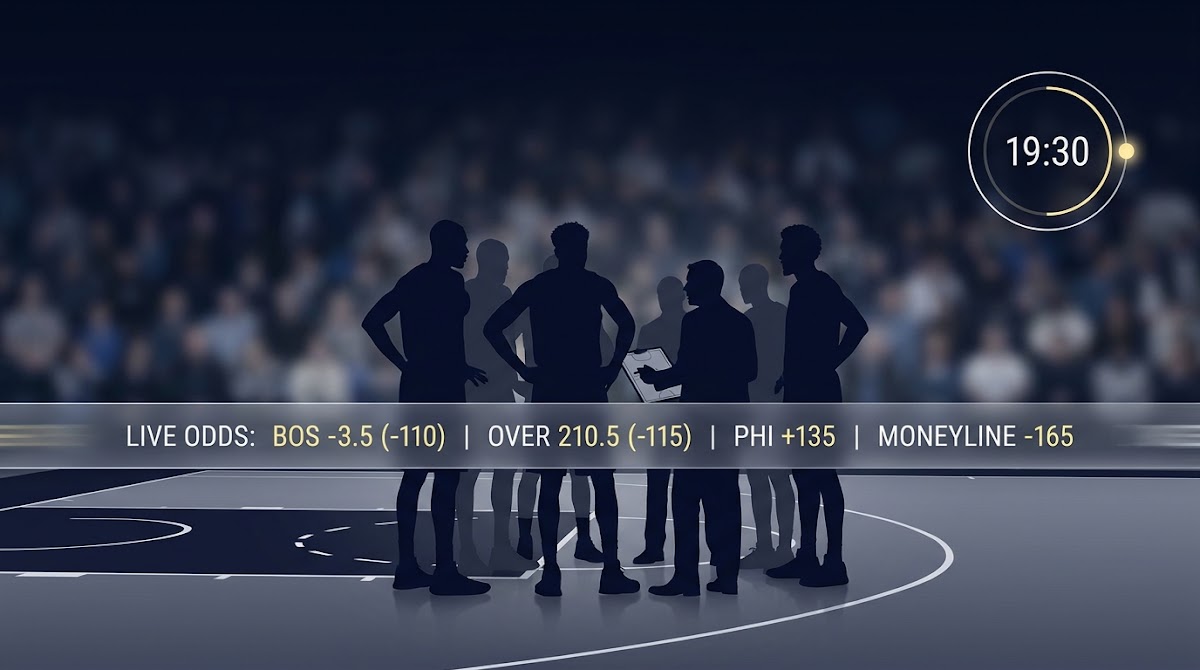
Overview: why coach stoppages matter in live markets
What this article covers
Coaches call timeouts for many tactical reasons and those stoppages can change short-term win probabilities, which in turn move live prices. This article explains the basic channels at work, what signals to monitor in real time, and a conservative approach to reacting so you can make repeatable decisions under pressure. The focus here is practical: learn to translate a coach stoppage into a disciplined trading or prediction action without overreacting.
How to use this guide in live play
Use the checklist items and the decision framework as a live reference when you watch markets. See a practical guide on using timeouts before placing a live bet. The guidance is designed for people who enter live prediction challenges or structured platforms where drawdowns and consistent performance matter. Treat each stop as information, not a guarantee, and log outcomes to improve over time.
In short, the two main channels through which timeouts change live lines are game-state effects on immediate win probability and market reaction to perceived information. Both channels are context dependent and can be subtle. Expect many timeout-driven moves to be temporary noise rather than durable edges.
monitor low-latency signals for timeout events
Prioritize low latency over feature breadth
A monitoring tool that brings together play-by-play events, refreshed market quotes and a synced video or broadcast feed is the practical minimum for applying the approaches below. Keep tools lightweight so you can act quickly and review outcomes later.
How timeouts are used tactically on court
Types of timeouts and typical aims
Timeouts are a tool coaches use to manage many short-term game states. Common aims include stopping opponent momentum, setting a quick offensive or defensive play, resting a key rotation player, or forcing a substitution pattern to exploit a matchup. The same pause can be used to manage the clock in endgame situations or to calm a team after a defensive lapse.
Not every timeout is equal. Early game stops tend to be routine or instructional. Late-game timeouts are purpose-built to influence a single possession or manage fouls and the clock. Recognizing the type of stop helps you anticipate the likely on-court change and the size of any corresponding market move.

Coaches commonly call timeouts to draw up a set play, give directions about who will take the next shot, or adjust defensive matchups. A timeout can also be used to rest a player showing signs of fatigue or to resolve foul trouble through substitution. These intentions are not always explicit to viewers, creating information asymmetry between the coaching staff and the public.

In structured prediction environments and funded challenge platforms, rules about maximum stake sizes and drawdown limits make timeout-driven moves especially important to evaluate conservatively. Use such environments to practice translating observed stoppages into measured reactions rather than chasing speculative edges.
How in-game bookmakers and exchanges form live lines
Principles of price adjustment
Live lines are updated to reflect both new information and the need to balance exposure. Market makers use automated models that react to play-by-play inputs, and traders step in when models miss contextual nuance. That combination means lines can move because a model updates win probability (see research on the reaction to news in live betting here), because the book needs to rebalance positions, or because a trader anticipates future flow.

Remember that markets primarily reflect supply and demand. A change in price is not proof of a durable change in outcome probability, it is evidence that money or model signals moved the quote. Learning to read whether a move is model-driven, money-driven or noise is a key skill for live prediction.
Role of liquidity and public money
Liquidity depth and the balance between public and professional action matter. In thin markets a small stake can nudge the line; in deeper markets it takes meaningful volume or a clear informational change. Public money tends to move quickly on visible events like a designed play or perceived momentum change. Sharp action often follows different patterns, including correlated moves across books or exchanges.
For live predictors the practical implication is to weigh the size and breadth of movement across multiple sources rather than reacting to a single quote update on one screen.
Immediate physical and tactical effects of a timeout on the court
Momentum pauses and player recovery
A timeout pauses play and gives players short recovery time. This can blunt a run by the opposing team or reduce fatigue for a player who will take a critical role on the next possession. The net effect on performance tends to be modest and usually lasts only a few possessions, but it can be enough to change short-run possession outcomes.
Because the effect window is brief, successful live responses often hinge on watching the first one or two possessions after the timeout to confirm whether the planned set executed as intended or whether the opponent still looks poised.
Set play implementation after the stop
Coaches often call timeouts specifically to install a particular set play. The clarity of the play, how many players on the court are part of that set, and how well the team rehearsed it all influence the probability of a favorable immediate outcome. Some timeouts are used to create mismatches via substitution patterns that become visible as lineups take the court.
Observing the first few seconds of the inbound and the spacing of the offense gives live predictors direct evidence of whether the coach achieved the desired tactical effect.
How markets typically react right after a timeout
Price moves versus implied probability shifts
Markets can show a quick quote change immediately after a timeout. That move might be a direct recalculation of win probability or simply a quote adjustment to balance liabilities. Distinguishing between a change in implied probability and a trade-driven quote shift is essential. Implied probability changes are model-oriented; trade-driven shifts reflect money flow.
In most cases, small price flickers should be treated as information to log, not as a basis for large stakes. Waiting for confirmation across multiple sources reduces the chance of reacting to transient noise.
Explore structured steps for timeout-aware live predictions on the FundedPlays Challenges page
If you want structured steps for applying timeout-based signals in live prediction challenges, review a concise process focused on verification, stake control and logging outcomes.
Public reaction and sharp money
Public reaction can amplify initial moves (see discussion of live-odds gambling advertising here), while sharp money tends to be more selective and often correlates across markets. A signature sign of sharper action is when multiple books show a consistent directional change and the movement sustains beyond one or two possessions. When movement is isolated to a single venue, exercise caution.
For live predictors the practical response is to measure both the speed and the breadth of the move before committing capital. Smaller probes or no action are often the best choices unless you have a well-defined edge.
Key contextual factors that change the effect of a timeout
Game clock and score margin
Late-game timeouts naturally carry more informational weight because the remaining clock and score interact closely with win probability. A timeout with under a minute left can be a clear signal about intent and setup, whereas an early-game stop is often routine and less predictive. Evaluate the clock and margin first to scale how much you treat the event as material.
Other context matters too: a timeout in a close game with few possessions left is more meaningful than one with a large lead and lots of time remaining.
Treat the timeout as contextual information, verify clock and lineup details, check for multi-book movement, and if you act use a small probe sized to your bankroll and challenge rules.
Player availability and foul trouble
Substitutions and foul trouble substantially change the expected outcome of specific possessions. A timeout that results in a preferred matchup or removes a trouble player from the court can be significant. Conversely, a timeout that simply rests a deep rotation player is less likely to shift probabilities materially.
When assessing a stop, check whether the coach is preserving a player for a final stretch or intentionally changing who will defend a primary scorer. Those details help you filter genuine opportunities from noise.
Signals to watch in the 30 seconds after a timeout
Line speed and depth
Watch how quickly your primary price sources update and whether several books mirror the change. Fast, broad updates suggest a market-level reassessment; single-source flickers usually signal thin liquidity or isolated order flow. Line speed is a quick proxy for the quality of information behind a move.
Also observe whether the quoted size or max bet hints at liquidity depth. Some interfaces surface offered sizes, and that can help you gauge whether the line move reflects a meaningful shift in supply and demand.
Visible lineup and play-calling indicators
On-court cues often resolve uncertainty before models do. Notice the inbound alignment, the spacing, who sets the screens, and whether a specific player is being targeted for the final action. The actual outcome of the first designed play is the clearest confirmation of the timeout's tactical success.
Combine the on-court observation with how quickly markets react across venues. If a designed play converts and multiple books adjust, the move has more credence than when the play fails and the line remains shifted.
A simple decision framework for reacting to timeout-driven line moves
Assess significance
Step one is context verification. Confirm clock, score, foul situation and visible lineup. Next, check whether multiple reputable sources updated their quotes in a consistent direction. If both context and breadth of movement align, the stop is more likely to have predictive value.
If either context or market breadth is weak, downgrade the signal and consider waiting for the first possession outcome before acting. Conserving capital and avoiding impulsive moves improves long-term performance in structured challenge environments.
Decide action and stake size
When you decide to act, size conservatively. A simple rule is to allocate a small fixed percent of your working bankroll for probes and to restrict single-possession plays to a tighter cap. The exact percentages depend on your personal risk tolerance and any platform-specific drawdown rules, but the principle is to keep probes small and measurable.
Record each decision with context notes so you can evaluate which timeout patterns are genuinely informative over many events. Discipline in sizing and logging is easier to maintain than infrequent large wins in the long run.
Bankroll and risk controls for live prediction challenges
Position limits and loss limits
Set explicit position limits relative to your challenge bankroll and abide by them. Fixed percent rules, such as risking a small single-digit percentage on probes, reduce the chance a single timeout misread causes a damaging drawdown. Larger positions should only be taken when multiple confirmatory signals are present.
Additionally, maintain daily or session loss limits to prevent emotional escalation. In funded or evaluation setups these guardrails protect both your account standing and your long-term record, which is typically the metric that matters most on structured platforms.
How to structure small probes
Probes are deliberately small bets used to test a signal. Use flat sizing for probes and keep them frequent but modest so you can build statistical evidence. If a pattern consistently yields positive expected value in your logged sample, only then consider modestly increasing stake sizes within your risk rules.
For many predictors the best use of probes is to validate ideas, not to attempt a rapid account rebuild. Conservative probes help you learn which timeout types produce repeatable edges.
Common mistakes and cognitive biases after a timeout
Overreacting to single events
One common error is overfitting a single timeout outcome. Human brains are tuned to narrative, which makes a dramatic inbound play feel predictive even when it was luck. Avoid elevating one observation into a strategy without multiple confirming samples.
Corrective action: keep a simple log of timeout outcomes and calculate a moving success rate before increasing exposure based on a perceived pattern.
Recency and confirmation bias traps
Recency bias makes recent positive outcomes feel more likely to repeat, while confirmation bias causes you to selectively recall stops that support your view. Both biases lead to stake escalation and poor long-term results. Regular review and blind testing help counter these tendencies.
As a practical habit, force yourself to write the reasoning and the disconfirming signs before placing a timeout-driven play. That little friction often prevents emotionally driven mistakes.
Short qualitative scenarios: sample plays and reasoning
Late-clock stop with a favored team up
Scenario description: a favored team calls a timeout with 30 seconds left and a two possession lead. Market move: books may tighten the favorite slightly if the stop suggests a plan to protect the clock or draw fouls. Conservative action: watch the first inbound and if the team executes a clear kill-clock sequence, the safer choice is to abstain or use a small hedge, because late-game execution and officiating variability can be decisive.
Reasoning: the timeout increases control but does not eliminate execution risk. In funded challenges preserving the account often outweighs a marginal theoretical edge.
Early-game timeout after a quick scoring run
Scenario description: Team B scores six quick points and Team A calls a timeout early. Market move: quotes may tick in favor of the team that called the stop if the market reads it as a momentum disruptor. Conservative action: avoid assuming the stop implies durable correction. Instead, observe the immediate possessions to see if the stop halted momentum before considering a small probe.
Reasoning: early game recovery tends to regress, and initial runs often self-correct. Quick probes can validate whether the stop produced real tactical change.
Timeout called to rest a key player
Scenario description: a timeout after a long defensive possession where a star player has visibly labored. Market move: minimal if the substitution pattern is routine, but larger if the timeout leads to the star briefly exiting and the opponent drawing confidence. Conservative action: interpret the move as a signal to watch substitution patterns closely. If injuries or extended rest are suggested, avoid large positions until further confirmation.
Reasoning: player availability is an important variable, but many rest patterns are short lived. Treat early signals as uncertain and avoid overleveraging.
How to build simple timeout-aware model features
Feature ideas to add to live models
Modelers can encode timeout events as short-term state variables. Useful features include a possession-based adjustment flag, time-to-next-possession indicators, whether the timeout occurred within a defined late-game window, and simple lineup encodings that capture substitutions associated with the stop. Another straightforward input is a binary flag for whether the timeout followed a scoring run of a predefined magnitude.
Don’t expect any single feature to be highly predictive on its own. Instead, capture the event, the context and the immediate outcome so you can test whether timeout-related inputs add value beyond standard play-by-play features.
Testing and validation tips
Use holdout testing with temporal separation to validate timeout features. Because these events are relatively infrequent, aggregate results over many games and avoid overfitting by penalizing complexity. Log each timeout with contextual metadata so you can slice performance by clock window, score margin and lineup changes.
Small sample caution: if you see promising results in-sample, only trust them after a period of prospective validation with live logging and consistent rules for probes and stake sizing.
Tools, data sources and monitoring for live decision-making
Feeds and latency considerations
Reliable play-by-play feeds and low-latency odds APIs are the backbone of timeout-aware live decision-making. Latency differences matter: a feed that updates several seconds faster than your odds source can provide a window to interpret events, but acting on out-of-sync information can also create false confidence. Be explicit about the latency of each feed you use.
If you do not have access to professional-grade low-latency data, focus on disciplined observation and small probes instead of automated heavy exposure. Human observation combined with conservative sizing is a valid approach for many predictors.
Simple dashboards and alerts
Set up a compact dashboard that shows the current clock, score, timeout events, recent possessions and the primary odds quote. Alerts that flag a timeout within a critical clock window can help you maintain attention without constant screen watching. Keep alerts narrowly tuned to avoid alert fatigue.
Avoid automating stake size escalation based on a single signal. Most users benefit from manual confirmation even when alerts reduce the time to awareness.
Summary and responsible practice checklist
Key takeaways
Timeouts can matter because they alter immediate in-game states and because markets react to perceived information. The two channels operate together: a tactical timeout can change the likelihood of a short sequence of possessions, and market participants may respond by moving live prices. However, many timeout-driven moves are temporary and noisy.
Prioritize context, breadth of market movement and observable on-court confirmation before sizing positions. Use probes, strict position limits and logging to convert observations into repeatable evidence rather than intuition-based plays.
Short checklist to follow next time
1) Check clock and score to scale significance. 2) Observe visible lineup and the first designed play. 3) Confirm multi-source line movement before sizing. 4) Use a small probe or abstain if confirmation is weak. 5) Log the event and the outcome for later review.
Applying these steps consistently helps you avoid common cognitive traps and protects your challenge standing on structured platforms that value consistent performance.
Wait to see the result of the first designed possession and check whether multiple books move in the same direction before sizing any stake.
No. Many stops are routine and produce transient noise; only those in clear contexts like late-clock situations or visible lineup changes tend to matter.
Use small fixed-percent probes and cap single-possession exposure according to your challenge rules and drawdown limits to protect long-term performance.