
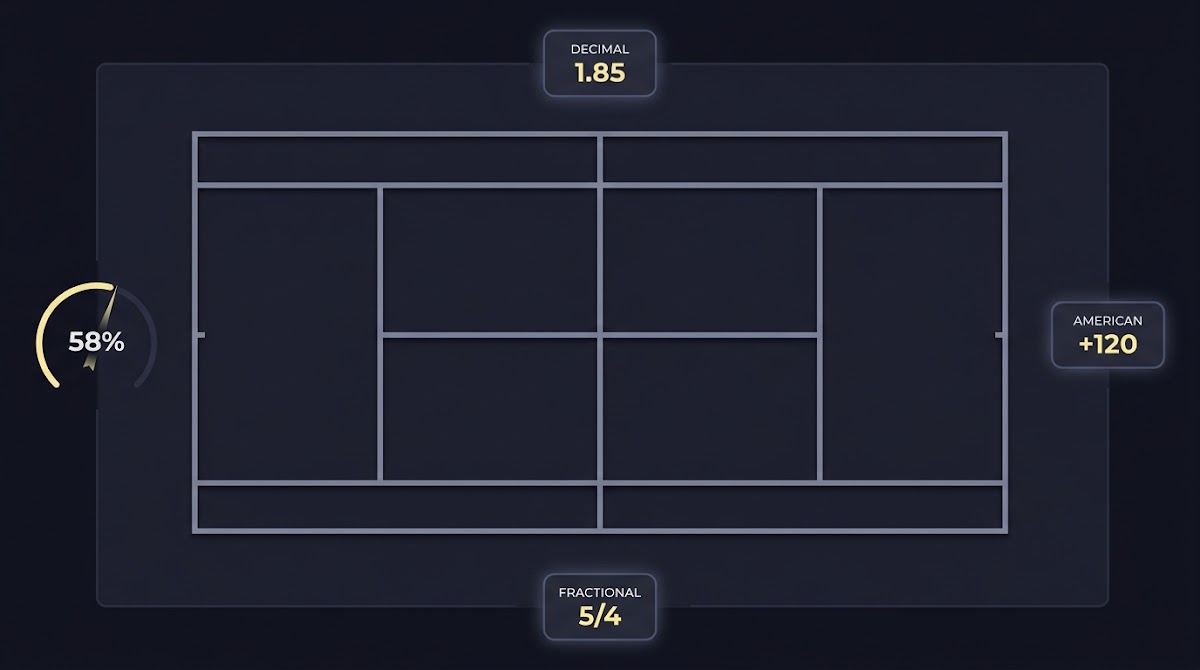
What a tennis moneyline is and why it matters
A tennis moneyline is a win-only market where you back the player or team you expect to win the match. This simple definition is the baseline for many bettors and analysts because it ties directly to a single outcome rather than scorelines or set counts, making moneyline markets a common starting point for pre-match evaluation and model building Investopedia moneyline definition.
Favorites and underdogs are shown differently depending on the odds format. In American odds favorites typically appear as negative numbers while underdogs have positive numbers, and both decimal and fractional formats represent the same relative value in other ways. That format variety is why a quick conversion step is useful before comparing prices across books or exchanges AGA sports betting 101.
For most users understanding moneyline prices is a matter of converting those prices into implied probabilities and then comparing those probabilities to your own view of the match. Using the moneyline as a baseline lets you focus on which side represents better value rather than getting lost in side markets or proprietary handicaps AGA sports betting 101.
Steps for a simple spreadsheet to convert odds to probability
Use one row per match
Keeping the moneyline simple is also practical when you track results. A win or loss is unambiguous, and many evaluation frameworks treat the moneyline as the canonical outcome for testing accuracy and consistency. That makes the market useful whether you are learning the mechanics or developing a performance-based process on a funded sports prediction platform.
How bookmakers and exchanges set initial tennis moneyline prices
Opening lines start with a synthesis of inputs: recent player form, head to head records, surface performance, injuries, and broader market sentiment. Providers use those signals to set an initial implied probability for each side and then express it as odds in their preferred format AGA sports betting 101.
Another key input is public betting patterns. If a lot of money arrives on one side the provider may shift the line to balance liability. Exchanges differ because they match users against each other and the displayed price can reflect available liquidity rather than a house-imposed margin AGA sports betting 101.
Exchanges can show more granular moves early when liquidity is deep, while a bookmaker may hold larger gaps when liability is uncertain. Regardless of provider, opening prices are just starting points and they will adjust as new information arrives, which is why comparing several regulated markets helps identify where value might exist.
Practice converting a sample line on your own
Try converting a sample opening line in a spreadsheet to see the implied probabilities yourself, then note how the result changes if you remove the bookmaker margin.
Many experienced users treat opening lines as reference points and then monitor price movement as the match approaches. That movement can reveal where sharp money or late information has altered the market view, and it is one reason to check several sources before making a stake.
How to read moneyline odds and convert them to implied probability
Odds appear in three common formats, and each has a standard formula for implied probability. Decimal odds are converted by taking the reciprocal, implied probability equals 1 divided by the decimal odds. Fractional odds convert by dividing the denominator by the sum of numerator and denominator. American odds use different formulas depending on sign: for positive American odds you use 100 divided by odds plus 100, and for negative American odds you use negative odds divided by negative odds plus 100. These formulas are standard practice when moving between prices and probabilities Investopedia implied probability.

Decimal, fractional and American odds formulas, How Tennis Moneyline Markets Work
Here are the formulas in plain terms: decimal to probability is 1 / decimal; fractional a/b converts to probability a divided by a plus b; American positive x gives 100 divided by x plus 100; American negative -y gives y divided by y plus 100. Using these exact steps lets you compare prices regardless of display format and is the first step toward spotting value Pinnacle odds conversion guide.
Worked example 1, decimal: if a player is at 1.80 in decimal odds compute 1 divided by 1.80 to get an implied probability of 0.555 repeating, which you then express as 55.6 percent. Worked example 2, American: if a player is -150 the implied probability is 150 divided by 150 plus 100, which gives 0.6 or 60 percent. These concrete examples make conversions routine once you practice them a few times Investopedia implied probability.
Convert odds to implied probability using the standard decimal, fractional or American formulas, normalize to remove overround, and treat live prices as snapshots since tennis scoring changes probabilities point by point.
Worked example 3, fractional: odds shown as 4/1 convert by taking 1 divided by 4 plus 1, or equivalently denominator divided by numerator plus denominator, which yields a 20 percent implied probability for the underdog in that case Pinnacle odds conversion guide.
Remember that implied probability from a single price is an estimate. Differences in rounding, display precision, and market margin mean the computed probability should be treated as a working value rather than a precise truth. Use the conversions to form quick comparisons and then normalize when required.
Overround and normalizing probabilities for fair comparisons
Bookmakers include a margin in published odds so the sum of implied probabilities across both sides usually exceeds 100 percent. That surplus is commonly called the overround or vig and it is how a provider builds an edge into the market. Spotting this overround is essential before you compare prices across providers Investopedia implied probability.
Normalization removes the overround so you can see fair probabilities for each outcome. The basic normalization method divides each side's implied probability by the sum of implied probabilities from the market, then multiplies by 100 to rescale to 100 percent. For example, if two sides sum to 105 percent you divide each side's implied probability by 1.05 to get a normalized, or fair, probability Pinnacle odds conversion guide.
Normalization matters because a market with a larger margin can make a side look cheaper than it really is when compared directly to a lower margin market. By comparing normalized probabilities you are effectively comparing apples to apples, which is the right starting point when searching for relative value.

After normalization you can see which provider offers relatively better fair odds. See the Funded Plays blog for related posts. That is not the same as guaranteed profit, but it highlights where a market may be more favorable once you account for the built-in margin.
How in play scoring in tennis changes moneyline prices
Tennis is scored point by point within games and sets, and each point changes the match win probability to some degree. That incremental structure means live moneyline prices update frequently, often after every point in closely contested games ITF rules of tennis.
Because every point can swing win expectation, live markets must react quickly. A service that updates prices fast will show noticeable moves after a break of serve, and even a single mini-run of points in a tiebreak can shift probabilities materially. For anyone tracking in-play moves it helps to log the price before and after significant events so you can see the magnitude of change in realistic terms Betfair in-play help.

Operationally, exchanges and bookmakers use short placement delays to manage risk when matches are running live. Those delays are brief but they can affect whether you see the same price you expect, especially on very fast markets where the display price can move between confirmation and execution Betfair in-play help.

Live conversions use the same formulas as pre-match, but because probabilities move rapidly you should treat any in-play computed probability as a snapshot, not a stable quantity. Logging timestamps with each recorded price helps you understand how quickly a market is moving during key moments.
Comparing markets and spotting relative value
To compare prices across providers first convert each visible price into an implied probability, normalize to remove the overround, and then compare those normalized probabilities to your own model or view. That sequence ensures you are comparing fair odds rather than raw displayed prices that hide different margins Pinnacle odds conversion guide.
Liquidity and market rules lead to persistent small differences between providers. Exchanges may quote tighter lines when liquidity is deep, while a bookmaker may have a slightly wider spread or a larger margin on certain lower-profile matches. Those differences are normal and part of the reason to check multiple regulated markets AGA sports betting 101.
Quick checklist before staking: verify the odds format, convert to implied probability, normalize for margin, confirm market rules and placement delay, and compare the normalized probability to your model or fair value view. Treat discrepancies with caution and prefer reproducible differences over one-off gaps.
When you find a persistent normalized advantage it may be worth logging similar checks over several matches to see if the edge repeats on Funded Plays. Small, consistent advantages are what matter in disciplined evaluation frameworks rather than occasional outsize wins.
Common mistakes and pitfalls to avoid
A frequent error is misreading odds format and applying the wrong formula. For example, treating American negative odds as if they were positive will produce incorrect implied probabilities. Double checking the format and the conversion rule before you calculate is a simple but effective safeguard Investopedia implied probability.
Ignoring the overround is another source of poor comparisons. If you compare two raw implied probabilities without normalizing you can be misled about which price is actually better. Always normalize before cross-market comparisons to remove the bookmaker margin effect Pinnacle odds conversion guide.
In live markets watch for placement delays and stake acceptance rules. A price that looks available on screen might change before a stake is accepted, and exchanges can decline an order if liquidity is insufficient. Operate with awareness of these operational constraints and treat fast-moving in-play prices as estimates rather than guarantees Betfair in-play help.
Finally, avoid overconfidence from single instances of success. Consistency, logging, and disciplined review produce reliable skill development over time. That approach aligns with responsible participation and systematic improvement rather than chasing one-off gains.
Practical examples and step by step scenarios
Pre-match example: suppose Book A lists Player 1 at -140 and Book B lists Player 1 at 1.71 in decimal. Convert -140 to implied probability by computing 140 divided by 140 plus 100 to get 58.33 percent. Convert 1.71 decimal by dividing 1 by 1.71 to get about 58.48 percent. Next sum the implied probabilities for both sides at each provider, normalize each side by dividing by the provider sum, and then compare the normalized values across Book A and Book B to see which provides the stronger fair probability for Player 1 Investopedia implied probability.
Walkthrough continued: if Book A's normalized fair probability for Player 1 is 56 percent and Book B's normalized fair probability is 57 percent, Book B is relatively better in that moment after accounting for margin. That does not create a guaranteed profit but it highlights where the market gives relatively more favorable fair pricing, which is the primary goal of these checks Pinnacle odds conversion guide.
Live scoring example: imagine Player 1 breaks serve early and leads by a set and a break. The win probability for Player 1 will increase quickly, and live moneyline prices will shorten to reflect that higher probability. If Player 1 then gets a medical timeout or a shift in momentum, the win probability can fall back, and prices will move accordingly. Because each point alters probability the market reacts point by point in many cases ITF rules of tennis.
Practical logging suggestion: record pre-match odds and normalized probabilities, then capture a timestamp and the live price after key events like a break of serve or a tiebreak. Over time you will see typical magnitudes of change for different match states, which improves your sense of when a live price represents a useful opportunity versus when it is simply transient noise Betfair in-play help.
Conclusion: quick checklist and next steps
Short takeaways: convert displayed odds to implied probability using the standard formulas, normalize probabilities to remove overround before comparing providers, and treat live prices as snapshots because tennis scoring changes probability point by point Investopedia implied probability.
Before you apply these checks on any platform verify the house rules and placement delays, and log both pre-match and in-play prices for repeated analysis. Consistent, disciplined checks matter more than occasional wins, and responsible participation should guide how you use these markets Betfair in-play help.
A moneyline bet chooses the match winner only. It does not depend on set scores and is settled when one player wins the match.
For positive American odds use 100 divided by odds plus 100. For negative odds divide the absolute odds by absolute odds plus 100.
Normalization removes the bookmaker margin so you compare fair probabilities rather than raw prices that include different margins.
References
- https://www.investopedia.com/terms/m/moneylinebet.asp
- https://www.americangaming.org/resource/sports-betting-101/
- https://www.investopedia.com/terms/i/implied-probability.asp
- https://www.pinnacle.com/en/betting-articles/betting-strategy/how-to-convert-odds-to-probability/
- https://www.fundedplays.com/challenges
- https://www.itftennis.com/en/about-us/governance/rules-and-regulations/rules-of-tennis/
- https://support.betfair.com/en/s/article/What-is-In-Play-betting
- https://www.fundedplays.com
- https://www.fundedplays.com/blogs
- https://www.fundedplays.com/blogs/how-fundedplays-evaluations-work
- https://www.covers.com/tools/odds-converter
- https://therundown.io/betting-calculators/implied-probability-calculator
- https://www.omnicalculator.com/statistics/implied-probability