

What tempo means in college basketball and why it matters for totals
How Tempo Shapes College Basketball Totals
In college hoops, tempo is the shorthand analysts use to describe how many possessions a game is likely to have and how quickly teams move the ball from one play to the next. At its core, tempo connects directly to scoring opportunity: more possessions usually mean more shot attempts, more transition chances, and more opportunities for points. For readers focused on totals, learning to read tempo is a way to translate style into expected scoring range.
Tempo is often measured as possessions per game or possessions per standardized interval, and analysts will adjust raw counts to account for things like free throw timing and offensive rebounds. Understanding these possession-based metrics helps you estimate the raw volume of scoring without assuming any specific efficiency levels.
Download the tempo checklist
Sign up for a short guide on tempo checks and pregame checklists to sharpen your totals workflow, no guarantees implied; the guide focuses on practical steps and disciplined record keeping.
College tempo differs from professional leagues because of structural rules and roster dynamics. Things like the shot clock length, substitution patterns, and the depth of rosters influence how often a team can restart play and how coaches manage minutes. Those structural factors create a wider range of tempos from one college game to another, which is one reason totals can be more variable at this level.
When you track tempo, think of possessions as the currency of scoring. Possessions convert into shots, and shots convert into points at a rate that depends on offense and defense. That separation between volume and rate is the foundation for using tempo in totals forecasting.
How tempo affects totals at a high level
There is a simple direct channel: more possessions generally mean more scoring opportunities. If a matchup produces a higher-than-normal number of possessions, it lifts the expected total because each possession is a chance to add points. For totals analysis, this is the most immediate lever: estimate possession volume first, then apply expected scoring per possession.
Tempo also works through indirect channels. Faster play increases the share of transition scoring, can lead to more quick decision making that sometimes creates offensive rebounds, and may change foul rates as defenders and attackers arrive on plays with different spacing. All of these secondary effects alter how possessions convert to points, so tempo rarely acts alone.
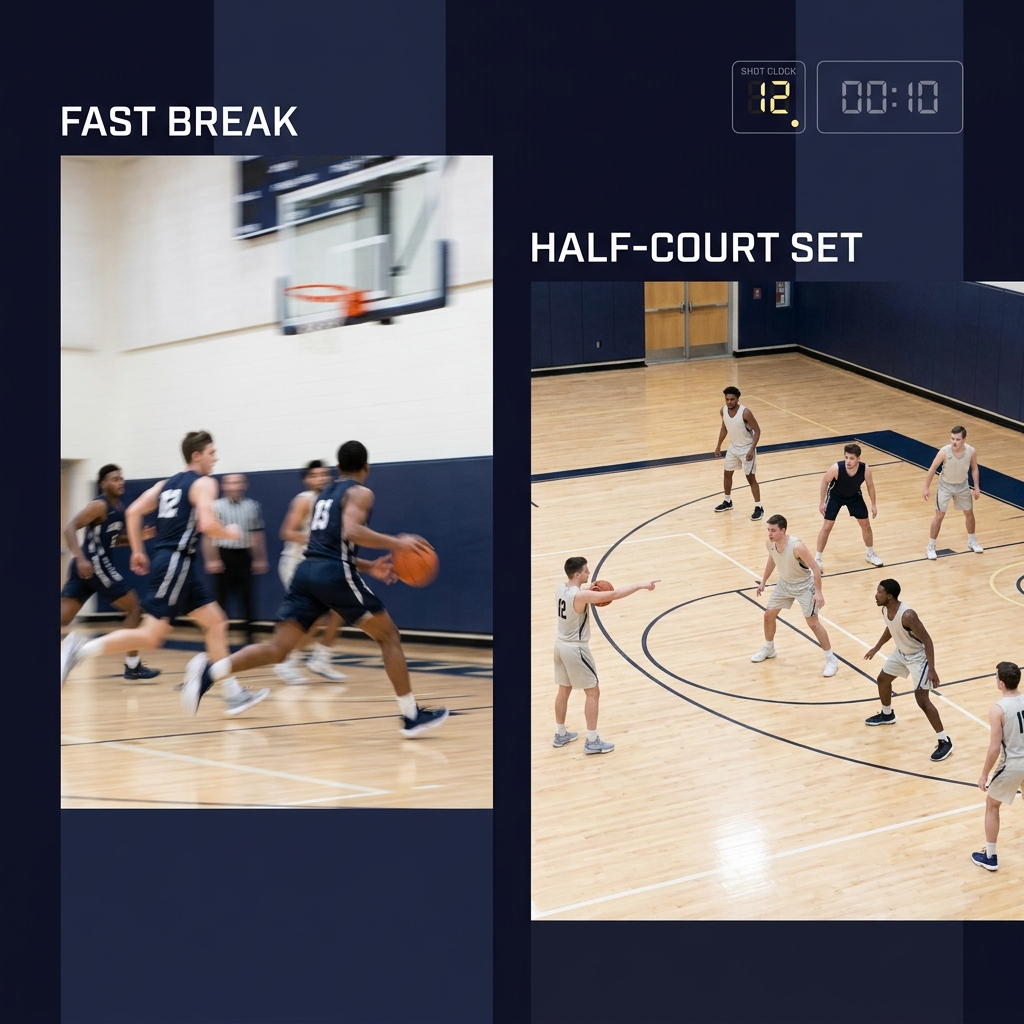
At the same time, efficiency can offset raw tempo. A high-possession game between two effective defenses may still produce modest scoring because points per possession remain low. Conversely, two efficient offenses can throw up a high total even at a moderate pace. Treat tempo as a major input, not the sole determinant.
Key tempo metrics, where to get them, and how to read them
Common tempo metrics include possessions per game, possessions per standard interval, and adjusted tempo measures that control for opponent style. Possessions per game is the most intuitive metric and is derived from box-score events. Adjusted tempo attempts to strip away schedule or opponent bias so you can compare teams on a level basis.
Data sources for these numbers are typically official box scores, team statistics pages, and college analytics aggregators that compile play-level or pace-adjusted figures. When you consult a box score, look for the events that feed a possession calculation, such as field goal attempts, turnovers, and offensive rebound outcomes, which together form the basis of possession estimates.
Tempo determines the number of possessions in a game, which sets the scale of scoring opportunities; when combined with expected points per possession, it helps produce an informed totals estimate.
To interpret tempo numbers, compare a team's raw possessions per game to its adjusted tempo. If a team shows a high raw number but lower adjusted tempo, that suggests schedule or matchup effects inflated their volume. Conversely, a team with a modest raw number but a higher adjusted tempo is probably running deliberately fast against typical opponents. Always check opponent context before using a tempo number in a totals decision.
How offensive and defensive efficiency interact with pace
Volume and rate are distinct. Possessions set the scale of opportunity while points per possession determine how often those opportunities convert. For totals forecasting, you need both. If you imagine possessions as the number of tickets in a raffle, offensive and defensive efficiency determine the chance that any ticket is a winner.
There is an efficiency trade-off to watch for. Sometimes teams that play faster sacrifice points per possession because quick shots or poor shot selection lower conversion rates. Other times, a team can push tempo precisely because it excels at scoring quickly and forcing turnovers, which amplifies tempo effects rather than offsetting them.
Use simple rules of thumb: when two teams both have above-average points per possession, tempo is more likely to inflate the total. When one or both teams are below average on efficiency, extra possessions may not move the total as much. Look for efficiency divergence between opponents as an indicator that tempo will translate into scoring rather than be absorbed by low conversion rates.

A step-by-step framework to adjust totals lines for tempo
Step 1 is to estimate baseline possessions for the matchup. Start with the teams' adjusted tempo and blend them while accounting for venue effects and likely matchup control. This gives you the expected possession count without yet converting to points.
Step 2 brings team styles and substitution patterns into the picture. Consider how bench rotations change when starters rest, whether a team uses clear clock-draining sets late in halves, and whether coaches habitually speed up or slow down in specific situations. These qualitative adjustments refine the possession estimate.

Step 3 combines possessions with expected efficiency to produce a totals estimate. Multiply your possession forecast by a reasoned estimate of points per possession for the matchup. Adjust for game context such as travel, short rest, and referee tendencies that affect foul rates. Finally, express the estimate as a range to reflect uncertainty rather than a single fixed number.
Always document assumptions so you can test them later, and remember that venue and late-game tactics can shift a projection during the live game, so treat your stepwise output as a baseline to be updated.
Conference, schedule and situational factors that change tempo expectations
Conferences often display style clusters. Some conferences emphasize fast transistions and open offense, while others favor halfcourt structure and control. When teams from different clusters meet, simple averages can mislead. Models that adjust for conference tendencies tend to produce more stable totals forecasts across inter-conference matchups.

Non-conference scheduling also matters. A season filled with mismatches can inflate average tempo statistics because favored teams pile up possessions against weaker foes. Neutral-site games and tournaments compress venue advantages and may change how coaches manage minutes, which in turn affects tempo and scoring patterns.
Situational modifiers to watch include back-to-back games, which can sap intensity and encourage coaches to shorten rotations, and tournament play, where coaching adjustments and stakes often change how much teams push pace. Foul trouble and late substitutions are immediate situational factors that can lower or raise expected possessions for a game.
Models, tools and simple calculations to turn tempo into a totals forecast
A simple possessions-based totals model multiplies an estimated possession count by an expected points-per-possession figure. That core arithmetic gives you a baseline total that you can further adjust for home advantage and matchup-specific efficiency differences. A spreadsheet is often the most practical starting tool for this calculation.
Common inputs include each team’s adjusted tempo, opponent-adjusted offensive and defensive efficiencies, and a venue factor. Keep inputs transparent and avoid loading the model with dozens of fragile parameters until you have solid out-of-sample tests that justify them.
quick possessions times points per possession calculator
use as a baseline check
For users ready to move beyond a simple spreadsheet, regression techniques or machine learning models can help if you have sufficient historical data. These approaches can capture nonlinear interactions between tempo and efficiency but also risk overfitting. Start simple, validate on held-out samples, and add complexity only when it reliably improves predictive performance.
Common mistakes and pitfalls when using tempo to predict totals
A frequent error is overreacting to small-sample tempo swings. A single high-possession game typically does not indicate a lasting change in style. Use rolling averages and other smoothing techniques to reduce small-sample bias.
Another mistake is ignoring efficiency offsets. Extra possessions are only valuable for totals if they convert at a reasonable rate. Failing to combine tempo with points-per-possession estimates will produce biased forecasts that often overshoot the true total.
Also watch for mixing per-game averages without context. Teams facing a string of weak opponents will show inflated raw tempo numbers that do not persist against stronger competition. Mitigation steps include opponent adjustment, weighting recent games appropriately, and scenario testing where you simulate different pace outcomes to understand sensitivity.
Practical examples: three matchup scenarios and how tempo changes the totals call
Fast team versus fast team. When two teams both prefer quick possessions, look for transition scoring and early shot-clock attempts to rise. If both offenses are efficient on the break, the baseline possession estimate should be higher and your projected total moves up. Before making a call, check whether either coach tends to shorten rotations late in games as that can reduce late-quarter possessions.
Slow team versus slow team. Games between deliberate teams can still produce scoring if one side converts a higher share of possessions through offensive rebounding or free throws. In this matchup type, look beyond raw pace for hidden sources of points, then decide whether modest extra possessions from garbage-time scenarios are credible in the specific matchup.
Mixed styles: predicting who forces the tempo. If a fast team faces a slow, controlled opponent, the key question is which team imposes its style. Signs that the fast team will force pace include deep rotation usage, aggressive press or trap defense, and a lineup that attacks early in possessions. If the slow team successfully slows the game with clock management and shot selection, tempo may stay lower and the total drops accordingly.
A sample playbook: applying tempo analysis to a live betting or pregame totals decision
Pregame checklist. Start with adjusted tempo estimates for both teams, then overlay opponent-adjusted efficiency numbers. Note venue and travel considerations, recent rotation changes, and any situational flags like short rest or injuries that could alter substitution patterns.
In-play indicators that change tempo expectations often appear early. Quick turnovers, unexpected early fouls, or an unusually fast offensive rhythm can be credible signals that possessions will run higher than your pregame baseline. Conversely, extended scoring droughts and frequent stoppages are signs to reconsider a high-possession projection.
When sizing exposure, treat tempo uncertainty like any other model risk. Reduce stake size when tempo signals are marginal or when efficiency indicators conflict with raw pace. Document your decisions and outcomes so you can refine the checklist over time based on real results rather than intuition alone.
How tempo shifts during a game and why that matters for totals trading
Substitution patterns are one of the most reliable causes of intra-game tempo shifts. When starters sit, bench groups often play at different speeds, and a bench-loaded tempo can diverge from the starters' rhythm. Watch how coaches use timeouts and substitutions in the first half to anticipate second-half pace changes.
Coaching responses also matter. If a team falls behind, coaches may intentionally speed play to create more possessions, while a lead often invites clock management. Halftime adjustments can therefore materially change second-half totals expectations, so reassess projections at the break rather than assuming linear continuation.
For traders, the key is to watch observable tempo signals and act quickly. If the live game shows a clear and sustained pace different from your baseline, consider trading to adjust exposure, but always factor in transaction costs and remaining time in the game before making moves.
Responsible limits: what tempo analysis can and cannot tell you
Tempo is a predictive input, not a certainty. It helps you form a range of likely scoring outcomes but does not guarantee which outcome will occur. Prediction uncertainty remains, and variance can be high in college games because of roster turnover and situational swings.
Use tempo analysis as one factor among many. When signals conflict, prefer moderation and smaller stakes. If confidence is low because of limited data or contradictory indicators, it is often better to pass than to force a large exposure based on tempo alone.
Finally, keep an eye on sample size and variance. Tempo-driven calls should be tested and validated over many games. Treat your early efforts as experiments: log results, learn from systematic errors, and tune your approach incrementally.
Conclusion and a practical checklist to apply tempo in your totals workflow
Quick pregame checklist: get adjusted tempo and possessions per game, compare offensive and defensive efficiencies, check for situational flags, and set a baseline possession estimate. Convert that baseline into a projected total using a reasonable points-per-possession figure, then express a confidence range.
Testing plan: use rolling samples to validate whether tempo adjustments improve predictive accuracy and backtest the step-by-step framework over a representative season sample. Record outcomes and update weights only when you see consistent, out-of-sample improvement.
Tempo is a powerful lens for totals work when used responsibly. It links style to scoring volume, but its predictive power increases when combined with efficiency measures, situational awareness, and disciplined testing. Use the checklist, document your assumptions, and iterate to improve forecasting over time.
Estimate the expected possessions for the matchup, multiply by a reasoned points-per-possession figure, and express the result as a range to reflect uncertainty.
Use rolling averages and opponent-adjusted tempo measures, and weight several games rather than reacting to a single outlier performance.
Avoid relying on tempo when efficiency indicators conflict with raw pace or when situational factors like injuries create high uncertainty.
References
- https://www.teamrankings.com/ncaa-basketball/stat/possessions-per-game
- https://www.ncaa.com/stats/basketball-men/d1
- https://pmc.ncbi.nlm.nih.gov/articles/PMC6234313/
- https://www.fundedplays.com
- https://www.fundedplays.com/blogs
- https://www.fundedplays.com/blogs/how-fundedplays-evaluations-work
- https://www.fundedplays.com/challenges