
What target share means and why it matters for football props
Definition of target share and how it differs from snap share and usage
Target share is the percentage of a team's pass targets that go to a specific player in a game or defined time window. Understanding How Target Share Affects Football Props starts with that simple ratio: higher percentage means more opportunities to catch passes and accumulate yards, which directly affects many receiving props.
Target share differs from related measures in meaningful ways. Snap share records how often a player is on the field, while opportunity share or targets measure how many actual pass attempts come to the player. A receiver can have high snap share but low target share if he runs blocking routes or the quarterback looks elsewhere.
Why props respond to target distribution across a game
Props reflect outcomes, and outcomes depend on chance plus opportunity. A consistent, high target share raises both the floor, because the player receives frequent short, catchable throws, and the ceiling, because more targets create more chances for explosive plays or touchdowns. That makes target share a primary usage metric when evaluating reception and yardage props.
In practice, target share signals volume. When a player's share is predictable, it reduces variance in reception-count props and helps bettors set reasonable expectations about likely catches and total yards.
How target share influences different types of football prop bets
Reception props versus yardage props versus touchdown props
Reception props are the most directly tied to target share. Each target is a direct path to a reception, so higher shares generally translate into more catches over the course of a game. This means target share is a first-order input for over/under reception decisions.
Yardage props depend on both volume and depth of target. A player with a high target share who runs mostly short routes will likely produce steady reception totals and modest yardage, while a lower-target deep threat can exceed yardage lines on a few long plays. Thus target share matters for yards, but the effect is mediated by route profile and air yards.
Target share should be the baseline input for reception and receiving yardage props because it reflects opportunity; adjust that baseline for matchup, route quality, and game script to produce a calibrated probability before betting.
Touchdown props are less tightly correlated with target share. Touchdowns are rare and situational, often tied to red zone play design, personnel packages, and game script. A high target share can increase touchdown chances slightly by increasing opportunities, but red zone target usage and how teams design scoring plays are often a stronger driver.
When target share matters most is in stable roles and consistent game plans. Early-season or spotty usage makes target share noisy. For reliable prop evaluation, prioritize target share where the player's role is established and the team's passing approach is steady.
Estimating a player's target share quickly from public data
Using box score stats and playcounts
When targets are published, compute target share as player targets divided by team total passing targets. This simple ratio gives a clear baseline to compare against prop expectations.
If live targets are not available, snap counts and route participation act as useful proxies. Snap counts tell you whether a player is on the field; route participation shows whether he is running pass routes where targets can occur. Use these together to estimate whether a player is likely to command a significant target share.
Quick route participation and targets check for fast prop decisions
Use in pregame and early live windows
Situational clues that change expected target shares
Injuries to teammates, quarterback tendencies, and game script are immediate modifiers. If a primary receiver is out, expect target redistribution to secondary pass-catchers. If a team is trailing and passing more, baseline target expectations should scale up along with pass volume.
For quick in-play or pregame checks, a short checklist helps: confirm snap share, confirm route participation, note any injury or rotation news, and scale baseline targets by expected pass attempts in the game.
A simple framework to incorporate target share into prop evaluation
Step 1: Establish baseline usage
Start by estimating expected pass attempts for the team, then multiply by the player's target share to get expected targets. For pregame, use season or recent game averages to set a baseline. For in-play decisions, use observed targets and early snap distribution to update the baseline.

Baseline usage anchors your decision. If a player's expected targets exceed what the reception or yardage prop assumes, the over becomes more attractive. If expected targets fall short, the under is often correct, all else equal.
Step 2: Adjust for matchup and game flow
Adjust baseline targets for opponent coverage tendencies and likely game script. If a defense consistently allows short completions and the offense favors high-percentage throws, expect target-heavy receivers to see a boost in both receptions and yards. Conversely, if a defense forces contested catches or surrenders few intermediate completions, lower your yardage expectations.
Game flow adjustments are qualitative but powerful. Anticipate changes in target distribution if a team is likely to run more often, if weather worsens, or if the game becomes lopsided and the trailing team abandons the run.

Translate expected targets into the likelihood of clearing a reception or yardage line by considering average catches per target for the player's route profile. For receptions, use a conservative catch-rate assumption for short-route specialists and a more variable assumption for deep threats. This produces an intuitive probability you can compare to the implied probability in the prop line.
Keep the math light. The framework is designed to be repeatable: establish baseline targets, apply modifiers, and map to a qualitative probability band. Over time, tracking your assumptions versus outcomes improves calibration and betting discipline.
Decision criteria: when to favor target share over other signals
High-target-share players vs high-efficiency low-volume players
Favor target share when a player shows consistent volume across multiple games and plays a defined role in the offense. Volume reduces variance and makes reception props more predictable. High-target-share players are especially valuable in games with expected moderate to high passing volume.
Contrastingly, when a low-volume player produces high efficiency or explosive plays, efficiency becomes the stronger signal for yardage or touchdown props. For those players, one or two opportunities can swing a props result, so model decisions around the distribution and depth of their targets rather than raw share.
When to weigh matchup data more heavily than target share
Use a priority order when time is limited: confirm baseline target share, check matchup adjustments, then add efficiency signals. That order helps maintain discipline and keeps decisions focused on the most predictive inputs.
Matchup data trumps target share when the defensive scheme specifically limits the type of production a player provides. If the opponent excels at limiting short-area receptions, a high target share may not translate into yards. If a defense has a history of bending but not breaking in the red zone, touchdown props become particularly noisy and require deeper situational analysis.
Common pitfalls and how target share can mislead you
Small sample artifacts and recency bias
One standout game can distort perception. A receiver who suddenly logs a double-digit target game may not have established a permanent role; treating that single performance as the new norm is a common error. Always compare recent spikes to longer-term patterns before adjusting prop expectations materially.
Recency bias leads bettors to overweight the latest game. Guard against it by using rolling averages or a minimum sample length when you establish baseline target share.
Ignoring route quality and target depth
Target share measures quantity but not quality. A large share of short check-down targets produces catches but fewer yards and less touchdown upside. Conversely, a low target share filled with deep, high-air-yard attempts can produce outsized yardage totals with few catches. Evaluate air yards and contested target rates alongside share to avoid misleading conclusions.
Also watch for role changes within a game. A player moved into a heavy blocking role or shifted to special teams will see target share fall even if season-level metrics suggest otherwise. Stay alert to snap count and route participation updates during live play.
Practical examples and scenarios: four worked cases
Example A: High target share receiver with low yards per catch
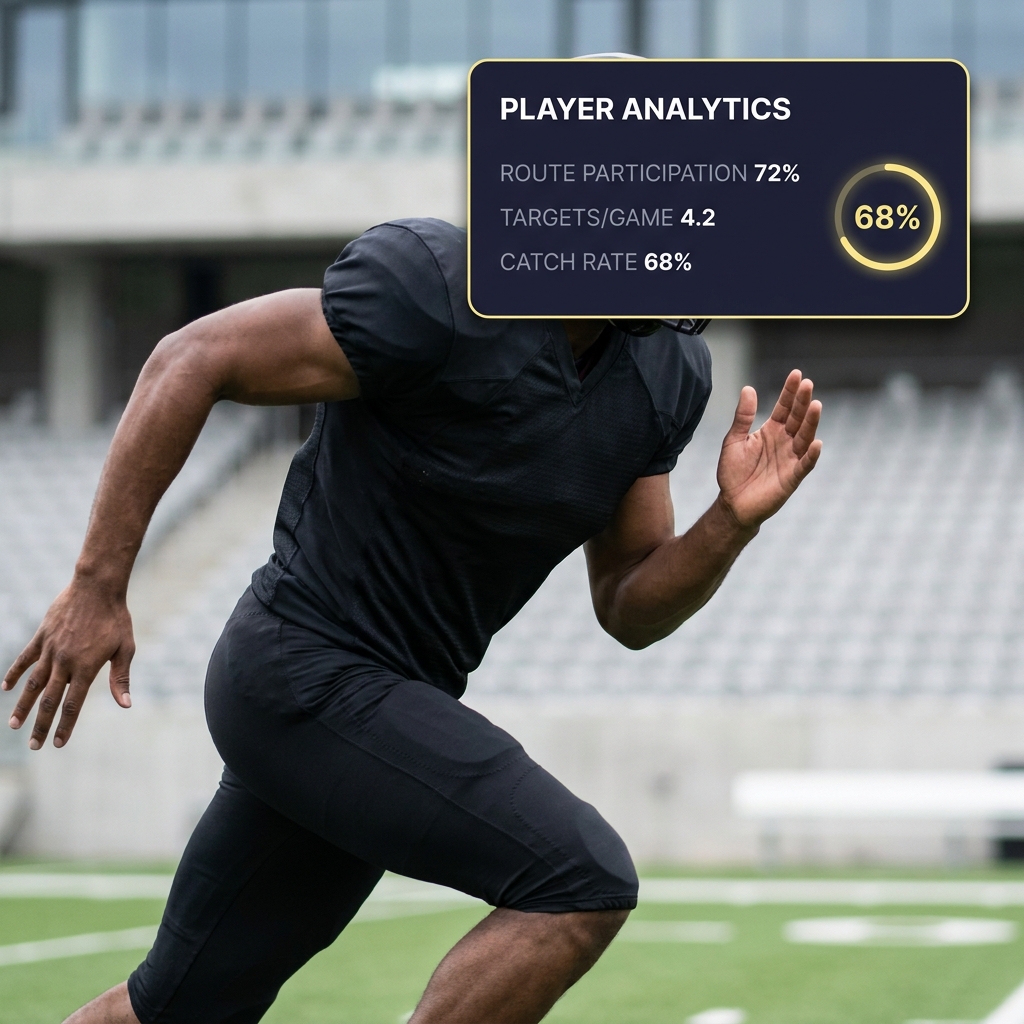
Imagine a slot receiver who runs a high percentage of short routes and commands a steady target share. For reception props, his volume supports the over on modest catch lines.
In that scenario, favor receiving reception overs when the expected targets exceed the line's implied targets, but treat yardage props conservatively unless you see evidence of deeper route usage.
Example B: Low target share deep threat with high yards per catch
Consider a deep-threat receiver targeted infrequently but for long gains. For receptions, his low target share makes reception overs risky. For yardage props, a few long completions can push him over the line, so efficiency and air yards become the dominant signals.

That means you might avoid reception overs but still consider yardage overs priced cheaply enough given the player's explosiveness, while understanding that variance is high.
Example C: Mid-season injury shifts target share
When a primary receiver misses time, expect immediate redistribution. Secondary options and tight ends often gain target share, and the change can be durable or temporary depending on how the offense adjusts. Update baseline targets quickly and check for role confirmation in the following games.
In live situations, monitor first-quarter snaps and early target patterns to determine whether the redistribution is sticking before sizing a prop bet significantly.
Example D: In-game adjustment driven by game script
If a team falls behind early, passing volume typically rises and some receivers see an uptick in targets. Conversely, a team leading comfortably may run more, reducing pass opportunities. Watch quarterback play, early possessions, and play-call balance to adjust expected targets and recompute prop probability during the game.
Worked examples make clear that target share is a foundation, but context and timing determine whether it is decisive for a particular prop.
How to combine target share with analytics tools and public models
Which public metrics complement target share
Pair target share with air yards, average depth of target, red zone target percentage, and catch rate trends. These metrics illuminate the quality and scoring opportunities behind raw share and help convert volume into probable outcomes.
Lightweight models that blend expected targets with air yard adjustments produce better yardage forecasts than share alone. Use public boxscore data and simple aggregates to check these signals quickly before placing a bet.
Try the pre-bet checklist on a few live games to calibrate your assumptions and improve decision consistency over time.
Simple model ideas to convert share into probabilities
A basic conversion maps expected targets into likely receptions by applying a conservative catch-rate per target based on route profile. For yards, multiply expected receptions by an assumed yards-per-catch figure adjusted for air yards. Calibrate these assumptions with a small sample of games to get intuition rather than full statistical precision.
Practical dashboards and boxscore summaries let you compute these conversions in minutes. The goal is not to build a perfect model but to produce a disciplined probability estimate that improves edge identification and reduces impulsive decisions.
Putting it together: a short checklist before placing a prop
Pre-bet checklist items
Confirm baseline target share from recent games or published targets, estimate team pass attempts, check matchup tendencies, and note any injuries or role changes. Compare your expected targets to the prop line's implied targets before sizing a stake.
Also verify weather and quarterback status, and ensure your bankroll plan limits exposure to single bets. Discipline is part of turning better analysis into better long-term outcomes.
In-play checklist items
Early in-game, confirm snap counts and the first two drives' target distribution. Watch for emergent patterns and adjust expected targets if a player is clearly seeing more or fewer targets than your baseline. Re-Evaluate the size of any live wager based on how strongly the new pattern deviates from pregame expectations.
A final reminder: avoid over-weighting a single signal. Use target share as a leading indicator, then layer matchup and route-quality checks to finalize your decision.
Conclusion: using target share to make smarter, more disciplined prop choices
Key takeaways
Target share is a powerful volume metric that most directly predicts reception outcomes and influences yardage potential when combined with route quality data. Use it as a baseline, adjust for matchup and game flow, and convert expected targets into a practical probability for props.
Next steps for readers
Start by measuring target share on a small sample of players and testing the checklist on low-stakes decisions. Record outcomes, refine your catch-rate and air yard assumptions, and apply the three-step framework to sharpen probability estimates for future props.
You can estimate a player's target share before kickoff by dividing recent player targets by team targets or by using snap counts and route participation as proxies; adjust for injuries and expected pass volume.
Not reliably; touchdowns are situational and depend more on red zone usage and play design than raw target share, though volume helps slightly.
Yes, but only after confirming early snap counts and target distribution; update your baseline if the in-game pattern diverges from expectations.
References
- https://www.fundedplays.com
- https://www.fundedplays.com/blogs
- https://www.fundedplays.com/blogs/how-fundedplays-evaluations-work
- https://www.fundedplays.com/challenges
- https://www.cbssports.com/fantasy/football/news/fantasy-football-expert-vs-nfl-prop-odds-six-receivers-projected-to-smash-overunders-in-betting-market/
- https://oddsindex.com/guides/nfl-player-props-guide
- https://fantasyteamadvice.com/nfl/advanced-stats/receiving