

How Sportsbooks Build a Betting Line: Overview
When you see a posted number on a game, that published price starts with internal power ratings and probabilistic models that estimate outcome chances, then it is adjusted before it becomes a public line. This is the stage where operators convert model outputs into implied probabilities and add a margin so the total implied chance exceeds 100%, producing the house edge commonly called the vig, which shapes expected hold for the book Investopedia explanation of vigorish.
The process preserves a model-derived view of likely outcomes while creating a small built-in profit for the operator, and regulators and industry reports track the realized result of that margin as hold or win percent in published revenue data Nevada Gaming Control Board reports.
Practice line-reading with structured challenges
Read the full framework below to see how model outputs, margin, and market action work together so you can interpret posted odds more clearly.
In practical terms, thinking of an opener as a model statement plus a built-in margin helps separate the bookmaker's true probability estimate from the published price. That distinction is useful when you compare lines, look for value, or study market movement.
From Power Ratings to Published Odds: The Core Framework
Most sportsbooks begin with a power rating model that weights inputs like recent performance, matchup factors, and situational adjustments to produce a base estimate for each outcome; these model outputs are the starting point for pricing Pinnacle's overview of odds drivers.

Step 1, convert the model probability into a standard quoted format, such as decimal or moneyline odds, which is a straightforward mathematical mapping from probability to price in preparation for publishing.
Step 2, embed an overround or vig across outcomes so the summed implied probabilities exceed 100 percent, creating the operator's margin; this is how sportsbooks ensure a theoretical expected hold before any trading or market action.
Step 3, reconcile third-party data feeds and vendor inputs with in-house ratings, applying manual trader adjustments where necessary to account for late information or specific liability goals, and then publish the opener for public trading Genius Sports on sportsbook data solutions.
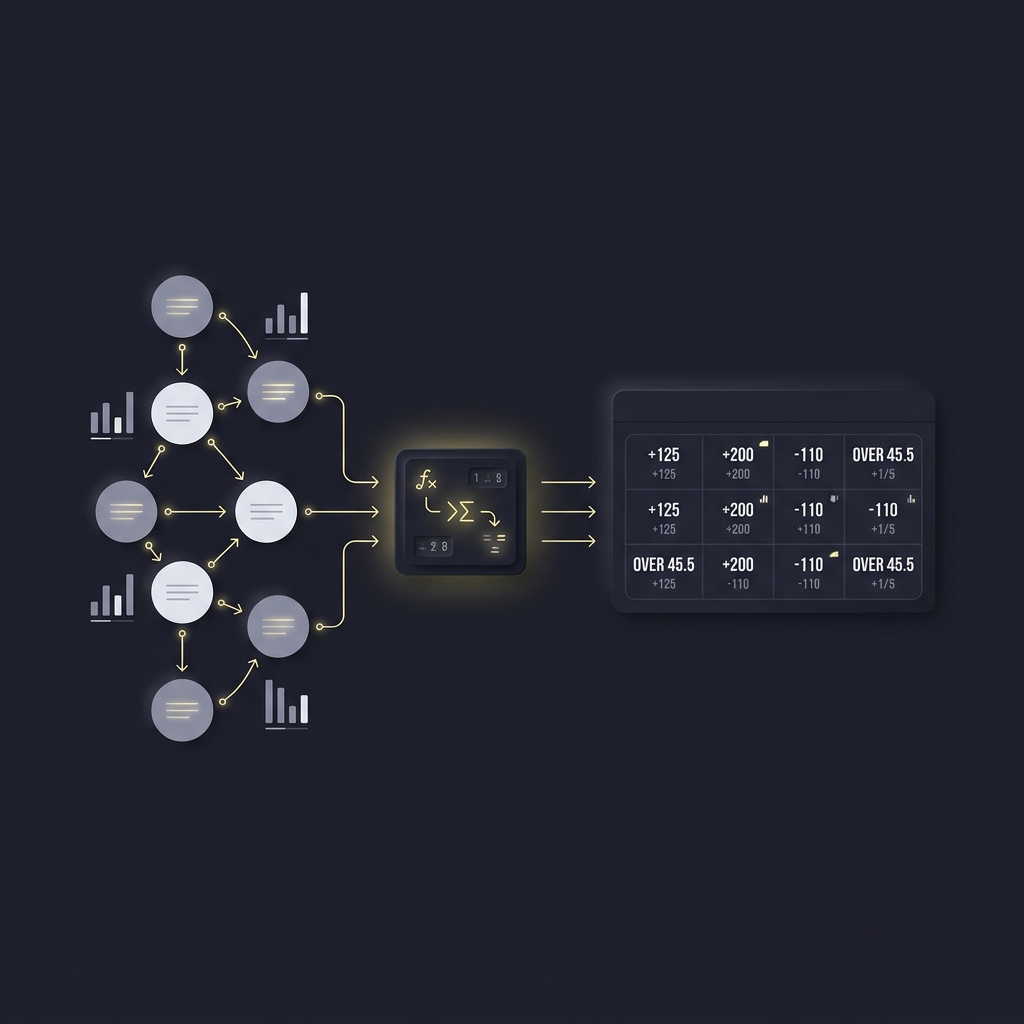
In practice the workflow is a mixture of automated model conversions and human review: models produce the first draft, vendor feeds supply standardized market data, and trading desks apply practical overrides to reflect risk appetite and anticipated wagering patterns.
How Hold and Vig Affect Breakeven and Value
Regulators and industry bodies define hold, often called win percent, as the book's net win divided by total handle, and they publish this metric at state and national levels so observers can see how margin translates into realized revenue American Gaming Association State of the States.
Treat the published odds as model probability plus an embedded margin; remove the vig to recover a fairer probability and use market and regulatory data to validate whether a posted price offers value.
Analysts commonly remove the vig from published odds to recover an estimated fair probability, then compare that fair probability to their model or market to find potential value; removing the margin increases the apparent chance for each side relative to the published numbers Investopedia explanation of vigorish and Understanding Odds and Betting Markets.
The practical result is simple: higher margins raise the breakeven win rate a bettor needs to be profitable, so measuring hold and accounting for the vig are central to any value assessment.
Why Lines Move After the Opener
Lines change for two main reasons, new public information and market action; a late injury, weather update, or confirmed starting lineup can alter the model inputs and prompt a direct adjustment to price Pinnacle's guide to what moves odds.
Market action is the other force: when respected or sharp bettors place significant wagers, trading teams often interpret that activity as a signal that their model or exposure needs updating and will move the line to rebalance liability.
Traders weigh the source of action against their own information and their book's exposure before moving a number, balancing automated model cues with manual oversight to avoid overreacting to short-term noise Kambi insights on market dynamics.
In-Play Odds: Real-Time Models and Controls
Live pricing depends on low-latency event data and automated probability models that recalculate outcome chances continuously as the game unfolds, producing rapidly changing in-play prices that reflect the current state of play live betting strategy guide and Genius Sports on real-time data feeds.
Operators often combine third-party live feeds with internal modeling to create in-play markets, and those models run at speeds that require careful integration of data quality checks and latency controls to keep prices coherent.

Human traders and risk managers oversee automated in-play systems to control exposure during volatile moments, stepping in when the model's output and the book's liability diverge or when a data feed glitch produces unrealistic odds Kambi on trading oversight.
Typical Mistakes When Interpreting Lines
A common error is not removing the vig and treating the published price as a true probability; that leads to overstating the implied expectancy of each side and misjudging value Investopedia on vigorish.
Another mistake is assuming every movement is driven by sharp bettors; many early shifts reflect public money, hedging by market makers, or low liquidity rather than an information advantage.
Finally, overreacting to small or short-lived moves can be costly because minor adjustments often reflect temporary imbalances rather than lasting changes to the expected outcome Pinnacle on interpreting moves.
Where Public Data Helps and Where It Falls Short
Official regulatory reports and industry surveys publish hold and revenue snapshots that let observers infer realized margin by sport and jurisdiction, which is useful for validating whether posted margins align with broader market results Nevada Gaming Control Board data.
Vendor feeds and public odds streams show posted prices and movement across operators, but they do not expose an operator's internal power ratings or short-term trader decisions, so public data is context rather than a complete view Genius Sports on data feeds.
Quick validation checklist for public hold and feed checks
Use reports to cross-check realized hold
Public datasets are valuable for trend analysis and for spotting anomalies, but they cannot replace access to a bookmaker's proprietary model or the live trading signals behind every decision.
Practical Example Scenarios and How to Read Them
Walkthrough: converting a power rating into published odds
Start with a power rating model that produces relative strengths for two teams, then translate those strengths into a model probability for each outcome; that probability is the conceptual 'true' chance before any margin is applied Pinnacle on model inputs.
Next, convert the model probability into a quoted price format and then apply a margin across the full market, understanding that the published odds intentionally understate the true probability in aggregate to create the operator's edge.
When you see the published number, mentally remove the vig to recover the fairer probability for comparison with your model; many analysts do this step as part of a value check.

Scenario: market action forces a line move
Imagine a situation where respected bettors place large stakes on one side after the opener; trading teams will examine whether those stakes reflect information the model missed or simply a mismatch with the book's exposure.
If the action creates an unacceptable liability, traders will move the number to encourage counter-bets and rebalance risk; that move can be corrective or protective depending on whether it aligns with new information Kambi on trader responses.
Live example: how a data-feed update affects in-play pricing
In play, an automated feed reports a turnover, injury, or scoring play, and the in-play model updates probabilities instantly, shifting lines to reflect the new game state; good feeds and models reduce latency between event and price update Genius Sports on low-latency feeds.
Traders monitor in-play volatility and step in when the model's new price conflicts with the book's exposure or when a feed anomaly creates implausible odds, temporarily suspending markets or widening prices to manage risk.
Reading these scenarios as a user, focus on whether moves are information-driven or action-driven, and use public feeds and regulatory reports to validate whether repeated patterns suggest systemic bias or normal market behavior.
The lifecycle of a line begins with power ratings and probabilistic models, then a margin is embedded to produce the published odds, and finally market activity and new information shape subsequent movement Investopedia on the role of vig.
Conclusions and Responsible Takeaways
Regulatory reporting provides an external check on realized hold and helps bettors understand how margin translates into the breakeven rates they must reach to be profitable AGA State of the States survey.
Interpreting lines responsibly means removing the vig when comparing prices, checking liquidity and venue-specific hold statistics, and treating market moves as signals that require context rather than absolute proof of mispricing.
As a practical option for practicing reading lines without real-money exposure, consider structured, challenge-based platforms that use virtual funded accounts to let you test interpretation and risk management skills in a regulated environment how our evaluations work.
The vig is the margin embedded in published odds so summed implied probabilities exceed 100 percent; removing it recovers an estimated fair probability.
Hold, or win percent, is defined as the book's net win divided by total handle and is reported by regulators and industry surveys.
No, public data and vendor feeds show posted prices and trends but do not disclose proprietary power ratings or short-term trader signals.
References
- https://www.investopedia.com/terms/v/vigorish.asp
- https://gaming.nv.gov/index.aspx?page=149
- https://www.pinnacle.com/en/betting-articles/educational/what-moves-betting-odds
- https://www.geniussports.com/sportsbooks/
- https://www.americangaming.org/resources/state-of-the-states-2025/
- https://www.kambi.com/insights/sports-betting-in-2025-and-beyond/
- https://www.fundedplays.com/challenges
- https://www.fundedplays.com
- https://www.fundedplays.com/blogs
- https://www.fundedplays.com/blogs/how-fundedplays-evaluations-work
- https://rg.org/guides/sports-betting-101/understanding-odds
- https://oddsindex.com/guides/live-betting-strategy-guide
- https://oddsmatrix.com/bookmaker-odds/