
How Set Betting Markets Work: Definition and context
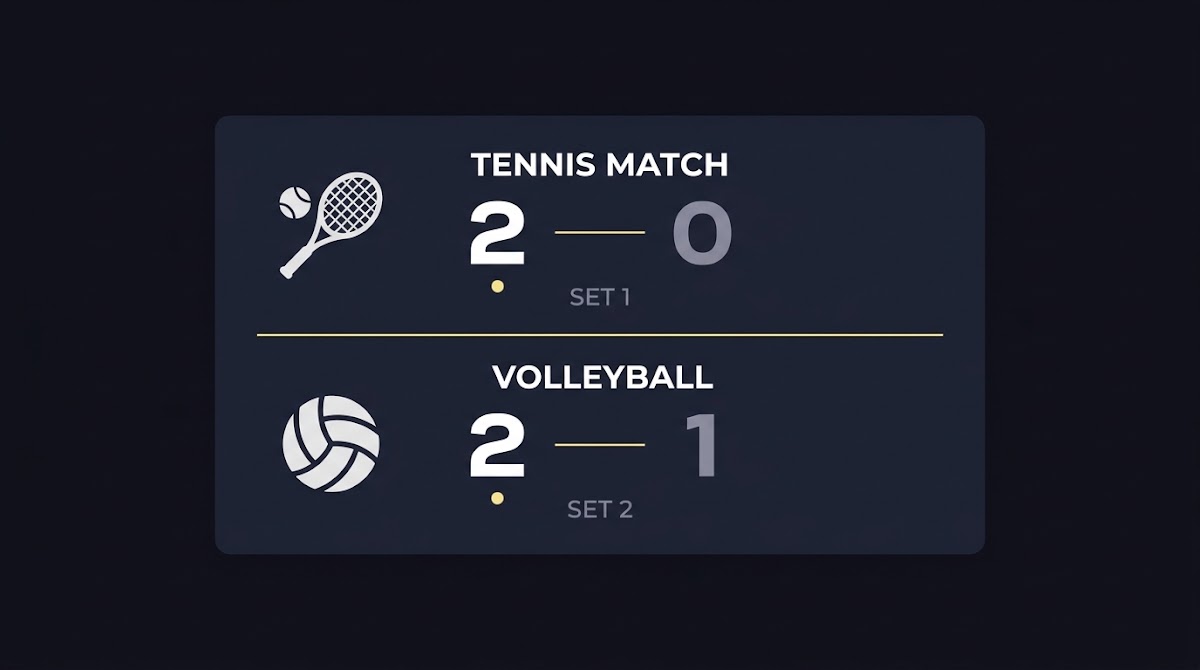
Set betting asks which player or team will win by specific set margins instead of asking only who wins the match. In plain terms, a set-betting market lists possible final set outcomes and lets you choose the one you expect to happen, so the focus is on sets rather than the overall match flow or point-by-point scoring.
This market type is most familiar in sports decided in sets, like tennis and volleyball, where matches are structured as best-of formats and each set is a distinct segment of play. The market treats a 2-0 or 2-1 outcome differently from a generic match-winner market because it separates straight-set results from longer matches that go the distance.
Compared with a match-winner market, set betting separates the final result into discrete set-score possibilities. Compared with correct-score markets, which try to pin down exact point scores or game counts, set betting compresses outcomes to the set level, reducing the total number of outcomes to a manageable list while still offering finer-grained choices than a single winner.
When you see a set-betting label, expect short codes or scoreline formats such as 2-0, 2-1, 3-1, or 3-2 that mirror the match format. The market’s clarity makes it useful for readers who want to express a view about match length and momentum rather than just the eventual winner.
Explore FundedPlays challenge options for skill-based practice
Continue to the mechanics section to see how operators list outcomes and how settlement rules work for set markets.
How Set Betting Markets Work: Core mechanics and market types
Set-betting markets usually appear in a few clear formats. The most straightforward is the final set score market, where each listed outcome is a possible final set count, for example 2-0 or 2-1 in a best-of-3 match. Set handicap markets add or subtract sets from a side to balance perceived differences between competitors. Combined markets can pair set outcomes with match-level conditions, like a player to win in straight sets and by a specified games margin.
Bookmakers or market operators typically enumerate outcomes as labeled scorelines. Each entry appears with odds and a short description, and the list covers all logical final set results given the format. For best-of-3 matches the operator will normally show 2-0 and 2-1 for each side. For best-of-5, outcomes expand to 3-0, 3-1, and 3-2 per side. This gives the market a clear, finite set of possible results that can be priced and traded.
Operators present these outcomes in compact ways so consumers can scan options quickly. Labels can use standard numeric scorelines, brief text like "Player A 2-0," or short codes that mirror the scoreboard. Traders and serious predictors often prefer scoreline labels because they map directly to match narratives and make it easy to compare a predicted set sequence to in-play developments.
Settlement rules are an essential operational detail. In general terms, a market settles based on the match’s official result as declared by the relevant competition authority; operators publish specific settlement rules such as those found in bet365's tennis rules for reference. If a match is completed under play, the final set score determines the winning outcome. If a match is abandoned or postponed and never completed, operators follow published rules that may void the market, apply a result if enough of the match was played, or use an official decision. Because these rules matter for whether a prediction stands or is voided, always check the operator’s settlement terms before recording or placing a prediction.
A short example helps make this concrete: in a best-of-3 tennis match the final set score market lists four primary outcomes across both players: Player A 2-0, Player A 2-1, Player B 2-0, Player B 2-1. Each outcome treats the path and length of the match differently even though two of those outcomes result in the same match-winner.

How Set Betting Markets Work: Pricing, odds and implied probability in set betting markets
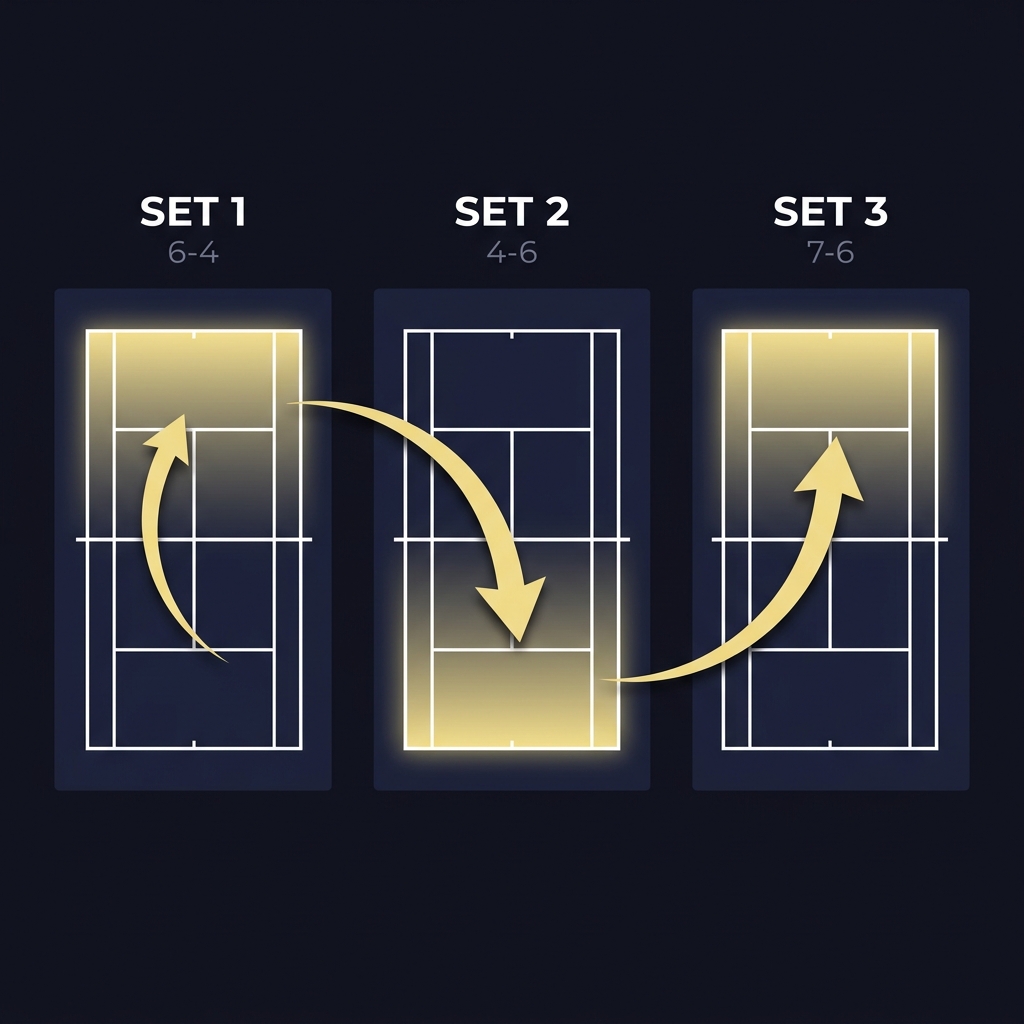
Pricing in set markets reflects the implied probability of each discrete outcome. Every listed scoreline carries a price that expresses how likely the market believes that specific sequence of sets will occur. Because a set market splits the match into multiple mutually exclusive outcomes, the implied probabilities across all listed outcomes sum to something above 100 percent due to the operator margin.
Odds appear in common formats such as decimal or fractional prices. Decimal odds show the return per unit staked, while fractional odds show the ratio of profit to stake. In practice, the choice of format does not change the relative attractiveness of an outcome; it mainly affects how you read the number on your screen. When you compare outcomes, think in terms of which outcome the market says is relatively more or less likely. See the CBS Sports tennis betting guide for further reading on odds presentation.
Set markets often show larger gaps between adjacent outcomes than simple match-winner markets. That happens because outcomes like a straight-sets win compress both form and match length into a single label. A straight-sets result can be materially more or less likely than a narrow victory, and pricing will reflect that difference with wider odds spreads than a two-way match market typically shows.
For readers learning to interpret these prices, a practical approach is to think qualitatively about how an outcome’s probability relates to match characteristics. For example, a server-dominated matchup may make a straight-sets outcome less likely to break serve, which shifts probability toward longer matches that feature tiebreaks. Conversely, a very one-sided pairing can make straight sets a clear favorite outcome in a set market.
Markets also embed operator margin, sometimes called the vigorish or overround, which means the summed implied probabilities will exceed a fair 100 percent. That margin reduces theoretical value relative to a fair book without margin, and it is one of the reasons why careful predictors compare their own view of implied probability against market prices before acting.
quick probability-check tool to compare combined implied probabilities in a multi-outcome set market
enter decimal odds for clear comparison
When reading odds, avoid fixating on the numeric format and focus on relative value. If your model or read suggests an outcome has materially higher probability than the market implies, the price may offer value. Remember that multi-outcome markets create more opportunities for value but also increase variance because you can be correct about the match winner yet wrong about the exact set sequence.
Market dynamics: liquidity, limits and settlement rules
Liquidity describes how much money is available at given prices and how easily you can back or lay an outcome. In set-betting markets, liquidity tends to be lower than major match-winner markets because the audience is narrower and the number of discrete outcomes is higher. Lower liquidity often means larger spreads between available prices and smaller maximum stake sizes at displayed odds.
Market depth affects how much you can stake at a given price. If a market is shallow, attempting a large stake can move prices against you, or the operator may refuse stakes above certain thresholds. This creates a practical limit on realizing theoretical edges found by a predictive model. If your analysis suggests value but the market cannot accommodate your stake without moving the price, the practical opportunity may be limited.
Operators set maximum stakes or limits to control exposure. These limits vary by market and by operator policies and can change as an event approaches or as money flows. When you’re evaluating an opportunity, confirm whether a listed price is available at a stake size that matters to you; otherwise, an apparent edge may not translate into a usable trade.
Settlement edge cases are another practical concern. Abandoned sets, retirements, or technical decisions such as walkovers can alter how a market settles; see DraftKings' tennis rules for one example of operator settlement guidance. Typical settlement approaches include voiding bets if the match is not completed, settling based on official results if enough of the match was played, or applying a governing body’s official decision. Because operators differ, those differences can affect whether a prediction stands or is returned to participants.
For practical discipline, always check settlement details before acting on an idea. A clear understanding of liquidity and stake limits helps you plan how to size positions and whether to use alternative markets like match-winner or total sets when the set market lacks sufficient depth.
Practical decision criteria and strategy for set betting markets
Set betting can add strategic value when you have an edge on match length or set-level dynamics. For example, if you expect a match to be longer than the market assumes, a prediction that favors extended outcomes may carry extra value. Conversely, when your read is about a dominant performance, straight-sets outcomes might be the target.
Key factors to weigh include player styles, surface characteristics, likely tiebreak frequency, and fitness levels. A matchup between two strong servers on a fast surface often increases the chance of short margins and tiebreaks, which changes the balance between straight-sets and extended outcomes. Similarly, if a player has recent match fatigue or a minor injury, that factor can tilt set-level probabilities toward shorter or longer outcomes depending on who is affected.
Compare surface and player styles, check fitness and recent form, evaluate tiebreak likelihood, and align your stake with the market's implied probability and your confidence.
In practice, incorporate set betting into a disciplined workflow: confirm the match format, check the operator’s settlement rules, assess liquidity and limits, and compare the market price against your own probability estimate. If you maintain a simple checklist, you reduce the chance of technical mistakes and ensure that trades are grounded in both a model and practical execution constraints.
When using set betting as part of a broader prediction practice, keep positions modest relative to your bankroll because multi-outcome markets carry higher variance. Use the market selectively when you have a clear, articulable reason to believe the listed outcomes are mispriced relative to your read.
Common mistakes and risk management in set betting markets
Frequent errors include confusing set and match markets, misreading settlement terms, and over-leveraging on low-probability outcomes. Another common mistake is assuming the market behaves like a two-way match market; set markets are multi-outcome and require a different mindset and sizing approach.

Bankroll management for multi-outcome bets should be conservative. Limit stake sizes, particularly on high-variance outcomes like long-comeback scenarios, and consider smaller flat stakes or fractionally reduced bets compared with match-winner selections. Track exposure by market type so you can see whether certain markets show consistent variance that needs a tailored staking approach.
Record keeping matters more than intuition. Maintain a log that captures market type, outcome selected, odds, stake, settlement result, and contextual notes about why you made the pick. Over time, separate records for set-betting markets will show whether your edge holds at the set level or whether your model is better suited to match-winner lines.
Beware small-sample fallacies. With rare outcomes, early wins or losses can mislead you about real skill. Use longer time frames and keep measured expectations about variance. If a strategy shows promise, test it with small stakes or in simulated environments before increasing exposure.
Examples and scenarios: how set betting markets play out in real matches
Scenario one, straight sets: imagine a best-of-3 match where one player dominates serve and returns with consistent pressure. In a set-betting market, the straight-sets outcome for the stronger player will typically be the market favorite and may carry the shortest odds. If the match follows that expectation, the set-score outcome resolves neatly and the market bet settles based on the official final set score.
Scenario two, comeback: consider a match where the underdog wins the first set and the favorite responds strongly to win the second set, forcing a decider. A set-betting bet on the favorite to win 2-1 would be the successful outcome in that narrative. In-play developments such as momentum swings, minor injuries, or weather interruptions affect the probability of that exact sequence and therefore change the value of set prices as the match progresses.

For practice, use scenario prompts to test your reads without financial risk on our blog. Pick a match, record your predicted set-score outcome and the market price, then follow the match to see how in-play events would have changed your decision. Repeating this exercise clarifies how much weight to give serve advantage, momentum, and fitness in your set-level reads.
When using a structured practice environment or a skill-focused challenge platform, treat results as learning opportunities rather than guaranteed signals of future earnings. Practice helps you refine probability estimates and record-keeping without exposing you to real financial risk. See how evaluations work in how evaluations work.
Conclusion: key takeaways and next steps
Set betting focuses on the final set-based outcome rather than only the match winner, giving you a way to express views about match length and momentum.
Prices in set markets reflect implied probabilities for each discrete outcome and often show larger gaps between options because they combine match winner and match length into one label.
Use disciplined decision rules, check settlement and liquidity before acting, and practice scenario exercises in a controlled environment to build consistent skill. Visit Funded Plays for related resources.
A set betting market asks for the final set-based result of a match, listing outcomes like 2-0 or 2-1 instead of only the overall winner.
Settlement depends on the operator's published rules; common approaches include voiding the market, using the official result, or applying a governing body's decision.
Consider set betting when you have an edge on match length or set dynamics, such as serve-dominated players or expected tiebreak frequency.
References
- https://help.bet365.com/s/en-us/sportsrules/tennis
- https://sportsbook.draftkings.com/help/sport-rules/tennis
- https://www.cbssports.com/betting/news/tennis/
- https://www.fundedplays.com/blogs
- https://www.fundedplays.com/blogs/how-fundedplays-evaluations-work
- https://www.fundedplays.com
- https://www.fundedplays.com/challenges