
What round totals are and why they matter
Round totals are betting markets that ask whether a fight will last more or fewer rounds than a stated number, often written as over 2.5 or under 2.5. How Round Totals Work in Combat Sports starts with that simple idea: a 2.5-round line means the book is asking if the contest will pass the halfway mark of the third round in a five-minute MMA round or the corresponding halfway point in boxing. Operators’ exact settlement language determines whether a finish at a specific second is a win, loss, or push, so small timing differences matter for the wager outcome.
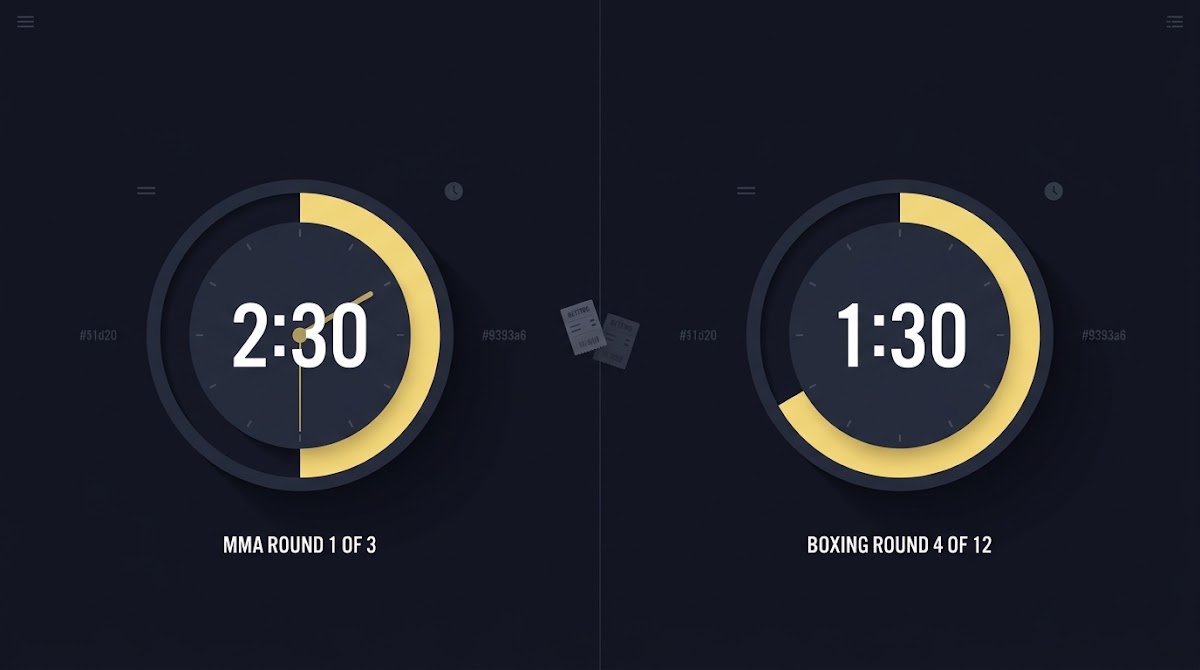
Fractional round totals are converted to exact time cutoffs defined in house rules, commonly 2:30 for MMA and 1:30 for boxing, and settlement depends on whether the fight crosses those time thresholds.
Definition of a round total, in practice, is straightforward: a half-round line uses a time threshold inside the round to convert fractional rounds into a determinable result. For example, over 2.5 means you need the fight to continue beyond the halfway mark of round three in MMA. That conversion from a fractional round to a time point is set by operator house rules and is the reason bettors must check those rules before placing a bet.
Who uses round totals and typical markets includes casual fans, prop bettors, and model-driven handicappers who want more granular ways to express a view than a simple fight winner market. Common phrasing you will see on a betting slip includes over 2.5 rounds, under 2.5 rounds, or whole-number lines such as 2.0 or 3.0. These markets are useful when you think a fight will end close to a round boundary but you need the exact settlement mechanics to know your exposure.
How half-round cutoffs are defined: MMA and boxing conventions
MMA: five-minute rounds and the 2:30 cutoff is the prevailing convention among major U.S. operators for settlement of half-round totals. In five-minute rounds most house rules treat 2:30 as the halfway mark, so over 2.5 typically requires the contest to go past 2:30 of round three to pay out. This time-threshold interpretation is consistent across multiple operator rule documents, so bettors referencing MMA half-rounds should assume the 2:30 cutoff unless the operator states otherwise. Bet365 MMA rules DraftKings sportsbook rules - MMA
Boxing: three-minute rounds and the 1:30 cutoff follow a similar logic but use a different numeric point. In boxing, the halfway mark of a three-minute round is 1:30, and totals settle based on whether the fight crosses that time marker in the stated round. Industry rule sets present the boxing settlement convention in the same format operators use for MMA, so the basic idea is consistent while the clock position differs. FanDuel sportsbook house rules DraftKings sportsbook rules - Boxing
Why these time points are used combines practical timing with consistent grading. Half-round cutoffs turn a fractional rounds line into an exact second, which makes settlement objective and auditable. While the 2:30 and 1:30 conventions are stable across major books in recent years, the specific wording and rare edge-case handling can vary, so confirming the operator text remains a best practice for bettors. Action Network over/under guide
How over/under totals actually settle in practice
Example: what over 2.5 rounds requires in MMA. If you bet over 2.5 in a standard five-minute round MMA fight, most house rules require the contest to pass 2:30 of round three before an over ticket wins. A finish at 2:31 in round three would be an over, while a finish at 2:29 would be an under, and a finish exactly at 2:30 depends on operator wording for that exact-second edge case. Use the operator’s MMA rules page to confirm how they handle finishes at the halfway second. BetMGM sports rules - MMA
Example: what under 2.5 rounds requires. Under 2.5 typically cashes if the bout ends before the halfway mark of round three in MMA; a stoppage at 2:29 would settle under, while anything past the threshold favors over. The same structure applies in boxing with the 1:30 midpoint, so under 2.5 in a boxing-style line depends on whether the fight ends before 1:30 of the relevant round. BetMGM sports rules - Boxing
Check house rules before you wager
Before placing a half-round wager, review the operator’s round-time wording so you know whether an exact-second finish could change settlement.
How whole-number totals are handled is often simpler to read. When totals are expressed as whole numbers, such as 2.0 rounds, standard house rules usually treat a finish that occurs exactly at the end of that many full rounds as a push. For example, a fight that ends at the 5:00 mark at the end of round two is commonly graded as a push on a 2.0 line and the stake is returned. The push convention keeps whole-number lines neutral when the bout finishes precisely on a round boundary. DraftKings sportsbook rules - MMA
When a fighter fails to answer the bell and other completed-round rules
Corner retirement and no-answer rulings often change how a contest is timed for settlement. If a fighter does not answer the bell for the next round, the settlement usually treats the bout as having ended at the end of the previous completed round. That means totals graded on completed rounds will reflect the last full round that finished before the no-answer call was recorded. This approach prevents ambiguous partial-round timings when a fighter withdraws between rounds. BetMGM sports rules - Boxing
Stoppage at the bell vs after the bell is another distinction to watch. A stoppage that occurs during a round is timed to the second of the event clock, while a fighter failing to leave the corner for the next round is handled as an end of the prior round. The two rulings produce different settlement results for close lines, so knowing how an operator defines the dividing line between a timed stoppage and a completed-round determination is important before you place a totals wager. DraftKings sportsbook rules - Boxing

Push rules, whole-number totals, and common settlement outcomes
What a push means for your stake is simple: when a ticket pushes the stake is returned and neither a win nor a loss is recorded for that bet. For whole-number totals most operators adopt a push if the bout ends exactly after the stated number of full rounds. That rule keeps whole-number lines from creating arbitrary winners when a contest finishes precisely on the round boundary, and it is a standard part of settlement language bettors should check on the betting slip or rules page. BetMGM sports rules - MMA
Examples with 2.0 and 3.0 totals help make this tangible. If you take 2.0 rounds and the fight ends exactly at the 5:00 mark at the end of round two, your bet is usually a push. If the contest ends at 4:59 of round three, that is treated differently because the fight extended beyond two full rounds. These outcome differences are why some bettors prefer half-round lines for clearer win-loss results and others prefer whole-number lines for a neutral push possibility.

How books communicate push rules is typically visible in the rules or the footnotes of a betting market. The betting slip often repeats the key settlement language, and reputable operators place the push rule in the sports rules or FAQ area of the help center. If the wording is unclear, capture a screenshot of the market and the rules text before the event to support any later inquiry about settlement.
Cancellations, postponements, no contests: how books usually treat totals
When totals are voided operators generally do so for cancellations, postponements, or official no contests that remove the event integrity. A common operator practice is to void bets when a bout is canceled or ruled a no contest unless the result had already been determined before the change. That means a totals wager may stand if the fight was already decided at the time of the ruling; otherwise the wager is typically voided and stakes returned. DraftKings sportsbook rules - MMA
Regulatory expectations and examples underline that jurisdiction rules can influence operator language. For instance, regulatory frameworks like those used in Nevada are consistent with voiding when event integrity is lost, and operator rules often reflect those regulatory norms. Bettors disputing a settlement can refer to both the operator’s published rules and the applicable regulatory guidance when seeking clarification. Nevada Gaming Control Board regulation William Hill house rules
What counts as result already determined is when an official outcome would not change despite a later ruling or no contest declaration. If an official stoppage time and winner were recorded before a subsequent administrative change that cannot alter the outcome, some books keep the original settlement. Because this area contains nuance and variation, the recommended bettor practice is to take a timestamped screenshot of the market and the event result if you anticipate a dispute.
Edge cases and operator-specific wording to watch for
Stoppage exactly at the halfway mark is the canonical edge case. Some operators rule that a finish precisely at 2:30 in MMA is an under, others treat it as an over, and some define it as book-specific depending on how they timestamp stoppages. Industry education pieces encourage bettors to read the house-rule phrasing because this rare scenario can flip outcomes for tightly priced tickets. Action Network over/under guide
Find the house-rule wording that controls round totals
Use before placing a half-round wager
Book-specific timekeeping language can appear under different headings such as event timing, settlement, or market rules. Some books provide explicit second-level guidance while others use broader phrases like halfway or completed round. When language is broad, contact customer service with a specific timing question and a screenshot so you have evidence of the market text at the time you wagered.
Why you must check current house rules is simple: operator wording can change, and the difference in one phrase can change a losing ticket into a winning ticket or vice versa. Checking the rules page and saving a copy of the relevant market text protects your ability to challenge a settlement that seems inconsistent with what you believed when you placed the wager.
Practical scenarios: MMA and boxing examples you can run through
Sample MMA scenarios with finishes at 2:29, 2:30, 2:31 make the concept concrete. If the house rule uses 2:30 as the halfway point, a finish at 2:29 of round three would settle under 2.5, 2:31 would settle over 2.5, and 2:30 is the operator-dependent edge where you must consult the specific book language. These three times are the most commonly discussed examples and map directly to how sportsbooks describe half-round settlement in their rule pages. DraftKings sportsbook rules - MMA
Sample boxing scenarios with finishes at 1:29, 1:30, 1:31 follow the same pattern but with the boxing midpoint. If a book uses 1:30 as the halfway point of a three-minute round, a stoppage at 1:29 is under, 1:31 is over, and 1:30 requires the operator’s rounding or exact-second rule. Run these scenarios in advance to see how each operator lists the cutoff for boxing totals and to decide whether a half-round or whole-number line fits your view.
How these scenarios change bet outcomes highlights the practical impact of seconds. A single second can flip a ticket from losing to winning, or push to loss, so bettors who trade small edges need to factor settlement wording into expected value calculations and position sizing. Confirming the operator’s rule for the precise second used to grade a stoppage reduces surprises after the event concludes.
Decision criteria: how to factor settlement rules into betting choices
When to prefer half-round lines vs whole-number lines depends on your tolerance for binary outcomes and pushes. Half-round lines remove the push possibility by converting a fractional rounds line to a timed threshold, which can be useful when you want a definitive win-or-lose result. Whole-number lines offer the safety of a push if the fight finishes exactly on a round boundary, which some bettors prefer when the expected finish is close to the bell.
How settlement quirks affect edge assessment is practical: if your model produces a small expected value edge that depends on a stoppage occurring within a one- or two-second window, operator-specific timing rules can erase that edge. Re-evaluate tight calls when the settlement hinge is a single second and favor markets where your edge is robust to small timing differences. Action Network over/under guide
Checklist for pre-bet rule verification is a short practical list: confirm round length for the sport, find the book’s halfway wording, check push rules for whole-number lines, and capture a screenshot of the betting slip and rules page. Use this checklist as a quick pre-bet routine to reduce settlement surprises and to make small disputes easier to resolve with documented evidence.
Common mistakes and how to avoid them
Misreading the betting slip is a frequent error. A bettor may assume a half-round cutoff when the operator uses different phrasing or a different rounding protocol. The fix is to read the market footnote and the sport rules page before you wager and to keep a screenshot of both the slip and the rule language.
Assuming all operators use identical wording is another common mistake. While many major U.S. operators follow the 2:30 and 1:30 conventions, edge-case wording varies. Bookmark the operator rules you use most and review them periodically to ensure no changes occurred that would affect your settlement expectations. BetMGM sports rules - MMA
Overlooking no-answer and push rules is also common. If you forget that a fighter failing to answer the bell often grades at the prior completed round, you may misjudge how a ticket will settle. Add the no-answer rule to your pre-bet checklist and note whether the operator explicitly uses end-of-round grading for corner retirements.
Quick reference cheat sheet: time cutoffs, pushes, voids
At-a-glance one-line rules to memorize: MMA half-round cutoff 2:30, boxing half-round cutoff 1:30. These simple anchors let you convert fractional rounds into a time threshold quickly when you scan a market or compare lines across operators. DraftKings sportsbook rules - MMA
One-line rules for push on whole-number totals and voiding on cancellations: whole-number totals usually push if the fight ends exactly at the full-round mark; cancellations and official no contests are commonly voided unless the outcome was already determined. Keep these one-line rules as a mental shorthand when you trade totals markets and attach evidence when disputing a settlement. Nevada Gaming Control Board regulation
Suggest keeping the cheat sheet as a screenshot or note in your phone so you can check a quick rule while events are active. The brief reminders reduce the need to hunt for rules during fast-moving event windows and help you make calm, informed choices when a ticket is at stake.
How knowing settlement rules fits into longer-term strategy
Performance tracking and dispute management benefit from consistent recording of settled outcomes. Keeping a ledger of your settled totals bets, including the operator, the settlement time, and a screenshot of the market, helps identify whether a specific rule or operator consistently affects your returns. That discipline mirrors how challenge-style platforms encourage record-keeping for accountability and improvement.
Using rules knowledge to refine models makes your edge more durable. If your model expects a cluster of stoppages near half-round marks, incorporate operator-specific settlement probabilities into your simulations so position sizing reflects the true realized variance. That approach reduces the chance of overstating an edge when settlement rules push small-probability outcomes against you.
How challenge-style platforms differ from sportsbooks is worth noting for those exploring alternatives. FundedPlays is a skill-based prediction platform and challenge-style platforms operator that emphasizes structured evaluations with virtual funded accounts and clear rules for performance. It provides a different environment from traditional sportsbooks by focusing on measuring consistent forecasting skill rather than accepting real-money wagers, and understanding settlement principles remains important regardless of venue.
Conclusion: check the rules, use examples, and keep a short checklist
Final takeaways are concise: for MMA, the commonly used half-round cutoff is 2:30; for boxing, the common cutoff is 1:30. Whole-number totals commonly push if a fight ends exactly at the full-round mark, and cancellations or no contests are usually voided unless the result was already determined. These are the functional rules you should commit to memory when trading round totals. DraftKings sportsbook rules - MMA
Where to go next: save a quick reference cheat sheet, screenshot the market and the operator rules before you bet, and keep your proof in case you need to ask for a settlement review. Regularly reviewing the house rules for the operators you use most reduces surprises and helps you apply tidy risk-management rules to small-margin totals markets. Action Network over/under guide
Over 2.5 in standard MMA means the fight must pass the halfway mark of round three, commonly 2:30, but check the operator’s house rules for exact handling of the halfway second.
If a fighter fails to answer the bell for the next round, most operators treat the bout as ending at the end of the previous completed round, so totals are graded on completed rounds.
Operators typically void totals wagers for cancellations, postponements, or official no contests unless the result was already determined at the time of the ruling.
References
- https://sportsbook.draftkings.com/help/sportsbook-rules/mma-ufc
- https://sportsbook.draftkings.com/help/sportsbook-rules/boxing
- https://www.actionnetwork.com/ufc/over-under-rounds-betting-explained
- https://help.nj.betmgm.com/en/sports-help/sports-rules/mma
- https://help.nj.betmgm.com/en/sports-help/sports-rules/boxing
- https://help.pa.bet365.com/s/en-us/sportsrules/mma
- https://www.fanduel.com/fanduel-sportsbook-house-rules-co
- https://www.fundedplays.com/challenges
- https://www.fundedplays.com
- https://www.fundedplays.com/blogs
- https://www.fundedplays.com/blogs/how-fundedplays-evaluations-work
- https://gaming.nv.gov/index.aspx?page=51
- https://williamhill.us/us/nv/support/house-rules/