
What a red card means in the Laws of the Game
Law 12: dismissal and match implications
A red card is a rule-based dismissal that reduces a team to one fewer player for the remainder of the match. Under IFAB's Laws of the Game, Law 12 defines a straight red card or a second yellow as a dismissal, and that permanence is the primary reason in-play markets change when a sending off occurs IFAB Law 12.
That permanence matters because probability models and traders treat numerical inferiority as a persistent shift in the match state, not a temporary disruption. A dismissal differs from an injury substitution because the team cannot restore the missing player, which changes expected scoring rates and therefore live prices.
Practice in structured challenges
Understand the rule first: a dismissal under Law 12 creates a lasting numerical disadvantage that markets must price, which is why immediate repricing follows.
Immediate on-field consequences
On the field, referees enforce the dismissal and the teams adapt formation and roles to cope with the loss. Coaches may choose to keep structure and sacrifice attacking ambitions or re-balance the lineup to protect vulnerable areas. Those tactical choices begin to shape the probabilistic outlook once the match restarts.
For anyone tracking live odds, the key takeaway is simple: the dismissal is the causal trigger for market moves, because it permanently alters the number of on-field players and therefore the match's expected dynamics.

How in-play exchanges react when a red card happens
Automatic suspension and repricing workflow
Major in-play exchanges typically suspend markets immediately after a red card and then re-open with adjusted prices once traders and liquidity providers have recalculated fair values. This suspension step prevents participants from transacting on stale prices while the market incorporates the new match state Betfair exchange rules (see related discussion on suspension and disciplinary incentives CEPR).
A red card causes a rule-based dismissal that creates a lasting numerical disadvantage; exchanges pause and then reprice markets to reflect changed scoring rates. Convert reopened decimal odds to implied probabilities, re-normalize to remove overround, factor minute, scoreline, and player role, and then adjust stake size conservatively.
Why odds can jump within seconds
When markets re-open, odds often jump sharply because participants simultaneously update implied probabilities and supply or demand liquidity at new levels. The size of the jump depends on how aggressively market makers and bettors change their views in that narrow window.
Exchange suspension also limits the risk of erroneous fills during a chaotic event. The temporary pause gives algorithms and traders time to reset price ladders and ensures the re-open reflects the new balance of information and risk appetite rather than transient confusion.
How a red card changes the probability of outcomes
From scoring intensity to win probability
Quantitative research consistently shows that being a player down reduces the penalized team's scoring intensity and lowers its win probability. Studies that measure event rates before and after dismissals find a measurable decline in expected goals and chances for the disadvantaged side, which is why win odds move unfavorably for the team with the red card The Red Card: Does it Matter? (see additional estimates Estimating the Effect of the Red Card).
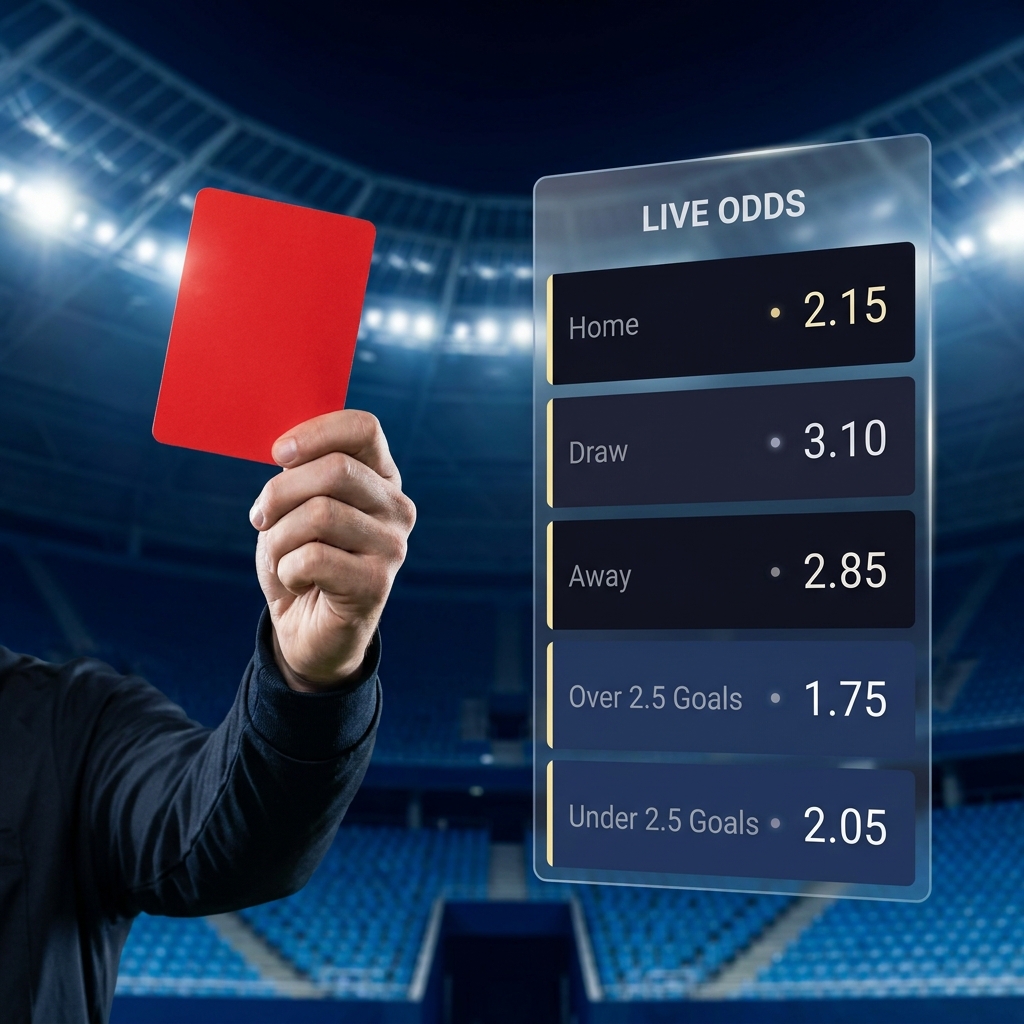
For traders and modelers, the practical implication is that pre-card probabilities are not valid after a dismissal. Models must update scoring rates and recalibrate the remaining time horizon to provide accurate post-card win probabilities.
Why early vs late dismissals differ
The timing of a dismissal matters. An early red card expands the remaining time window over which the numerical disadvantage can affect the match, producing a larger cumulative effect on outcomes. Conversely, a late dismissal compresses the period in which the disadvantaged team must compensate, reducing the aggregate impact on win probability.
That timing effect arises because scoring is a time-dependent process. When substantial match time remains, the disadvantaged team has more opportunity to concede or to attempt recovery, and the probabilistic cost of playing a man down compounds over minutes (see timing analysis Vecer 2009).
Tactical reshaping after a dismissal and how it moderates market moves
Common tactical responses
Coaches respond to a red card in predictable ways: many teams adopt a deeper defensive block, shift to a formation with fewer forwards, or make substitutions to shore up defensive structure. These adjustments change the pattern of chances and can blunt the raw numerical disadvantage.
Technical tournament reports document these patterns and note that tactical reshaping moderates how much markets adjust immediately after a sending off UEFA technical report.
Scoreline and opponent strength as moderators
The current scoreline and the opponent's relative strength change incentives. A leading team that loses a player will likely defend the lead more conservatively, while a trailing team may gamble by keeping an attacker on despite the numerical disadvantage. Those differences alter the expected post-card probabilities.
Market participants who ignore tactical context risk overestimating the pure effect of numerical inferiority. Understanding how teams typically respond under different scorelines helps interpret the scale of the odds move.
Practical method: converting decimal odds to implied probability and re-normalizing
Formula and step-by-step example
To read live odds as probabilities, convert decimal odds to implied probability using the formula implied probability equals one divided by the decimal odds. For example, decimal odds of 2.50 correspond to an implied probability of 0.40 or 40 percent Implied Probability definition.

When markets include multiple outcomes, convert each decimal price to implied probability and then re-normalize them to remove the market overround. Re-normalizing scales the implied probabilities so they sum to 100 percent, giving a consistent probability distribution for modeling.
Accounting for the overround
Step 1: convert each decimal odd to implied probability by taking one divided by the decimal number.
Step 2: sum the implied probabilities across all outcomes. Step 3: divide each implied probability by that sum to re-normalize to 100 percent. The result is a set of probabilities that reflect the market consensus without the bookmaker or exchange margin.
Market and contextual factors that change the size of the odds move
Minute of the match and remaining time
The match minute at which a dismissal occurs is a primary determinant of the magnitude of the odds move. Early dismissals usually cause larger shifts because they affect more of the remaining match, while late dismissals have a smaller aggregate effect because less time remains for scoring changes to materialize UEFA technical report.
When modeling or trading, account explicitly for remaining minutes as a multiplier on the expected change in scoring intensity.
Scoreline, player role, and liquidity
Scoreline determines incentives. A team leading by one goal that loses a player will likely accept a lower possession profile to preserve the result, while a trailing team faces pressure to attack despite being shorthanded. The dismissed player's role matters too, because losing a central defender has different tactical consequences than losing a forward.
Finally, market liquidity and depth at the moment of suspension influence how far the price moves on re-open. Thin liquidity can magnify jumps or create temporary anomalies that reverse as more volume arrives Exchange rules and market behavior.
Short case studies: typical live scenarios and expected odds responses
Early red card for underdog
Case A. Imagine an early dismissal for an underdog who had already been defending deep. The favored team gains a material advantage and its win probability often increases substantially, because the larger remaining time window allows the stronger side to exploit numerical superiority through sustained pressure.
Traders will typically widen the favorite's implied probability quickly, but the exact move depends on formation adjustments and the opponent's capacity to sit deep and absorb pressure without conceding high-quality chances.
Late red card for leader
Case B. Consider a late sending off for the team that is leading. With little time left, the trailing team gains a short window to press, but the aggregate effect on win probability is smaller. Markets often move less dramatically, though opportunities can exist if the favored side shows signs of tactical fragility.
In both cases, tactical substitutions and whether the dismissed player occupied a central or wide role will further moderate the observed odds response, so live decision making should factor those specifics into any stake adjustment.
How to adjust staking and risk after a red card
Re-calibrating implied value
After a red card, recalculate implied probabilities from the re-opened odds before placing new stakes. Use the re-normalized probabilities to judge whether the new price offers value versus your updated model of match outcomes Implied Probability definition.
Because the time horizon is shorter after a dismissal and variance typically increases, reduce stake sizes relative to normal sizing rules unless you have a clear edge supported by model recalibration.
Bankroll and volatility considerations
Practical staking adjustments include trimming position size, diversifying stakes across correlated in-play markets, or waiting for additional market depth before entering. Remember that markets may initially overreact, producing both opportunity and additional risk if liquidity is low.
Conservative players should document each post-card decision to allow later analysis and to prevent emotionally driven increases in position size during volatile periods.
Common errors and traps bettors make after a red card
Overreacting to headline odds
A common mistake is assuming the maximum possible impact from a sending off without considering minute, scoreline, or tactical response. That overreaction can lead to inflated stakes on perceived value that evaporates as context is incorporated.
Another trap is treating the first re-open price as definitive when, in low liquidity, the market may settle at a different level as more participants enter or as bookmakers adjust their books Exchange rules for in-play events.
Ignoring tactical context
Ignoring formation changes, substitution patterns, or opponent strength leads to poor forecasts. Two teams might both lose a player yet respond in opposite ways based on coaching philosophy and fatigue, so context matters as much as the numerical count.
To avoid these traps, combine the mechanical signal of a dismissal with quick checks of formation, recent substitutions, and the remaining tactical options available to each team.
Position-specific effects: how a defender vs attacker dismissal differs
Goalkeeper or central defender dismissed
Loss of a goalkeeper or central defender often forces more radical tactical responses. Goalkeeper dismissals are rare but produce outsized effects because teams may need an immediate substitution that alters the shape of the side and introduces psychological disruption.
Empirical work highlights that defensive removals change expected goals conceded more directly than forward removals, though the precise magnitude depends on how coaches reallocate defensive duties after the red card How Red Cards Change Football.
Forward or winger dismissed
When an attacker is sent off, the immediate effect can be more subtle because the team can often replace attacking intent by pushing midfielders forward. The team may retain a coherent defensive shape, reducing the short-term jump in probability against them.
Because role-specific granularity is still an active research area, treat position effects as qualitative modifiers rather than precise adjustments unless you have league-level data supporting a quantitative rule.
Data and modeling: building minute-by-minute post-card win probability
Necessary data inputs
To model post-card probabilities, you need pre-card win probability, match minute, current scoreline, player role of the dismissal, and a parameter that captures expected tactical shifts or formation change. Including expected goals rates and event-level tracking improves minute-level accuracy.
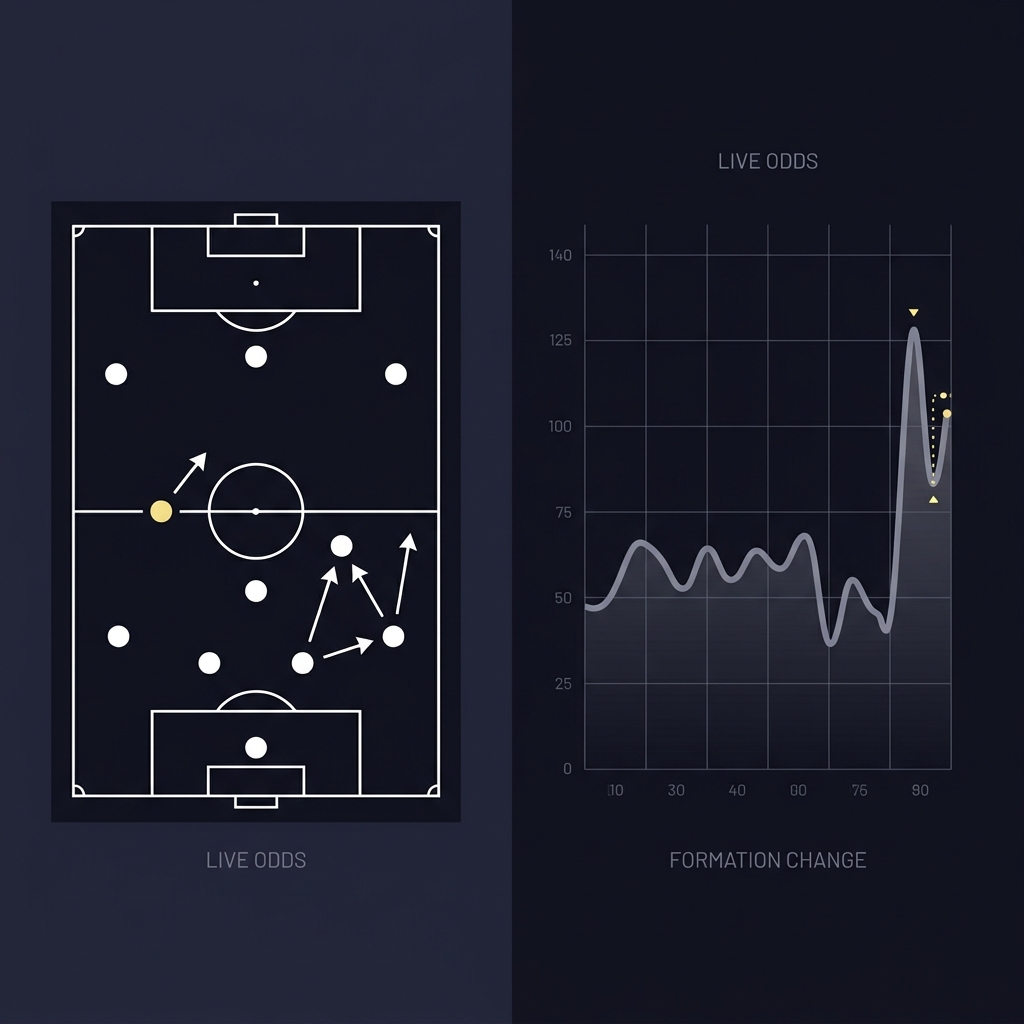
Using micro-event tracking enhances models by supplying shot quality and possession dynamics, which help distinguish a deep defensive block from an opponent-led territorial gain UEFA technical report.
Limitations and open questions
Red cards are relatively infrequent, so models risk overfitting to small samples if they attempt highly granular roles or league-specific coefficients without adequate data. Current research notes open questions about how player role and micro-event features can further refine minute-by-minute estimates.
Modelers should prioritize parsimony, validate on holdout sets, and be cautious when transferring coefficients across leagues that have different tactical norms and substitution behaviors.
Quick tools and mental checklists to use in live play
Three-step checklist
Use a short mental workflow to stay clear during the chaos: convert odds to implied probabilities, re-normalize to remove overround, and then apply contextual adjustments for minute, scoreline, and player role.
quick in-play decision checklist
Use during market pause
These steps are deliberately compact so you can run them in seconds between whistle and kick restart. If the market is thin, prioritize waiting for re-open and additional trades before committing significant stakes.
When to wait for repricing
Wait for repricing when liquidity is low or when tactical changes are obvious but not yet reflected in prices. Act sooner when you detect a consistent mispricing and the market shows sufficient depth for your intended stake size.
Develop simple heuristics by minute and scoreline so the choice to act or wait becomes a rule rather than an emotional call during live play.
Checklist before acting on a post-card price
Verify exchange suspension status
Step 1: confirm markets have re-opened. If markets remain suspended, prices are not actionable and fills may not occur. Exchanges publish pause and resume behaviors in their rules, which is why confirming status is practical risk control Exchange rules.
Step 2: recompute implied probabilities from the available decimal odds and re-normalize to clear the overround before comparing to your model's view.
Recompute implied probabilities
Step 3: check remaining time and scoreline and adjust stake sizes for the shorter horizon and often higher variance. Step 4: document the decision in a quick note to build an in-play decision log for later review.
Following this checklist reduces the chance of acting on stale prices or over-committing during volatile, low-liquidity moments.
Final summary: key takeaways and responsible in-play behavior
Top five takeaways
Red cards create a permanent numerical disadvantage defined by Law 12, and exchanges typically suspend and then reprice markets to reflect the new match state IFAB Law 12.
The magnitude of odds moves depends on minute, scoreline, dismissed player role, tactical adjustments, and market liquidity. Convert decimal odds to implied probabilities and re-normalize to judge value after the repricing Implied Probability definition.
Responsible participation reminder
In-play volatility after a dismissal can create both opportunity and risk. Use disciplined stake adjustments, document decisions, and treat post-card trades as higher variance actions that warrant conservative sizing.
Approach these moments as learning opportunities: record outcomes, analyze patterns, and refine your judgment about when a repricing represents genuine value and when it is market noise.
Most major exchanges suspend markets immediately and reopen within seconds to a few minutes depending on liquidity and the event. That pause is designed to avoid stale pricing while traders recalculate values.
Not always, but reducing stake size is generally prudent because variance increases and time horizons shorten. Only increase size if a recalibrated probability shows clear, repeatable value.
Yes. Losing a central defender or goalkeeper tends to have a larger immediate tactical and probabilistic effect than losing a wide attacker, though specifics depend on the coach's response.
References
- https://www.theifab.com/laws/latest/fouls-and-misconduct/
- https://www.betfair.com/exchange/plus/en/football/rules
- https://papers.ssrn.com/sol3/papers.cfm?abstract_id=1449071
- https://www.researchgate.net/publication/46554858_Estimating_the_Effect_of_the_Red_Card_in_Soccer_When_to_Commit_an_Offense_in_Exchange_for_Preventing_a_Goal_Opportunity
- https://cepr.org/voxeu/columns/impact-suspension-rules-fouls-football-case-study-premier-league
- https://ideas.repec.org/a/bpj/jqsprt/v5y2009i1n8.html
- https://www.uefa.com/insideuefa/technical/technical-reports/uefa-euro-2024-technical-report/
- https://www.investopedia.com/terms/i/implied-probability.asp
- https://www.fundedplays.com/challenges
- https://theanalyst.com/eu/2021/11/how-red-cards-change-football/
- https://www.fundedplays.com/blogs
- https://www.fundedplays.com/
- https://www.fundedplays.com/blogs/how-fundedplays-evaluations-work