

How Puck Lines Work: definition and the basic rule
The phrase How Puck Lines Work refers to a specific type of hockey market where a goal handicap is applied to each side, most commonly set at -1.5 for the favorite and +1.5 for the underdog. In this setup the favorite must win by two or more goals to cover the puck line, while the underdog can lose by one or win outright and still cover. This is the standard structure in NHL markets and is described in industry summaries and betting guides Investopedia puck line definition.
Puck-line markets carry odds on both sides, not just a simple handicap. That means the market shows a price for the -1.5 side and a price for the +1.5 side, and the payout depends on the posted price. Settlement rules for these markets are set by each operator and define exactly which game events count toward the result. For general settlement language and examples you can consult sportsbook help resources that explain how hockey markets are graded DraftKings help center hockey rules.
Unless a market is explicitly labeled as a period-only market, most full-game puck-line wagers are graded to include overtime and shootouts in final settlement. That means a puck-line result will often reflect the final official game result after OT or a shootout if those rules apply to the market offered FanDuel hockey rules.

How Puck Lines Work compared with moneylines and point spreads
How Puck Lines Work in contrast to a moneyline is mainly about the handicap. A moneyline prices each team to win the game straight up, while a puck line applies a goal spread that changes the outcome required to cash. If you want a quick rule of thumb: moneyline wins if the team wins any kind of finish, puck line -1.5 requires a margin of two or more goals to be a winning puck-line result. This contrast is outlined in accessible guides that compare market types for NHL betting Action Network puck line guide.
Point spreads in other sports are conceptually similar to puck lines because they both impose a handicap, but the numbers are different and pushes behave differently. In football or basketball spreads might be whole numbers or halves and can result in a push when the final margin equals a whole-number spread, depending on the market. Puck lines most commonly use a half-goal increment, which removes pushes on the standard -1.5 market but can reintroduce push risk on whole-number alternate markets if offered.
How sportsbooks settle puck lines: overtime, shootouts, and house rules
Sportsbooks publish house rules that describe how hockey wagers, including puck lines, are graded. A core point to check is whether a market is full game or period-only and whether overtime and shootout results are counted for settlement. The operator rules page is the authoritative source for how they grade final outcomes DraftKings help center hockey rules or see bet365 ice hockey rules.
Help-centers and house-rule pages often include specific clauses that clarify exceptions, such as what happens to bets if a game is postponed, abandoned, or completed under special circumstances. When in doubt, look for the settlement language or examples in the sportsbook help area to see the operator's practice for full-game puck-line markets FanDuel hockey rules.

Prompt readers to check the sportsbook settlement language specifically
Look for wording that mentions overtime or shootout
Be cautious with period-only listings. Books will often offer period-specific puck lines, such as first-period puck lines, and those are commonly settled only on play within the stated period. That labeling changes both the expected outcome and which events count, so confirming the market label is a basic step before interpreting the handicap or placing a stake.
Reading American and decimal odds for puck-line prices
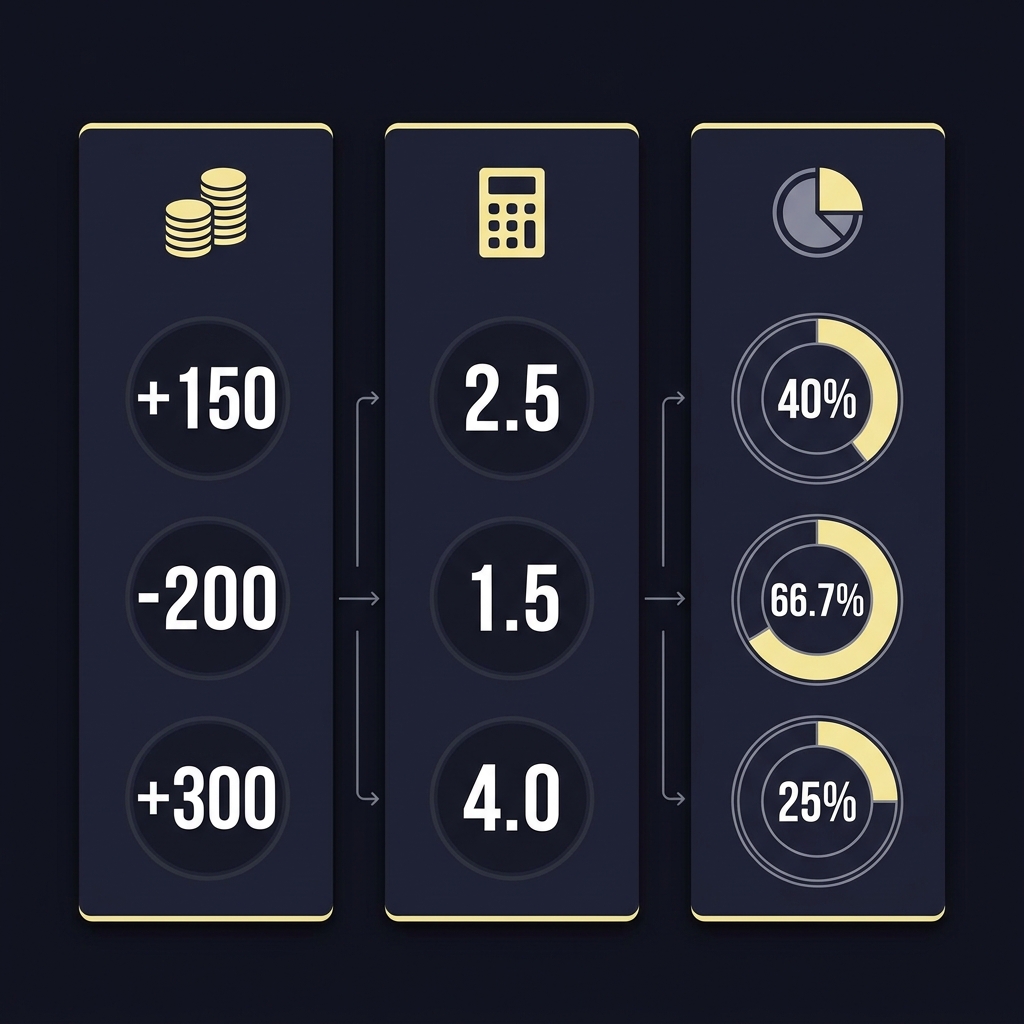
How Puck Lines Work includes understanding how odds are displayed and how to convert them. Many operators list puck-line prices in American format, for example -120 or +150 next to the -1.5 or +1.5 line. Converting those prices to decimal odds makes payout math straightforward and reduces errors when comparing markets. A standard conversion method and examples are available in odds education resources Pinnacle odds conversion guide.

To convert an American negative price to decimal, take 100 divided by the absolute value of the negative price and add 1, or use the compact formula explained by odd conversion guides. For example, -150 becomes 1 + (100 / 150) = 1.6667 in decimal form. Positive prices convert by adding 1 to the ratio of the odds over 100, so +200 becomes 1 + (200 / 100) = 3.0. Writing out the steps and checking the result with a quick handheld calculation reduces mistakes when you compute expected payouts.
Calculating implied probability and expected value for puck-line bets
You can use simple formulas to turn American odds into implied probability and then compare that to your own estimate of a result. For negative American prices use the formula absolute value divided by absolute value plus 100; for positive prices use 100 divided by the positive price plus 100. Educational resources on odds conversion explain these formulas and why they help standardize price comparisons Pinnacle odds conversion guide.
Puck lines apply a goal handicap, usually -1.5 and +1.5; full-game markets are commonly settled including overtime and shootouts unless labeled otherwise, and you should verify settlement language in the operator's house rules before wagering.
Putting implied probability into practice means asking whether your internal model gives a higher chance of a puck-line result than the market implies; if it does and your model is reliable, the wager may offer positive expected value in principle. Expected value is a conceptual comparison: it is the probability you estimate multiplied by the potential payout minus the complement multiplied by the stake. Use this comparison as a filter rather than a guarantee when choosing markets.
How payouts and stake returns are determined on puck-line bets
How Puck Lines Work in payout terms depends on the posted American odds and the stake. The standard approach is: convert the American odds to decimal, multiply the decimal odds by the stake to find the total return on a win, and remember that the stake is forfeited on a loss under normal settlement rules. Odds education materials explain the conversion step and the logic behind returning the stake on wins Pinnacle odds conversion guide.
House rules also govern settlement and stake handling. For example, operator help pages state that winning bets return the stake plus winnings and losing bets forfeit the stake; those terms are typically reiterated in hockey rules and market settlement sections. When learning how payouts work, confirm the operator's language on winning and losing settlement to avoid surprises around edge cases DraftKings help center hockey rules.
Common alternate puck lines, pushes, and margin trade-offs
Books often offer alternate puck-line prices such as -2.5 or +2.5. Moving the handicap out by an additional goal or two generally improves the price for the side that needs more margin, but it changes the variance and the probability that the bet will cash. Guides that explain puck-line mechanics and alternate lines describe this trade-off of margin for price and the situations where a bettor might prefer an alternate line Action Network puck line guide.
When a line is on a whole-number handicap, some books can return pushes if the final margin exactly matches that number, subject to their house rules. Pushed wagers are typically refunded or voided according to the operator policies listed in the help center, so confirm how pushes are handled before committing to a market FanDuel hockey rules.
Alternate markets do not remove push logic on half-goal lines because halves prevent ties, which is why -1.5 and +1.5 are common: they eliminate most pushes and force a win or loss result. Specialist sites and guides that cover alternate lines and market structure explain why books price these lines differently and how to weigh the improved price against increased margin requirements TheLines puck line page.
Practice puck-line checks with FundedPlays challenge guidance
Bookmark this checklist and return to it before you place a puck-line wager to reduce mistakes and confirm settlement rules.
Decision criteria: when to choose a puck line instead of a moneyline or totals
How Puck Lines Work matters to market selection because puck-line bets can be preferable when you expect a clear margin and want to exploit price differences. Choose a puck line when you have a reasoned estimate that a team will win by two or more goals, such as a clear mismatch in lineup, travel load, or goaltender availability noted in matchup analysis Action Network puck line guide. Learn more at Funded Plays.
Prefer the moneyline when you expect a close game or when the margin is uncertain, because the moneyline only requires a straight-up win. Totals can be the better option when the main edge you have is about scoring frequency rather than margin. A simple decision framework is: if your model predicts a two-plus goal outcome with confidence use a puck line, if it predicts a narrow finish use the moneyline, and if scoring rate is the central variable use totals.
Bankroll management and sizing for puck-line bets
Bankroll discipline reduces the chance that a losing sequence ends your ability to keep betting. Simple methods like flat stakes or a fixed percentage of bankroll keep variance manageable and reduce emotional risk. For most readers a flat-stake plan or a conservative percent-per-wager approach is a pragmatic starting point because it prevents large swings from a few losing bets.
Puck lines can have different variance than moneylines because the handicap changes the distribution of wins and losses. That means you should consider smaller stake sizes if you are moving to alternate lines with greater margin requirements or higher variance. The core principle is consistent sizing and avoiding the temptation to chase losses, which preserves your long-term ability to evaluate models and markets.
Common mistakes and traps with puck-line bets and how to avoid them
One of the most frequent errors is not checking whether a market includes overtime and shootout results. Assuming full-game settlement when a market is period-only can flip a winning outcome into a losing one. To avoid this, always read the market label and consult the operator's help pages when the label is unclear DraftKings help center hockey rules, or read Legal Sports Report.
Another common trap is confusing moneyline outcomes with puck-line results. A team can win the game but still fail to cover a -1.5 puck line if the margin is only one goal. Double-check which market you are looking at and run the scenario mentally before placing a wager to ensure you understand the cashing condition FanDuel hockey rules.
Ignoring push rules or assuming pushes behave the same across operators is also costly. Whole-number alternate lines can lead to pushes that are handled differently depending on the operator's settlement language, so confirm push handling in the help center before you size a stake that depends on a narrow set of margins Action Network puck line guide.
Practical scenarios: three step-by-step puck-line examples
Example A: Favorite covers a -1.5 line (full calculation)
Step 1, scenario: Team A is listed at -1.5 with American odds of -120 and you stake 100 units. For this example assume the market is full game and includes overtime or shootout if necessary, per typical settlement rules.
Step 2, convert the odds: Convert -120 to decimal by calculating 1 + (100 / 120) = 1.8333. That decimal is the multiplier you use to compute the total return on a winning stake Pinnacle odds conversion guide.
Step 3, compute the payout: Multiply the decimal 1.8333 by the stake 100 to obtain 183.33 units returned. The profit on the bet is 83.33 units and the stake is returned as part of the total if the puck line resolves as a win.
Example B: Underdog wins but does not cover +1.5
Step 1, scenario: Team B is +1.5 at +140 and your stake is 100 units. If Team B loses by one goal but wins in overtime or a shootout depending on the market label, the +1.5 side typically covers because the handicap gives the underdog an extra goal cushion. Confirm settlement language to be certain of those counts.
Step 2, convert the odds: Convert +140 to decimal by calculating 1 + (140 / 100) = 2.4. Multiply by the stake to find a total return of 240 units on a winning bet, meaning a profit of 140 units if the +1.5 side covers under full-game settlement Pinnacle odds conversion guide.
Example C: Alternate -2.5 line and push considerations
Step 1, scenario: A book offers an alternate -2.5 line at a more attractive price than -1.5. The extra goal margin reduces the chance of a winning result but usually improves the payout. Because -2.5 uses a half-goal increment, a push is not possible in this market format.
Step 2, check price and margin trade-off: If the -2.5 line is priced to reflect the reduced chance of a win, decide whether the improved payout compensates for the lower probability compared with -1.5. Specialist resources on alternate puck lines explain why operators price these lines the way they do and how to evaluate them relative to your model Action Network puck line guide.
Quick pre-bet checklist: what to confirm before placing a puck-line wager
How Puck Lines Work in practice starts with a short checklist you can run in under a minute. Confirm the market label to see if it is full-game or period-only and whether overtime and shootouts are included in settlement. The sportsbook help center or house rules area is the right place to verify this language DraftKings help center hockey rules.
Check the exact puck-line number and whether alternate lines or props are being shown. Verify the odds format and, if needed, convert the American price to decimal to compute quick payout estimates and implied probability. If the market uses a whole-number handicap consider the push handling in the operator rules before committing to a stake FanDuel hockey rules.
Conclusion: key takeaways and next steps
How Puck Lines Work can be summarized in a few rules: the standard puck line in NHL markets is -1.5 for favorites and +1.5 for underdogs, puck-line bets carry prices and are settled according to house rules, and full-game markets commonly include overtime and shootouts unless stated otherwise. These core points are consistent across market guides and house-rule documents Investopedia puck line definition.
Next steps are practical: practice the conversions from American to decimal odds, use implied probability to compare prices to your model, and run the quick checklist before betting. Keeping a conservative stake plan and double-checking settlement language will reduce avoidable errors and help you interpret puck-line markets cleanly. See our blog or read more about how we evaluate opportunities at how our evaluations work.
Prefer the moneyline when you expect a close game or when the margin is uncertain, because the moneyline only requires a straight-up win. Totals can be the better option when the main edge you have is about scoring frequency rather than margin. A simple decision framework is: if your model predicts a two-plus goal outcome with confidence use a puck line, if it predicts a narrow finish use the moneyline, and if scoring rate is the central variable use totals.
Generally full-game puck-line bets include overtime and shootouts unless the market is explicitly labeled as period-only; always check the operator's house rules to confirm.
If the puck-line bet loses the stake is typically forfeited, while winning bets return the stake plus winnings according to the posted price.
Pushes can occur on whole-number alternate lines if the final margin equals the handicap; standard -1.5 lines avoid pushes because the half-goal eliminates ties.