
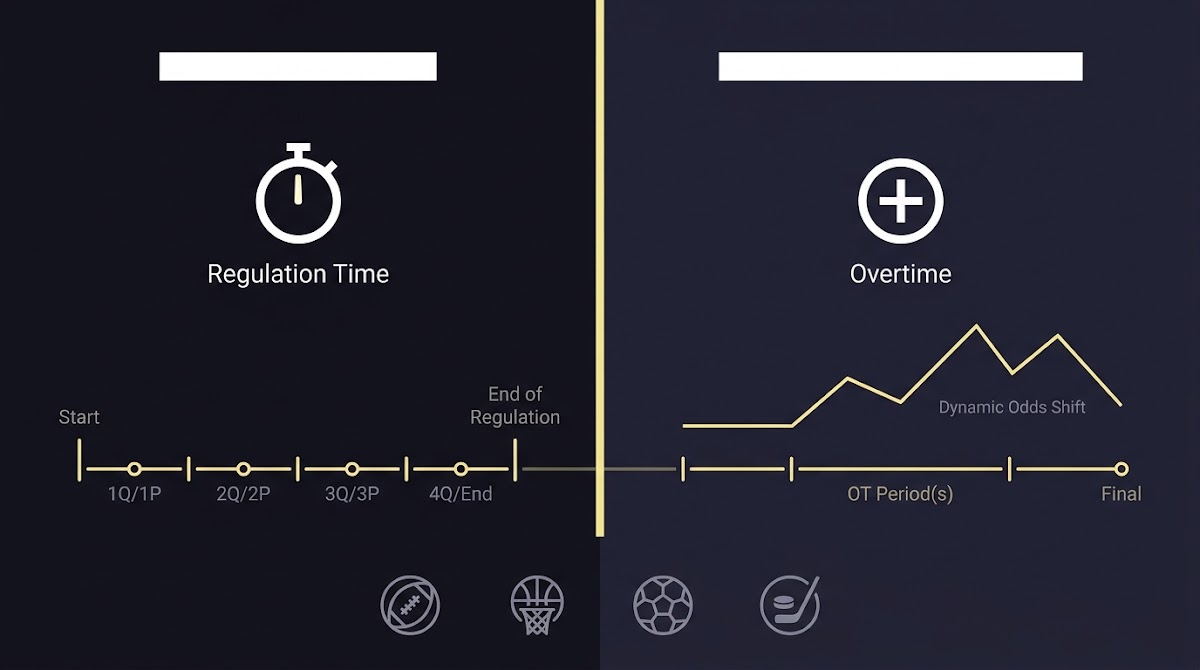
Quick definition: what it means when a moneyline includes overtime
What bookmakers typically mean by a standard moneyline, How Overtime Rules Affect Moneyline Pricing
When a bookmaker posts a standard two-way moneyline, the operator’s house rules commonly make clear whether that price settles only at the end of regulation or after any overtime, and in many cases the default is that overtime is included; that distinction determines whether a regulation tie can push a bet or whether extra-session outcomes are part of the priced event, which affects settlement and implied probability math.

A two-way moneyline typically names only two outcomes, usually a home win or an away win, and when that market includes overtime the final result is whatever the game’s official winner is after any extra time; by contrast a three-way market or an explicitly labeled regulation-only moneyline is graded at the end of regulation, meaning overtime goals or possessions are excluded from settlement.
Difference between two-way, three-way, and regulation-only markets
Two-way moneylines resolve to a winner and loser as defined by the operator’s grading rules, three-way markets add a draw option that is decided at the end of regulation, and regulation-only lines are explicitly limited to regulation outcomes so bettors and traders must reprice if they want a fair comparison between the two types of markets, because the same posted odds can represent different event sample spaces.

How major U.S. leagues handle overtime and why each format changes pricing
NFL: regular-season OT versus postseason OT and settlement implications
The NFL’s regular-season overtime is a single 10-minute period after regulation where a game can remain tied at the end of that period, while postseason overtime ensures both teams will have a possession and play until a winner is decided, and those mechanics change the way books think about regulation-only versus OT-included pricing because regular-season ties create a nonzero push risk in some markets, whereas postseason contests remove that push possibility; see the official NFL overtime rules for the specific language governing possessions and ties NFL overtime rules.
NBA: repeated five-minute OT and why moneylines always include OT
NBA games use five-minute overtime periods repeatedly until a winner emerges, so two-way moneylines effectively cover the full final-score outcome with no tie possible at settlement; that removes a separate draw probability from the model and means regulation-only pricing is less common for standard moneyline markets in basketball, as described in the league rulebook Official NBA Rulebook.
League overtime formats determine whether a market can end tied after extra time or must produce a winner, and that difference changes the event sample a moneyline prices; to compare OT-included and regulation-only markets you must verify house rules, convert and normalize implied probabilities, and estimate any regulation-draw or OT-tail before reassigning probability mass.
NHL: regular-season 3-on-3 plus shootout versus playoff sudden-death OT
In the NHL regular season a five-minute 3-on-3 overtime is followed by a shootout if needed, but playoff games use full-strength sudden-death overtime periods until a goal is scored; because the regular-season shootout introduces a skills-based tiebreaker distinct from regulation performance, books frequently list both OT-included and regulation-only lines so bettors can choose how to price shootout influence NHL official rules.
NCAA football: alternating-possession OT and the two-point rule impact
College football’s overtime gives teams alternating possessions and mandates two-point attempts from the third overtime onward, which removes ties and concentrates scoring variance into overtime sessions; that structure tends to widen the difference between regulation-only and OT-included pricing because extra possessions with forced conversion rules change the distribution of likely finishing margins NCAA football rules.
What sportsbooks’ house rules say about overtime and settlement
Typical phrasing in help centers and rule pages

Help-center and rules pages commonly state that standard moneylines include overtime unless otherwise specified, and they explain that separately marketed regulation-only or three-way lines are graded at the end of regulation, so verifying an operator’s grading language is the first step before comparing prices across markets DraftKings help center.
How regulation-only markets are defined and graded
Operators that offer regulation-only markets will usually define the explicit cut-off as the end of the fourth quarter, end of the standard playing time, or a similar phrase and will provide the settlement rule in plain language; knowing exactly which events count as regulation avoids mistaken comparisons where the posted odds represent different outcome sets and different implied probabilities for the same labeled result.
Converting odds to implied probability and adjusting for the overround
How to convert American moneyline odds to implied probability
To compare markets you need to convert American moneyline odds to implied probability: for a negative moneyline (favorite) the formula is implied probability = -moneyline / (-moneyline + 100), and for a positive moneyline (underdog) it is implied probability = 100 / (moneyline + 100); applying those formulas to both sides gives the raw probabilities before the bookmaker margin is removed, which is the groundwork for any OT adjustment Implied probability definition.
Example 1, step-by-step: suppose an NBA two-way moneyline shows -140 for Team A and +120 for Team B. Convert -140 to an implied probability of 58.33 percent using the negative formula, and +120 converts to 45.45 percent using the positive formula; those two raw probabilities sum to 103.78 percent, which is the bookmaker overround that must be normalized before making fair comparisons.
Convert American odds to implied probability and normalize for overround
Use for quick manual checks
After converting the pair of odds to raw implied probabilities you normalize by dividing each raw probability by the sum of raw probabilities so that the normalized probabilities sum to 100 percent; removing the overround lets you compare the market-implied chance of outcomes on the same basis, which is essential before you estimate any regulation-draw share or OT tail.
A simple adjustment method: estimate the regulation-draw share and reprice a market
Step-by-step approach to estimate regulation draw probability
Step 1, confirm the market grading rule with the operator and the league OT format so you know whether a regulation tie is possible and which extra-session formats apply; this is crucial because leagues with no possible regulation ties (for example, NBA repeated OT) require a different handling than leagues where ties can occur after the allotted overtime period; see the DraftKings help center and William Hill house rules DraftKings help center William Hill house rules.
Step 2, after you normalize the implied probabilities, estimate a regulation-draw or regulation-OT probability using league context and historical frequency as a heuristic; where ties are possible you treat the draw as a separate probability mass you can remove from the OT-included pair and reassign appropriately to compute a regulation-only price.
How to reallocate implied probability from a posted OT-included line to a regulation-only price
Step 3, remove the normalized overround-adjusted draw mass from the OT-included prices: if the operator’s normalized pair sums to 100 percent including a draw estimate of X percent, then the regulation-only winning probabilities for each side are the conditional probabilities given no draw, calculated by dividing each side’s normalized probability by (100 - X); that yields regulation-only implied probabilities which you can reconvert back to American odds for direct comparison with posted regulation-only lines.
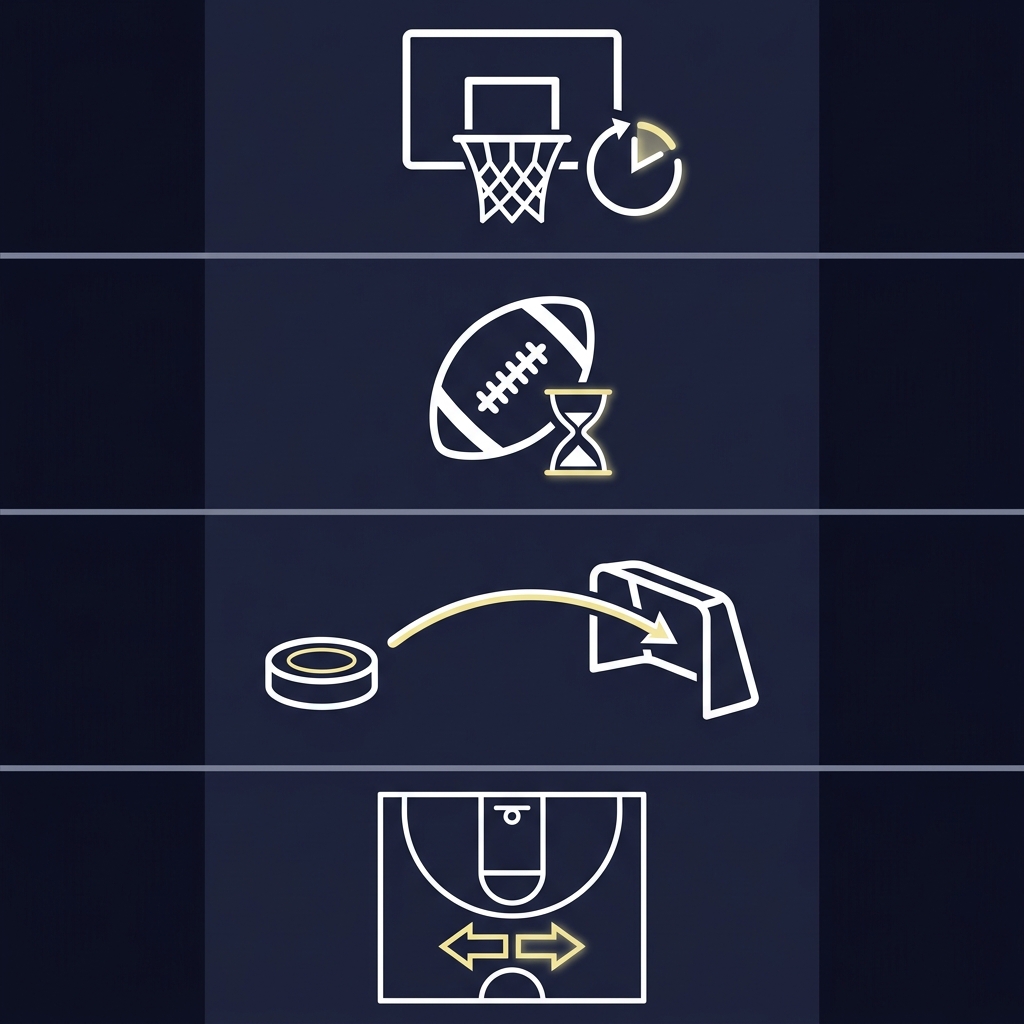
Step 4, remember to treat the draw estimate as a model input, not a fact; the heuristic should reflect whether the league’s overtime rules make ties plausible after the specified extra time, and your estimate should expand or contract depending on team styles, context, and available data for the specific competition.
League-specific worked examples: NBA, NFL, NHL, NCAA
NBA example: why OT inclusion usually has minimal effect on two-way moneylines
Because NBA overtime repeats five-minute periods until a winner is decided, the two-way moneyline is effectively a final-score market that already includes extra time with no tie possibility; in practice that means the OT-included price and any regulation-only price will differ mainly by the small probability that scoring patterns change late in regulation, but books rarely separate those markets for standard moneylines Official NBA Rulebook.
Practice the steps from a challenge-style exercise
Try the step-by-step calculation on a sample NBA game to see how small the regulation-only adjustment usually is.
NFL example: accounting for a possible tied result in regular season
In the NFL regular season a 10-minute overtime can still end in a tie, so an OT-included moneyline may understate the conditional win probabilities for each team if you compare it with a regulation-only market that ignores the tie; to compare fairly remove the overround and add back a draw estimate equal to your assessment of the probability that the game is tied after the overtime period, then condition on no draw when you compute regulation-only prices NFL overtime rules.
NHL example: when to prefer regulation-only lines because of the shootout
For regular-season hockey the shootout is an additional, skills-focused tiebreaker that can produce winners who are not necessarily the stronger team over regulation minutes, so bettors who believe shootouts are largely a lottery or favor certain skaters may prefer regulation-only lines that exclude the shootout, and books reflect that preference by publishing both types of lines in many markets NHL official rules.
NCAA example: how multi-possession OT bodies change variance and pricing
College football’s alternating-possession format with mandatory two-point tries from the third OT increases variance in final outcomes compared with single-possession extra periods, which means OT-included moneylines can show wider spreads when teams project to be evenly matched in regulation; when you reprice, allow for greater uncertainty in the OT tail than you would for a single short extra session NCAA football rules.
How to decide which market to use: practical decision criteria
When regulation-only is preferable
Choose regulation-only when the extra-session tiebreaker materially changes the expected outcome relative to regulation, for example in sports with shootouts or skills-focused penalties that do not reflect 60 minutes of play, or where you have a strong view on how extra-session format advantages one side.
When OT-included lines may offer value
Use OT-included lines when the league’s extra-session is an extension of the same play style and skillset that determined regulation, such as repeated overtime periods in basketball, or when you lack reliable information to estimate the draw or OT tail accurately and prefer the cleaner single-market exposure.
Checklist for live pre-bet comparison
Simple pre-bet checklist: verify the operator’s grading rules, convert posted odds to implied probabilities, remove the overround and normalize, estimate the regulation-draw or OT-tail given the league format, and compute the conditional regulation-only prices for direct comparison; following these steps reduces mispricing from comparing apples and oranges.
Common mistakes and pitfalls to avoid
Ignoring house rules or assuming pushes
Do not assume all moneylines are graded the same across operators; a market labeled the same at two sites can settle differently if one operator includes overtime by default and another offers regulation-only as the default, so check the help center or rules page before you act (for example, Matchbook or FanDuel) DraftKings help center.
Forgetting to normalize implied probabilities
Comparing raw posted odds without removing the overround leads to misleading probability comparisons because the bookmaker margin biases each side’s implied chance; normalizing the probabilities restores a 100 percent reference frame and makes side-by-side pricing meaningful.
Using regulation data without adjusting for OT structure
Avoid applying a regulation-draw rate or OT variance estimate from one league directly to another without accounting for differing overtime mechanics, because the presence or absence of a shootout, the number of extra possessions, and the chance of a tie all change the underlying distribution of outcomes NHL official rules.
Short conclusion and next steps for readers
Overtime rules materially change settlement and pricing in league-specific ways, and the operator’s house rules usually define whether standard moneylines include overtime; treating those two facts as the starting point prevents basic mispricing when you compare markets DraftKings help center.
Next steps: check the grading rules for the operator you use, convert odds and normalize to remove the overround, and apply the simple adjustment method outlined here to estimate regulation-only prices; these steps make market comparisons systematic and repeatable while reminding you that estimates are model inputs, not guarantees of outcome.
No. Many operators specify that standard moneylines include overtime by default, but some markets are explicitly labeled regulation-only or three-way and are graded at the end of regulation, so always check the operator rules.
Convert American odds to implied probabilities, normalize to remove the overround, estimate any regulation-draw or OT-tail, then condition the probabilities on no draw to produce regulation-only prices.
Leagues with possible regulation ties or shootouts, such as the NFL regular season and the NHL regular season, typically need an explicit adjustment; leagues with repeated OT until a winner, like the NBA, usually do not.