
What odds movement actually means: implied probability and overround - How Odds Movement Changes Expected Return
Bookmaker prices are not just payout quotes, they encode an implied probability for each outcome plus a margin known as the overround. Translating a price into an implied probability is the first step any bettor must take to understand how a price move affects expected value, and a practical guide to converting odds is available from Pinnacle's educational resources Pinnacle betting resource on converting odds.
At a conceptual level, the overround is the sum of implied probabilities across all outcomes minus 1, and that excess is the bookmaker margin that reduces bettor EV compared with a raw probability model. When you compute a perceived edge you should compare your forecast to the market implied probability after netting out overround, because the margin changes the payout the market effectively offers Pinnacle betting resource on converting odds.
Line movement is simply the market changing those quoted prices before or during an event; a move toward you increases payout and usually lowers the market implied probability, while a move away reduces payout and raises the market implied probability. Both payout and probability shift at once, so odds movement directly alters the expected value you would compute from a given forecast Pinnacle betting resource on converting odds.
Recompute the market implied probability net of overround, calculate the new EV using your forecast, update your fractional Kelly stake accordingly, and then decide to place, scale, hedge, or pass based on the recomputed EV and platform constraints.
It is important to emphasize that a price move alone does not guarantee value; it only changes the inputs to your EV calculation. To determine whether a move improved or worsened your position you must recompute the implied probability and compare it to your independent forecast Pinnacle betting resource on converting odds.
Why pregame and in-play line moves matter: timing and market efficiency
Evidence and market studies show that the closing line in liquid sports markets is typically the market's most efficient price, and that consistently achieving a better price than the close is a useful long-run performance signal. Research summarizing closing line value and market efficiency provides a foundation for treating the close as a useful benchmark when evaluating whether early or late bets offered a real edge Pinnacle guide on closing line value.
Timing involves a tradeoff: early lines can contain mispricings that attentive analysts may exploit, but early bets also face greater variance and a higher chance that subsequent information will move the market toward the eventual consensus. Near-close bets tend to have smaller visible edges but tighter uncertainty around the market probability, so they reduce information risk at the cost of fewer large mispricing opportunities Pinnacle guide on closing line value.
Analyses of market efficiency and liquidity affect how quickly prices converge. Major leagues and popular markets have faster price discovery and higher efficiency, while niche leagues or markets with sparse liquidity can show persistent mispricings. Analyses of market efficiency and liquidity highlight that price discovery speed varies across events and platforms, which is why some edges appear early and evaporate as information flows into liquid markets Harvard Sports Analysis Collective on CLV and market efficiency and an INFORMS analysis.
Practically speaking, when targeting early edges you should quantify the extra uncertainty relative to the expected improvement in price rather than assuming early numbers are always superior. A measured approach combines a forecast confidence interval with an expected CLV estimate to decide whether an early mispricing is worth the additional variance Pinnacle guide on closing line value.

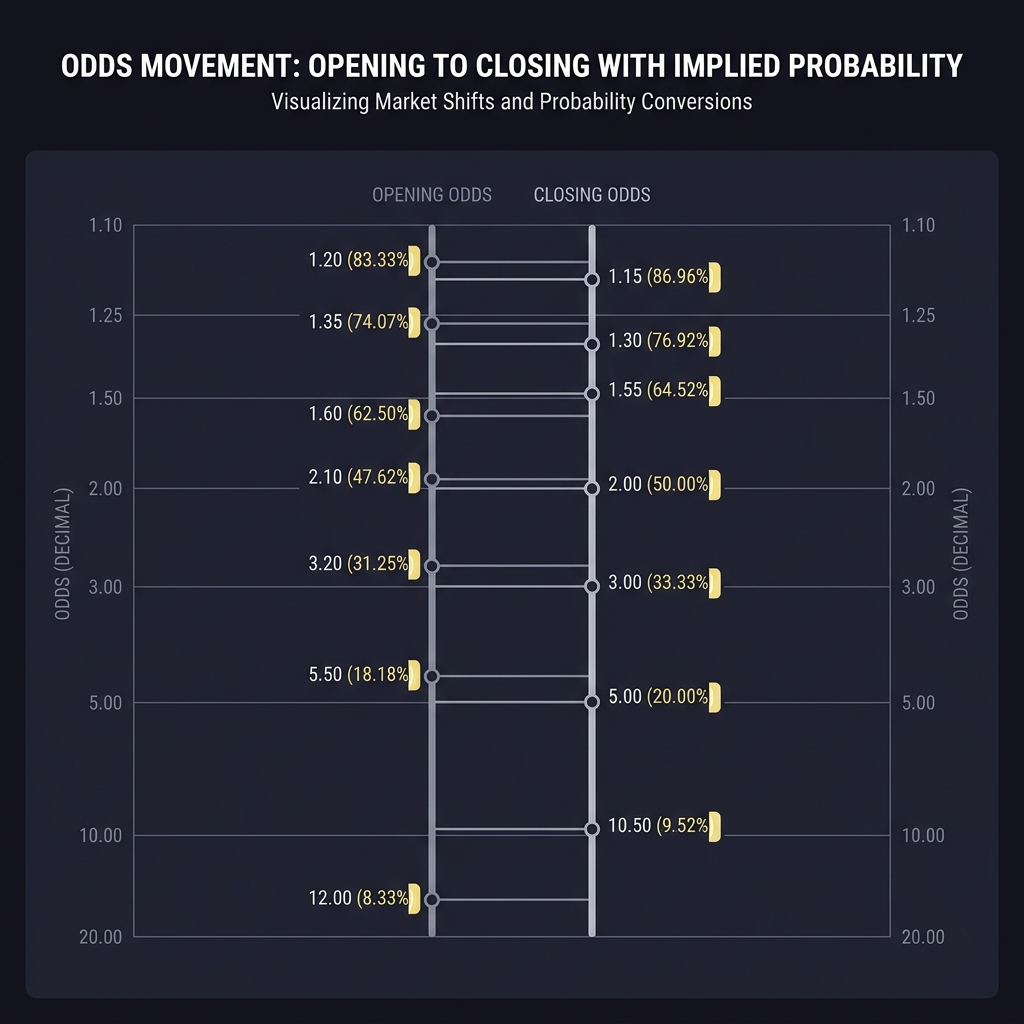
Stepwise, use these formulaic actions: convert decimal odds to implied probability as 1 / decimal_odds; if the market's total implied probability across outcomes exceeds 1, normalize each implied probability by dividing by the overround factor; compute payout per unit as decimal_odds - 1; then EV = (your forecast probability - market implied probability) * payout per unit. That workflow shows how a moved price alters both the payout term and the market probability term, so the sign and size of EV can change materially Pinnacle betting resource on converting odds.
Define a material odds move as one that changes the recomputed EV by an amount that would alter your planned stake under your sizing rules or your decision threshold. In practice, materiality depends on your bankroll, your stake rule sensitivity, and transaction limits; closers or in-play scalpers will use a smaller materiality threshold than long-term value players when deciding to act Pinnacle guide on closing line value.
Operationally, run this short checklist before placing, holding, or hedging: 1) convert the current odds to implied probability and net the overround; 2) compute EV using your independent forecast; 3) compare the recomputed EV to your stake-sizing rule and platform constraints; 4) decide to place, scale, hedge, or pass. Automating these steps in a simple spreadsheet or calculator reduces decision latency and helps enforce discipline Pinnacle betting resource on converting odds.
Get the EV Recalculation Checklist
Download a concise EV-recomputation checklist or spreadsheet to run the conversion and stake-update workflow each time prices move.
Closing line value and decision rules: when a price move should change your plan
Closing line value, measured as the difference between the price you obtained and the eventual closing market price, is linked to long-term returns in mature markets when measured consistently. Evidence suggests that strategies showing positive CLV over many bets correlate with improved performance, though CLV is a diagnostic metric rather than a guarantee of future profit Pinnacle guide on closing line value.
Use simple decision rules mapped to expected closing outcomes: if the current price is worse than your expected close and your recomputed edge falls below your trading threshold, reduce or cancel the planned stake; if the price improves relative to your forecast, consider scaling up subject to your sizing and bankroll rules. These rules convert CLV thinking into actionable choices tied to stake sizing and risk limits Harvard Sports Analysis Collective on CLV and market efficiency.
Track CLV as a performance metric in your trading log: log the price you took, the closing price, and the difference as part of a monthly review. Use the CLV series to evaluate whether your sourcing of early edges is sustainable in the markets you play, and to calibrate how aggressively you pursue early lines versus late entries Pinnacle guide on closing line value.
quick EV recomputation from current odds and forecast
How stake sizing should change as odds move: Kelly and fractional Kelly
The Kelly criterion links stake size to edge: the fractional stake is proportional to the edge, so when a price move reduces your computed edge the Kelly-optimal stake declines proportionally. The Kelly framework remains the theoretical reference for sizing when edge is known and stable Bell System Technical Journal on Kelly.
In real markets practitioners commonly apply fractional Kelly because parameter estimates are noisy and full Kelly can produce large volatility. Fractional Kelly reduces drawdown risk by scaling down the theoretical stake; the fraction selected depends on estimation confidence and the bettor's tolerance for variance Bell System Technical Journal on Kelly.
When you recompute EV after a move, update your stake by recomputing the Kelly fraction using the new edge figure and scale by your chosen fraction. If the edge approaches zero or becomes negative, the Kelly solution is to stop or reduce exposure toward zero rather than to increase risk to chase a loss; that behavior preserves long-run EV and controls drawdown risk Pinnacle guide on closing line value.
For users engaging with challenge accounts or simulated funded accounts, integrate these stake rules with the account's drawdown limits and allowed stake granularity. A brief reference to a challenge platform can help orient how stake rules map to real execution environments.

When odds move against you: hedging, reducing variance, and when to accept a smaller EV
When a moved price turns your projected edge negative, fixed-odds hedging and arbitrage frameworks show that trading some expected return to reduce variance can be a rational choice, especially for positions with high remaining time-to-resolution or where a negative edge threatens drawdown limits SSRN working paper on arbitrage and hedging and an AEA conference paper.
Evaluate a hedge by comparing the recomputed EV after hedging, the cost of the hedge including spreads or platform fees, and the residual variance. Only hedge when the expected utility of the hedged position, accounting for your risk preferences and platform constraints, exceeds the utility of holding the original stake SSRN working paper on arbitrage and hedging.
Partial hedges or reducing stake size are commonly preferred when liquidity limits or transaction costs make a full hedge infeasible. In many cases scaling down exposure to match the new, lower edge while logging the event for CLV review is a pragmatic compromise SSRN working paper on arbitrage and hedging.
Before hedging, confirm that execution costs, platform limits, or overround effects do not negate the theoretical benefit; on thin markets the apparent hedge may be expensive to implement and could lower net EV after costs are accounted for Pinnacle betting resource on converting odds.
Practical scenarios and worked formulas (no numbers): early edge, closing drift, and a hedge example

Scenario B, odds drift in your favor after you have a position: recompute the market implied probability and the payout term, then update the fractional Kelly fraction using the higher edge. Consider scaling up only to the extent your bankroll, platform limits, and drawdown rules allow, remembering that incremental scaling increases short-run variance even if it raises expected return Bell System Technical Journal on Kelly.
Scenario C, hedge example when edge turns negative: use an arbitrage-style approach to construct a partial hedge that reduces exposure to adverse outcomes. Translate the intended hedge into an effective change in payout and market probability for the combined position, compute the new EV and variance, and only execute if the hedged EV net of fees and overround remains higher in expected utility terms than holding the unhedged stake SSRN working paper on arbitrage and hedging.
Across scenarios, practical constraints such as market liquidity, exchange differences, and the bookmaker overround alter how theory maps to practice. Always check execution costs, allowed bet sizes, and platform-specific rules before implementing these formulaic updates, and log both the pre-move and post-move computations for retrospective analysis Pinnacle betting resource on converting odds.
Implementation checklist and final takeaways
Operational checklist to run before and after placing bets: 1) convert current odds to implied probability and net overround; 2) recompute EV using your forecast; 3) update fractional Kelly stake based on the new edge; 4) decide to place, scale, hedge, or pass; 5) log the price taken and eventual close to track CLV for performance review for performance review. Use CLV tracking as a diagnostic metric for long-run strategy calibration Pinnacle guide on closing line value.
Key takeaways: odds movement changes both payout and market implied probability so you must recompute EV after material moves; closing-line performance is a valuable long-run diagnostic; the Kelly framework provides the baseline for stake updates but fractional Kelly helps manage estimation risk; and hedging can be justified when a moved price turns your edge negative, provided costs and liquidity permit Bell System Technical Journal on Kelly.
Responsible participation reminder: CLV and computed positive EV are probabilistic, not guarantees. Track outcomes, manage bankroll, and use fractional sizing to limit drawdowns while you evaluate a strategy's real-world performance Harvard Sports Analysis Collective on CLV and market efficiency.
Convert decimal odds to implied probability by taking 1 divided by the decimal odds, then normalize across outcomes to remove the bookmaker overround when comparing to your forecast.
Closing line value is the difference between the price you obtained and the closing market price; tracking it over time helps diagnose whether your sourcing of early edges is sustainable.
Consider hedging when the recomputed edge turns negative and the expected utility of a hedged position, after fees and liquidity costs, exceeds holding the original stake.
References
- https://www.pinnacle.com/en/betting-resources/educational/convert-odds-to-probability
- https://www.pinnacle.com/en/betting-resources/educational/what-is-closing-line-value
- https://harvardsportsanalysis.org/2024/03/closing-line-value-market-efficiency
- https://papers.ssrn.com/sol3/papers.cfm?abstract_id=4746270
- https://onlinelibrary.wiley.com/doi/10.1002/j.1538-7305.1956.tb03809.x
- https://www.fundedplays.com/challenges
- https://www.fundedplays.com/blogs/how-fundedplays-evaluations-work
- https://www.fundedplays.com
- https://www.fundedplays.com/blogs
- https://pubsonline.informs.org/doi/10.1287/mnsc.2022.00456
- https://scholarship.claremont.edu/cgi/viewcontent.cgi?article=5145&context=cmc_theses
- https://www.aeaweb.org/conference/2010/retrieve.php?pdfid=406