
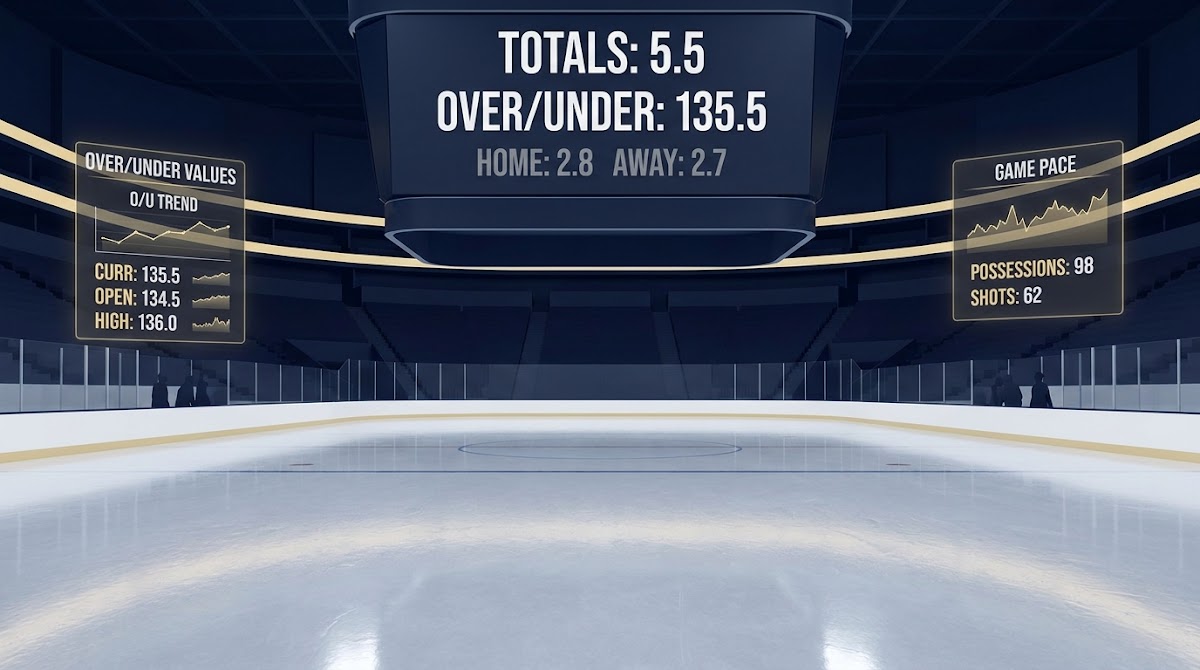
How NHL Totals Markets Work: definition and settlement rules
How NHL Totals Markets Work starts with a simple definition: a totals market, commonly called an over/under, asks whether the combined goals scored by both teams in a game will be above or below a posted number. This is the market most readers think of when tracking game scoring, and understanding how a book settles that market is the first practical step for anyone evaluating a totals price.
Most U.S. sportsbook house rules settle NHL totals on the final score including any overtime period, and many books treat the shootout outcome as one goal toward the game total when their language specifies that the final game result is used for settlement; check the specific rule language for the book you use to be sure of the exact handling DK Sportsbook house rules.
Practice prediction discipline with FundedPlays Challenges
Sign up for brief email updates or request a free pregame checklist to make settlement and starter checks routine before lock.
Why that settlement detail matters: an identical score at the end of regulation can flip an over or under if the game extends to overtime and a shootout goal is included by the house rules. The NHL’s official rules define how overtime and shootouts function and therefore why extra periods may change whether a totals wager is graded as over or under NHL Official Rules 2024-25.
Readers evaluating totals should internalize three short points: totals measure combined goals, settlement language controls whether extra time counts, and the settled final score is the contractual outcome for your bet. Keep these simple rules in mind whenever you compare posted totals across books or when a line sits near a half-goal boundary.

The NHL uses a short overtime period and, if necessary, a shootout to decide regular-season games, with procedures outlined in the league rulebook; those extra phases extend games beyond regulation and can add goals that some sportsbooks include in totals settlement NHL Official Rules 2024-25. See Action Network's guide on which bets are affected for practical betting implications.
How NHL Totals Markets Work: when overtime and shootouts affect your bet
Sportsbook house rules commonly state explicitly whether overtime and the shootout count toward totals. For example, one leading U.S. house rule set clarifies that the final game result, including overtime and the shootout where specified, is used to settle wagers on totals, and another comparable house rules page lays out similar settlement language for hockey markets FanDuel sportsbook rules. Other operators publish their help pages as well, for example bet365 help center.
Practical example: if regulation ends 2-2 and the posted total is 4.5, the settled outcome depends on your book’s rule language. If a book counts a shootout goal toward the final score, a 3-2 shootout resolution would settle as 5 total goals and therefore as an over; if the book excludes shootout goals, the settled total would be 4 and therefore an under. Verify the exact wording in the book’s rule section before assuming how a close total will be graded.
Because settlement can vary and because totals often hinge on a single goal, especially around half-goal lines, confirming settlement language before lock is a simple but high-return habit for totals-focused bettors.
How sportsbooks set NHL totals: predictive models and the bookmaker margin
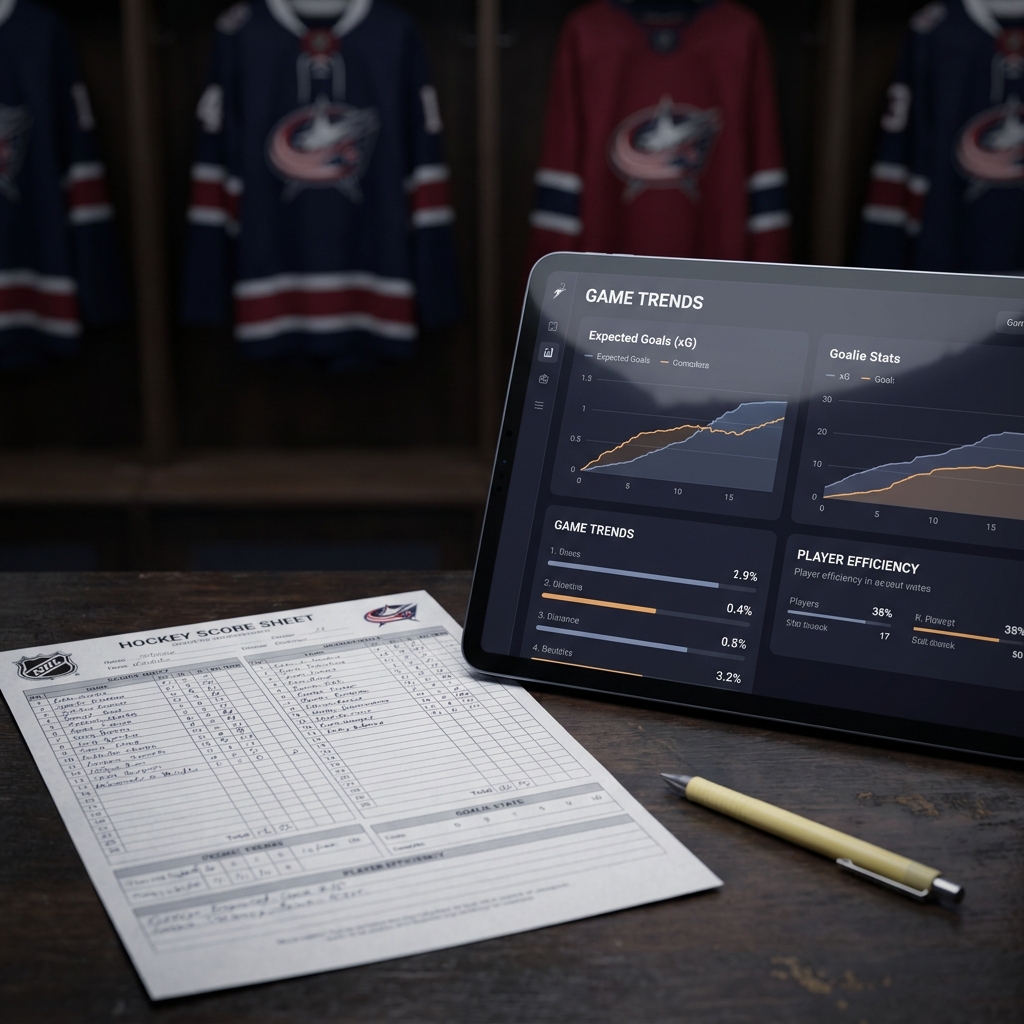
Bookmakers do not pick totals at random; they start with a model-based estimate of expected combined goals and then add a margin to ensure a profit edge, a process described in bookmaker educational materials that shows model output feeding pricing and market adjustments Pinnacle Betting Resources.
At a high level the workflow looks like this: generate an expectation using team and player inputs, translate that expectation into a raw line, test the line against market appetite and competitor prices, then add a vig or margin and post the public total. That margin means the implied probabilities derived from posted odds do not equal the pure model probability unless you remove the bookmaker’s built-in edge.
Because different books use different models, weight inputs differently, and react to market flow in distinct ways, posted totals can and do vary across operators. A small disagreement between books often reflects differences in model assumptions or the book’s exposure rather than a single objective ‘correct’ number.
Key inputs that move NHL totals: expected goals, goaltenders, pace
Modelers and informed bettors focus on a handful of measurable drivers when projecting totals. Expected goals, or xG, combines shot quantity and shot quality into a single scoring expectation that is more predictive of scoring than raw goals alone, and model methodologies explicitly incorporate these components when forecasting totals MoneyPuck model methodology.
Check the sportsbook’s settlement language first. If the book counts overtime and shootout goals toward the final score, include likely extra-time scoring in your projection; if it excludes them, base your totals decision strictly on regulation and overtime rules as written.
Goaltender selection is among the most direct single-game inputs that can alter a totals projection. Modern models account for goalie performance and confirmed starts because a late goalie change can change the expected goal total enough to move a posted line; that is why many bettors watch confirmation of the starter closely and why books will adjust lines around confirmed goalies MoneyPuck model methodology.
Pace, measured by how often possession leads to shots and how many raw attempts a team produces, and special-teams context such as power-play minutes also feed into xG-style forecasts. High-pace teams with aggressive shot profiles push projected totals higher, while a matchup featuring a lock-down defensive structure or low-volume attacking teams suppresses the expected combined goals value.
Reading prices: American odds, implied probability, and accounting for vig
American odds on totals can be converted to implied probabilities using standard formulas, and understanding that conversion is the baseline step before comparing a posted price to your own projection. The conversion method and definition are summarized in educational finance and betting resources Implied Probability: Definition, Formula, and How to Calculate.
Worked example: American odds of +120 convert to an implied probability via the usual formula, and negative odds of -150 use the inverse form; once you have implied probabilities for both sides, the sum above 100 percent represents the bookmaker margin or vig. Adjusting for that margin gives you a cleaner comparison between your model probability and the market's implied chance.
quick edge calculator for totals bets
Compare edge to vig before staking
Conceptually, to judge value you remove the market vig to estimate a fair market probability and then compare that to your model. If your model gives a significantly higher probability than the vig-adjusted market number, you might have an edge worth staking; if not, the prudent action is to pass or take a minimal position.
Practical pregame checklist for evaluating a totals bet
Before you wager, run a compact checklist to cover settlement, starters, and market checks. First, open the sportsbook rule page and confirm whether overtime and shootouts count toward the settled total; small wording differences can change the outcome of tight lines DK Sportsbook house rules. To save time, use a quick bookmark or the search feature on a book’s help pages and consider bookmarking the Funded Plays homepage for fast reference.
Second, confirm the starting goaltenders and watch for late scratches or changes; a confirmed goalie with a markedly different save-expectation profile can move a totals projection. Third, compare posted totals across books and against any xG or team-scoring projections you consult to spot outliers and potential edges.
Practical example: if regulation ends 2-2 and the posted total is 4.5, the settled outcome depends on your book’s rule language. If a book counts a shootout goal toward the final score, a 3-2 shootout resolution would settle as 5 total goals and therefore as an over; if the book excludes shootout goals, the settled total would be 4 and therefore an under. Verify the exact wording in the book’s rule section before assuming how a close total will be graded.
Fourth, if you use a quick calculator or spreadsheet, input the posted odds, remove the vig to get an adjusted market probability, and then compare to your projection to estimate edge. Fifth, if the edge is marginal, consider sizing conservatively or skipping the bet; totals lines can swing on late, small pieces of information, and quick discipline preserves bankroll.

Fourth, if you use a quick calculator or spreadsheet, input the posted odds, remove the vig to get an adjusted market probability, and then compare to your projection to estimate edge. Fifth, if the edge is marginal, consider sizing conservatively or skipping the bet; totals lines can swing on late, small pieces of information, and quick discipline preserves bankroll.
Common mistakes and pitfalls when interpreting totals
A frequent mistake is overreacting to one off-night. Single-game results are noisy; models and bookmakers rely on longer-term patterns like shot quality and volume rather than one anomalous score. Treat short samples cautiously when updating projections.
Another common error is ignoring house rules and settlement details until after the fact. When a total sits near a hook or half-goal, settlement language matters, and failing to verify it can turn what looked like a successful read into an unwelcome graded outcome.
Finally, many bettors look at raw posted odds without adjusting for the bookmaker margin. Implied probabilities directly from prices include the vig, so value judgments require removing that margin or comparing model edges that already account for it.
How line movement works after the open and signals to watch
Initial posted totals reflect a book's model and its risk position, and early market moves may come from new information or from staking patterns that change a book’s exposure. Watch for movement that coincides with clear news events, such as a confirmed goalie change, because that type of information typically reflects a true update to expected goals Pinnacle Betting Resources.
Not all movement is information-rich. Small, incremental shifts can merely reflect books trimming a margin or matching competitor pricing. Large, sudden moves or a line pulled and reposted often indicate a significant piece of information or a large incoming wager that altered the book’s exposure quickly.
Common triggers for meaningful movement include goalie news, visible roster changes, injury updates, or, for outdoor games, weather and ice conditions. When you see a move, ask whether it is driven by news you can verify, or whether it aligns with broader market flow and margin rearrangements.
Bet sizing and assessing value on NHL totals
Conservative stake sizing is appropriate for totals unless you can quantify a clear edge. A simple rule is to bet a fraction of your bankroll proportional to the estimated edge; when edge is small or uncertain, scale down and protect capital for clearer opportunities. The key is discipline and consistency rather than chasing small perceived advantages.
Scale bets up only when a confirmed goalie change or late information materially alters expected goals and when your model shows a reliable divergence from the vig-adjusted market probability. If your model edge exceeds the bookmaker margin by a meaningful amount, consider increasing stake in measured steps rather than moving to full confidence immediately.
Remember that implied probability calculations and vig adjustments are tools to quantify edge, not guarantees. Use them to size bets prudently and to avoid overexposure to variance inherent in single-game outcomes.
Examples and scenarios: reading two sample matchups
Low-scoring matchup: goalie matchup focus
Imagine two defensive teams with average pace and a posted total of 4.0. Your model, which weighs recent xG rates and goalie save-expectation splits, projects a combined goal expectation of 3.6 in regulation. If the market posts odds implying a 50 percent chance of under after vig removal but your model shows a 60 percent chance, you have a quantified edge to back the under, assuming confirmed starters match the ones used in your projection.
Key steps in this scenario: confirm both starters, check for any late changes to defensive personnel, and recompute your model with the confirmed goalie profiles. If a starter with a notably higher save-expectation enters, the projected total might drop further and strengthen the under case.
High-pace matchup: xG and shot volume focus
Consider a high-pace matchup where both teams play uptempo hockey, generate a lot of shots, and spend significant minutes on the power play. A posted total of 6.0 may reflect that environment, but your xG-based projection that adjusts for recent shot quality and special-teams rates might give a 6.5 expectation. Convert the posted odds to implied probability, remove the vig, and if the adjusted market number is lower than your projection, you may have a directional edge on the over.
In this matchup, the process is similar to the low-scoring example: verify starters, confirm special-teams availability, and compare multiple sources of projections. If the market moves in response to late injury news that reduces power-play minutes, the over case can evaporate quickly, so be ready to update the projection and stake size.
House rule differences across sportsbooks and why to check them
While most reputable U.S. books publish house rules that appear similar at a glance, small differences in phrasing can change settlement outcomes. Some books explicitly include shootout goals in their final score language, while others limit settlement to regulation plus overtime but exclude the shootout. For tight totals, this difference changes how a bet is graded FanDuel sportsbook rules. See betfair support for another example of published hockey settlement language.
To save time, use a quick bookmark or the search feature on a book’s help pages and search for the term settlement, final score, or shootout to find the relevant language. When a posted total is within a half-goal of a likely shootout outcome, double-checking the rule wording is a fast habit that reduces surprises at settlement.
Using models and tools: xG tables, goalie splits, and live adjustments
Useful model outputs for totals evaluation include team xG rates, goalie save-expectation splits by situation, and special-teams offensive rates. These metrics let you move from raw goals to an expectation based on the underlying chance of scoring from shots and situations, which is more stable than short-term goal spikes MoneyPuck model methodology.

Before lock, check confirmed starters and last-minute lineup notes and rerun your projection with those inputs. During play, in-game metrics such as real-time xG build and shot volume let you judge whether a live total adjustment is warranted, though live wagering requires rapid decision-making and a clear plan to manage additional variance.
Limits of prediction models and responsible participation
Models are estimates based on historical data and structured assumptions; they provide probabilities, not certainties. Outcomes remain subject to variance and random events, so even a well-calibrated model will lose on many individual bets despite being correct on average.
Responsible participation means treating models as decision aids, checking the house rules, sizing bets sensibly, and not assuming short-term success guarantees future gains. Keep records, review performance objectively, and adjust your approach when your process, not just outcomes, indicates drift or persistent misspecification.
Conclusion: interpreting NHL totals markets and next steps
To summarize, how NHL totals markets work comes down to three practical pillars: know how your book settles games with overtime and shootouts, understand the model drivers like xG and goaltender performance that determine the expected combined goals, and always convert prices to implied probabilities while adjusting for the bookmaker margin before assessing value Implied Probability: Definition, Formula, and How to Calculate.
Next steps for readers: build or consult a simple projection that uses xG and goalie inputs, confirm house rules and starters before lock, and compare multiple books to find the most favorable posted totals. Visit the Funded Plays blog for related posts and tools to help operationalize these steps.
It depends on the sportsbook’s house rules. Many U.S. books count the shootout as one goal toward the game total when their rules state the final result includes the shootout; always check the book’s settlement language before placing a totals wager.
xG combines shot volume and shot quality to estimate scoring more reliably than raw goals; models use xG to set expected totals and capture underlying scoring trends that single games can obscure.
Convert American odds to implied probabilities, then adjust the summed probabilities to remove the vig; compare the vig-adjusted market number to your model probability to estimate edge.
References
- https://help.draftkings.com/hc/en-us/articles/115001252284-DK-Sportsbook-House-Rules-Ice-Hockey
- https://www.nhl.com/fans/rules
- https://sportsbook.fanduel.com/sportsbook-rules
- https://www.pinnacle.com/en/betting-articles/educational/how-do-bookmakers-create-odds/JEY2CXLFZVSMB4JQ
- https://moneypuck.com/about.htm
- https://www.investopedia.com/terms/i/implied-probability.asp
- https://www.fundedplays.com/challenges
- https://www.fundedplays.com
- https://www.fundedplays.com/blogs
- https://www.fundedplays.com/blogs/how-fundedplays-evaluations-work
- https://help.pa.bet365.com/s/en-us/sportsrules/ice-hockey
- https://support.betfair.com/app/answers/detail/ice-hockey-rules/
- https://www.actionnetwork.com/nhl/nhl-betting-rules-overtimes-shootouts