
How MMA Moneyline Markets Work: Basics
A moneyline is the simplest way to price a single fight: it names the expected winner and shows the payout using American odds, where negative numbers mark the favorite and positive numbers mark the underdog. For readers new to MMA moneyline betting, think of the market as a straight win or lose choice with the listed American odds indicating how much you must stake or how much you would win on a specified wager; this definition and common presentation are standard in betting glossaries and primers Investopedia moneyline definition.
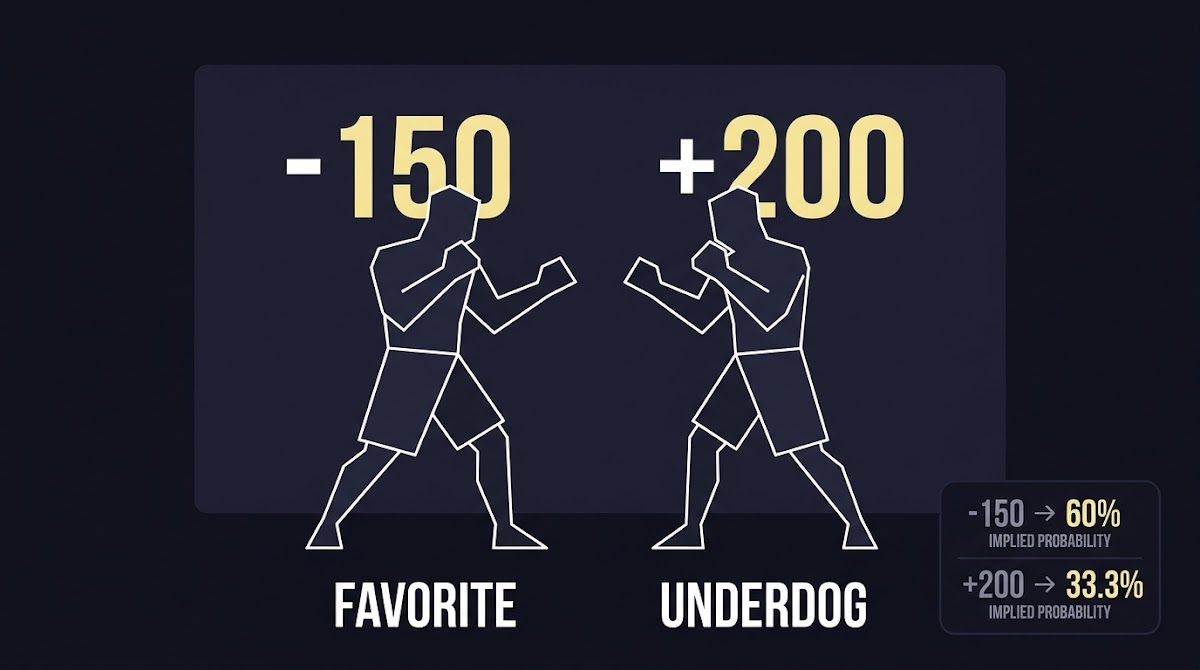
In practice, a short example helps. If a fighter is priced at -150 that indicates the fighter is the favorite and the pricing follows the negative odds convention; a fighter at +200 is the underdog and would return a larger profit on a smaller stake under the positive odds convention. Those simple examples illustrate how books express likelihood and payout without implying any particular probability beyond what the odds encode.
Most MMA matches are offered as two-way moneyline markets, resolving to one fighter winning or the other fighter winning, but some operators can offer a three-way market that includes a draw outcome and different settlement rules. That distinction matters because a three-way market changes the way prices are allocated and how implied probabilities are calculated compared to a simple two-way market, so always confirm the market type before placing a stake American Gaming Association sports betting glossary.
Try structured challenges on FundedPlays
Check the market type and settlement rules on the page you plan to use before placing or comparing moneyline prices.
What a moneyline is in MMA
For many bettors the moneyline is the go-to market for a single contest because it is direct: pick the fighter who wins the bout in regulation or by the methods the operator specifies for that market. The price does the heavy lifting; it communicates relative expectation in a numeric form that can be converted into probabilities for comparison or for building portfolios of predictions.
American odds notation and quick examples
American odds show favorites with a minus sign and underdogs with a plus sign. The minus number tells you how much you must risk to win 100 units, while the plus number tells you how much you would win on a 100 unit stake. Those are compact conventions that make cross-market comparisons possible once you convert the odds into implied probability using standard formulas in later sections.
Types of MMA Moneyline Markets: Two-way versus Three-way
Two-way moneyline markets are the default for most MMA fights and resolve to one fighter winning or the other fighter winning. In this format the book does not pay a draw outcome because most MMA governing rules produce a winner or a decision that is treated as a win for one side according to the event rules. That operational simplification keeps pricing and settlement straightforward for most events and is commonly how sportsbooks present MMA matches.
Three-way markets exist when an operator explicitly lists a draw as a third possible outcome, which changes settlement rules and how probability must be allocated. A draw in MMA is rare, but when a three-way market is offered the price set for each outcome will reflect that extra possibility and implied probabilities are split across three outcomes rather than two. Because settlement differs, it is important to read the market terms so you understand whether the book treats certain decisions or no-contest rulings as draws or as voided bets American Gaming Association sports betting glossary.
How two-way markets settle
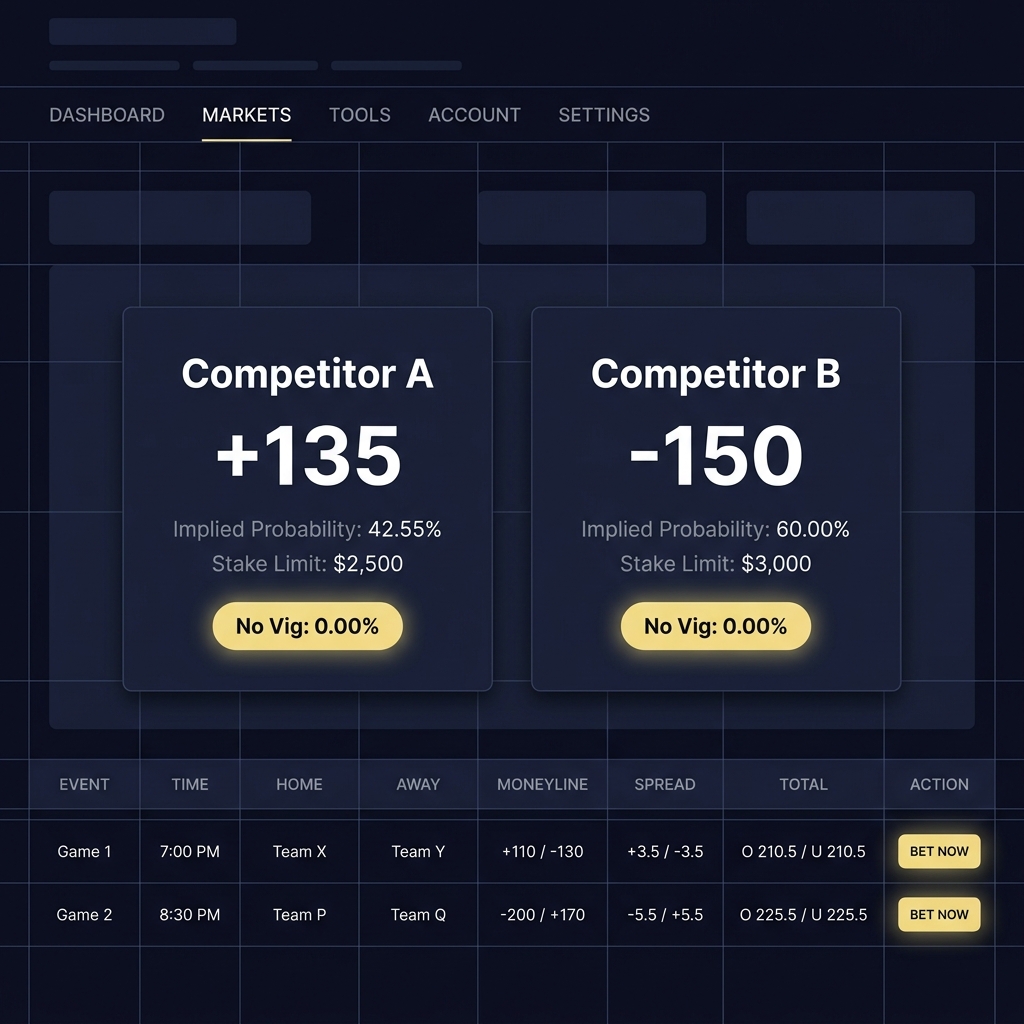
When a market is two-way, settlement is binary: the listed favorite or the listed underdog is paid according to the posted odds and all other outcomes are excluded. That means events like disqualifications, cancellations, or regulatory reversals may be handled by the operator under specific rules, which is why checking the official market terms matters before staking.
How three-way markets treat draws and pricing implications
In a three-way market, the draw price absorbs some of the implied probability that would otherwise be shared between the two fighters. That creates different value dynamics and often slightly wider prices on the favored outcomes because you are also pricing the small but non-zero chance of a draw. A three-way structure therefore changes both the numeric odds and the implied no-vig comparisons used later when you normalize prices for comparison purposes.
How to Convert Moneyline Odds to Implied Probability
Converting American moneyline odds into an implied probability is a basic skill for comparing prices across operators. For negative American odds the formula is p = (-A)/((-A) + 100). For positive American odds the formula is p = 100 / (A + 100). These are the standard conversion formulas widely used to turn American odds into the probability the market implies Covers explained implied probability.
Step-by-step, pick one price, determine if it is negative or positive, and apply the matching formula to compute the implied percentage. For clarity, if you see -150 you use the negative formula; if you see +200 you use the positive formula. The next section shows worked numerical examples to help you practice the conversion without advanced tools.

Convert each operator's American odds to implied probabilities, normalize to remove vig so probabilities sum to 100 percent, standardize stake sizes for fair comparison, and confirm settlement rules before acting.
Worked conversions force the idea home and let you verify your own calculations. After the worked examples you will also see how summed implied probabilities typically exceed 100 percent because of the bookmaker margin, which is the subject of the next H2.
Formulas for negative and positive American odds
Keep the two formulas handy and treat them like a conversion cheat sheet when scanning lines. The mechanics are simple enough to implement in a spreadsheet or a small calculator and are precise: apply the formula that matches the sign of the American odds and interpret the result as the implied chance the market assigns to that outcome.
Step-by-step conversion examples
Example one: a favorite at -150. Apply the negative formula to compute implied probability as (- -150)/((- -150) + 100) which reduces to 150 / 250, or 0.6, so the market implies about a 60 percent chance for that fighter. Example two: an underdog at +200 becomes 100 / (200 + 100) which is 100/300, or about 33.3 percent. These same steps scale to any American-odds price you encounter and are quick to perform in a spreadsheet or with the simple calculator suggested later Covers explained implied probability.
Understanding Vig and No-vig Fair Probabilities
When you convert a full set of prices for an event into implied probabilities, the sum of those probabilities often exceeds 100 percent. That excess is the bookmaker margin, commonly called the vig or the overround, and it is the mechanism sportsbooks use to ensure a positive house edge across the book; recognizing this helps you avoid treating raw implied probabilities as if they were 'fair' odds Smarkets explanation of probability and margin.
Deriving no-vig probabilities is a normalization step that removes the embedded margin so you can compare the underlying expectations across different operators. A common method divides each implied probability by the sum of implied probabilities for all outcomes so the normalized probabilities add to 100 percent. This no-vig adjustment is a comparative tool and does not change the fact that the operator retains a margin; it simply reveals the relative distribution the market implies after you remove the overround.
What the bookmaker margin is and how it shows up in implied probabilities
The margin exists because books set prices slightly on their side of true expectation to secure long-term revenue; as you sum the converted implied probabilities, the amount over 100 percent is the overround. That is the practical measure bettors use when they compare how steeply different operators price the same matchup, and it is the reason two books with identical underlying models can still quote slightly different payouts.
How to remove the vig to get no-vig probabilities
To normalize, compute each implied probability, add them, then divide each implied probability by that sum. The result is the no-vig probability for that outcome. This removes the relative effect of the margin so you can compare which book is offering better value on the same conceptual probability distribution.
How MMA Moneyline Markets Work: How Sportsbooks Set and Move Odds
Sportsbooks set opening moneyline prices using a mix of internal models, historical data, domain knowledge, and initial market-making judgment. Those models balance statistical inputs with qualitative information about fighters, injuries, weight issues and other elements that influence expected outcomes. The process of creating and adjusting lines is a standard industry approach to offer efficient markets to customers Pinnacle on how bookmakers set odds.

Once an opening line is published, the price may move as new information arrives or as betting volume generates market response. Heavy stakes on one side create pressure for a bookmaker to reprice so exposure is balanced; new public or regulatory information can also shift the underlying expected probabilities and prompt price changes. This interaction between initial models and market feedback is why lines rarely remain static in the days and hours before a fight Pinnacle on how bookmakers set odds.
Sources used by sportsbooks when setting opening lines
Operators combine data such as fighter records, method breakdowns, activity levels, and weight cut concerns with market-implied signals from other books and betting exchanges. That mix of model output and human judgment produces an opening price that represents the operator's best initial read on an event, subject to later revision.
Why lines move and how betting pressure interacts with new information
Lines move for two main reasons: informational updates and position management. When new facts arrive they change the event expectation; when a book gets unbalanced exposure due to bettor action it may move prices to manage risk. Understanding these dynamics helps you decide when a line movement is meaningful for value assessment and when it is simply a liquidity response.
Hold, Handle and Regulatory Metrics: What Reports Actually Mean
Regulators and public reports often show handle, revenue and hold for operators, and these terms have specific definitions in regulatory glossaries. Handle is the total amount wagered, revenue is the operator's gross receipts after paying winning bets, and hold is revenue divided by handle, which expresses the operator-level margin over a report period Massachusetts Gaming Commission wagering glossary.
Importantly, hold is an operator-level metric for a reporting window and is not the same as a per-market overround. A high or low hold number in a report does not directly indicate the technical vig on any single moneyline you might compare; it reflects aggregated outcomes across many markets, promotional adjustments, and book-level accounting over the reporting period.
Definitions of handle, revenue and hold
Handle equals the total stakes placed, revenue equals total stakes minus payouts to winners, and hold equals revenue divided by handle. Those definitions are standard in wagering regulatory documents and provide a consistent way to read operator reports without conflating them with per-market pricing mechanics.
Why hold at operator level differs from per-market overround
The per-market overround is calculated from the set of implied probabilities in a specific market; hold aggregates results after the event and across many markets. Because hold reflects realized outcomes and accounting adjustments, you cannot use a single operator's hold number to directly infer the vig on one specific moneyline without additional detailed data.
Practical Steps to Compare Moneylines and Reduce Vig Costs
When comparing moneylines across operators adopt a repeatable routine: convert quoted American odds to implied probabilities, compute the sum to see the overround, and normalize to no-vig probabilities for apples-to-apples comparison. Doing this in a simple spreadsheet or calculator gives you a consistent baseline for comparing the relative price each operator offers on the same theoretical outcome Smarkets explanation of margin and probability.

Convert American odds to implied probability and normalize to no-vig
Use three outcomes for two-way as duplicate of second field when needed
Standardize stake sizes when you compare books so you are measuring price differences consistently rather than mixing stakes and outcomes. Use the same nominal stake or the same proportional stake on each price, record the quoted odds, and compute expected value estimates against your own probability model. Consistent stake normalization reduces variance in your comparative sample and highlights real price differences rather than noise from different stake amounts.
Standardizing stake sizes and converting to no-vig probabilities
To compare, choose a reference stake and compute the payout each operator would offer on that stake. Combine that with no-vig probabilities to see which operator pays more relative to the normalized expectation. Recording these comparisons over time builds an empirical view of which operators tend to quote friendlier prices for the types of fights you analyze.
Checklist for comparing prices across operators
Use a short checklist: 1) confirm market settlement rules, 2) convert American odds to implied probabilities, 3) sum implied probabilities to detect overround, 4) normalize to no-vig probabilities, and 5) compare expected payout for a standardized stake. Track results and note any systematic patterns you see across operators.
Decision Criteria: How to Judge Value in MMA Moneylines
The core decision rule is simple: if your assessed probability for an outcome exceeds the market's no-vig probability by a margin that covers your required edge and variance, the price may represent value. That comparison turns your subjective or model-based estimate into a consistent, testable decision criterion for whether to take a line or pass.
Practically, many experienced predictors require a buffer between their estimate and the market no-vig price to account for estimation error. That buffer should reflect your confidence, the liquidity and volatility of the market, and how much variance you are prepared to accept in the short term.
Comparing your estimated probability to the market's no-vig price
Compute your model probability, compare it to the normalized no-vig probability, and consider the difference in light of uncertainty. If your estimate is substantially higher, the line may be worth taking; if it is close or below the normalized market probability, patience or passing is often the better option.
When to take a line and when to pass
Rules of thumb help avoid overtrading. Require a non-trivial margin for action, avoid taking incremental bets based on small line moves without new information, and stay disciplined with stake sizing so one judgment error does not overly affect your results.
Common Mistakes When Using Moneyline Markets
A frequent error is ignoring whether the market is two-way or three-way and assuming settlement rules are identical across operators. That can lead to surprise outcomes when a draw or no-contest is treated differently than you expected. Always confirm settlement rules before staking to avoid this mistake American Gaming Association sports betting glossary.
Another common mistake is using operator-level hold reports to judge a single market's vig. Because hold is an aggregate business metric, it does not say what the overround was on any specific moneyline, so inferencing a single-market margin from operator hold is unreliable for price comparison purposes Massachusetts Gaming Commission glossary.
Ignoring vig and settlement rules
Not accounting for vig can make two superficially different prices look similar when one actually offers better no-vig value. Make the normalization step part of your routine to avoid being misled by raw odds alone.
Overreacting to small line moves
Small moves often reflect liquidity management or modest new information and may not represent a change significant enough to alter your probability estimate. Reassess your model and the context before chasing marginal price movement.
Examples and Scenarios: Converting, Adjusting and Comparing Lines
Worked example one: Two-way fight with prices -150 and +130. Convert -150 to implied probability using the negative formula: 150 / (150 + 100) gives 60 percent. Convert +130 using the positive formula: 100 / (130 + 100) gives about 43.5 percent. Sum is 103.5 percent, so the overround is 3.5 percent; normalize by dividing each implied probability by 1.035 to get no-vig probabilities for fair comparison. The mechanics follow the standard conversion and normalization approach described earlier Covers explained implied probability.
Worked example two: A three-way market priced at -140, +120 and +900 for a draw. Convert each into implied probabilities, sum them, and then divide each probability by the total to get no-vig probabilities that sum to 100 percent. The draw outcome noticeably changes the allocation compared to a two-way market and often reduces the no-vig probability assigned to the favorite relative to a two-way structure.
Derived comparison across two hypothetical operators
Operator A quotes -150 for the favorite and +130 for the underdog; Operator B quotes -160 and +140. Convert all prices to no-vig and compare which operator gives the higher normalized payout against your assessed probability. The winner of that comparison is the operator offering better relative value for that specific matchup and stake normalization.
Highlighting settlement differences
If one operator uses a three-way market and the other uses a two-way market, adjust your conversion so you compare the same conceptual set of outcomes. Settlement type can materially change which operator appears to offer value after normalization.
Bankroll Management and Stake Sizing with Moneylines
Consistent stake sizing is a practical control when you are comparing prices because it ensures your comparisons measure price, not stake. Use a fixed nominal stake for comparisons or a fixed percentage of a reference bankroll when moving from analysis to active selection. This is general guidance about disciplined comparison and not financial advice, and outcomes depend on your own decisions and adherence to rules.
For analysis tasks, using small, uniform stakes lets you test which operators reliably quote better no-vig payouts without exposing large portions of your bankroll to early variance. Track results and adjust only after sufficient samples indicate a persistent edge in quoted prices.
Simple stake-sizing approaches for disciplined comparison
Choose one of two approaches: fixed nominal stakes for each comparison or a modest percentage of a reference bankroll to scale stakes with account size. Both methods keep your price comparisons consistent and easier to evaluate over time.
Why consistent stakes matter when comparing prices
Different stakes produce different payout amounts and can obscure whether an operator's price is better. Consistency reduces that noise so you can focus on true price differences and their effect on long-term results.
How Settlement Rules Affect Payouts and Strategies
Settlement edge cases include no-contest rulings, regulatory overturns, and differences in how split decisions or technical decisions are treated by the operator. These conditions can change whether a bet wins, loses, or is voided, so confirm the operator's stated settlement rules for the specific market you are using American Gaming Association sports betting glossary.
Before placing moneyline wagers, run a short checklist: verify two-way versus three-way, check the operator's rules for no-contest or late replacement fighters, and confirm how promotions, prop bets or special markets are resolved. This quick pre-stake review prevents many common surprises.
Examples of settlement edge cases
Typical edge cases are late scratches where a fight is canceled or rebooked, results overturned after the event by athletic commissions, and alternate methods of resolving decisions in exhibition or special rule matches. Each of these can be handled differently by operators, so it pays to read the market rules before betting.
Checklist to confirm settlement before staking
Confirm the market type, read the settlement rules, and note any event-specific clauses such as weight-issue settlements or rules for exhibition matches. If the operator's language is unclear, use customer support channels for clarification before staking.
Conclusion: What Readers Should Take Away
Moneylines are a straightforward way to express who a bookmaker expects to win a fight, but to compare prices effectively you must convert American odds into implied probabilities and normalize them to remove the bookmaker margin. Understanding and adjusting for vig helps reveal which operators offer relatively better value for the outcomes you expect Investopedia moneyline definition.
Make a habit of confirming settlement rules, standardizing stake sizes for comparisons, and tracking the results of your price checks. That disciplined routine is the practical next step for anyone who wants to compare MMA moneyline prices responsibly and consistently.
A moneyline is a straight win market priced in American odds where negative numbers mark favorites and positive numbers mark underdogs.
Use the standard formulas: for negative odds p = (-A)/((-A)+100); for positive odds p = 100/(A+100).
The vig, or overround, is the excess above 100 percent when you sum implied probabilities; removing it yields no-vig probabilities for apples-to-apples comparisons.
References
- https://www.investopedia.com/terms/m/moneyline-bet.asp
- https://www.americang.org/resource/sports-betting-glossary/
- https://www.covers.com/betting/what-is-implied-probability
- https://help.smarkets.com/hc/en-gb/articles/360000916137-Betting-odds-explained-probability-and-margin
- https://www.pinnacle.com/en/betting-resources/educational/how-do-bookmakers-set-odds
- https://www.fundedplays.com/challenges
- https://massgaming.com/wp-content/uploads/2023/03/Sports-Wagering-Report-Glossary.pdf
- https://oddsjam.com/betting-calculators/implied-probability
- https://therundown.io/betting-calculators/implied-probability-calculator
- https://www.omnicalculator.com/statistics/implied-probability
- https://www.fundedplays.com
- https://www.fundedplays.com/blogs
- https://www.fundedplays.com/blogs/how-fundedplays-evaluations-work