
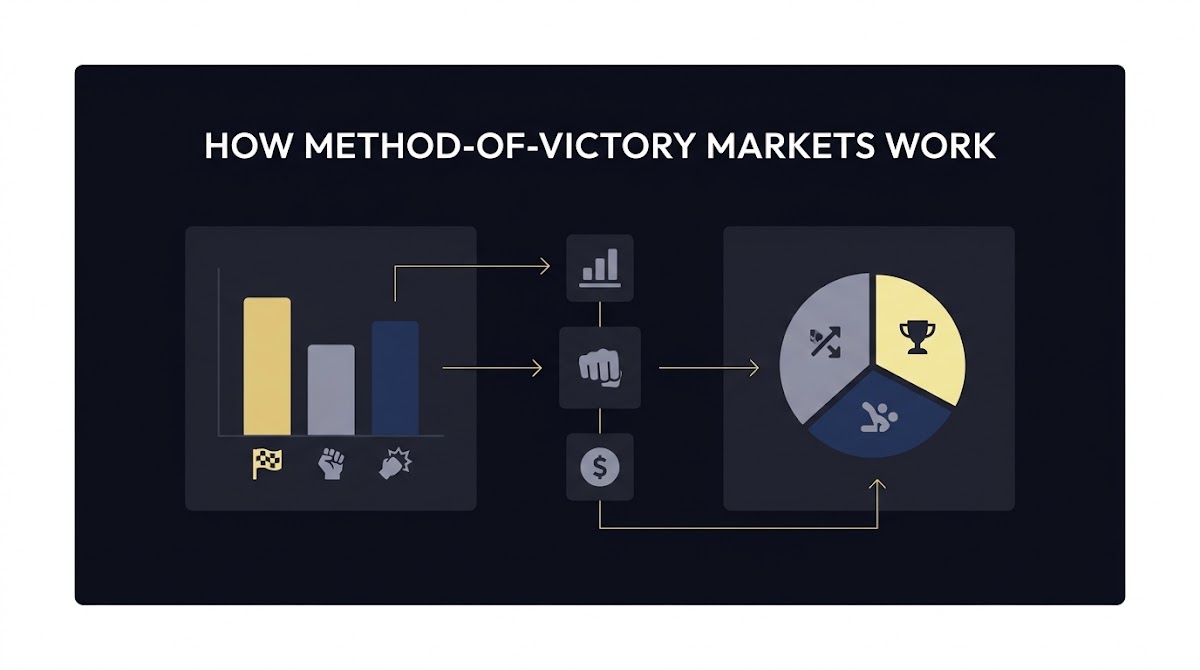
What method-of-victory and victory-margin markets are
Method-of-victory and victory-margin markets describe bets that settle based on how a contest finishes rather than simply who wins. For combat sports these markets specify outcomes such as KO, TKO, submission, or decision and pay when the officially recorded result matches the selected grouping; for team sports the markets are often split into win-band ranges that settle on the points or goals margin. When reading or pricing these markets it helps to treat the quoted selection as a specific official outcome category rather than a loose prediction, because settlement follows the operator definition of the official result.
These markets appeal to users who want more granular choices than a straight winner market. Handicappers and analytics users who model outcome processes use method-of-victory and victory-margin markets to express views about finish type or margin size, and in-play traders use them to manage exposure as events unfold. For combat sports, common outcome groupings include KO and TKO clustered together and submissions as a separate class; for team sports, win-bands like 1-3 points or 4-6 points define the settlement buckets.
Try FundedPlays Challenges to practice forecasting and market checks
See the worked examples later in the article to practice converting odds and checking settlement outcomes.
Because exact mappings vary by operator, users should treat market labels as shorthand and confirm the market rules whenever settlement matters.
Scope: combat sports versus team sports
Combat sports method-of-victory markets focus on the recorded finish method, for example a knockout, submission, or judge decision. Team-sport victory-margin markets define additional ranges that describe how many points or goals separate the teams at final whistle. The choice of market depends on whether you are forecasting finish mechanics or the distribution of final margins.
Why these markets exist and who uses them
Operators offer these markets to provide variety and to serve users who prefer predictions about how, not just who. Professional handicappers, simulation users, and tournament-style competitors use them to target specific edges that may not appear in straight moneyline markets.
How operators map real outcomes to market selections
Exact settlement depends on the operator market rules, which define how official outcomes map to each selection and how edge cases are treated. For example, some operators explicitly group disqualification outcomes with KO/TKO, while others treat a technical decision as a distinct category; checking the help or market-rules page avoids surprises when an uncommon result occurs DraftKings Sportsbook Help Center and other house rules pages such as William Hill's house rules.

Reading a market-rules page is procedural. Start by finding the section that lists the selection mapping, then locate the clauses about disqualifications, technical decisions, and abandoned contests. Those clauses explain whether a result outside the normal outcome list voids the market or forces a particular settlement type, and they typically include timing rules for when an official outcome becomes binding.
Common grouping conventions are straightforward: KO, TKO, and similar referee stoppages are often grouped; submissions are separate; and decisions cover judge outcomes. In team sports, operators publish the exact numeric boundaries for win-bands so you know whether a four-point margin is in the 1-3 band or the 4-6 band. When in doubt, default to the operator's published text, not to inferred meanings. For exact mappings see house rules such as FanDuel's house rules.
Edge cases to watch for include disqualification and abandoned matches, which operators usually call out with specific settlement rules. If a contest is stopped and a technical decision is applied, the market rules will say whether that technical decision counts as a finish, a decision, or a voided market.
Odds formats and how to convert them to implied probability
Before judging value you must translate quoted odds into an implied probability. The simplest formula for decimal odds is p = 1 / decimal. Fractional and American formats convert to decimal first, then apply the same reciprocal rule. Treat implied probability as a standardized starting point for comparing your own estimate with the market's view.
Here are the standard conversions in brief. For decimal odds use p = 1 / decimal. For fractional odds a/b convert to decimal by decimal = (a/b) + 1, then apply the decimal formula. For American odds, convert positive and negative formats into decimal and then to probability using the same reciprocal approach. These calculations give the raw market-implied probability prior to accounting for any bookmaker margin.
Settlement is determined by the operator using the officially recorded result and the market-specific mapping described in the operator's market rules; edge cases like disqualification or technical decisions are handled according to those published rules.
Worked example: a selection priced 4.50 in decimal odds implies p = 1 / 4.50 = 0.2222, or 22.22 percent. If you are given fractional 3/2 convert to decimal 2.5, then p = 1 / 2.5 = 40 percent. Use these conversions to compare the market's view to your model or judgment.
Remember that implied probability is a tool for assessing relative value; it does not guarantee outcomes. It is the starting input for an expected-value calculation rather than a prediction by itself.
Overround and how bookmakers embed a margin in prices
Bookmakers build a margin into prices so that the sum of implied probabilities across all selections typically exceeds 100 percent. The process is called overround and you calculate it by converting each selection to implied probability and summing them; the excess above 100 percent is the bookmaker margin. Understanding overround helps you adjust the market-implied probabilities before comparing them to your own estimates Pinnacle Betting Resources.
In practice overround varies by market and operator. Some niche markets or low-liquidity victory-margin offerings have higher embedded margins than major moneyline markets. That difference matters because a higher margin reduces the apparent value in each selection, so you should be stricter about accepting small edges in higher-margin markets.
How prices are set and move: models, trading, and information flow
Operators produce initial lines using pricing models that consider team or athlete strength, historical finish rates, and event context; traders and automated market makers adjust those lines as money and new information arrive. Models provide a baseline while trading desks and automated systems refine prices to manage exposure and reflect incoming bets and public information Pinnacle Betting Resources.

Market movement follows a cause and effect pattern. Injury news, late changes to cards or lineups, and large stakes placed on particular outcomes will move a price. In-play, the state of the event pushes markets further as the likely finish method or margin changes. Traders may widen spreads or suspend markets entirely if uncertainty or risk increases significantly.
Because models embed a margin and traders act to limit risk, operators sometimes restrict or suspend markets ahead of material events to protect integrity and manage liability. Exchange guidance and operator help documents describe these procedures and the circumstances that trigger suspensions Betfair Help Centre.
In-play mechanics: dynamic prices and suspensions around material events
In-play method-of-victory and victory-margin markets update continuously to reflect the changing probability of each finish or margin, but they are commonly paused around material events such as the ending sequence of a fight, a last-minute goal, or a VAR stoppage. These suspensions let operators reconcile information and reduce the risk of accepting bets at stale prices Betfair Help Centre and live-betting guides such as OddsIndex's guide.
Practical scenarios where suspensions occur include the final moments of a closely contested match, the referee stopping a fight, or an official review that changes the likely outcome. In-play traders should anticipate short windows where the market is unavailable and design hedges and stake plans that accommodate brief suspensions.
Quick tool and calculator guidance to check implied probability and expected value
Use a simple calculator or a spreadsheet to standardize conversions and expected-value checks. Enter the quoted odds, your stake, and your estimated probability for the outcome. The tool should output the implied probability, expected return, and a suggested hedge if you supply multiple selections.
Calculate implied probability and expected value from quoted odds and a personal probability estimate
Round probabilities to two decimal places
Interpreting outputs. A positive expected value indicates your estimate exceeds the market-implied probability after accounting for stake and margin. If the tool shows a small positive EV, check overround and liquidity before placing a trade. For combinations, ensure the tool can accept multiple implied probabilities and compute joint EV correctly.
When using the calculator for hedges, feed in current live prices rather than pre-game numbers. Live conversion keeps your decision framework responsive to market shifts and allows you to size offsetting positions with more precision.
How to hedge and manage exposure in these markets
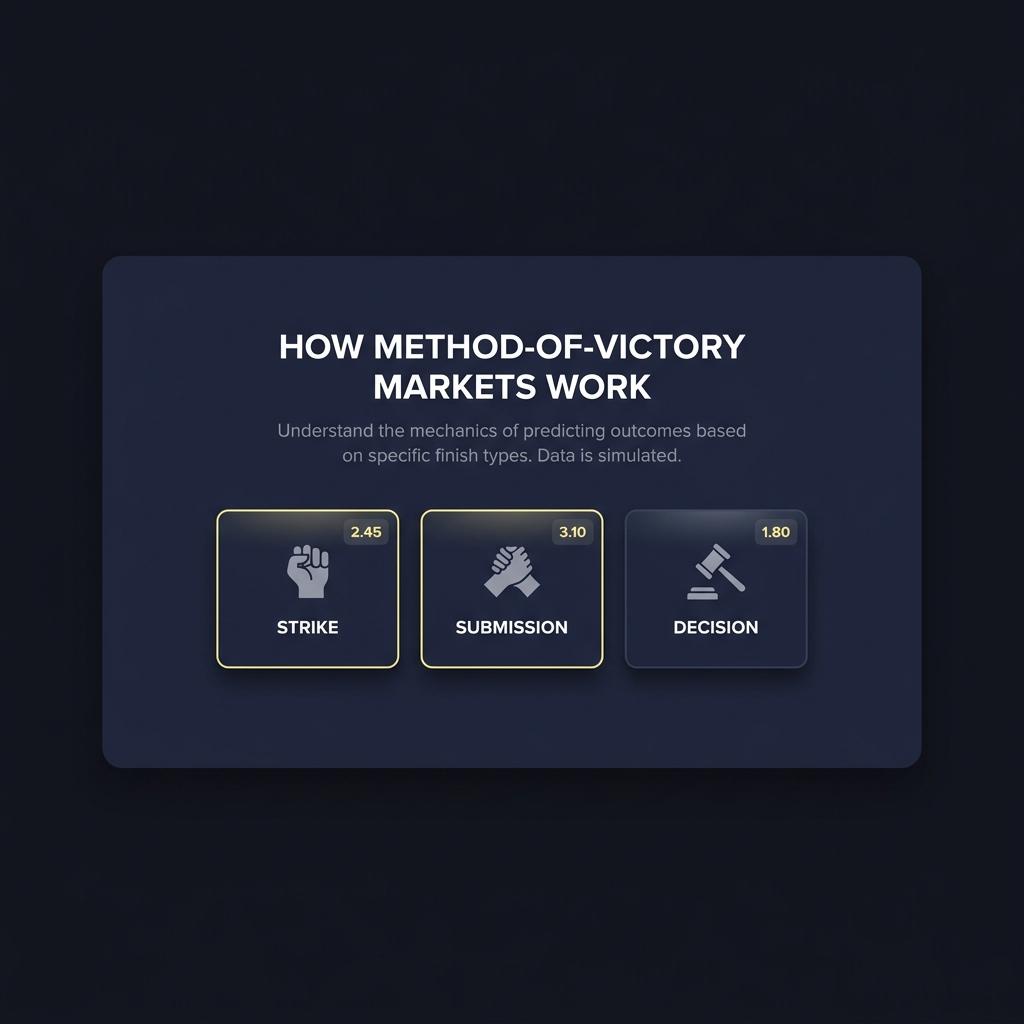
Hedging reduces net exposure by offsetting positions across related selections. For example, if you back a KO/TKO selection and later believe a decision is more likely, you can lay the decision selection or back an opposing win-band in a correlated team market to limit downside. Exchanges and partial-lay features make these trades practical for many users Betfair Help Centre.
Hedging costs include worse prices, increased transaction fees, and market friction, so the decision to hedge should weigh the reduction in downside against the likely cost. Use hedges for material exposures or when event state changes materially; avoid over-hedging small positions where fees and slippage erode any potential gain.
Practical example 1: Calculating payouts for a KO/TKO/submission selection in combat sports
Start with a quoted decimal price and convert it to implied probability. Suppose a KO/TKO selection is 5.00 decimal. The implied probability is p = 1 / 5.00 = 0.20 or 20 percent. If you stake 10 units and the outcome occurs, the payout is stake times decimal odds, here 10 * 5.00 = 50 units gross. Net profit is 40 units after returning the stake.

Before accepting the price confirm the operator mapping, since some houses include disqualification outcomes in the KO/TKO group while others do not. Check the market rules so you know whether a DQ or technical decision would have produced a settled win for your selection or a different outcome; the market-rules documentation lists these mappings explicitly DraftKings Sportsbook Help Center.
Adjust the expected return using your own probability. If your model assigns a 28 percent probability to a KO/TKO, expected value per unit equals model probability times payout minus stake times market probability factors. The overround reduces this edge, so convert all selections and re-normalize if you want an overround-adjusted EV estimate before staking.
Practical example 2: Calculating value in a victory-margin market for a team sport
Assume three win-bands on offer with decimal prices 3.00 for 1-3 points, 4.50 for 4-6 points, and 6.00 for 7+ points. Convert each to implied probability: p1 = 1/3.00 = 33.33 percent, p2 = 1/4.50 = 22.22 percent, p3 = 1/6.00 = 16.67 percent. Sum these to check overround and margin. The summed implied probabilities will typically exceed 100 percent because of the operator margin, and that excess is the overround you should account for in EV calculations Implied probability definition.
If your model estimates a 28 percent chance for the 1-3 band and 33.33 percent is the market-implied number, you have an edge and may compute expected return accordingly. Always confirm band boundaries on the operator page so you know whether a three-point margin is included in the lower band or the higher band.
When multiple bands exist, consider relative liquidity and settlement timing. Low-liquidity bands can have wider spreads and larger margins, which reduce the real value of a perceived edge. Practical decisions require checking band rules, current market depth, and the implied probability conversions before committing funds.
Decision criteria: When a method-of-victory price is worth taking
Require a clear edge before acting: compare your model or justified estimate to the market-implied probability and only take the selection when your estimate materially exceeds the market after adjusting for overround. Include operational considerations like liquidity and suspension risk in the decision.
Also factor bankroll sizing and stake rules. Use a fixed percentage of a disciplined bankroll to avoid overexposure to a single finish type or a volatile in-play window. When markets are thin or at risk of suspension, reduce stakes or skip the selection entirely.
Common mistakes and settlement pitfalls to avoid
Failing to check the operator market rules is a frequent cause of unexpected settlements. Assuming KO and DQ are treated the same, or that a technical decision will be paid like a normal decision, leads to disputes; consulting the published market rules avoids those mistakes DraftKings Sportsbook Help Center.
Misreading overround and treating summed implied probabilities as if they total 100 percent is another common error. Always account for the bookmaker margin when you calculate expected value so you do not overstate the quality of a small edge.
Finally, be mindful that live markets may be suspended and official outcomes can be delayed. Settlement follows the operator's official result procedures, and delayed confirmations can change expected timing for payouts and account adjustments.
How settlement is determined and where to check final outcomes
Settlement is based on the officially recorded result the operator uses in its market rules. That official result is typically the same source used for match outcomes, and the operator's help centre explains the timing and any deviations for special cases.
If a settlement appears inconsistent with the published rules contact the operator's support with the relevant market rule citations and the official result. Operators have dispute processes and will review the official record against their settlement rules before making final adjustments.
Conclusion: Practical next steps and responsible participation
Checklist for first-time users: read the market rules, convert quoted odds to implied probability, adjust for overround, compare the market to your model, and size stakes with disciplined bankroll rules. Practice these steps in small-stakes or simulated environments before increasing exposure.
Method-of-victory and victory-margin markets reward careful rule checking, consistent probability conversion, and an understanding of liquidity and in-play suspension mechanics. Outcomes depend on your performance and the operator's settlement rules, and operators do not guarantee winnings or qualification for any reward programs.
A method-of-victory market settles on how a contest finishes, for example KO, submission, or decision in combat sports. Exact settlement follows the operator's published market rules.
Convert decimal odds with p = 1/decimal. Convert fractional or American odds to decimal first, then use the same formula. Use the implied probability to compare to your own estimate.
Consult the operator's market-rules or help centre page for the event and market; those pages list selection mappings, edge cases, and timing for final outcomes.
References
- https://help.draftkings.com/hc/en-us/articles/4403491223579-Combat-Sports-Rules
- https://williamhill.us/us/nv/support/house-rules/
- https://www.fanduel.com/fanduel-sportsbook-house-rules-co
- https://www.pinnacle.com/en/betting-articles/Betting-Strategy/what-is-overround-bookmaker-margin/123456
- https://www.fundedplays.com/challenges
- https://support.betfair.com/app/answers/detail/a_id/404
- https://oddsindex.com/guides/live-betting-strategy-guide
- https://www.fundedplays.com/blogs/how-fundedplays-evaluations-work
- https://www.fundedplays.com/blogs
- https://support.betfair.com/app/answers/detail/a_id/1287
- https://www.investopedia.com/terms/i/implied-probability.asp
- https://www.fundedplays.com/