
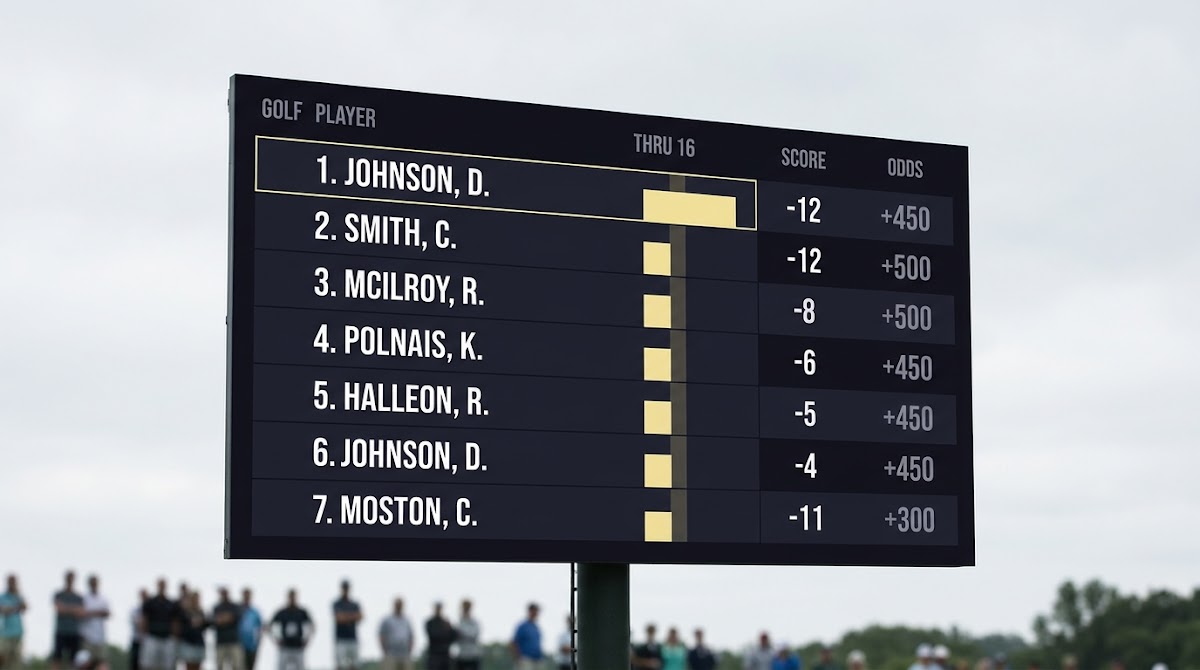
What an outright winner market is in golf
Definition and how it differs from match and futures markets
How Golf Outright Winner Markets Work is essentially about a market that prices the probability a named player wins the tournament, and that market settles on the official tournament winner after any playoff, under the Rules of Golf and related committee procedures, which govern tie resolution in stroke play events R&A committee procedures.
An outright market differs from match bets and head-to-head markets in that it covers the single outcome of winning the whole event rather than a comparison between two players, and it differs from finishing-position markets because it specifically resolves to the winner rather than an ordinal finish. That structural difference affects how odds are priced and how stakes are returned at settlement.

Operators typically list outright markets both before the tournament, when books quote prices for the full field, and during play as live markets that update with leaderboard movement. The timing and availability of in-play markets vary by operator and by the event itself.
Outright markets are commonly labelled as the tournament winner market or simply outright, and they coexist with other market types so participants should choose the market that matches the outcome they want to model or simulate.

How odds formats map to implied probability
Decimal, American and fractional formats and simple conversion formulas
Decimal odds present total payout per unit stake as a single number and the total payout equals stake times the decimal odds, with profit equal to payout minus stake; this simple relationship is the basis for many straightforward payout checks American Gaming Association guide. CBS Sports betting guide.
To convert decimal odds to implied probability use the formula implied probability equals 1 divided by decimal odds, which gives a quick market-implied chance for comparison to your own estimate. Equivalent conversions exist for American and fractional formats, so confirm the operator display and use the right conversion method for the odds format you are reading Investopedia implied probability article.
Check place terms and run a quick outright simulation on the FundedPlays Challenges
Try a quick simulation by converting decimal odds to implied probability and comparing that number to your own estimate before you commit time to a full model.
How to read implied probability and why it matters for value
Reading implied probability helps you identify whether a quoted price represents value compared with your independent estimate. If your estimate of a player's chance is higher than the market implied probability, there may be an overlay to investigate further.
Remember that different odds formats display the same information in different ways, so a clean conversion step reduces misreading and prevents simple calculation errors from turning into repeated mistakes in your simulations.
Pre-tournament versus in-play outright markets and regulatory expectations
How prices update during play and what drives mid-event moves
Pre-tournament markets reflect pre-event information such as form, injuries, and course fit, while in-play prices update to incorporate live information like leaderboard movement, weather changes, and player withdrawals. The mechanics of these updates are typically automated and aim to reflect shifting probabilities as the event unfolds UK Gambling Commission technical standards.
When you use in-play quotes in a simulation, be aware that latency, update frequency, and the operator's internal models can change available prices rapidly, which influences both the fairness of the quote and the usefulness of a snapshot for your analysis.
Outright markets determine payout based on the official tournament winner after any playoff; each-way structures split stake into win and place legs and dead-heat rules proportionally reduce place returns when players tie for a paying position.
If you plan to compare live quotes with your model, check whether the operator publishes latency policies, refresh rates, or disclaimers about provisional pricing and in-play matching before you rely on a single observed price.
Regulator expectations that displayed odds reflect underlying probabilities

Because regulatory guidance can affect how operators manage in-play updates and client interfaces, anyone modelling markets over time should include a check for published technical standards or guidance documents in their due diligence workflow.
Because regulatory guidance can affect how operators manage in-play updates and client interfaces, anyone modelling markets over time should include a check for published technical standards or guidance documents in their due diligence workflow.
How settlement works: official result, playoffs and dead-heat rules
Why outright bets settle on the playoff winner in stroke play events
Outright winner markets settle on the official tournament winner after any playoff, because ties for first in stroke play are resolved by the playoff procedure set out in the Rules of Golf and related committee procedures R&A committee procedures.
Operationally, that means an outcome that looks tied at the end of regulation play is not final for outright settlement until a playoff result is declared official by the tournament committee, and the sportsbook or platform will use that official determination when finalizing winning positions.
How dead-heat rules affect payouts for tied finishing positions
When multiple players tie for a paying position, dead-heat rules typically split the stake or the place return proportionally among the tied participants, which reduces the effective return compared with a sole finish; operator house rules define the exact method used for division Smarkets help centre article. PGATour article.
Because dead-heat treatment can substantially change place payouts and affect linked each-way calculations, check the operator terms so you know whether place returns are adjusted proportionally or by another specified mechanism.
Each-way bets: structure, place terms and how they change returns
Definition: stake split into win and place parts
An each-way bet is two linked bets: one part backs the win, the other backs a place. The single stake is typically divided equally between the win and place components, and each component is settled independently according to the operator's place terms.
The place component uses reduced place odds and is only paid if the selection finishes within the qualifying positions set by the operator for that event, so the number of paying places and the fraction used for place odds materially change the expected return on the combined each-way stake Pinnacle each-way betting guide. bet365 rules.
How operator-specific place terms and reduced place odds affect payouts
Operators set place terms as both the number of places paid and the fraction of the win odds that apply to a place return. Because those terms vary by event and by operator, the same selection can deliver very different each-way returns depending on where you place the bet.
Always confirm the current place terms for the event you are modelling; differences in the number of paid places or in the place fraction are common and they affect how you compare your own probability estimates to market prices.
Payout math: working through decimal odds and each-way math
Decimal payout formulas and profit calculation reminders
For decimal odds the total payout equals stake times the decimal odds, and the profit is the payout minus the original stake; this is a simple and repeatable calculation you can apply to both win-only and place returns American Gaming Association guide.
Keep the arithmetic consistent: when you calculate implied probability use the same odds format or convert to decimal first, then use 1 divided by the decimal odds to get the implied market chance for the outcome Investopedia implied probability article.
simple payout and each-way math helper
copy into a spreadsheet to reproduce calculations
How place returns and dead-heat adjustments are calculated conceptually
Conceptually, an each-way place return is calculated by applying the reduced place odds to the place portion of the stake and paying that independently of the win part; when a dead-heat occurs for a paying place the operator typically divides the relevant stake or return proportionally among the tied players to reach the settled amount Smarkets help centre article.
When you build a spreadsheet or simulation, model the two linked calculations separately: compute the win leg payout, compute the place leg payout with the reduced fraction, and then apply any dead-heat division rules specified by the operator to the place returns as needed.
How to evaluate value and decide which outright to back
Implied probability versus your model or edge
Value assessment starts with comparing your estimated probability for a player to win with the market implied probability derived from the displayed odds. If your estimate exceeds the market-implied chance by a margin that justifies taking on variance, that selection may be worth further consideration.
Use consistent assumptions when you compare probabilities, and adjust your estimate for live information if you are looking at in-play quotes rather than pre-tournament prices. Treat the market figure as a benchmark not a guarantee. (see Funded Plays)
Practical checks: player form, field strength, course fit, and operator terms
Before backing an outright selection, review player form, event field strength, and course fit, and always cross-check the operator's place terms and dead-heat policies because those rules affect the returns on each-way structures or finishing-position models.
Combine a clear probability check with disciplined bankroll rules: set stake sizes based on the edge you estimate and the variance profile of outright markets, and avoid chasing short-term confirmation without documented reasoning and risk controls.
Common mistakes and settlement pitfalls to avoid
Forgetting to check place terms and dead-heat rules
A common mistake is assuming standard place terms; because operators vary the number of paid places and the fraction applied to place odds, failing to confirm the actual terms can lead to materially different expected returns and surprising settlement outcomes Smarkets help centre article.
When you model or simulate, include a step that pulls the operator place terms into your input assumptions so you do not rely on a memory of typical terms that may not apply to the event you are analysing.
Confusing provisional leaderboard status with official results
Provisional or interim leaderboards during play are not the same as the official result used for settlement, because playoffs and post-round adjustments can change the final winner; the official determination after any playoff governs outright settlement under the Rules of Golf R&A committee procedures.
Allow for administrative lag when you track settlement and avoid treating a provisional in-play quote as final until the tournament committee publishes the official result and the operator confirms settlement.
Practical scenarios and worked examples to try yourself
How to set up a simple simulation comparing your probabilities to market odds
Suggested simulation checklist: collect decimal odds for the selections you want to test, convert those to implied probability using 1 divided by the decimal odds, compare each implied probability to your estimate, and then apply the operator place terms and dead-heat rules when modelling each-way or finishing-position payouts. (Funded Plays evaluations)
Make the simulation reproducible by storing the operator place terms and a clear note on whether you used pre-tournament or in-play prices. That record keeps your comparisons consistent when you rerun the model under slightly different assumptions. (see Funded Plays blogs)
Two scenario sketches showing how each-way terms and dead-heats change outcomes
Sketch one, each-way place impact: conceptually split the stake into equal win and place parts, apply decimal payout math to the win leg, then apply the reduced place fraction to the place leg and compute a separate payout. Summing those settled amounts gives the total return on the original stake for events where the place leg wins but the win leg does not.
Sketch two, dead-heat effect: when a dead-heat occurs for a paying place, adjust the relevant place leg by dividing the stake or the return proportionally among tied players per the operator's rule. That division reduces the effective place return and should be included in any realistic simulation of finishing-position markets.
Before you draw conclusions from these sketches, confirm exact operator settlement formulas because some platforms describe the split in terms of stake division while others describe it in terms of adjusted returns; either method changes the mechanics but both seek to reflect fair division among tied claimants.
Summary and next steps
Checklist to take away before placing or simulating outright bets
Convert odds to decimal and calculate implied probability, compare that implied number to your independent estimate, check operator place terms and dead-heat rules, and confirm that a playoff winner is the official settling outcome for an outright market under the Rules of Golf R&A committee procedures.
Use simulations or small-scale practice to validate your process, and document the operator rules you used so you can reproduce the settlement math and spot differences if you switch platforms or events.
Where to read official settlement and operator rules
Read the Rules of Golf for the tournament tie procedures and check the operator help or terms pages for settlement, place, and dead-heat rules before you place or simulate any outright or each-way positions.
Responsible practice means keeping your assumptions explicit, checking rules per event, and treating market prices as estimates to test rather than certainties to follow.
Outright markets settle on the official tournament winner after any playoff; the tournament committee's official declaration governs settlement.
Each-way bets split the stake into win and place parts; the place leg uses reduced place odds and pays only if the selection finishes within the operator's specified paying positions.
Dead-heat rules typically divide the stake or return proportionally among tied players for a paying position, which reduces the effective payout compared with a sole finish.
References
- https://www.randa.org/rog/2023/rules/committee-procedures/section-5/5a-deciding-ties
- https://www.americangaming.org/education-and-resources/how-to-bet/
- https://www.investopedia.com/implied-probability-what-it-is-calculation-4586208
- https://www.fundedplays.com/challenges
- https://www.gamblingcommission.gov.uk/technical-standards/remote-gambling-and-software-technical-standards
- https://help.smarkets.com/hc/en-gb/articles/208433915-Golf
- https://www.pinnacle.com/en/betting-articles/betting-strategy/each-way-betting-explained/QKR2ZP2YGX8MXU26
- https://www.cbssports.com/betting/news/golf/
- https://www.pgatour.com/article/news/betting-dfs/2024/01/04/dead-heat-understanding-how-ties-can-impact-your-golf-bets-and-profits
- https://help.bet365.com/s/en/sportsrules/golf/outright-betting
- https://www.fundedplays.com
- https://www.fundedplays.com/blogs/how-fundedplays-evaluations-work
- https://www.fundedplays.com/blogs