
What does 'pulling the goalie' mean and why it matters for live markets
Definition and common contexts
Pulling the goalie refers to the in-game tactic where a team removes its goaltender for an extra skater, usually to maximize scoring chance when trailing late in the game. This move is most common in the final minutes, often when a team is down by one or two goals and needs to create an overload in attack. The immediate consequence is a change in on-ice manpower and objective risk for both teams, which is what live markets react to.
Immediate game-state changes when the goalie is pulled

When the goalie is off the ice the attacking team gains an extra attacker, shot volume typically rises, and the defending side faces a clear trade-off: better offensive pressure for the trailing team against a higher chance of conceding an empty net goal. Those shifts alter the probabilities that live pricing models and traders use when setting moneyline, spread, and totals prices.
Treat the event as a sharp change in variance: update scoring and concession probabilities, confirm liquidity, reduce stake size, prefer short-settlement markets, and use pre-defined stop rules to limit drawdown.
That short diagnostic question is useful live: given time remaining and score margin, does the marginal probability of scoring exceed the marginal probability of conceding by enough to justify a bet? Asking this helps separate instinct from an actionable decision.
How the game-state shift affects scoring probabilities
Qualitative direction of probabilities
Adding an extra attacker raises the attacking team s expected opportunity rate; see analysis on hockey-graphs.com. Practically, expect higher shot attempts in the attacking zone and more chaotic patterns around the goal. At the same time, the defending side's chance to score on the empty net also increases, so the net benefit is a balance between increased expected goals for the attacker and the rising empty-net risk for the defender.
Timing and its asymmetric effects
Time-on-clock and score margin skew the risk-reward dynamic. With very little time left, the attacking team often accepts a large concession risk for a small increase in scoring probability because the alternative is losing outright. Earlier pulls trade off differently: with more time there is room for both sides to generate chances, and the expected return profile shifts. These timing asymmetries are why the same tactic looks attractive or unattractive depending on minutes and seconds remaining.
quick live odds adjustment to estimate net scoring edge after a pull
use as a fast heuristic only
For live evaluation a compact mental model or a tiny spreadsheet that adjusts baseline scoring probability by time bands can be enough to move from intuition to a testable proposition. The tool spec above is a simple starting point for a live calculator you can run with minimal inputs.
How live markets typically reflect a pulled goalie
Immediate price movement patterns
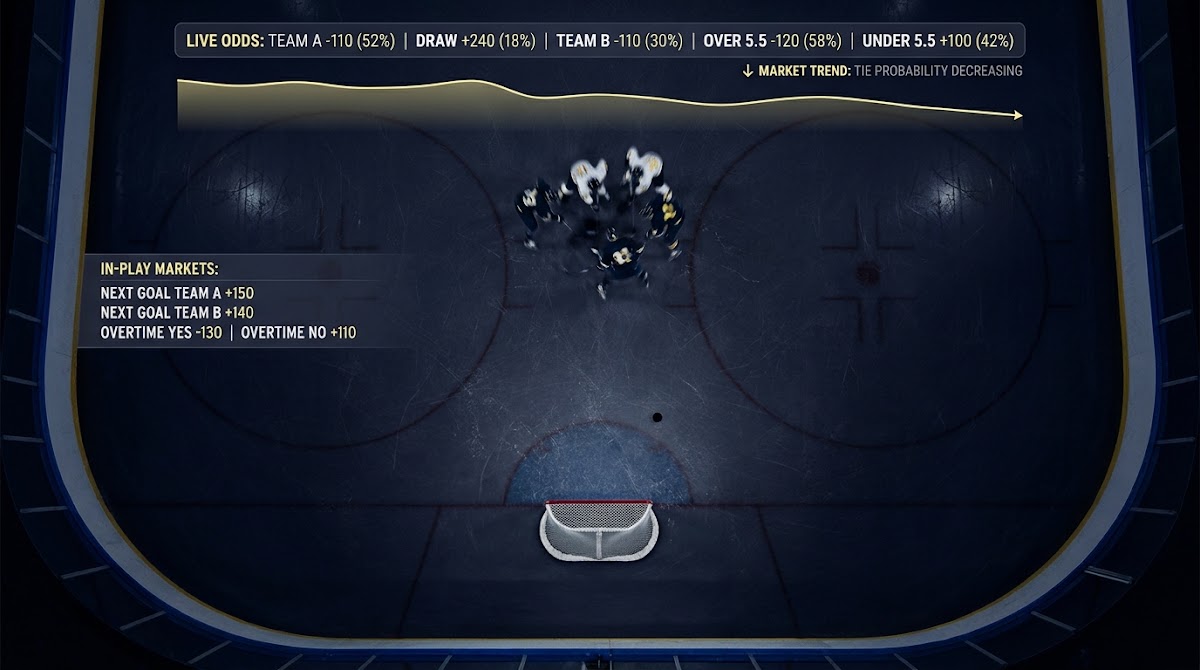
Markets usually react quickly to a pulled goalie because the state change is visible and binary. Moneyline prices for the trailing team often compress, reflecting the higher chance of a late goal, while the favorite s payout moves to account for empty-net risk. At the same time, next-goal and short-interval markets become significantly more volatile and attract concentrated attention from traders and recreational players alike.
See FundedPlays challenge rules and how structured evaluation works
Read this guide for practical checklists and tools that help evaluate pulled-goalie moments without relying on emotion.
How fast prices adjust depends on where liquidity sits and how many participants are watching the game. In deep markets, re-pricing can be almost instantaneous; in thinner markets or prediction platforms with lower activity, changes come in steps and may leave temporary mispricings.
Spread and total-line behavior
Spread and totals lines respond differently. Totals markets may widen because the variance of remaining scoring increases, while spread markets try to rebalance the expected goal differentials in a shorter time window. Operators may also shift lines conservatively to protect against a single high-impact event like an empty-net goal that suddenly decides the market outcome.

How operators and markets reprice risk after a goalie pull
Latency and human vs. algorithmic responses
Repricing comes from a mix of automated engines and human traders. Algorithmic systems update quickly when the new state is fed into a model, but human desk traders will intervene when models produce extreme or counterintuitive prices, or when exposure needs immediate management. The coordination between automated and human responses determines whether a market snap-adjusts or moves in visible steps.
Limits, caps and rapid hedging
Operators manage sudden exposure through limits such as price caps, temporary suspensions, or aggressive liability hedging. When a late pull concentrates money on one side, a trading desk might lay off risk into an exchange, tighten available limits, or widen the margin they require. For traders and predictors, recognizing these operational behaviors can explain why some markets stop moving even though game-state volatility remains high.
Market liquidity, depth and the effect on execution
Why liquidity matters for live execution
Liquidity determines whether a perceived edge is actually executable. A favorable price on paper can vanish as you place an order if available depth is shallow. Slippage is the practical cost of taking liquidity in a live pulled-goalie moment, and it can turn a promising idea into a losing trade very quickly when markets swing.
Differences across market types
Different platforms handle execution risk in different ways. Exchanges offer peer liquidity and visible order books, but they can be thin late in games. Fixed-odds operators control prices but may adjust them suddenly or suspend markets to manage liability. Skill-based prediction platforms and challenge systems can combine features of both, with platform-specific rules that affect how and when you can place orders.

To check whether a price is actually available, look for the size shown at top prices, recent trade prints if provided, and any indicators the platform offers about fills. If those signals are weak, assume slippage and adjust stake accordingly. See this discussion of evaluations for more on platform indicators.
Decision criteria: when a pulled-goalie situation is a tradable edge
Checklist for quick decisions
Use a compact checklist for live calls: time remaining, score margin, manpower and penalties, recent momentum, visible liquidity, and the current market price versus your model. Each item should be fast to evaluate so you can form a clear yes or no without overthinking under time pressure.

Quantitative vs qualitative signals
Quantitative signals include odds-implied probability, recent shot volume, and expected goals estimates if available. Qualitative signals cover momentum, how the team is handling pressure in the attacking zone, and coaching tendencies about when a team typically pulls the goalie. Blend both: let numbers form the base case and use qualitative cues as tiebreakers when the model edge is marginal.
Bankroll and drawdown rules specific to pulled-goalie scenarios
Position sizing when volatility spikes
Treat pulled-goalie moments as high-volatility windows. Use reduced stake sizes and apply stricter fraction-of-bank rules compared with your normal live staking. Because empty-net goals can create asymmetric losses, caps that limit exposure to a small share of your bankroll help avoid catastrophic hits in a single game.
Setting stop conditions and loss limits
Define stop conditions in advance. For example, set a maximum loss per play and a maximum number of pulled-goalie trades per session. Pre-defined exit rules help remove emotion and keep drawdowns predictable, which is crucial when markets can flip within seconds as a result of a single shot or turnover.
Common trader and bettor mistakes after a goalie is pulled
Emotional overreach and confirmation bias
One common error is overbetting on momentum after a team appears to seize control. Confirmation bias can make a trader overweight a single successful example and then misapply that belief in other games. The cure is strict stake discipline and post-trade review to test whether the intuition holds across many instances.
Misreading short-term noise as a persistent signal
Another frequent mistake is treating short-lived bursts of pressure as a durable trend. A pulled-goalie window often produces noisy high-volume sequences that do not reliably translate to a goal. Use objective metrics such as sustained zone time or repeated high-quality chances before scaling exposure.
Signals and data to monitor in real time
Clock, shot metrics and venue context
Prioritize the clock and score first, then shots on goal and shot attempts as the next-best real-time proxy for attacking momentum. Zone time and repeated entries in the attacking zone are also high-value signals for measuring pressure. Contextual notes like travel schedules or team styles can shift expectations but are secondary to live on-ice indicators during the final minutes.
Public sentiment and market flow indicators
Watch market flow for signs of public versus sharp activity. Sudden large bets, rapid price compression, or a lot of small bets pushing the same side indicate where attention and money are concentrated. Use these signals to judge whether a price is driven by recreational volume or by informed participants who might have a real edge.
Modeling approaches and simple heuristics to price pulled-goalie scenarios
Quick probability adjustments
Small, defensible heuristics work well live. For instance, adjust a baseline scoring probability upward by a time-band factor and subtract a fixed concession penalty for empty-net risk. The goal is to keep the calculation small enough to run in seconds while capturing the main directional effects of the pull.
Small models you can run live
Consider a Poisson-inspired tweak for very short intervals, or prepare a lookup table of implied scoring adjustments by time remaining and score margin. Backtest these heuristics on historical game footage or replayed sequences to check calibration before using them live, and always include transaction cost buffers for slippage and platform margins. See this academic analysis for related methods: shareok.org.
Practical scenarios: time, score and manpower examples
Down by one with 1:30 left
When a team is down by a single goal with about 90 seconds left, pulling the goalie often increases expected shot volume but also makes the opponent s task of scoring an empty-net goal easier. In this setting markets usually move toward the trailing team on the assumption of increased attacking pressure, but the implied edge can be small because the concession risk is large relative to the time left. Trade consideration: prefer next-goal markets when liquidity and prices permit, and use smaller stakes on long-dated market outcomes. Related analyses that discuss expected value and timing are available at resolutewealthmanagement.com.
Down by two with 3 minutes left and a power play
A two-goal deficit with three minutes left and a power play changes the calculus. The extra skater plus man advantage can substantially alter expected goals in favor of the trailing team. Markets may widen totals and create sharper movement in next-goal lines. In that case the potential edge can justify a slightly larger stake, but only if liquidity supports execution and your model shows a clear advantage over the offered odds.
In both scenarios, contingency rules matter: abort if an obvious empty-net chance appears against you, scale into positions rather than placing a single large stake, and prefer markets that settle in short windows to limit exposure.
Case study: a live trade walkthrough (hypothetical)
Trade setup and rationale
Imagine a game where Team A trails by one with 2:10 left. Your model says the trailing team s chance to score in the remaining time after a pull is higher than the market implies, and next-goal odds offer a perceived edge. The thesis hinges on sustained zone time and favorable matchup lines for Team A s attackers in the final minutes.
Execution, outcome and post-mortem
Execution steps: confirm available liquidity, place a scaled back bet sized to a small fraction of your bankroll, set a hard loss cap, and watch for rapid price movement. Outcome possibilities include scoring to tie, conceding an empty-net goal, or regulation ending unchanged. In the post-mortem, record whether your model assumptions about sustained pressure held, whether slippage ate the edge, and whether your stake sizing rules prevented an outsized loss.
Frame the entire case as illustrative; the goal is to learn from the trade mechanics and refine your checklist, not to claim a repeatable winning method without testing.
How to integrate pulled-goalie signals into your live toolset
Quick dashboard features to build
Essential dashboard elements include a live clock and score overlay, a shots and zone-time widget, a visible liquidity indicator, and a quick bet sizing slider. These features let you move from signal to execution without hunting for information across multiple screens. For additional dashboard ideas see our blog.
Alerts and automation ideas
Build simple alerts for price thresholds, automatic stake reduction during high-volatility windows, and a next-goal watchlist. Keep automations minimal and always include manual override options so you can respond to rare or novel game situations that a rule set did not anticipate.
Practical closing: rules of thumb and a checklist to use next time
Top 7 rules of thumb
1. Treat pulled-goalie moments as high volatility windows and reduce stake size. 2. Prioritize time remaining and score margin over narrative momentum. 3. Favor short-settlement markets when possible. 4. Confirm visible liquidity before sizing. 5. Use a pre-defined stop and loss cap. 6. Scale into positions when the model edge is marginal. 7. Record every trade for post-game calibration.
Pre-game and live checklist
Live checklist paragraph: before the final minutes, set your stake caps, enable alerts for pulled-goalie events, prepare quick access to next-goal and short-interval markets, and decide in advance how you will respond to an empty-net concession. Responsible participation reminder: these are high-variance scenarios and outcomes are not guaranteed. Learn more at Funded Plays.
Teams commonly pull the goalie late in regulation when trailing by one or two goals and needing to increase scoring chances; timing and score margin determine the tactic s risk profile.
Short-settlement markets such as next-goal or very short interval bets are often preferable because they limit exposure to empty-net outcomes and settle quickly.
Use reduced stake sizes and strict caps, scale into positions when the edge is marginal, and apply predefined stop rules to limit drawdown.
References
- https://hockey-graphs.com/2020/05/18/the-state-of-goalie-pulling-in-the-nhl/
- https://shareok.org/bitstreams/19d0b9cf-8fa0-4d4e-bf3e-d8787e24717a/download
- https://www.resolutewealthmanagement.com/blog/pulling-the-goalie-some-math-would-have-sent-the-preds-to-the-playoffs-las
- https://www.fundedplays.com/challenges
- https://www.fundedplays.com
- https://www.fundedplays.com/blogs
- https://www.fundedplays.com/blogs/how-fundedplays-evaluations-work