

How Game Handicaps Work in Tennis: A concise overview
How Game Handicaps Work in Tennis is a straightforward question for many fans and analysts. In short, a game handicap gives one player a theoretical advantage or disadvantage in games so that the adjusted score reflects a level contest. This guide uses plain language and hypothetical examples so you can read real match cards with more confidence.
The purpose here is practical. You will learn how handicaps are structured, where they apply in a match, and which checks matter before you rely on a line. That foundation helps you compare different handicaps and judge whether a line offers value.
What follows is a clear roadmap: first we break down the basic components, then we show common types, describe how values move, explain format interactions, offer decision rules, warn about common mistakes, and finish with step-by-step scenarios you can practice with. Read sequentially or skip to the section you need.
a brief checklist to help interpret a tennis game handicap
Use for quick pre-match checks
The checklist above is intended as a compact aid when you first look at a handicapped match card. Keep it visible while you practice with the scenarios later in the article.
By the end you should be able to spot the main parts of a handicap, explain why a line moved, and apply a few disciplined decision rules to decide whether a handicap looks sensible for your purposes.
Basic components of a tennis game handicap
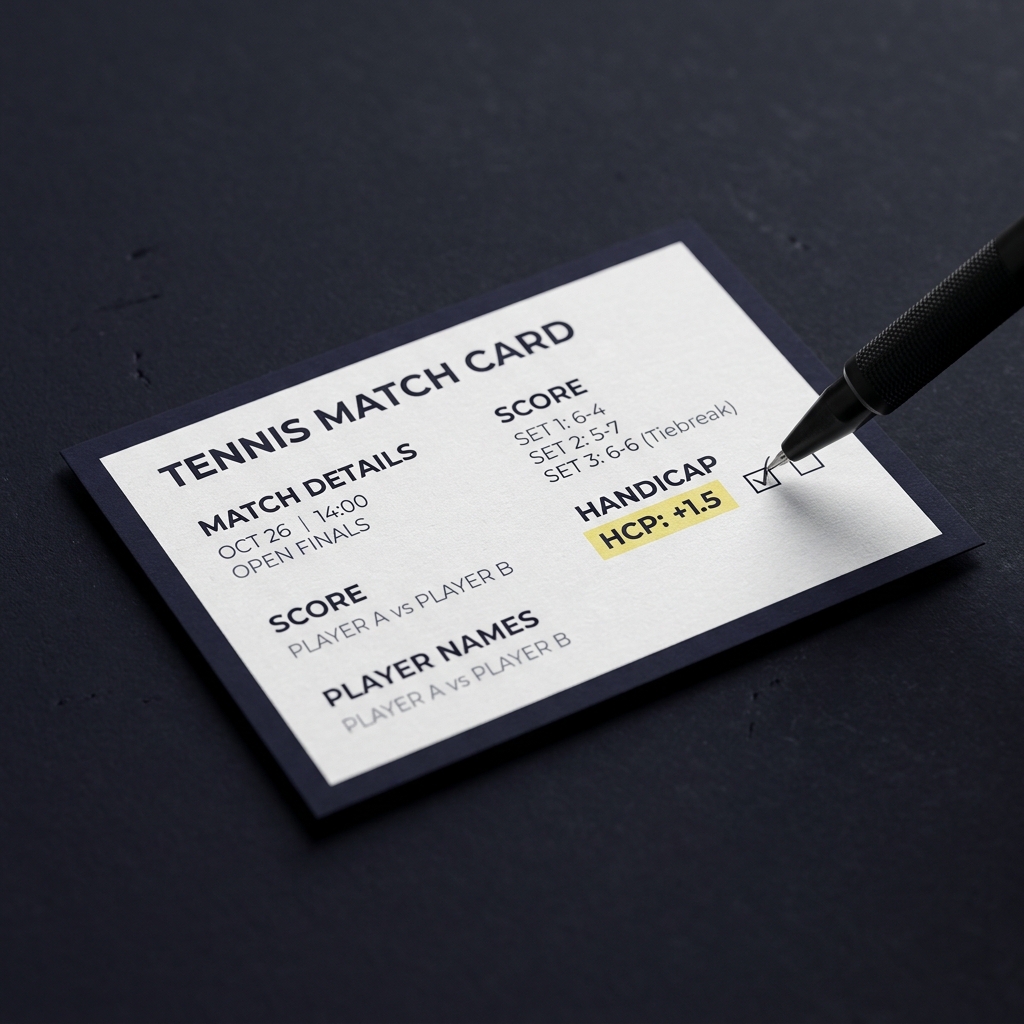
A game handicap is built from a few clear parts. First, there is the handicap value, which is the number of games added to or subtracted from a player to produce an adjusted score. Second, there is the identification of the favored player, the one who receives or concedes those games. Third, there is the adjusted score concept, which is the match score after the handicap is applied.
Whole-game handicaps generally award or take whole games, while fractional or partial handicaps split a game advantage so that outcomes can be shared across outcomes. The important practical difference is how ties or half-wins are resolved by a provider, so always check the rule definitions.
Step 1, identify the handicap value and which side it applies to. Step 2, confirm whether the handicap is a whole-game or fractional type. Step 3, note the scope: is the handicap quoted per game, per set, or for the entire match. These checks help you translate a line into an expected adjusted result.
Practice reading handicapped match cards with the challenges page in mind
Bookmark this guide and continue to the practical examples section to practice reading handicapped match cards. This guide is meant to be a steady reference you can return to while learning.
Terminology you will see on match cards includes "handicap value", "favored player", and "adjusted score". Providers may use slightly different wording, but the concepts remain consistent: a value, a direction, and an applied adjustment to the raw match result.
Finally, remember that a game handicap is a tool to express relative expected performance. It does not change the rules of tennis play, only how outcomes are measured against an artificial baseline for comparison or settlement.

Types of game handicaps used in tennis and when each is used
Handicaps can be offered before a match starts or adjusted while a match is underway. Pre-match handicaps reflect expected advantages based on available information at the start. In-play handicaps shift as the match unfolds and as new information like momentum, an injury, or the scoreline itself appears.
Pre-match handicaps are common for clear reasons: they summarize expected game differences given relative quality, surface, and recent form. In-play or live handicaps let lines react to events and keep options open for bettors or analysts who follow changing match dynamics.
Verify the scope of the handicap, confirm provider rules about tiebreaks and fractional outcomes, compare the line to surface and recent form, and use a short checklist to record your reasoning before you act.
Handicaps also differ by scope. A set-level handicap applies to a single set, a match-level handicap alters the overall match game total, and some cards show a per-game spread for segments of the match. Understanding which scope you are looking at is essential because the same numerical value can play very differently depending on the unit it modifies.
Situations that commonly justify different handicap approaches include a big disparity in player experience, an expected slow start by a favorite, or a match where one player historically wins more service games. Providers use different formats to express those expectations, so keep a practical eye on scope and timing.
How game handicaps are typically calculated and adjusted
Handicap values start from an assessment of relative player strength and match context. Key inputs include comparative player ability, recent form, the playing surface, head-to-head history when relevant, and situational factors such as weather or injury reports. These inputs are combined in a model to yield an initial handicap value.
As new information arrives, providers may adjust the handicap. This movement is often called line movement. When a match opens and early indications suggest a different balance than expected, the handicap will shift to reflect the new consensus. The process is model driven and also influenced by market flows when applicable.

Different platforms or operators can use different models and rules, so the numerical steps behind a handicap are not universal. A single provider will also publish rules that explain how fractional outcomes are settled, how tie cases are treated, and whether particular scoring situations are excluded from a handicap.
In practice, think of calculation as two phases. The first is the pre-match model, which sets a starting point. The second is adjustment, which responds to new signals. Both phases are guided by the same basic inputs but their relative weight varies by provider and by the moment of adjustment.

Applying game handicaps across match formats and scoring rules
Match format matters because the same game handicap can play differently in best-of-three versus best-of-five contests. A fixed game advantage is proportionally larger in a shorter match and smaller over a longer match, because the relative opportunity to overturn an advantage changes with match length.
Tiebreaks, super-tiebreaks, and shortened formats alter how games are counted and how an adjustment affects settlement. Some providers explicitly state whether tiebreak points count as games for the purpose of a handicap or whether a super-tiebreak is treated as a separate scoring block. Always read the provider note on special scoring rules.
When reviewing a match card, ask two checks: does the provider include tiebreaks in game counts, and how are super-tiebreaks treated. These two checks often resolve the biggest ambiguities that affect how a handicap plays out in practice.
Also consider match pacing. In best-of-three matches a swing of a few games early can decide the result, while in best-of-five there is more time for recovery. That difference changes how meaningful a given handicap looks, particularly when you overlay player fitness and historical patterns.
Decision criteria and simple strategy when using game handicaps
Clear criteria make deciding about handicaps easier. First, check consistency with expected strengths. Does the handicap reflect what you know about the players on the surface? Second, confirm alignment with recent form. Third, factor in match context, like fatigue from a previous match or travel schedule.
Basic strategy principles include focusing on value rather than chasing lines, managing expectations by recognizing variance, and treating handicaps as one signal among several. A handicap should be a part of an evidence set not the sole determinant of a view.
Practical checklist rules: verify provider definitions, check whether tiebreaks are included, compare the line to simple heuristics from recent head-to-head and surface records, and prefer lines that fit the broader match story. Use small practice bets or simulated records to test your read without risking undue funds.
Bankroll principles still apply. Whether you are tracking a strategy on paper or in a funded challenge, control exposure and do not over-react to single-match outcomes. Consistency and discipline are the reliable ways to see whether a handicap-based approach produces repeatable edge over time.
Common mistakes and pitfalls with game handicaps
A frequent error is assuming all providers use the same conventions. The same headline handicap number can settle differently depending on provider rules for tiebreaks, fractional outcomes, or scoring exceptions. Read the rule text before you rely on a line.
Another common trap is misreading the scope. Confusing a set-level handicap for a match-level handicap leads to wrong conclusions. Take a moment to confirm whether the adjustment applies to a single set, a series, or the full match.
Cognitive traps also matter. Overreacting to short-term variance, anchoring on one statistic, or giving undue weight to a single recent match are all ways to skew judgment. Use multiple checks and keep a record of reasoning to avoid these pitfalls.
To avoid these errors, develop a habit of quick verification before you commit. Read provider rules, run a short hypothetical scenario in your head, and note any special scoring language that changes how the line settles.
Practical examples and scenarios to practice interpreting handicaps
Scenario one, a simple walkthrough: imagine a match card that gives a favored player an advantage applied to the match total. First, identify the favored player and the scope. Second, note whether the line is whole-game or fractional. Third, ask whether tiebreaks count for the provider. Based on those checks, write down the adjusted outcome narrative and see whether the adjustment flips the match winner or simply compresses the margin.
Scenario two, a comparative exercise: take two handicaps for the same matchup from different providers. Stepwise, list each provider rule that affects settlement, write the adjusted score interpretation for each handicapped version, and record which one seems to offer more value relative to your own read of the match. The exercise trains you to notice small rule differences that matter in practice.
A practice exercise you can use now: when you next see a handicapped match card, perform these checks and jot answers on paper. 1) Handicapped value and direction. 2) Scope of application. 3) Tiebreak and special rules. 4) How movement would affect your read. Compare this to your initial intuition and note where your view changed.
Repeat the exercise across surfaces and formats. Over time you will develop a quick pattern recognition for when a handicap is plausibly fair and when it looks mispriced against the match context.
Conclusion: when to use game handicaps and next steps
Takeaways are simple. A game handicap is an adjustment that makes match outcomes comparable by adding or subtracting games to a player. The tool is useful when you want to compare relative performance or measure match outcomes against an expected baseline. It is not a guarantee of any specific result.
Recommended next steps: check provider rules before committing to a line, practice with hypothetical scenarios and small simulated records, and keep a disciplined checklist for pre-match checks. These habits make it easier to evaluate whether a handicap offers value in your view.
Remember that implementations vary by provider and that handicaps are one signal among many. Use them to sharpen judgments, not to substitute for careful match study.
A game handicap is an added or subtracted game advantage applied to a player to create an adjusted score that reflects an expected balance between players.
No, providers differ; some count tiebreaks as games for settlement while others treat them separately, so always check the provider rules.
Yes, handicaps can help compare relative performance and spot value, but they should be one input among several and used with disciplined checks.
References
- https://www.rulesofsport.com/betting/tennis/what-is-tennis-handicap-betting/
- https://www.usta.com/en/home/improve/tips-and-instruction/national/tennis-scoring-rules.html
- https://en.wikipedia.org/wiki/Tennis_scoring_system
- https://www.fundedplays.com
- https://www.fundedplays.com/blogs
- https://www.fundedplays.com/blogs/how-fundedplays-evaluations-work
- https://www.fundedplays.com/challenges