
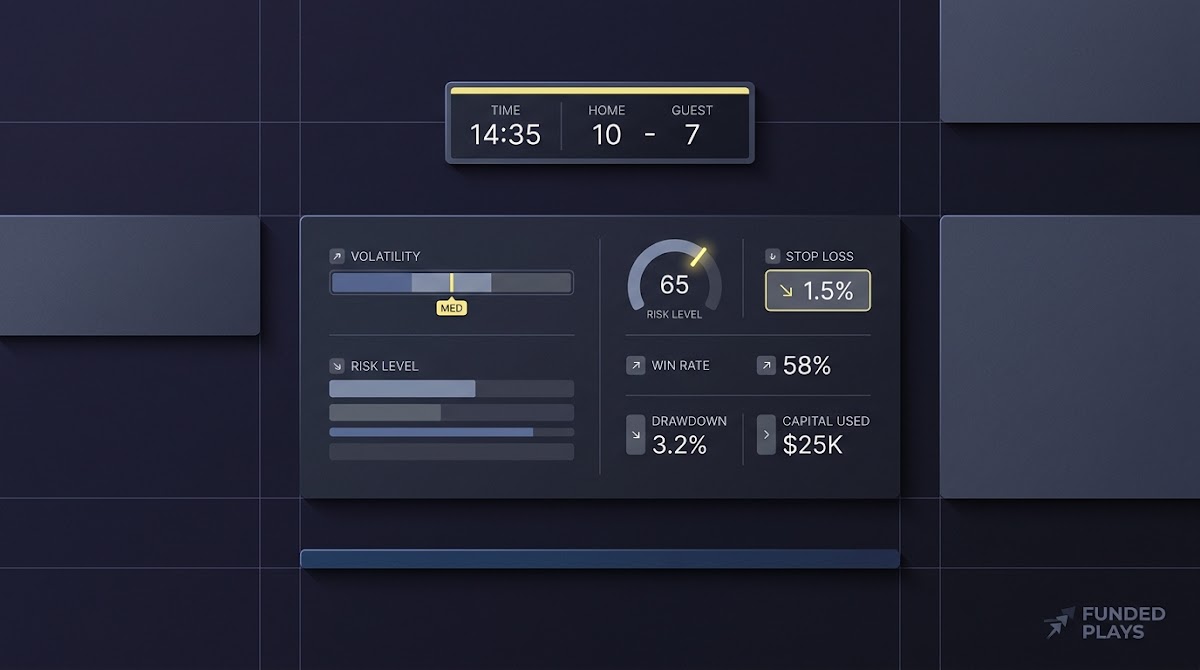
Why this matters: risk management in funded challenges
What readers will learn: How Funded Accounts Change the Way Traders Manage Risk
This article explains how funded-account style challenges reshape the way traders approach risk, and offers a clear playbook you can apply to a sports prediction evaluation. Readers will get practical steps on position sizing, drawdown planning, and measuring performance under the constraints of a virtual bankroll.
We will describe what funded-account challenges are, the typical rules that influence risk choices, and a repeatable framework for surviving and qualifying. This is an educational guide; it does not promise earnings or guarantee qualification, and it does not replace careful reading of platform rules.
Structure of the article: definitions and context, the behavioral shifts traders should expect, an actionable three-step risk-management framework, decision criteria for picking challenge parameters, common mistakes and fixes, worked scenarios with hypothetical numbers, and a concise system to measure and iterate your plan.
How funded challenges differ from betting and investing
Funded challenges use virtual capital and explicit evaluation objectives, which changes incentives compared with plain betting or investing. Instead of aiming only for maximum nominal profit, participants must manage relative risk to stay inside drawdown limits and meet time-based targets. That often means prioritizing consistency and rule compliance over chasing big short-term wins.
Because qualification depends on meeting the evaluation rules rather than generating unconstrained profits, the approach to bankroll management must be aligned with those rules from day one. The rest of the article shows how to translate those constraints into concrete risk controls and routines.
What funded accounts are and the context for traders
Definition and key characteristics
A funded account challenge is an evaluation designed to test a trader or predictor using a simulated bankroll and clearly stated objectives. Participants place predictions or trades against a virtual account, and success is measured against platform rules such as profit targets, maximum drawdown thresholds, and allowed position sizes.
Key characteristics include the use of a virtual bankroll, stage-based objectives (an evaluation period followed by a funded phase for qualifiers), and conditions that govern how positions may be sized or closed. The structure rewards disciplined, repeatable processes rather than one-off successful wagers.

Typical rules you will encounter
Common rule elements that shape risk decisions include drawdown limits, which define the maximum loss from a peak before disqualification; position size caps, which limit exposure on any single selection; profit targets to qualify; and a fixed evaluation period that creates a time horizon for meeting objectives.
Other rules can include restrictions on correlated positions, limits on the number of concurrent open positions, and requirements on how realized and unrealized losses are counted. Always treat the rule sheet as the operational definition of success for an evaluation.
Review Challenge Rules and Prepare a One-Page Risk Checklist
Review the challenge rules before you begin and use a one-page risk checklist for each session to keep position sizing and drawdown limits top of mind.
Remember that outcomes depend on meeting platform rules and your own execution. Qualification is achieved by complying with the evaluation framework and demonstrating consistent performance, not by guaranteeing profits or returns.
Core ways funded accounts change risk behavior
Shift from short-term wins to consistency
Under funded-account rules, the value of a single large win is often lower than the value of a string of controlled, positive sessions. Because drawdown thresholds are explicit and sometimes strict, a high-variance approach that produces occasional big winners and frequent deep losses will usually be penalized. To operate successfully, traders shift toward strategies that prioritize win rate stability and controlled variance.

In practical terms this means favoring smaller, more frequent gains and accepting slower progression toward profit targets. The goal is to move the virtual bankroll up while keeping peak-to-trough declines inside the allowable drawdown window.
How formal rules alter risk appetite
Hard drawdown rules directly cap how much you can lose in absolute or percentage terms, reducing the practical leverage you can apply. Position size limits further constrain individual bets, which forces traders to think in terms of relative risk per trade rather than absolute dollar upside.
These constraints increase the importance of correlation management. A portfolio of seemingly independent picks can become concentrated when several outcomes are linked, producing outsized aggregate losses. Under funded rules, managing correlation becomes part of standard bankroll management rather than an optional refinement.
Psychological effects and compliance
Knowledge of explicit disqualification criteria changes psychology. Traders often feel less pressure to chase short-term recovery because a single oversized recovery bet can violate rules and sabotage future qualification. That reduced urge to chase can actually help long-term discipline, provided a clear plan is in place for situations where drawdown approaches critical thresholds.
Adhering to rules is itself a risk-management action. Compliance prevents unnecessary disqualifications and protects the value of a consistent strategy over time. Documenting the rule set and integrating it into trading routines reduces the chances that emotion-driven decisions will override the plan.
A practical risk-management framework for funded accounts
Step 1: set your risk budget and position-sizing rules
Start by defining a per-trade risk budget as a percentage of the virtual bankroll. Two common methods are fixed-percentage sizing and volatility-adjusted sizing. Fixed-percentage sizing sets a constant percent risk per selection, while volatility-adjusted sizing scales exposure based on measured variability of outcomes.
Example checklist for Step 1: choose a per-trade risk percent, set a maximum concurrent exposure limit, and define a minimum unit size. These choices must be consistent with platform position-size caps and drawdown rules. If the challenge limits single-position exposure to 5 percent, ensure your per-trade risk sits comfortably below that cap while allowing for multiple simultaneous positions if your strategy requires them.
Keep your initial per-trade risk conservative, especially on early evaluation attempts. Conservatism increases the chance of surviving variance and learning from the live environment. You can increase risk gradually in later attempts once you have a track record under the specific rules.
Define conservative per-trade risk that fits under position-size caps, cap aggregate exposure to correlated events, and create staged recovery rules so you do not chase losses with oversized bets.
Step 2: account for correlation and event risk
After defining nominal per-trade risk, assess how individual selections might correlate. Correlation can be structural, such as two picks depending on the same game outcome, or it can emerge from shared external factors like injury news or weather. Cap aggregate exposure to correlated events to avoid a single scenario producing multiple simultaneous losses.
Use simple rules to limit correlation: set a maximum share of the bankroll exposed to a single event cluster, and avoid placing multiple similarly directional positions that react to the same trigger. This preserves your recovery margin and prevents clustered losses from breaching drawdown rules.
Step 3: plan for drawdowns and recovery paths
Define what drawdown levels will trigger a change in behavior. For example, set a cooling-off rule after reaching 50 percent of the allowed drawdown, and an immediate stop-trading rule if you hit the full limit. Recovery planning means calculating how much percent gain is required to return from a given drawdown and pacing your risk to avoid forcing outsized recovery bets.
Hypothetical recovery math: if the allowed drawdown is 10 percent and you incur a 6 percent loss, you need approximately 6.38 percent gain on the remaining capital to return to the starting point. Avoid strategies that rely on frequent recovery bets with sizes that would violate drawdown rules if they fail.
Combine these steps into a checklist you follow each session: confirm per-trade unit size, review correlated exposures, and note current drawdown status with a planned action at each threshold. This procedural discipline converts rules into operational safeguards.
Choosing account parameters and strategy: decision criteria
Matching strategy to challenge rules

Select challenge size and time horizon based on your estimated edge, win rate, and variance tolerance. A smaller virtual bankroll with tight drawdowns favors low-variance strategies and high win rates. A larger challenge with more lenient drawdown rules might accommodate strategies with a lower win rate but higher average return per trade.
When to prioritize survival vs. growth
Early in an evaluation, prioritize survival. The ability to keep trading inside the rules is the single most important factor to achieve eventual qualification. As you build a record, you can tilt toward modest growth while maintaining the stop points and cooldown rules that preserved you earlier.
Decision checklist for mode switching: monitor recent realized variance, current drawdown relative to allowed limits, and remaining time in the evaluation period. Favor survival if variance or drawdown is elevated or if much of the evaluation period remains. Consider incremental growth only when you have a stable win rate and fresh room in the drawdown allowance.
Common mistakes traders make under funded rules
Traders unfamiliar with funded-account constraints often make a set of repeatable errors that lead to disqualification. Common mistakes include exceedance of position limits, ignoring aggregate exposure to correlated events, failing to read the rule details for how drawdowns are calculated, and letting emotion drive oversized recovery bets.

Corrective steps are straightforward: reduce unit sizes when variance increases, build an immutable stop-loss discipline by codifying it in your routine, and perform a quick simulation before trying a more aggressive recovery path. Read rule language carefully; small differences in how unrealized losses are treated can change your allowable behavior.
One practical rule of thumb is to always plan for the worst-case sequence of outcomes for the number of open positions you hold. If a worst-case run would breach drawdown rules, reduce exposure proactively rather than waiting for losses to accumulate.
Practical scenarios and worked examples
Example 1: a conservative route to qualification
Hypothetical example, conservative path: assume a virtual bankroll and a 10 percent allowable drawdown. Choose a per-trade risk of 0.5 percent and limit concurrent exposure to 4 percent. With consistent small wins, the virtual bankroll can grow slowly while keeping maximum adverse excursion well under the drawdown cap.
Session routine for the conservative path: before trading, confirm the current peak equity and drawdown used by the challenge, set unit size to 0.5 percent of current capital, check that no two active positions are exposed to the same event, and log each selection with reason and stop level. At the end of the day, record realized P/L, maximum adverse excursion, and any rule-relevant notes.
Example 2: managing a mid-evaluation drawdown
Hypothetical recovery scenario: you start an evaluation and after several sessions you are at 6 percent drawdown of a 10 percent allowed limit. Recovery planning requires acknowledging that a reckless 3 or 4 percent recovery bet could push you past the limit if it fails. Instead, implement a staged recovery plan that reduces per-trade risk to 0.25 percent and focuses on high-probability, low-variance setups until the drawdown is below a conservative trigger, such as 40 percent of the allowed drawdown.
Practical steps: pause new position increases for a fixed number of sessions, reduce unit size, and increase pre-session checks on correlated exposures. If your strategy has an edge that favors longer shot sizes, move into smaller but more frequent setups and maintain strict stop-loss discipline until confidence and drawdown metrics recover.
Sample end-of-day checklist to copy: confirm current drawdown percent, record maximum adverse excursion values, list correlated open positions, log trader state (alertness, emotion), and decide whether to continue or cool off for the next session.
How to measure performance and iterate your plan
Key metrics to track
Track a concise set of metrics each session: drawdown, maximum adverse excursion, win rate, average return per trade, and expectancy. These numbers reveal whether your strategy's live behavior matches simulated expectations and whether rule constraints are being respected.
Keep a compact daily journal with these values and a short note about rule-relevant events. Over multiple attempts, aggregated metrics will show whether you should adjust unit size, reduce correlation, or change the pace of entries.
simple session log to track key metrics
Use this template each session
Use the tool to keep consistent records and to calculate whether observed win rate and expectancy are sufficient to meet challenge targets. Regular review makes it easier to spot creeping increases in variance or correlation that would otherwise threaten qualification.
When to change your approach
Change your approach if your measured metrics deviate from expectations for a sustained period. If win rate falls while maximum adverse excursion increases, reduce unit size and reconfirm edge assumptions. If you consistently hit correlation-trigger events, alter the portfolio construction rules to limit simultaneous exposures.
Decide on a review cadence that suits the evaluation length. For short evaluations, daily review of core metrics is prudent. For longer windows, consider a weekly analysis with a focused checklist and simple A-B tests for strategy tweaks rather than wholesale changes mid-evaluation.
Conclusion: a disciplined path through funded challenges
Key takeaways
Funded-account rules change incentives by making drawdown limits, position-size caps, and compliance central to success. The three most important adjustments are conservative, rule-aligned position sizing; explicit correlation controls; and a rehearsed drawdown recovery plan with immutable stop rules.
Next steps for readers
To get started: choose a challenge that matches your variance tolerance, simulate your strategy under the platform rules, and adopt a strict pre-session risk checklist. Remember that funded challenges reward consistency and compliance, not reckless risk-taking.
A funded account evaluation uses simulated capital and explicit rules like drawdown limits and position-size caps, so success depends on following those rules and demonstrating consistent performance rather than unrestricted wagering.
Start conservatively with a fixed-percentage or volatility-adjusted unit size that fits well below single-position caps and aggregate exposure limits, and reduce risk after drawdowns.
Review key metrics daily for short evaluations and at least weekly for longer ones, focusing on drawdown, maximum adverse excursion, win rate, and expectancy.
References
- https://www.fundedplays.com/blogs/how-fundedplays-evaluations-work
- https://apextraderfunding.com/resources/trading-strategies-insights/effective-risk-management-strategies-for-prop-firm-funded-accounts/
- https://www.fundedroll.com/blog/best-risk-management-strategy-funded-traders
- https://fortraders.com/blog/the-best-risk-management-plan-to-pass-any-funded-account-challenge
- https://www.fundedplays.com/blogs
- https://www.fundedplays.com
- https://www.fundedplays.com/challenges