
What is moneyline betting? The simple definition
Moneyline as an outright winner bet: how does moneyline betting work
At its core, a moneyline bet asks you to pick the outright winner of a game or match. That simplicity makes moneylines the most direct way to back a team or player, because the wager ignores score margins and total points and focuses only on who finishes first.
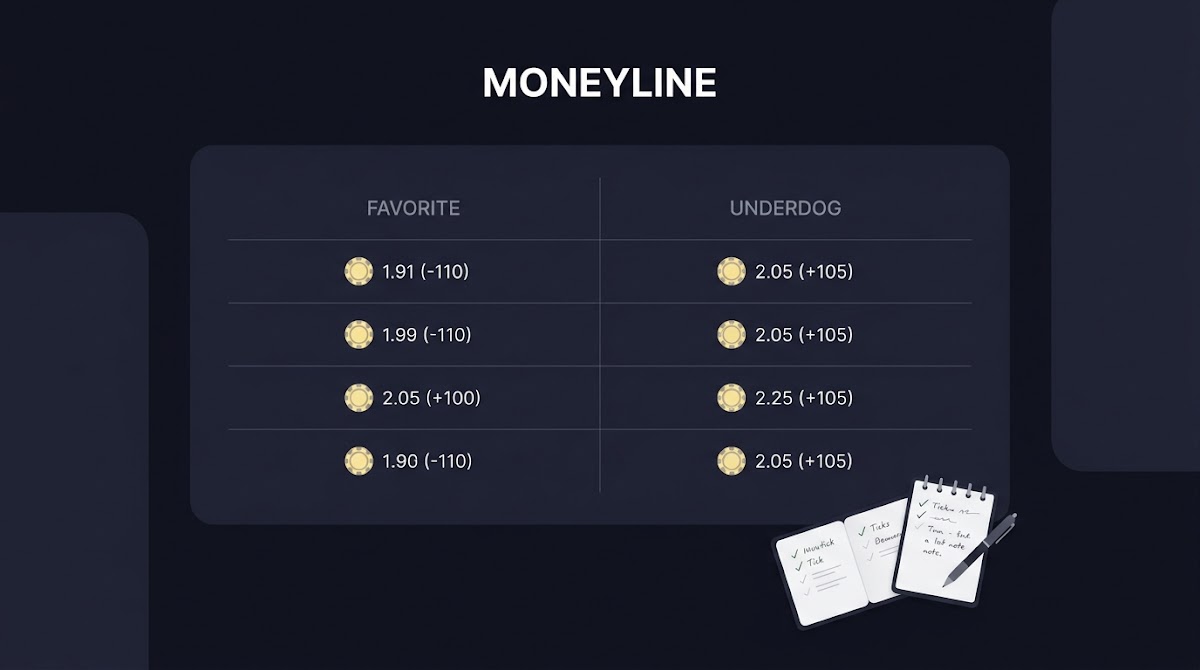
American moneyline odds show favorites and underdogs using a plus or minus sign. A negative number indicates the favorite and shows how much you must risk to win 100, while a positive number shows how much you win on a 100 stake for an underdog. This notation is explained clearly in common industry guides, which help beginners translate the line into expected payout structure Investopedia moneyline bet guide.

Quick qualitative example: if a favorite is listed at -180 and the underdog at +150, the favorite pays less on a successful bet than the underdog because the favorite is seen as more likely to win. That payout difference is the practical tradeoff you evaluate when choosing between backing a heavy favorite or taking an underdog. See a conversion chart at BoydsBets conversion chart.
How American moneyline odds look: favorites and underdogs
The negative sign on a favorite, and the positive sign on an underdog, are shorthand for payout direction and implied probability. For beginners learning moneyline odds explained, recognizing this notation is the first step to making apples to apples comparisons across different markets and books Investopedia on American odds.
Quick example of payout interpretation
Imagine a match with a favorite at -200 and an underdog at +160. The numbers tell you that the market expects the favorite to win more often, so the payout is smaller for a winning bet on the favorite, and larger for the underdog. Use this basic idea to compare whether the extra payout on an underdog matches your belief about its chances.
Practice moneylines safely with a simulated challenge
Try a short simulated challenge or a paper tracking sheet to practice converting odds and recording outcomes without risking much money.
How to read and convert American moneyline odds to implied probability
Why implied probability matters
Converting moneyline odds into an implied probability gives you a common scale to compare the market price with your own estimate of the chance an outcome occurs. That comparison is the foundation of identifying potential value and deciding whether a bet is worth the stake Investopedia on American odds.
Conversion formulas for positive and negative odds
There are two standard formulas used for American odds. For positive odds, the implied probability is 100 divided by (odds plus 100). For negative odds, the implied probability is the odds absolute value divided by (odds absolute value plus 100). Presenting them as step friendly rules helps beginners use a calculator or a simple spreadsheet to convert any moneyline. For quick online conversions try tools like Omnicalculator implied probability calculator.
Here are the formulas in plain form: for +X odds, implied probability = 100 / (X + 100). For -Y odds, implied probability = Y / (Y + 100). Knowing these two formulas lets you translate any American moneyline into a probability number you can compare to your own estimate Wikipedia odds entry.
Step by step worked example (small, hypothetical)
Step 1: Take a hypothetical underdog at +150. Use the positive odds formula: implied probability = 100 / (150 + 100) = 100 / 250 which equals 0.40 or 40 percent. This tells you the market thinks the underdog has about a 40 percent chance.
Step 2: For a hypothetical favorite at -180 use the negative formula: implied probability = 180 / (180 + 100) = 180 / 280 which is about 0.643 or 64.3 percent. Comparing your own estimate to these implied probabilities is the next step when you are testing whether the market price offers value.

Why sportsbooks include a margin and how that affects your edge
What the vig or overround means
Bookmakers set prices so the combined implied probabilities of both sides exceed 100 percent. That excess is commonly called the vig or overround, and it is how operators build a margin into prices to cover costs and ensure a long term edge for the house Investopedia on American odds.
The practical effect of the overround is that a simple comparison of your estimated probability to a single market price can overstate value unless you account for the bookmaker margin. This is why many bettors convert both sides to implied probabilities and then normalize them if they want a clearer sense of the market stance.
Moneyline betting is a clear and simple way to learn market pricing and payouts, but beginners should use small stakes, convert odds to implied probabilities, and track results because sportsbooks include a margin that affects long term expectations.
As industry trackers show, operators retain a measurable share of wagering volume over time. Reviewing hold and revenue data provides context for how large that structural headwind may be for casual bettors and why a measurable predictive edge is typically needed to offset it AGA commercial gaming revenue tracker.
Moneyline versus point spread and totals: the practical differences
What spreads and totals measure versus moneylines
A point spread predicts the margin of victory and totals predict combined points, whereas a moneyline only requires selecting the outright winner. That distinction means different skill sets are useful for each format: margin models help with spreads, while winner probability models are central for moneylines Investopedia moneyline bet guide.
When moneylines are the better bet type
Moneylines can be preferable when the question you can answer best is who will win rather than by how much. Situations like short matches, single elimination games, or contests affected by key injuries often make outright outcomes more predictable than margins, so a moneyline bet may suit those cases.
When spreads or totals make more sense
If your analysis reliably forecasts margins or total scoring, spreads and totals may offer more consistent edges. For example, a model that predicts scoring distributions can exploit totals lines better than a model focused solely on winner probabilities.
Basic bankroll and staking guidance for beginners
Setting a budget and stake sizing basics
Before placing real-money moneyline bets, set a separate learning budget and decide on a consistent stake size as a small percentage of that bankroll. Responsible play frameworks recommend keeping stakes small and predictable so that each loss does not unduly affect your ability to learn and continue testing strategies AGA responsible play guide.
Why consistent small stakes matter
Consistent small stakes reduce the risk of chasing losses and help you gather reliable data about whether your process is working. When you size stakes proportionally, you make learnable mistakes rather than volatile ones, which is essential when evaluating whether your estimates beat implied probabilities over time.

Responsible play checklist
Keep these simple rules: set a clear bankroll, use fixed or proportional stakes, avoid chasing losses, and review results on a regular cadence. These steps help beginners keep decisions rational and focused on skill development rather than short term emotion AGA responsible play guide.
How to assess whether you have a realistic edge on moneylines
Comparing your estimated probability to implied probability
The basic test for value is comparing your estimated probability with the market implied probability. If your estimate exceeds the market's implied probability by enough to cover the bookmaker margin, the bet may offer positive expected value. Use the converted probabilities as the common language for that comparison Investopedia on American odds.
Calibrating strike rate expectations
Strike rate is the percentage of your bets that win, and comparing it to implied probabilities helps you see whether your real results align with expectations. A lower than expected strike rate may mean your model is optimistic or you are underestimating variance, while a higher strike rate might indicate a genuine edge or a short sample anomaly.
What industry hold data implies about required edge
Operator hold data and state level trackers show that sportsbooks retain a portion of wagers over time, so the structural headwind requires bettors to outperform the market consistently to be profitable. Reviewing aggregated hold metrics gives practical context for how large an edge you may need to overcome the built in margin AGA commercial gaming revenue tracker.
A simple decision framework and checklist for placing a moneyline bet
Step 1: line shop and convert to implied probability
First, check multiple available prices and convert them into implied probabilities so you can compare apples to apples. Small differences in price can materially affect expected value, so line shopping is an easy, repeatable habit that improves outcomes over time Investopedia on American odds. You can also use an odds converter such as AceOdds odds converter to speed calculations.
Step 2: compare to your model or edge threshold
Decide on a minimum edge threshold and only place bets when your estimated probability exceeds the market implied probability by that margin. Factor in the bookmaker margin when you set this threshold so you are not confusing apparent value with true expected value.
Step 3: set stake and follow bankroll rules
Confirm your stake follows your preagreed bankroll rules and that you are not placing the bet for emotional reasons. Record the bet with all key fields so you can review it later and learn from the result AGA responsible play guide.
convert American odds to implied probability and compare to an edge threshold
Use in a spreadsheet to automate conversions
Common beginner mistakes and how to avoid them
Chasing losses and emotional betting
Chasing losses is one of the fastest ways to turn small setbacks into large losses. Responsible play guidelines recommend stopping after a preset loss limit and taking a break to reassess rather than increasing stake size to recover quickly AGA responsible play guide.
Ignoring vig and failing to line shop
Failing to account for the vig or skipping line shopping reduces long run expected value. Small price improvements and awareness of built in margins can make the difference between a losing approach and a breakeven or winning one over many bets Investopedia on American odds.
Poor record keeping
Without a simple bet log you cannot measure strike rate or ROI, so keep a minimal record that captures stake, odds, implied probability, and outcome. That data is the only reliable way to tell whether your process is improving AGA commercial gaming revenue tracker.
Practical examples and scenarios you can try on paper
Example 1: backing an underdog where implied probability and your estimate differ
Hypothetical scenario: you believe an underdog has a 45 percent chance, while the market shows +120 which implies roughly 45.5 percent using the positive odds formula. In such a close case, factor the bookmaker margin and transaction costs before deciding to back the underdog. Label the example hypothetical and use it to practice converting odds and recording your decision.
Example 2: when a favorite's low payout suggests a different approach
Hypothetical scenario: a heavy favorite is -300, implying about a 75 percent chance. If you estimate the true chance at 65 percent, the favorite is overpriced relative to your model, and a smaller stake or a pass may be more appropriate. Use these scenarios to practice discipline and stake sizing decisions.
How to record and interpret the results
Record each practice decision with date, event, odds, implied probability, your estimate, stake, and outcome. After a dozen or a few dozen entries, look for patterns in strike rate and ROI and adjust your approach incrementally rather than reacting to single results UNLV hold data.
How to track your results and measure progress
Key metrics to record: stake, odds, implied probability, outcome
At minimum, record these fields for every bet: date, event, stake, odds, implied probability, your estimated probability, and the outcome. These items allow basic calculations of strike rate and ROI and reveal whether your estimates are well calibrated over time Investopedia on American odds.
How to calculate simple ROI and strike rate
Strike rate is the number of wins divided by total bets. Simple ROI can be measured as net profit divided by total stakes. Compare your strike rate to the average implied probability of the markets you bet on to judge whether the results reflect an edge or random variance.
When to revise your process
Review your record at regular intervals, such as monthly or after a preset number of bets, and only make small changes at a time. Large, frequent changes based on short samples can obscure whether any single tweak improves long term results AGA commercial gaming revenue tracker.
When moneyline betting may not be right for you
Personal risk tolerance and goals
Reflect on whether your risk tolerance and time commitment match the skills needed to build an edge. If you prefer low effort and low risk, moneylines that require ongoing research and tracking may not be a good fit for your goals AGA responsible play guide.
Time and effort required to develop an edge
Developing a predictive edge takes time, testing, and honest record keeping. Industry hold data suggests operators retain part of the handle, so casual players without a clear edge face a structural disadvantage unless they invest in learning and discipline UNLV hold data.
Alternatives to moneyline betting for learning
If moneylines do not match your goals, consider paper trading, simulations, or spending more time on analytical skills before risking significant funds. These alternatives let you practice the same conversion and tracking skills without exposing your real bankroll to large early losses.
How funded challenge platforms can help you practice moneyline skills
What funded sports prediction challenges typically offer
Platforms provide structured evaluation challenges that use virtual bankrolls so you can test prediction skills in a competitive environment without immediately risking large amounts of your own money. These challenges focus on consistency and discipline rather than quick wins. See the Funded Plays blog Funded Plays blog for examples.

Using virtual bankrolls to test strategies
Practicing with a virtual bankroll helps you refine line shopping, implied probability checks, and staking rules while keeping financial risk low. Treat performance in a simulation as learning data, not a guarantee of future success. See how how Funded Plays evaluations work for one example of an evaluation structure.
Limits and realistic expectations
Read challenge rules carefully and remember that simulated success does not guarantee real money results, because live stakes introduce different pressures and limits. Use these tools to build habits and track calibration rather than to assume guaranteed outcomes.
A simple 30 day practice plan for absolute beginners
Week 1: learn odds and convert them daily
Day by day, practice converting a handful of moneyline odds to implied probabilities and note the results. Focus on understanding how favorites and underdogs translate into probabilities and payouts.
Week 2: create a tracking sheet and record hypothetical bets
Set up a simple spreadsheet with the minimum fields and log hypothetical bets to measure your early strike rate. Keep stakes tiny or use only paper bets to avoid unnecessary risk while learning.
Weeks 3 and 4: small live stakes or funded simulation and review
Move to small live stakes or a funded simulation if you feel comfortable, keeping stakes a small percentage of your budget. Review results weekly and adjust one small part of your process at a time based on the recorded data AGA responsible play guide. You might also try a challenge at Funded Plays.
Summary: is moneyline betting good for beginners?
Key takeaways
Moneylines are the simplest bet type by mechanics, because you only need to pick the winner. However, sportsbooks add a margin to prices and industry hold data shows a structural headwind for casual players, so discipline, tracking, and conservative stakes are essential Investopedia moneyline bet guide.
A balanced recommendation
Beginners can start with moneyline betting as a learning platform provided they use small stakes, convert odds to implied probability, track results, and consider practicing in simulations or structured challenges before increasing risk. The path emphasizes skill development and responsible play rather than quick profit promises AGA responsible play guide.
A negative moneyline indicates the favorite and shows how much you must risk to win 100; it signals a higher implied probability of winning.
Use the formulas: for +150, probability = 100 / (150 + 100). For -150, probability = 150 / (150 + 100).
Yes. Paper trading, simulations, and structured funded challenges let you practice converting odds and tracking decisions without large financial exposure.
References
- https://www.investopedia.com/moneyline-bet-5209454
- https://www.investopedia.com/american-odds-definition-and-examples-5216987
- https://en.wikipedia.org/wiki/Odds_(gambling)#Moneyline
- https://www.americangaming.org/resources/commercial-gaming-revenue-tracker/
- https://www.haveagameplan.org/sports-betting-101/
- https://gaming.unlv.edu/reports/NV_sportsbetting_hold.html
- https://www.fundedplays.com/challenges
- https://www.fundedplays.com
- https://www.fundedplays.com/blogs
- https://www.fundedplays.com/blogs/how-fundedplays-evaluations-work
- https://www.aceodds.com/bet-calculator/odds-converter.html
- https://www.boydsbets.com/money-line-conversion-chart/
- https://www.omnicalculator.com/statistics/implied-probability