
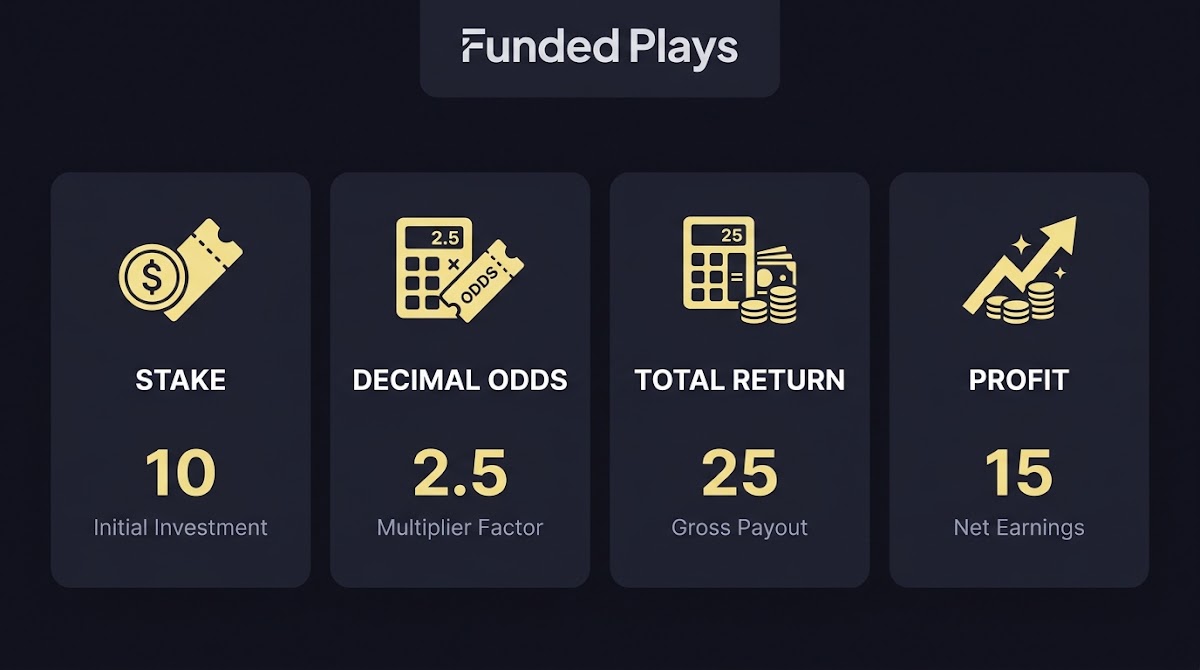
What decimal odds are and why they matter
Definition in one sentence: How Decimal Odds Work
Decimal odds show the total return you receive for each unit staked, so they map directly to payouts and are easy to use in calculators and spreadsheets. This straightforward mapping makes it possible to compute expected returns with a single multiplication and to show profit as stake times decimal minus one according to industry explanations Investopedia odds differences.
Compared with other formats, fractional odds typically show only the net profit for a successful outcome, and American odds use a plus or minus convention that reflects stake-relative payouts. Because decimal odds report total return, they are especially convenient when you want quick, unambiguous numbers for programming, spreadsheets, or multi-leg calculations.
Short example, one line: decimal 2.50 means each unit staked returns 2.50 units in total, of which 1.50 is profit on a one-unit stake.
Quick reminder of the payout and profit formulas
Use for quick manual checks
How decimal odds show total return and profit (the core formulas)
Formulas: total return and profit
The basic formulas are short and repeatable. Total return equals stake multiplied by the decimal odds, and profit equals stake multiplied by decimal minus one. These relationships make it simple to compute exact payouts without extra conversions in many cases Investopedia implied probability page.
In practical terms: if you stake S and the decimal price is d then total return = S × d and profit = S × (d − 1). Keep stakes and decimals as numbers in your spreadsheet to avoid display formatting issues.
Short numeric example
Worked example: stake $20, decimal 2.50. Step 1, total return = 20 × 2.50 = 50. Step 2, profit = 20 × (2.50 − 1) = 30. That yields $50 back from a $20 stake and $30 profit.
Converting between decimal, fractional, and American odds
Decimal to fractional and back
Conversions are algebraic and easy to implement in a sheet: fractional = decimal − 1, and decimal = fractional + 1. For example, decimal 2.50 corresponds to fractional 1.50, which you can express as 3/2 in fractional form. These conversion rules are standard and widely used in reference explanations Investopedia odds differences.
Practical tip: when storing fractional odds in a spreadsheet, keep them as numeric ratios rather than text to avoid accidental string formatting and to allow arithmetic operations for implied probabilities or expected values.
Try a Quick Conversion
Try a quick conversion in your spreadsheet: enter a decimal, subtract 1 to get the fractional profit, then add 1 to convert back and confirm you recover the original decimal.
American to decimal (positive and negative cases)
American odds convert to decimal with two simple rules. For positive American odds A use decimal = 1 + A/100. For negative American odds A use decimal = 1 + 100 / |A|. These formulas let you standardize a U.S. format into the decimal space for calculation and comparison Investopedia guide.
Spreadsheet-ready examples: +150 becomes 1 + 150/100 = 2.50. For −200 the decimal is 1 + 100/200 = 1.50. Always double-check the sign when copying American odds, since a misplaced sign yields the wrong conversion.
Quick conversion table to copy into a spreadsheet
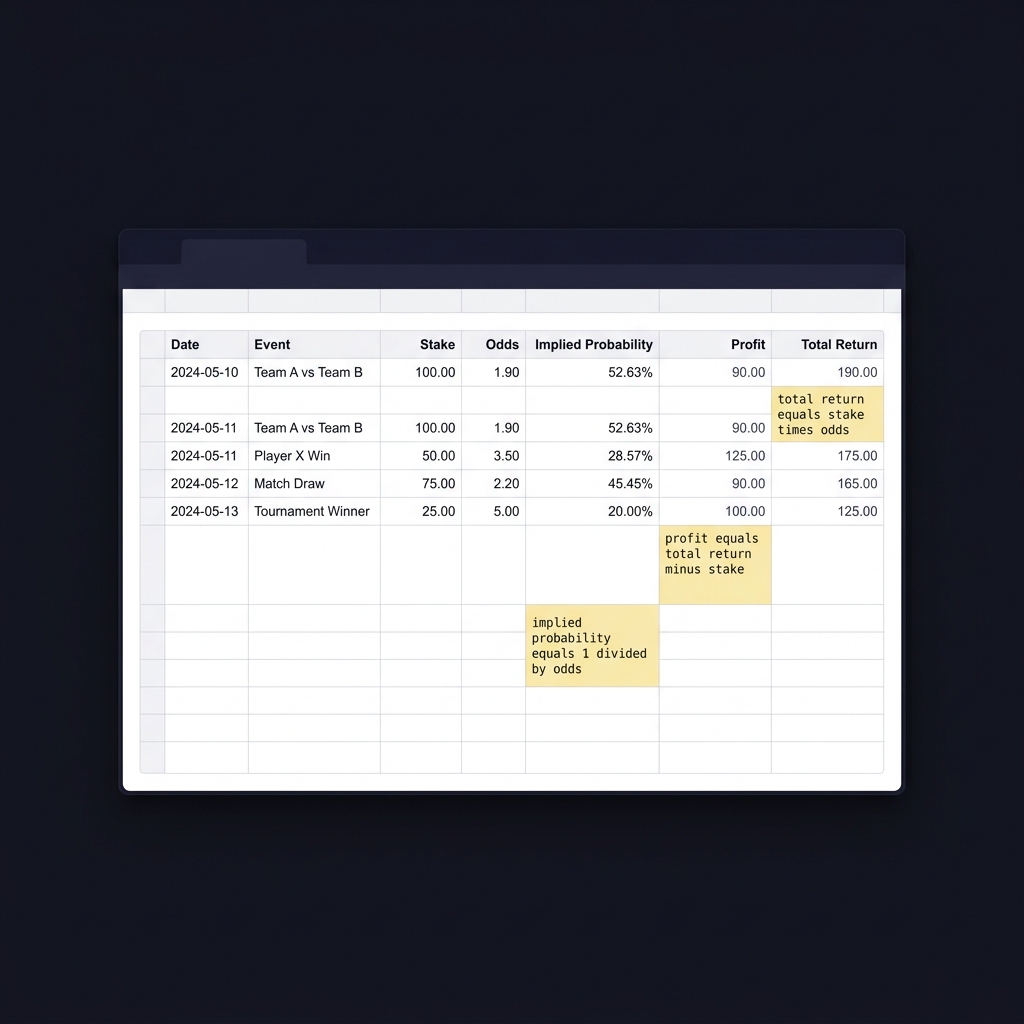
Copy-ready one-line formulas you can paste: total_return = stake*decimal; profit = stake*(decimal-1); implied_prob = 1/decimal; frac_profit = decimal-1; decimal_from_A_pos = 1 + A/100; decimal_from_A_neg = 1 + 100/ABS(A).
How to calculate implied probability from decimal odds
Formula and assumptions
The implied probability of an outcome given decimal odds d is 1 divided by d. This assumes you are reading the raw market price and are disregarding any bookmaker margin that may be embedded in the market price Investopedia implied probability page (Smarkets help).
Because implied probability is a simple reciprocal of the decimal, it is straightforward to implement in models and to compare with your own probability estimates. Remember that this is a model of chance based on price, not a statement of an objectively measured real-world frequency.
Example calculation and interpretation
Example: decimal 2.50 implies 1/2.50 = 0.40, or 40 percent implied probability. Use that as a market-implied benchmark rather than an absolute truth when comparing with your forecasts. You can also check with an implied-probability calculator such as Implied Probability Calculator.
Bookmaker margin and overround: what the implied probabilities miss
Definition of overround
When you sum the implied probabilities across all mutually exclusive market outcomes and the total exceeds 100 percent, the excess portion is the bookmaker margin commonly called the overround. That margin is how markets build in a spread between true probabilities and offered prices Investopedia overround definition.
Because overround inflates implied probabilities, you should not directly compare raw market implied probability to your model without adjustment. A simple proportional normalization is one quick correction, though more sophisticated margin-removal methods exist in analytic work.
Decimal odds show total return per unit staked; total return = stake × decimal, profit = stake × (decimal − 1), and implied probability = 1/decimal, with overround adjustments needed to remove bookmaker margin.
Quick check you can run: add the reciprocal of every decimal price in a market to see whether the sum is above 1.00 and by how much; that difference is the overround and indicates how much margin your comparison needs to account for.
How to spot margin-inflated probabilities
If a three-outcome market sums to, say, 1.08 after taking reciprocals, the 8 percent extra implies a margin rather than extra chance. From there you can rescale the implied probabilities by dividing each implied probability by the total sum to get a normalized probability distribution without the built-in margin.
Regional formats: where you will typically see decimal odds
Geographic conventions (Europe, Australia, Canada, U.S., UK/Irish racing)
Decimal odds are the prevailing format in many parts of the world, including Europe, Australia, and Canada, while American odds are still common in the United States and fractional odds retain currency in UK and Irish horse racing contexts. These patterns reflect regional market conventions rather than differences in mathematics Massachusetts Gaming Commission sports wagering overview.
When working across sources, identify the format early and convert to your canonical format so you do not mix representations in calculations. Many platforms provide a display setting to switch formats, which can reduce manual conversion errors.
Practical tip for international users
If you collaborate with users in different regions, agree on a standard internal format for models and automation, and convert at input and output boundaries. Decimal is often the most convenient canonical choice for automation and spreadsheets.
Step-by-step payout checks and sandbox testing for prediction challenges
Why small test stakes or simulated runs matter
Before you apply a change across many predictions or a larger bankroll, run a short sandbox test using tiny stakes or a demo environment. This confirms that your conversion and payout math align with what a platform actually returns and helps catch differences in rounding or platform-specific rules Investopedia implied probability page.

A 5-step sandbox checklist
Five-step checklist you can copy: 1) Choose a small test stake you can afford to treat as live practice. 2) Convert the displayed odds into your canonical decimal format. 3) Compute expected total return and profit using the formulas. 4) Place the test prediction in the platform demo or with a tiny real stake. 5) Verify the platform pays out the expected total return and that any fees or rules are applied as disclosed.
If the platform provides a virtual bankroll or demo challenge, prefer that for initial verification. Always read challenge rules and payout notes so you do not misinterpret differences between gross payout and any net adjustments a platform may apply.
Common mistakes and pitfalls when using decimal odds
Rounding errors and spreadsheet pitfalls
Rounding mistakes often come from hidden cell formats or percent displays in spreadsheets. Store decimals as plain numbers with enough precision and format only for display to avoid calculation drift and surprising totals BCLC GameSense odds guide.
Micro-example: if you round 2.333 to 2.33 for display but use the rounded value for many stakes, your cumulative error can be material across many predictions. Use stored full-precision values and format cells for presentation separately.
Misreading American signs or fractional forms
Mixing up the sign on American odds or treating fractional notation as total return rather than profit are common errors that lead to wrong payouts. Double-check a conversion on one stake before scaling a model that consumes many market prices.
Never assume a shorthand format means the same thing across sources; confirm whether a fractional is profit-based and whether an American number is positive or negative before converting to decimal.
Ignoring overround and fee adjustments
Treating raw implied probabilities as exact chances without adjusting for overround or platform fees can create systematic bias in value calculations. Check summed implied probability and read any platform fee or rule disclosures that may affect net returns.
Worked examples: step-through calculations you can copy
Single-leg payout example (decimal 2.50)
Step-by-step single-leg: 1) Stake = $20. 2) Decimal = 2.50. 3) Total return = 20 × 2.50 = 50. 4) Profit = 20 × (2.50 − 1) = 30. Result: receive $50, net +$30.

Multiple outcomes and overround example
Three-outcome market example: prices 1.80, 2.20, 3.60. Implied probabilities are 1/1.80 = 0.5556, 1/2.20 = 0.4545, 1/3.60 = 0.2778. Sum = 1.2879, so overround is 28.79 percent, indicating the market includes margin rather than representing a fair sum of probabilities. Use proportional rescaling or more advanced margin-removal techniques before comparing to your model.
American to decimal conversion worked example
Convert American +150 and −200. For +150 decimal = 1 + 150/100 = 2.50 so a $10 stake returns 10 × 2.50 = 25 total. For −200 decimal = 1 + 100/200 = 1.50 so a $10 stake returns 10 × 1.50 = 15 total. Check the signs carefully to avoid reversed conversions Investopedia odds differences.
Using decimal odds to compare markets and find value
Simple expected-value check
Expected value for a single bet uses your model probability and the market payout. Using decimal d and stake S, profit on win = S × (d − 1). If your model assigns probability p, then EV = p × S × (d − 1) − (1 − p) × S. Factor S out for a per-unit check: EV per unit = p × (d − 1) − (1 − p).
Before comparing model to market, adjust market implied probabilities for overround. That yields cleaner comparisons and reduces false positives for perceived value.
How to compare two markets with decimal odds
To compare markets, convert both to decimal, normalize implied probabilities if needed, and compute EV per unit for the same model probability. The market with the higher EV per unit is preferable under your model assumptions, acknowledging model error and uncertainty.
Quick formulas and a cheat sheet for spreadsheets or apps
One-line formulas to copy
Cheat sheet: total_return = stake * decimal. profit = stake * (decimal - 1). implied_probability = 1 / decimal. fractional_profit = decimal - 1. decimal_from_american_pos = 1 + A/100. decimal_from_american_neg = 1 + 100 / ABS(A).
Rounding and formatting recommendations
Store raw decimals to high precision in hidden cells, use separate formatted cells for display, and avoid percent formats for decimals until you intend to display probability. Keep a canonical decimal column and derive everything from that to ensure consistency across sheets and scripts.
How decimal odds relate to responsible participation and platform rules
Why understanding odds reduces mistakes
Clear odds understanding helps avoid unintended exposure and prevents errors that can arise when you misread payouts or mix formats during rapid decision cycles. Always confirm payout mechanics and any posted platform rules before scaling because platform rules can affect net outcomes and eligibility for rewards.
Responsible participation means using small tests, reading challenge rules, and remembering that historical performance does not guarantee future results; platforms may have specific withdrawal and reward rules that change net returns.
When to prefer decimal odds in research and prediction workflows
Use cases: modeling, portfolio-level checks, and automation
Decimal odds are efficient for algorithmic models, portfolio-level EV computations, and automation because one multiplication yields total return and profit follows directly. Keep decimal as your internal canonical format when building analytic pipelines to minimize conversion steps and errors. For more reading, see our blogs.
When another format might be convenient
Fractional or American formats may be convenient for local presentation or when working with legacy sources. Convert at the I/O boundary and keep one canonical representation internally to avoid mixing formats inside models.
A pre-submission checklist: what to verify before you place a stake or submit a prediction
Five quick verification steps
Five checks: confirm the displayed format, convert to decimal, compute expected total return and profit, check market overround, and verify platform rules that affect payouts. Run these on a tiny test stake if anything looks unfamiliar.
Troubleshooting common platform differences
If platform payouts do not match your calculation, check rounding conventions, whether the platform rounds to cents or whole units, and any posted fees or special rule clauses. If needed, run an extra test stake or contact platform support with your worksheet for clarification.
Summary and next steps
Key takeaways
Three essentials to remember: decimal odds show total return and profit = stake × (decimal − 1); implied probability = 1/decimal but watch for overround; and convert and test with small stakes or sandbox runs before you scale.
Where to learn more
Practice conversions in a spreadsheet, run sandbox tests using demo or virtual tools, and consult regulator and education pages for odds and responsible participation guidance. For longer reads and updates, see the Funded Plays blog overview.
Multiply your stake by decimal minus one; profit = stake × (decimal − 1).
Implied probability is the reciprocal of the decimal price, 1/decimal, and reflects the market price rather than an absolute chance.
Sum the reciprocals of all market decimals to find the overround, then normalize each implied probability by dividing by the sum to approximate a margin-free distribution.
References
- https://www.investopedia.com/ask/answers/071615/what-are-differences-between-american-odds-fractional-odds-and-decimal-odds.asp
- https://www.investopedia.com/terms/i/implied-probability.asp
- https://www.investopedia.com/terms/o/overround.asp
- https://www.investopedia.com/articles/investing/042115/betting-basics-fractional-decimal-american-moneyline-odds.asp
- https://help.smarkets.com/hc/en-gb/articles/214058369-How-to-calculate-implied-probability-in-betting
- https://www.omnicalculator.com/statistics/implied-probability
- https://massgaming.com/sports-wagering-101/
- https://www.fundedplays.com/challenges
- https://www.fundedplays.com
- https://www.fundedplays.com/blogs/how-fundedplays-evaluations-work
- https://www.gamesense.com/understanding-odds.html
- https://www.fundedplays.com/blogs