
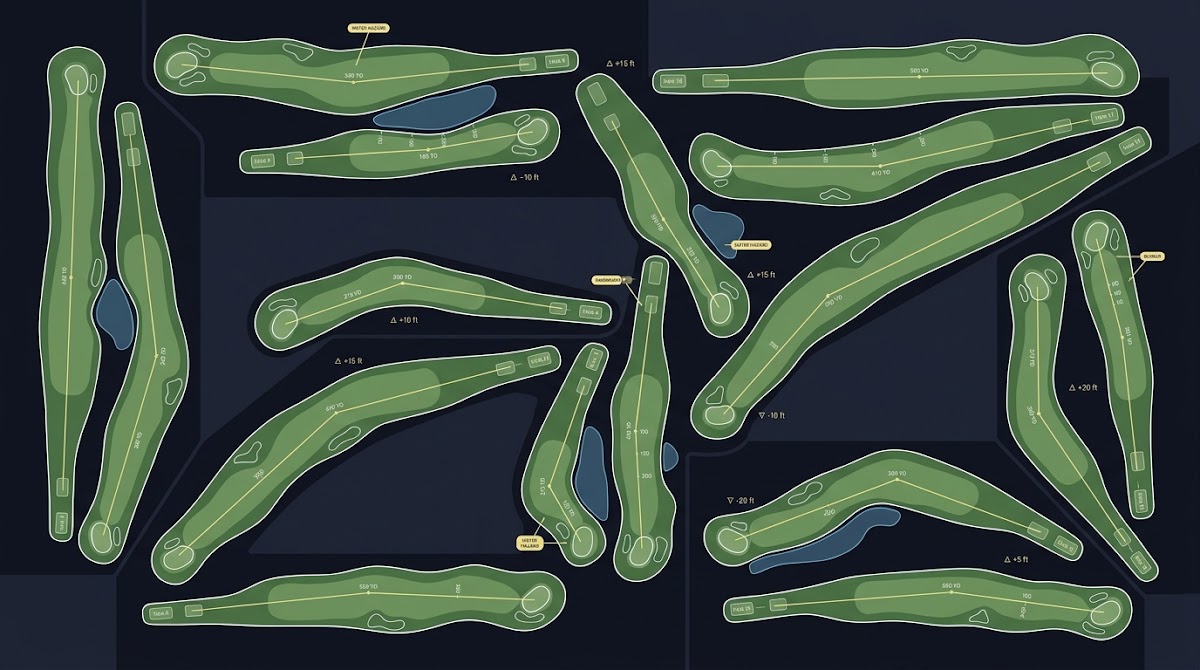
How Course Length Changes Player Advantage: definition and context
How Course Length Changes Player Advantage begins with a simple but important distinction: measured yardage is the raw number printed on a scorecard, while effective playing length accounts for factors that make a hole play longer or shorter in practice. The USGA Course Rating System sets out how those adjustments work, and it treats effective playing length as the metric that better predicts scoring outcomes rather than raw yardage alone USGA Course Rating System.
Measured yardage is straightforward to record, but it can mislead when roll, elevation, prevailing wind, altitude, or forced layups change how long shots actually play from the tee to the green. For players and organizers assessing fairness or competitive balance, that difference matters because effective playing length is what rating systems use to estimate difficulty and handicap numbers, not the headline yardage.
Get the Yardage vs Effective-Length Checklist
Download a one-page checklist to compare measured yardage and effective playing length before making course adjustments. It lists the main on-course checks and simple data points to collect.
For a short example, imagine two par-4s both listed as 420 yards on the card. One sits on firm ground with a downhill fairway that allows roll, while the other forces a layup over hazards and plays uphill into a prevailing wind. Even though the printed yardage matches, the second hole's effective playing length will be higher and will tend to favor players who hit the ball farther from the tee.
That difference is why coaches, club managers, and competitive players should focus on effective playing length when they ask how course length shifts advantage across their member base or field. See more context on our blog.

How course rating systems quantify effective playing length
The USGA Course Rating framework converts raw yardage into an effective playing length by adjusting for several specific modifiers, including roll, elevation, wind, altitude, and forced layups. These adjustments are built into the official rating approach so that two holes with identical measured yardage can receive different difficulty assessments based on how they play in real conditions Course Rating vs. Slope Rating.
Key adjustments used to estimate effective playing length include:
- Roll, which can shorten the effective distance when firm turf or slopes add yards after the ball lands.
- Elevation, where downhill holes play shorter and uphill holes play longer.
- Wind, especially prevailing wind directions that systematically help or hinder tee shots.
- Altitude, since thinner air at higher elevations reduces aerodynamic drag and extends carry and roll.
- Forced layups and required positioning, which can lengthen a hole's effective playing distance by removing the option to attack.
The World Handicap System 2024 update added a Short Course Handicap mechanism to handle very short layouts more consistently, which improved the ability to compare player performance across short and long venues without bias from conventional yardage metrics World Handicap System 2024 guidance.

Practically, this means that when clubs and analysts compare two courses or different tee setups, they should use effective playing length and official rating adjustments rather than raw yardage to anticipate scoring effects and handicap impacts.
Why distance typically becomes more valuable as holes get longer
The concept of marginal value of distance says that an extra yard from the tee is more likely to reduce approach distance and increase scoring leverage on longer holes than on very short ones. Analytics work that estimates distance value across hole lengths finds that the benefit of added driving distance generally increases with hole length, shifting advantage toward longer hitters on longer courses How Valuable Is Distance? analysis.
Mechanically, longer tee shots reduce the remaining yardage to the green, making approaches shorter and often easier, which raises the probability of hitting the green in regulation. That mechanism explains why long hitters often show a scoring edge on longer holes and courses.
Course length affects player advantage through effective playing length adjustments and approach-distance distributions; longer holes tend to favor longer hitters, but local player mix, hole design, and setup modifiers determine the actual winners and losers.
At the tour level, data from recent seasons show that longer hitters tend to post lower scoring averages overall, though course setup can narrow that gap. When organizers design courses with more positional, short-iron approaches, or when they penalize roll and favor precision, the pure distance advantage is reduced PGA TOUR scoring statistics.
For analysts modeling advantage by length, approach-distance distributions are the key transmission mechanism: they show how changes in tee-out distance map to approach shots and ultimately to scoring outcomes.
How player populations change who benefits from added yardage
Not all groups gain equally when a course gets longer. 2024 amateur shot-tracking reports document substantial variation in average driving distance by age and handicap, which means the same yardage change can help younger, longer-hitting members while disadvantaging older or higher-handicap players 2024 Arccos Distance Report.
For a club that serves mostly older players, lengthening tees to match a regional championship standard could increase approach distances for a large share of players and make many holes effectively harder. Conversely, venues with stronger, lower-handicap regulars may see a length increase reinforce their existing scoring advantages.
Before changing yardage or tee placements, decision-makers should assess their local player pool by simple segments such as age brackets and handicap bands. That assessment clarifies who gains, who loses, and what mitigation options like forward tees or multiple tee boxes are appropriate.
Modeling effective playing length for analysis and forecasting
Analysts who want to estimate how yardage changes will shift advantage should start with a concise set of primary inputs: effective playing length per hole, the approach-distance distribution for the relevant player groups, and hole-level features that force or remove options. Using those inputs makes it possible to model how a tee change shifts expected approach distances and scoring probabilities USGA Course Rating System.
Primary model inputs should include a) hole-level effective playing length, b) approach-distance distribution by player segment and tee, and c) a mapping of approach distance to scoring probability derived from shot-tracking or historical scoring data. Secondary modifiers that matter include wind patterns, turf firmness and fairway roll, and forced-layup design elements, since those change effective outcomes without altering raw yardage.
Below is a short checklist to structure a modeling workflow:
- Collect effective playing length for each hole using rating adjustments and course notes.
- Assemble approach-distance distributions for the target player segments.
- Estimate how a yardage change shifts approach-distance bins for each group.
- Translate approach-distance shifts into expected changes in green-in-regulation and scoring probabilities.
- Run sensitivity tests for wind, firmness, and forced-layup scenarios.

Using this framework, analysts can produce estimates of who benefits under realistic conditions and identify where alternate tees or minor routing changes would restore balance without wholesale redesigns. Learn more on the Funded Plays homepage.
Decision criteria for clubs and tournament organizers
When deciding whether to lengthen or shorten a course, start with clear goals: the intended field, desired scoring range, and whether the club prioritizes member enjoyment, competitive challenge, or tournament standards. These goals should guide any yardage changes.
Practical decision checklist for yardage changes:
- Define the target player mix: members, elites, or mixed fields.
- Evaluate effective playing length rather than only measured yardage.
- Project approach-distance shifts by player segment using local data where possible.
- Consider operational impacts on pace of play and safety when adding length.
- Test changes with alternate tees or temporary tee markers before permanent work.
Maintenance and routing constraints can limit options. In many cases, alternate tees or minor re-routing provide more flexible, cost-effective ways to tune competitive balance than adding significant new yardage, because they can change effective playing length for targeted groups while minimizing construction and upkeep impacts R&A and USGA Distance Insights.
When deciding whether to lengthen or shorten a course, start with clear goals: the intended field, desired scoring range, and whether the club prioritizes member enjoyment, competitive challenge, or tournament standards. These goals should guide any yardage changes.

How players adapt tactics and club selection by course length
On longer layouts, club selection often shifts toward maximizing distance from the tee. Players who can confidently hit driver more often will see their average approach distances shrink, increasing the chance to hit greens in regulation and lower scores. That simple tactical shift is one reason longer courses favor long hitters in many matchups How Valuable Is Distance? analysis.
Example tactical adjustments for different course types include choosing a 3-wood or hybrid off the tee on tight holes, prioritizing fairway position over raw distance when forced-layup lines are present, and selecting longer or shorter irons into greens depending on approach distance variance.
Quick approach-distance comparison by tee and player group
Use as a starting point for simple scenario checks
For short or tight courses that reward position and wedge play, players should emphasize club choices that leave consistent yardages into greens and focus on short-game percentage gains rather than adding distance. Practicing recovery shots and wedge accuracy typically yields more benefit on those courses than chasing more yards off the tee.
Typical mistakes and misinterpretations when assessing length effects
A common error is over-relying on measured yardage and ignoring effective playing length adjustments. Raw yardage alone misses key playability factors and can lead to incorrect conclusions about who benefits from a change USGA Course Rating System.
Other frequent mistakes include extrapolating professional tour results directly to amateur populations, and overlooking wind, firmness, or forced-layup features that alter effective outcomes. The WHS Short Course Handicap update reduced some short-course comparison errors, but analysts still need local, hole-level context to draw correct conclusions World Handicap System 2024 guidance.
Simple checks that help avoid these mistakes are comparing approach-distance distributions between relevant groups, testing proposed tee changes on a sample of holes, and running sensitivity analyses around wind and firmness scenarios rather than relying on a single estimate.
Practical example: how a yardage change shifts advantage for a club's member base
Set up a realistic scenario using amateur distance distributions. Suppose a club has two main segments: older social members with an average drive near 220 yards and competitive members averaging 260 yards. If the club lengthens the back tees by 20 to 40 yards per hole, average approach distances for the two groups diverge further, making several par-4s play substantially more difficult for the shorter-hitting group 2024 Arccos Distance Report.
Step-by-step assessment for that scenario:
- Calculate new effective playing length for each affected hole using local roll and elevation notes.
- Estimate how the added tee yards change approach-distance bins for each segment.
- Translate approach-distance changes into expected green-in-regulation shifts using local or published shot maps.
- Summarize outcomes: which holes become significantly harder for the shorter group, and how many shots the change might cost on average.
Expected practical outcomes often include the need for forward tees or revised yardage options to preserve playability for the shorter-hitting members, and a communication plan so members understand the rationale for changes and have clear alternatives.
Practical example: how tour setups reflect the distance advantage
Tour-level evidence reinforces the principle that distance often correlates with lower scoring averages. PGA TOUR statistics from recent seasons show that many of the lower scorers are strong off the tee, especially on longer setups where approach distances shrink for the longest hitters PGA TOUR scoring statistics.
Organizers can, however, design setups that narrow this gap by creating holes that reward precise positioning, introduce tight landing areas, or emphasize approach angles where short irons prevail. Those choices reduce driving distance value and shift the skill premium toward accuracy and short-game creativity.
For players and coaches, the tour evidence is useful as an existence proof that distance matters, while reminding practitioners to avoid simple extrapolation: amateur populations and course conditions often change the size and direction of the advantage.
How architects and route planners use length alongside other features
Architects balance length with features like forced layups, bunker placement, and green angles to shape how holes play. A relatively short hole with an angled green and penal bunkers can play longer in effective terms than a longer hole that offers run and recover options R&A and USGA Distance Insights.
Practical constraints such as property limits, maintenance budgets, and sustainability goals often prevent simple length changes. Instead, architects use routing, tee placement variety, and hazard positioning to tailor effective playing length to the desired player experience without requiring large-scale land changes.
When architects aim for equitable play across skill tiers, they plan multiple teeing grounds, consider forward options that stay on-line, and use subtle green and bunker shaping to achieve the intended balance instead of relying solely on yardage.
Open questions and future uncertainties for 2026 analyses
Several open issues remain for analysts through 2026. Equipment rule changes and evolving tee-placement policies could shift where the advantage sits across player speed tiers, and ongoing shot-tracking expansion would improve confidence in estimates. These uncertainties matter when projecting long-term effects of static yardage changes R&A and USGA Distance Insights.
Data improvements that would reduce uncertainty include more hole-level records of effective playing length, expanded amateur shot-tracking across geographic regions, and standard reporting of approach-distance distributions by handicap band. Those inputs would let clubs and analysts move from rough scenario checks to more precise forecasts of who benefits from yardage changes.
Conclusion: practical takeaways and next steps for readers
Key rules of thumb are simple. First, treat effective playing length as the operative measure when assessing how yardage affects scoring; raw yardage alone is misleading. Second, recognize that the marginal value of distance rises on longer holes, so added yardage tends to favor longer hitters. Third, always consider the local player mix before committing to yardage changes, since older or higher-handicap populations often experience larger relative impacts USGA Course Rating System.
Actions for players, clubs, and analysts include checking effective playing length before changing tees, analyzing approach-distance shifts for relevant player groups, and testing changes with temporary tees or alternate routing where possible. These steps let stakeholders tune competitive balance without unintended consequences. See our evaluation approach for more detail: how Funded Plays evaluations work.
Ultimately, how a course plays is the result of many interacting factors. Length is powerful, but its effect depends on effective playing length adjustments, hole design, and the players who use the course. Careful measurement and modest experiments often produce better outcomes than large, irreversible changes.
Effective playing length adjusts raw yardage for roll, elevation, wind, altitude, and forced layups to better reflect how a hole plays and to predict scoring difficulty.
Not always; longer courses tend to favor distance on average, but player mix, hole design, and setup choices can narrow or reverse that advantage.
Test with temporary tees or markers, analyze approach-distance shifts for local player segments, and run sensitivity checks for wind and firmness before permanent work.
References
- https://www.usga.org/handicapping/course-rating.html
- https://www.usga.org/handicapping/whs-2024.html
- https://datagolf.com/how-valuable-is-distance
- https://www.pgatour.com/stats/stat.120.y2024.html
- https://arccosgolf.com/blogs/resources/2024-arccos-distance-report
- https://www.fundedplays.com/challenges
- https://www.fundedplays.com
- https://www.fundedplays.com/blogs
- https://www.fundedplays.com/blogs/how-fundedplays-evaluations-work
- https://www.usga.org/content/usga/home-page/articles/2024/10/course-rating-vs-slope-rating.html
- https://www.randa.org/en/what-is-golf/our-work/distance-insights