

What confirmation bias means for sports analysis
A concise definition
How Confirmation Bias Distorts Sports Analysis is easy to see once you know what to look for: it is the tendency to favor information that confirms an existing belief while ignoring or downplaying evidence that contradicts it. In sports contexts that tendency shows up when an analyst, fan, or handicapper selectively collects statistics or highlights that support a favored view and discounts counterexamples.
Look for signs like only citing supporting stats, dismissing contrary data quickly, and feeling defensive about alternative views. A short precommitment checklist and a decision log reveal these patterns.
Why it matters in match and player evaluation
Confirmation bias matters because a series of small, undetected preferences in what you notice and remember compounds into systematically worse forecasts. When a decision maker repeatedly gives more weight to confirming signals, they effectively narrow the data set that informs future calls. Over weeks and months that narrowing can shift an otherwise disciplined approach into one that chases narratives rather than outcomes.
To separate confirmation bias from related effects, note three nearby concepts. Anchoring happens when an early piece of information fixes expectations too strongly. Selection bias arises when the sample you analyze is not representative of the broader population. All three distort judgment, but confirmation bias specifically describes the interpretive filter that privileges supportive evidence while minimizing discordant data.
How confirmation bias forms in sports contexts
Sources: fandom, limited data, and narrative thinking
Several common psychological and situational triggers make confirmation bias likely in sports analysis. Team loyalty and fandom create a lens through which the same event looks friendlier to a supporter than to a neutral observer. A short run of good performances can look like proof of a trend when it is actually a small sample. Media highlights and replays elevate memorable plays and can skew what analysts remember from a game.
Common triggers before and during a season
Recency effects amplify short streaks, making the latest outcome feel more informative than it statistically is. Small sample size problems mean early-season results or a few games against weak opponents can be misleading. Narrative fallacy turns a string of events into a tidy story, and that story then filters which facts are noticed. Recognizing these triggers helps you treat surface-level impressions as provisional hypotheses rather than final judgments.
Early warning signs: how to spot bias in your own process
Checklist of cognitive red flags
Spotting bias starts with a short list of red flags you can use immediately. Watch for hunting for confirming stats only, dismissing contrary metrics as irrelevant, and forming explanations that rely on selective plays or moments rather than consistent patterns. If you feel defensive about alternative views or find yourself arguing to preserve a pick, that defensiveness is itself a sign to pause.
Quick self-assessments to apply before placing a prediction
Run a five-minute self-audit before locking a prediction. Ask whether you deliberately looked for disconfirming cases and whether you checked sample sizes and opponent context. If the answer is no, stop and perform one quick falsification check: identify a plausible scenario that would prove your pick wrong, and estimate how likely that scenario is.
Practice disciplined evaluation with structured challenges described on the FundedPlays Challenges page
Download or print this article's quick checklist to use before every match. It fits on one page and is designed for rapid self-audit without adding time to your routine.
Simple examples show how the same event can be read differently without bias. A striker scoring two tap-ins against a weak opponent can look like a return to form to a fan. A more neutral read would note the quality of chances, opponent context, and whether the striker’s underlying process changed. The checklist trains you to ask for that context before rewarding the headline outcome.
A practical framework to detect and counter confirmation bias
Four-step framework: question, collect, test, decide
Use a short, repeatable four-step process to keep analysis honest. Step one, explicitly state your hypothesis about the match or market. Step two, collect evidence deliberately including data that could disprove the hypothesis. Step three, test alternative explanations and run a rapid falsification check. Step four, decide using pre-defined criteria such as minimum effect size or sample thresholds and record the rationale.
This framework forces a habit of seeking disconfirming evidence instead of assembling only supportive facts. Treat the hypothesis like a scientific claim and try, briefly, to break it. That practice reduces the power of narrative thinking and emotional attachment to a single view.

One practical advantage of repeating this framework in a low-risk environment is that you build the habit of structured evaluation. Skill-focused simulation platforms let you practice the steps without committing funds in a real-money market, but outcomes still depend on your decisions and discipline. Read more on our blog about practice and evaluation routines.
Decision criteria: how to evaluate evidence and models
Signal quality: sample size, variance, and context
Not all signals are equal. Strong signals come from adequate sample sizes, consistent effect sizes, and a close contextual fit between the observed data and the match conditions you face. Small samples and high variance increase the chance that a visible pattern is noise rather than signal. Whenever possible, prefer measures that capture process rather than result alone, for example quality of chances or frequency of high-value events instead of raw scoring totals.
When to trust a model and when to override it
Models are tools, not oracles. Trust a model when its assumptions match the present conditions, its inputs are stable and appropriate, and it has demonstrated predictive value on out-of-sample cases. Override a model when you can point to a clear regime change, a data input that the model lacks, or a documented overfitting tendency. When you override, record the reason and set a short horizon to reassess that decision to avoid persistent subjective drift.
Simple qualitative checks reduce model failure risk. Inspect recent model predictions for systematic misses, check whether the training set resembles the current sample, and test sensitivity to extreme inputs. These safeguards make it easier to distinguish a single surprising outcome from a genuine model failure.
Objective pre-match checklist to limit biased calls
Precommitment and bet-slate rules
An objective pre-match routine reduces impulse decisions. Start by writing your hypothesis and the conditions that would falsify it. Set stake rules in advance so that you do not escalate after short-term losses. Outline a maximum stake per pick and a cooling-off rule for emotional reactions.
Rapid sanity checks before finalizing a pick
Perform quick sanity checks: cross-verify a statistic across at least two sources, check recent head-to-head context, and confirm sample sizes are sufficient for the signal you are using. Snapshot your rationale so that you can review it after the match. That snapshot aids later post-match review and makes pattern detection easier.
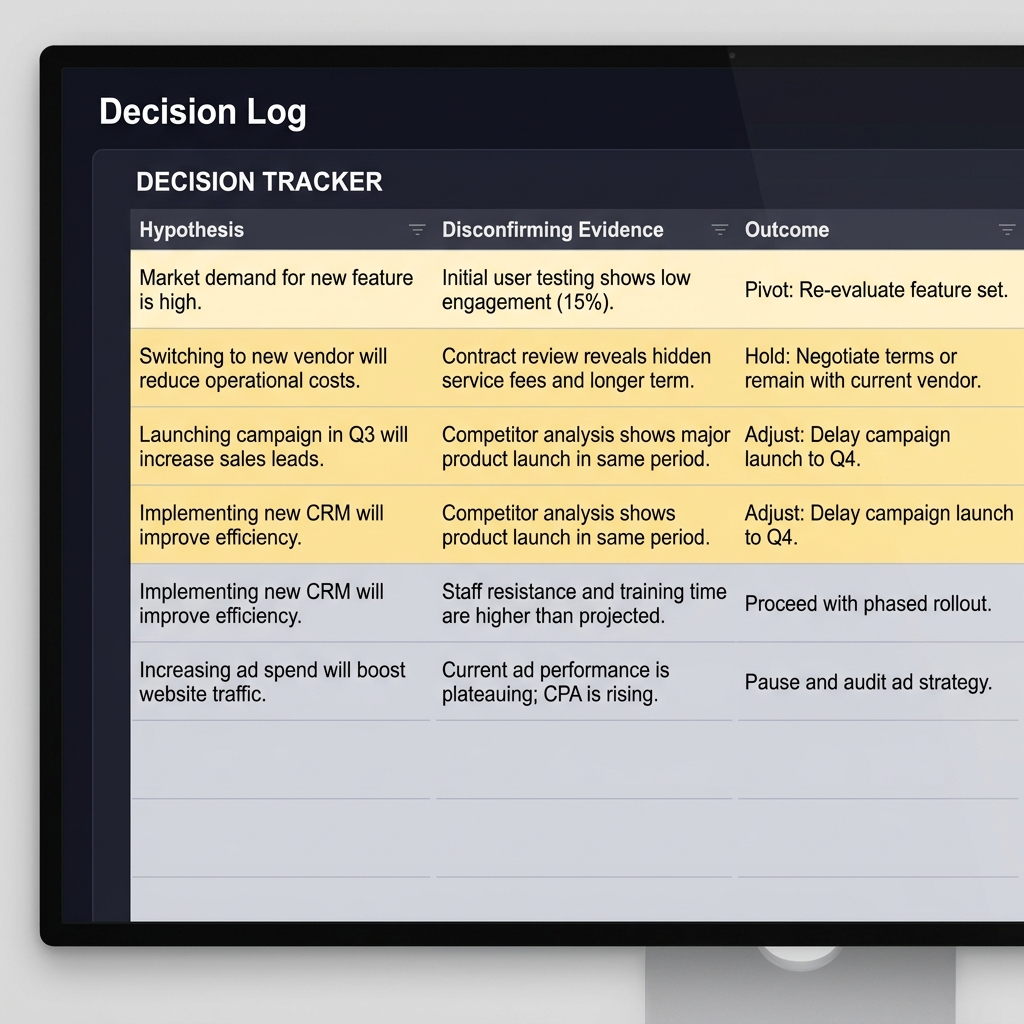
Keeping a compact decision log makes this routine practical. Record the hypothesis, stake, disconfirming evidence, and why you made the call. Over time the log becomes a mirror that reveals systematic bias patterns and helps you refine your precommitment strategy.

Typical errors and cognitive traps that look like analysis
Common missteps: cherry-picking, story bias, and hindsight rationalization
Many mistakes masquerade as careful analysis. Cherry-picking selects the one metric that supports a desired conclusion. Story bias fits results into a tidy narrative after the fact, and hindsight rationalization retrofits explanations to events that surprised you. Each of these traps feels persuasive because it produces a cohesive account, but cohesion is not the same as predictive value.
How emotion and identity amplify mistakes
Emotional attachment increases the cost of being wrong and so strengthens the urge to defend a pick. Identity, such as being known as a devotee of a team or a specialist in a sport, can make people keep improbable positions to preserve reputation. Recognizing that emotion and identity drive interpretation is the first step in defusing their impact.
a simple tracking spreadsheet template to record picks and bias signals
copy this table into a new spreadsheet to start tracking
Practical remediation includes forcing at least one opposing explanation into your writeup and waiting a short cooling-off period before finalizing a pick. Time-delayed review reduces the immediate pull of emotion and increases the chance that you will see flaws in your reasoning.
Practical example 1: evaluating a favorite team without bias
Step-by-step walkthrough of a pre-match analysis
Imagine you support a team that has won three matches in a row and you are tempted to back them again. Start by writing the hypothesis: the team will continue to win because X, Y, and Z. Next list what would disprove that hypothesis such as a key player absence, a shift in opponent tactics, or poor underlying metrics.
What to record and why it matters
Collect evidence including average chance quality, opponent strength, and scheduling effects. Run a quick falsification: identify a realistic scenario that would produce the opposite result and estimate its probability. Decide only after your disconfirming list is nonempty and after you set a stake consistent with the confidence you have. Record the full decision so you can review it after the match and separate luck from genuine process improvement.
Practical example 2: model signals versus human intuition
When models disagree with gut feeling
Picture a model that favors the away side while your experience and recent viewing suggest the home side looks sharper. Rather than choosing sides immediately, follow a reconciliation protocol. First, check the model inputs for freshness and relevance. Second, test whether the model trained on data matching current conditions. Third, list what additional information your intuition uses and whether that information can be coded or approximated for the model.
A protocol for reconciling differences
Use a short checklist to reconcile model and intuition. If the model fails a basic data-fit check, favor a cautious human override with a clear reassessment window. If intuition rests on a single observable that you cannot validate independently, prefer the model but reduce stake size. Document the decision and the rationale so you can later evaluate which approach produced better results and whether bias influenced your call.
Designing simple tests and experiments to reveal bias
A/B style tests for picks and strategies
Run low-effort A/B style experiments to expose biased behavior. Split similar ideas into two groups: one filtered through your usual process and one that forces disconfirming evidence. Track outcomes for both groups and compare simple metrics such as win rate and return per unit risk. Keep runs modest and focused so that you reduce the temptation to chase noise.
How to interpret results and avoid false positives
Small test runs produce noisy outcomes. Treat early results as provisional and focus on whether one method produces consistent directional differences rather than immediate statistical certainty. Use simple stopping rules and update rules that translate experimental insights into clear decision thresholds rather than ad hoc changes.
A short tracking template with dates, group label, stake, and outcome makes experiments reproducible and reviewable. Over time you will see which procedural changes reduce bias and which simply shift exposure to different risks.
Incorporating analytics, watchlists, and guardrails
How to use analytics to reduce bias, not amplify it
Analytics help when used to measure process rather than to confirm a favored narrative. Prefer sandboxed metrics such as adjusted chance quality or possession danger measures that highlight reproducible signals. Avoid chasing a single number because that encourages metric-chasing where you optimize a headline measure rather than predictive value.
Practical guardrails to enforce discipline
Implement concrete guardrails such as stake caps, mandatory cooling-off periods after a loss, and automated alerts when you deviate from your usual stake distribution. Keep a focused watchlist of teams or players you follow closely so you do not overextend analysis across too many cases and fall back on surface impressions.

Bankroll and risk management to reduce biased decisions
Why fixed stake rules matter
Fixed stake rules prevent emotional escalation. When you commit to a flat stake plan or a small percent-of-bankroll approach, you reduce the urge to chase recent losses or to inflate stakes on favorite teams. Those simple rules convert judgment improvements into durable risk control and reduce the pressure to rationalize bets after the fact.
Simple money management templates
Two immediate templates are practical. A flat stake plan keeps risk constant per pick and makes performance comparisons straightforward. A percent-of-bankroll plan scales risk to account size but requires discipline in setting sensible percentages. Separate an experimental testing bankroll from your performance account so that you can try new signals without contaminating the main track record.
Building a habit of disciplined, bias-resistant analysis
Weekly review routines
Set a weekly review to examine your decision log and look for patterns. Compute simple summary metrics such as hit rate, average stake, and return per unit risk for different pick types. Use the review to adjust guardrails and to identify recurring bias types such as favorite-team effect or overreliance on recency.
Using decision logs to identify patterns
Decision logs are the most reliable mirror of behavioral bias. They make invisible habits visible by linking rationale to outcome. Over months you can see whether changes in process, like forcing a falsification step, altered outcomes. Share select entries with a peer or accountability partner to surface blind spots and to test whether your written rationale would persuade an impartial reader.
Conclusion: clear next steps and resources to keep improving
A short action plan for the next 30 days
For the next 30 days adopt three simple actions. First, use the pre-match checklist for every pick and snapshot the rationale. Second, run one small A/B experiment that forces disconfirming evidence for half your picks. Third, keep a decision log and perform a weekly review to spot recurring bias patterns. These actions create a feedback loop that promotes continuous improvement. Also review how Funded Plays evaluations work to align simulation practice with evaluation best practices.
Where to go from here
Confirmation bias will remain a recurring challenge, but structured routines and deliberate practice reduce its influence. Use analytic guardrails and simple experiments to turn subjective impressions into testable hypotheses. Practicing in a skill-focused simulation environment like Funded Plays can accelerate habit formation, while remembering that no platform guarantees results and that disciplined process is the source of long-term improvement.
It is the tendency to notice and weigh information that supports an existing belief while ignoring contradicting evidence, leading to skewed predictions.
No, but you can reduce its impact with precommitment routines, forced falsification checks, and regular decision log reviews.
Improvements show over weeks to months as habits and reviews reveal patterns; short experiments help speed learning but results are not guaranteed.
References
- https://thedecisionlab.com/biases/confirmation-bias
- https://journalistsresource.org/home/confirmation-bias-strategies-to-avoid-it/
- https://pmc.ncbi.nlm.nih.gov/articles/PMC12660316/
- https://www.fundedplays.com
- https://www.fundedplays.com/blogs
- https://www.fundedplays.com/blogs/how-fundedplays-evaluations-work
- https://www.fundedplays.com/challenges