
What American odds mean: a plain-language definition and context
How American Odds Work starts with a simple definition: American odds, often called moneyline odds, are the U.S. display format that shows how much you would win relative to a base amount. The format uses a plus sign for potential profit on a $100 stake and a minus sign to show the stake required to win $100, and this presentation is the default display in U.S. markets according to standard references on odds and betting formats Wikipedia Odds (gambling) entry.
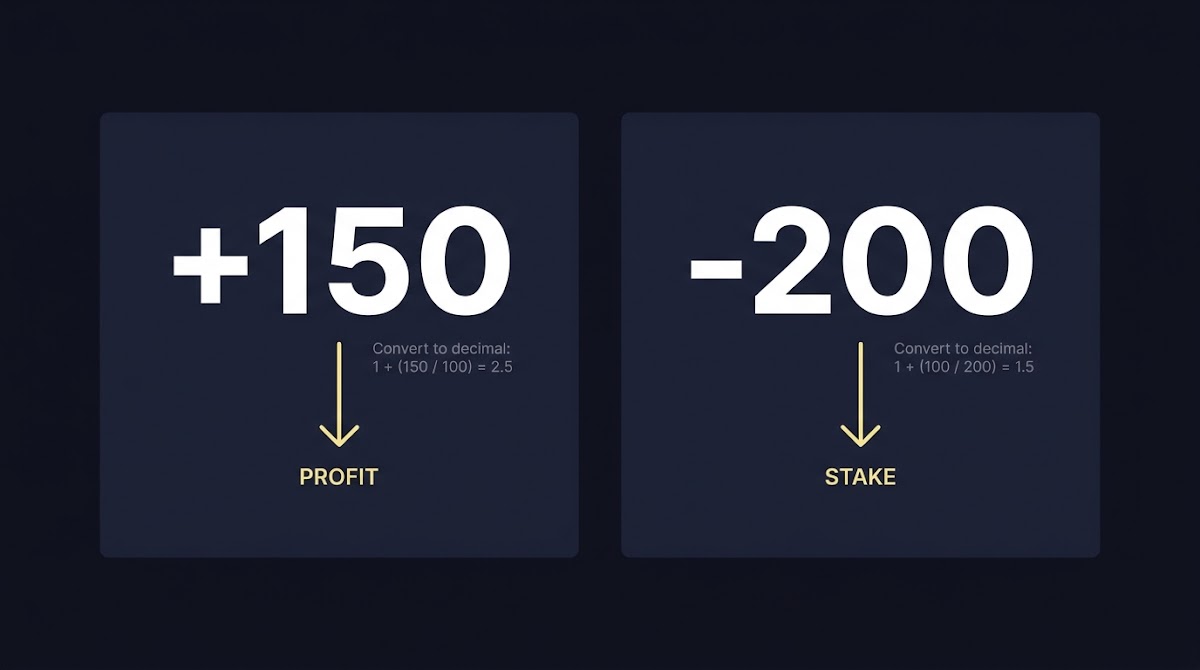
In everyday terms, a positive value like +150 tells you how much profit a $100 stake would return, while a negative value like -200 tells you how much you must stake to earn $100 in profit. This way of showing price is simply a display choice; it represents the same underlying probability that decimal or fractional odds also encode, so conversions let you compare prices across formats easily DraftKings help center article.
How to convert American odds to implied probability (formulas and short examples)
To turn American odds into an implied probability, use the standard formulas: for positive odds +A use P = 100 / (A + 100), and for negative odds -A use P = A / (A + 100). Writing the rule this way makes it easy to apply to any signed American number, and the approach is the same across reputable betting education resources Investopedia implied probability guide. You can also try an implied probability calculator if you want a quick check.
Worked example 1, positive case: +150 means A = 150, so P = 100 / (150 + 100) = 100 / 250 = 0.40, or 40 percent implied probability. This tells you the market price encodes about a 40 percent chance for that outcome.
American odds use plus signs to show profit on a $100 stake and minus signs to show the stake required to win $100; use the standard formulas to convert to implied probability and decimal odds so you can calculate expected payouts and compare prices.
Worked example 2, negative case: -200 means A = 200 (absolute value), so P = 200 / (200 + 100) = 200 / 300 = 0.666..., or about 66.7 percent implied probability. That percentage shows the market price that corresponds to the favorite in that matchup. The formulas above do not adjust for bookmaker margin; raw implied probabilities reflect the market price before any margin-correction.
Before moving on, try converting a different headline number such as +250 with the same rules to check your mental math. This quick practice helps make the conversion routine when reviewing lines.

Convert American odds to decimal and fractional formats
Converting American odds to decimal odds is straightforward: for positive odds +A, decimal = 1 + A/100; for negative odds -A, decimal = 1 + 100/A, where A is the absolute value. This conversion gives the total return per unit stake and is a common tool for comparing prices across providers Pinnacle conversion guide. For quick conversions you can also use Pinnacle's odds converter Odds Converter Calculator.
Worked conversion for +150: apply decimal = 1 + 150/100 = 1 + 1.5 = 2.5. That decimal tells you a $1 stake returns $2.50 total, which matches the payout interpretation that a $100 stake returns $250.
Worked conversion for -200: apply decimal = 1 + 100/200 = 1 + 0.5 = 1.5. That means a $1 stake returns $1.50 total, aligning with the rule that staking $200 wins $100 for a $300 total return. Fractional odds express the same relations in another readable form; converting between fractional and decimal is routine once you have the decimal value.
Convert American odds to decimal odds quickly
Use American Odds as signed numbers
Payout mechanics and worked examples: what +150 and -200 mean in cash terms
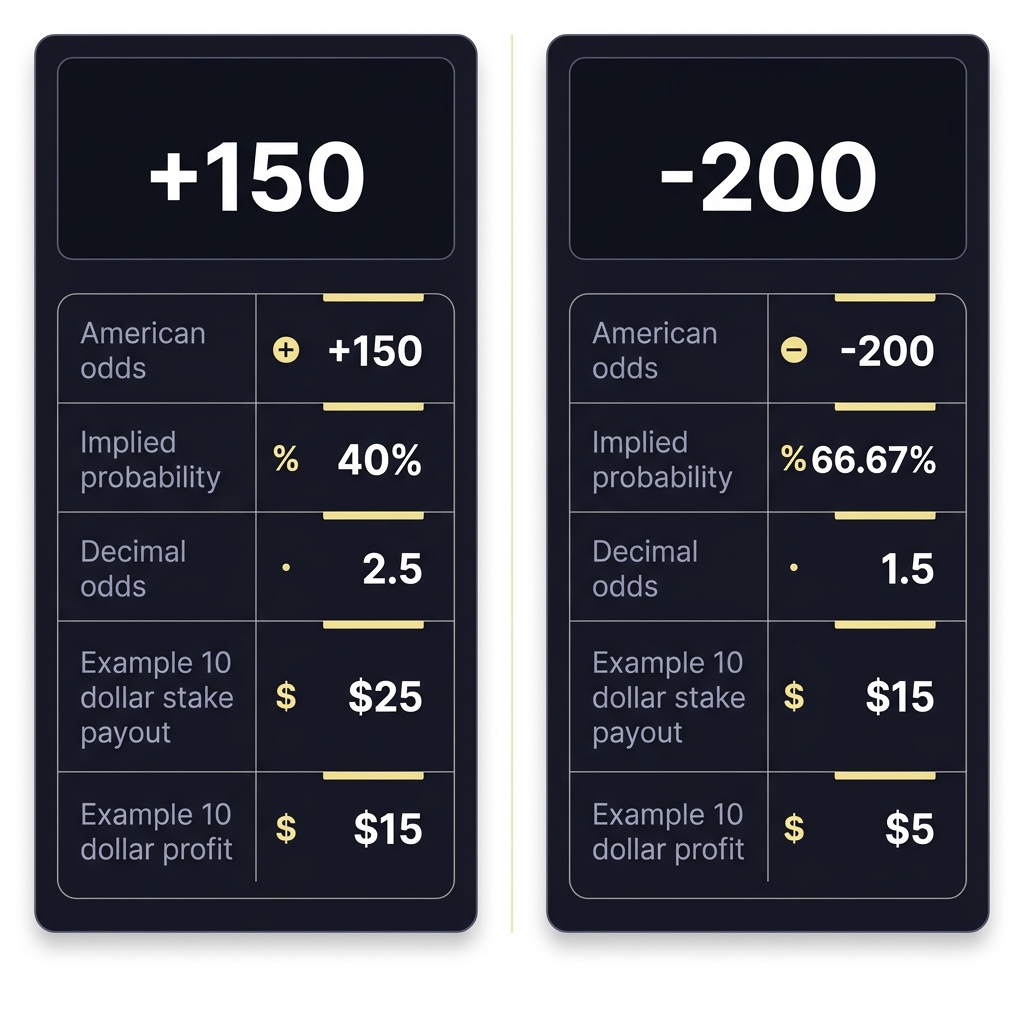
Start with the headline examples used across guides: +150 returns $150 profit on a $100 stake, for a total $250 return, while -200 requires a $200 stake to win $100, for a total $300 return. These payout rules are standard and help you convert odds into cash terms quickly when planning stakes DraftKings help center article.

To see how scaling works, take the +150 case and scale to smaller stakes: a $10 stake at +150 yields $15 profit (10 * 1.5) for a $25 total return. For -200, a $10 stake would not directly scale to win $100, so instead compute proportionally: decimal 1.5 times $10 yields a $15 total return, so $5 profit on a $10 stake. These simple multiplications are helpful when you manage a defined bankroll or test strategies in simulated accounts.
When you convert odds for planning purposes keep the language clear: stake is the amount you put up, profit is the money you gain on top of getting your stake back, and total return equals stake plus profit. Using stakes like $10 or $50 and recomputing totals builds practical intuition.
How sportsbook margin (vig) affects implied probabilities and fair odds
Sportsbook prices normally embed a margin, often called the vig or overround, so the sum of implied probabilities across outcomes typically exceeds 100 percent. That margin is how a bookmaker ensures a long-term edge and is present across U.S. markets American Gaming Association resource.
Short numeric example: imagine a two-outcome game where the market shows odds implying 52 percent for Team A and 52 percent for Team B, summing to 104 percent. That extra 4 percentage points is the overround the bookmaker built into the prices. Detecting this overround tells you the market includes margin that should be removed when you want an estimate of fair probabilities Investopedia implied probability guide.
Explore FundedPlays Challenges for Structured Evaluation
Use the example above to follow the margin-adjustment steps below and see how estimated fair probabilities change; this is a planning exercise, not a promise of results.
A common simple method to remove margin is proportional normalization: divide each outcome's implied probability by the sum of all implied probabilities, then rescale so the total becomes 100 percent. Using the two-outcome example, divide each 52 percent by 104 percent to get 0.5, or 50 percent fair probability for each side. This proportional method gives a first-order fair estimate useful for comparing your model output to market prices.
Keep in mind more sophisticated margin-adjustment techniques exist, but proportional scaling gives a practical, low-friction way to see whether a quoted line offers potential value relative to your estimated chance.
Using American odds in skill-based prediction and funded challenge contexts
In skill-based prediction environments and funded challenge formats, converting odds to implied probabilities helps set consistent, quantitative decision rules. When you know the market price as a percentage, you can use value thresholds to decide which forecasts to enter without relying purely on intuition Massachusetts Gaming Commission sports wagering 101.
For example, a simple rule might be to place a prediction only when your own model or judgment estimates an outcome's chance at least five percentage points higher than the market's fair probability after margin adjustment. That discipline focuses on expected value rather than short-term win streaks and fits the evaluation mindset used by FundedPlays, which center on structured challenges and consistent performance rather than one-off bets.
Keep bankroll sizing and record-keeping tight in any evaluation. Treat each stake as part of a test to measure whether your edge exists over time, and avoid overbetting based on small samples or emotional reactions to recent wins or losses.
Common mistakes and pitfalls when reading and using American odds
A few frequent errors cause confusion. First, people often mix up profit and stake by misreading the signs; remember plus shows profit on $100, minus shows the stake needed to win $100. Second, negative odds conversions can trip calculators if you forget to use the absolute value when applying the formula. Simple checks like writing the calculation out or using the decimal conversion as a sanity check reduce these errors Investopedia implied probability guide.

Other common pitfalls include failing to adjust for the overround, which leads to overconfident probability estimates, and scaling mistakes when moving from $100 examples to small-stake practice-always recompute via decimal conversion to verify the math. Finally, avoid treating short-term results as proof of a long-term edge; maintain logs and consistent sizing rules to judge performance properly.
When to prefer decimal or fractional formats: practical guidance
Decimal odds are often the quickest format for mental math and spreadsheets because the decimal directly shows total return per unit stake. That clarity makes decimals useful when you plan a series of stakes or build models that aggregate expected returns Pinnacle conversion guide.
Fractional odds remain common in some regions and for historical reasons; some people prefer them for head-to-head phrasing such as two-to-one. Ultimately personal workflow matters: use decimals for spreadsheet work and quick scaling, fractionals for specific communication preferences, and American odds when operating in U.S. displays.
Remember that behind each format is the same implied probability; converting and adjusting for margin are the key steps for apples-to-apples comparisons.
Quick reference: step-by-step conversion cheat sheet and final checklist
Three-step conversion cheat sheet: 1) Check the sign. If positive, use A as the positive number; if negative, use A as absolute value. 2) Convert to implied probability using P = 100 / (A + 100) for positive A and P = A / (A + 100) for negative A. 3) Convert to decimal if needed using decimal = 1 + A/100 for positive, or decimal = 1 + 100/A for negative. This quick sequence gets you from American odds to a working probability and a decimal payout number Pinnacle conversion guide.
Final checklist before using odds in a prediction or challenge: check the sign, convert to an implied probability, remove bookmaker margin if comparing to your model, scale the stake using decimal odds for the correct payout, record the decision and stake, and review outcomes consistently. Treat conversion as a tool for disciplined decisions, not a guarantee of success.
With these steps you can move from seeing a line to making a structured decision in a skill-based context, using the same core math whether the display shows American, decimal, or fractional odds.
Use the formula for positive American odds: P = 100 / (A + 100). For +150, P = 100 / 250 = 40 percent.
Negative odds show the stake needed to win $100; -200 means you must stake $200 to win $100, for a $300 total return.
No. Bookmakers include a margin, so adjust implied probabilities proportionally to estimate fair chances before comparing to your model.