

hawks cavs prediction: context and what this guide covers
This guide outlines the Cavaliers' recurring vulnerability patterns and how those patterns matter when you create a hawks cavs prediction. It is intended to help readers translate observed team tendencies into actionable pregame checks, market choices, and live adjustments without promising outcomes.
Readers should use this article as an analytical toolkit: a map of common Cavs weaknesses, a list of live cues to watch, and a decision framework to size and place predictions. It is not financial advice and does not guarantee results.
Review challenge-style checklists and structured prediction rules
Use the pregame checklist below to organize observations, confirm player availability, and set disciplined stake limits before you place a hawks cavs prediction.
hawks cavs prediction: summary of the Cavaliers' core weakness themes
When preparing a hawks cavs prediction, focus on a short checklist of structural areas where the Cavs commonly show stress: offensive consistency, defensive transition and switching, bench drop-off, matchup sensitivity in specific lineups, and the effect of rest or injuries on rotation stability.
Prioritize weaknesses by market impact. Offensive inconsistency and bench scoring tend to change totals and late-quarter spreads. Defensive lapses in transition or perimeter closeouts often create moneyline or spread edges for the opponent. Contextual factors like rest, travel, and short-term injuries can amplify any of these themes.
Quick priority list for a single-game prediction
- Offense: cold-shooting stretches and creator overload
- Defense: transition and perimeter switching problems
- Depth: bench scoring and defensive drop-off
- Roster context: rest, back-to-back, and late scratches
Use this checklist to weight your model inputs, adjust totals, or choose player prop focus areas.

Offense: where the Cavs can struggle and what that means for a hawks cavs prediction
Offensive inconsistency is one of the clearest signals to watch when forming a hawks cavs prediction. If a team shows a heavy reliance on a few primary creators, scoring can become streaky and totals can swing quickly if shot-makers are cold.
Common offensive warning signs to monitor include low assist rates, stagnant half-court sets, and long periods without made threes. If these appear in pregame reports or live early-game windows, expect team totals to be vulnerable and spread expectations to shift toward the opponent.
Structural Cavaliers weaknesses, such as transition defense, perimeter closeouts, and bench drop-off, change which markets are favorable. Use a pregame checklist to confirm minutes and injuries, score matchup factors, and select totals, spreads, or props based on preset risk rules rather than ad hoc decisions.
Practical pregame and live cues that suggest offensive trouble: slow ball movement in recent games, poor assist numbers in the first quarter, repeated early empty possessions, and visibly conservative end-of-clock plays. Watching these cues helps decide whether to lean totals down or favor opponent scoring props.
For models, reduce projected team scoring when the offensive profile shows creator overload and low assist rates; for live betting, a slow start in the first quarter is an early warning to reassess projected pace and totals for the rest of the game.
Defense: defensive gaps that Hawks can exploit in a hawks cavs prediction
Defensive vulnerabilities that move markets are usually observable: slow or disorganized transition defense, perimeter closeouts that leave open looks, and rotations that lag on drives to the rim. These are the areas that opponent teams, like the Hawks in a matchup, can systematically target in offensive game plans.
Transition defense problems often show up as early possessions in the first quarter or immediately after turnovers. If a team gives up easy early buckets, totals rise and the opponent's moneyline becomes more attractive, especially if the opponent thrives in early-run situations.
Perimeter switching and closeout issues create open three-point opportunities or driving lanes. If rotation patterns show frequent mismatches when switching, that usually benefits teams that can spread the floor and attack mismatches. Rim protection and late rotation timing are also decisive; when interior deterrence is limited, opponents will call more plays to attack the paint, changing the mix of points and affecting prop choices.
Bench, depth and lineup instability: under-the-radar Cavs issues
Bench scoring and defensive drop-off are subtle but consequential for game flow. If the second unit produces significantly fewer points or weaker defensive effort, opponents can exploit those minutes to build leads or narrow margins, which has a clear impact on quarter-by-quarter spreads and player minutes-based props.
Lineup construction matters: specific combinations may amplify matchup problems, and coaches who tinker with rotation timing can create windows where opponent strengths overlap with weak Cavs units. Watch for minute spikes and how bench pairs are used in offensive and defensive possessions.

For live and pregame decisions, monitor the minutes distribution after the first substitution sequence. If a bench group is repeatedly targeted by opponent lineups, consider betting on opponent scoring during those minutes or favor props for opposing role players who face those matchups.
Injury, rest and roster context: non-performance factors that influence a hawks cavs prediction
Even small absences or rest decisions can magnify the Cavs' structural weaknesses. A missing rotation player or a scheduled rest day can increase minutes for bench units and expose defensive or scoring gaps that normally remain hidden.
Back-to-back games and compressed travel reduce energy and typically lower defensive intensity. For a hawks cavs prediction, give extra weight to recent schedule density when evaluating the Cavs' ability to sustain transition defense and consistent half-court execution.
Pregame checklist for roster context
- Scan the official injury report and note full-game and questionable statuses
- Confirm projected minute distributions for starters and primary bench wings
- Check travel and rest: back-to-back, cross-country trips, or reduced practice windows
- Watch for late scratches and how coaching comments describe rotation intentions
These checks should alter model inputs for projected points, assist adjustments, and substitution-driven matchup vulnerability scores.
A decision framework: turning Cavs weaknesses into a repeatable hawks cavs prediction approach
Apply a concise, repeatable framework before you commit capital. Start with a data check, assess matchup weightings, measure market edge, and size risk using fixed rules rather than emotion. The goal is disciplined, repeatable prediction behavior.
Suggested worksheet tool to score matchup factors and produce a single weighted deficit value that feeds into your market choice logic.
Score matchup factors to prioritize market choices
Score 1 to 5 where higher means greater concern
Framework steps
- Data check: confirm lineup availability and minute projections
- Weight weaknesses: assign heavier weights to transition and bench issues if early-season trends show instability
- Market test: compare your weighted deficit value to the market line; only act when an edge exists
- Risk sizing: set stake as a fixed percentage of your prediction bankroll depending on confidence
- Live adjustments: update scores after the first substitution sequence and at halftime
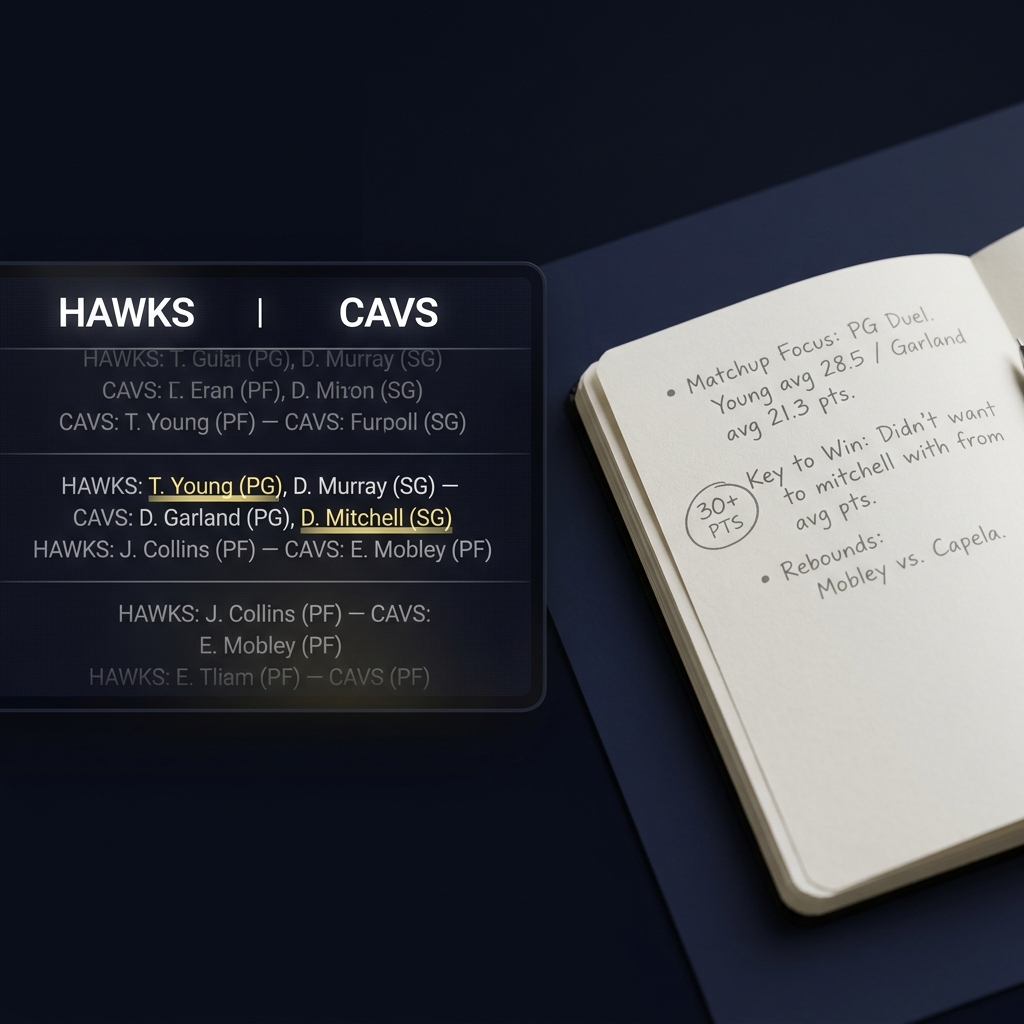
When your worksheet score passes your preset threshold for concern, rules might direct you toward totals, a small spread play, or specific player props. If the score is marginal, prefer smaller stakes or skip the market.
Common prediction mistakes and how to avoid them in a hawks cavs prediction
Overreacting to single-game anomalies is a frequent error. A single cold-shooting night does not always indicate a systemic change. Avoid moving model baselines without a clear pattern that persists beyond one or two games.
Recency bias and confirmation bias lead predictors to overweight the most recent performance or seek data that fits a hypothesis. Protect yourself by using blind checks: set thresholds for how many games you need before changing core model parameters.
Quick live-betting rules to avoid common traps
- Do not increase stake size after a small early loss
- Require two confirmed cues before shifting your pregame bias
- Use minute or lineup confirmations rather than headlines alone
Practical scenarios: three sample hawks cavs prediction scenarios and reasoning
Scenario A - Hawks exploit transition and win outright. Assumption: the Cavs show poor early transition defense and the Hawks enter with high early-possession efficiency. If pregame minutes show short rotation depth for the Cavs, consider a Hawks moneyline or a moderate spread play early, with a small stake sized to your risk rules.
Scenario B - Cavs control half-court but bench issues keep game close. Assumption: starters produce efficient offense but the second unit offers limited scoring. In that case, favor player props for starters and avoid totals until bench minutes are clarified; also consider late-quarter spread swings when bench minutes dominate.
Scenario C - Late-game matchup swings and prop focus. Assumption: close game with specific mismatches emerging in the fourth quarter. Use in-game observations of fatigue, substitution patterns, and matchup exploitation to shift from team lines to targeted player props that reflect who will handle crucial possessions.
In each scenario, adjust stake sizing to reflect uncertainty and prefer smaller stakes when roster questions or late scratches create volatility.
Conclusion: key takeaways for your next hawks cavs prediction
Keep three mental models in mind: prioritize transition and bench concerns, weight rest and injuries heavily, and prefer props when matchup swings are narrow but predictable. These short rules help translate structural Cavs weaknesses into clearer market choices.

Final pre-submission checklist
- Confirm injury report and projected minutes
- Run the matchup worksheet and compare to the market
- Set stake size according to fixed risk rules and confirm you have an exit or salvage plan
Responsible prediction practice matters: use disciplined sizing and accept uncertainty rather than chase guaranteed outcomes.
Treat bench drop-off as a multiplier for second- and third-quarter markets; confirm projected minutes, then reduce team scoring projections or favor opponent scoring measures during those minutes.
When offensive cues show creator overload or cold-shooting risk and defensive lapses are limited, totals are often preferable; use pregame pace indicators and early-game assist rates to decide.
Compressed schedules and cross-country travel typically reduce defensive intensity and depth reliability, so increase the weight of transition and bench concerns when these factors are present.
References
- https://www.fundedplays.com/blogs
- https://www.fundedplays.com/blogs/how-fundedplays-evaluations-work
- https://www.fundedplays.com
- https://www.fundedplays.com/challenges
- https://www.nba.com/game/cle-vs-atl-0022501173
- http://www.espn.com/nba/teams/comparison/_/team1/atl/team2/cle
- https://www.si.com/nba/hawks/onsi/news/atlanta-hawks-vs-cleveland-cavaliers-game-preview-injury-report-starting-lineups-for-friday-s-matchup-01kntm1e035t