
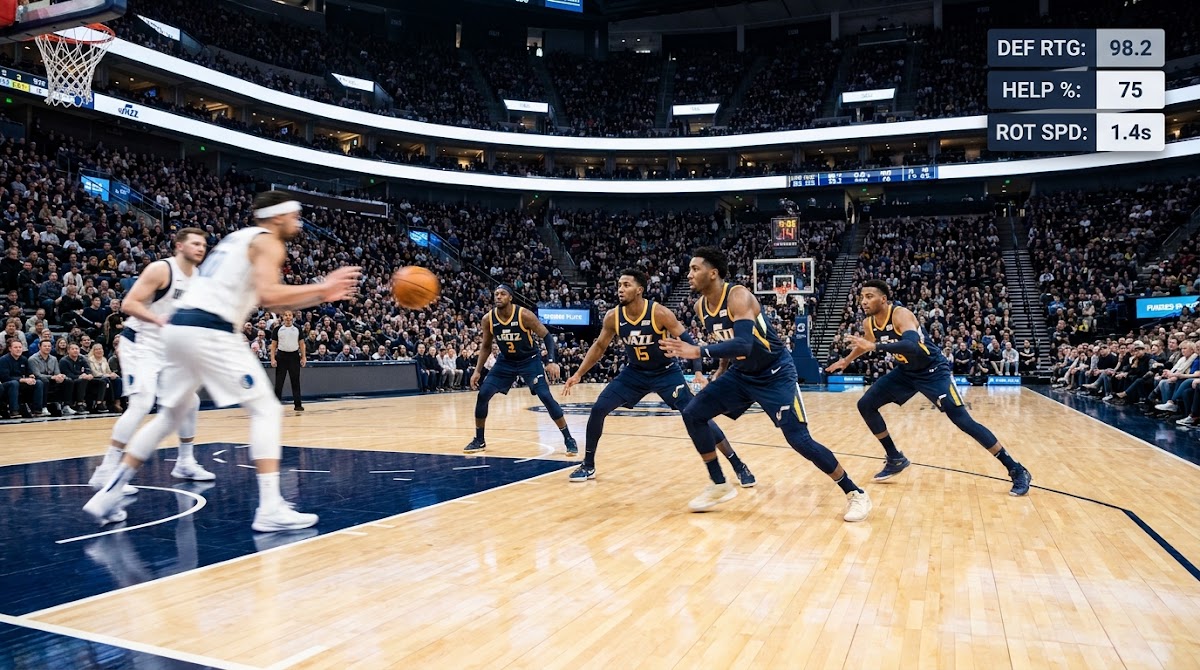
What it means to be the NBA's No. 1 defense
The simplest, accepted way to name the league leader in defense is by Defensive Rating, which measures points allowed per 100 possessions. For clarity on that definition, see the NBA.com Stats glossary for Defensive Rating, which defines the metric and its intent to remove pace from defensive comparisons NBA.com Stats glossary.
Because Defensive Rating is normalized to 100 possessions, it corrects for pace differences so a slow team that allows fewer raw points is not automatically treated as the better defense. That per-100 framing makes cross-team comparisons more meaningful, and it is why Defensive Rating remains the primary title metric for the top defense on weekly leaderboards.
Open the NBA.com team-defense leaderboard and watch Defensive Rating changes in real time
Use this while following weekly updates
The live leaderboard is dynamic over the course of a season; teams move up or down as samples grow and rotations change. When you read statements about the No. 1 defense, they are typically tied to the current Defensive Rating ranking at that moment rather than a final, season-long award.
Where to find the live defensive leaderboard and how to read it
The authoritative, up-to-date source for which team is currently first by Defensive Rating is the NBA.com team-defense leaderboard. When you open the table, sort order is keyed to DEF_RATING so smaller numbers indicate better defense, and the leaderboard updates as new games are entered into the season dataset NBA.com team-defense leaderboard.

On the leaderboard, focus on the DEF_RATING column and the sample size behind it. Numerical margins at the top can be thin; for example, a 99.8 Defensive Rating was cited as second-best in a weekly NBA.com power ranking snapshot, which shows how tight the race for first can be in any given week NBA Power Rankings (March 9, 2026). You can also compare the live view to other leaderboards such as ESPN's team stats ESPN team stats for alternative presentations of similar defensive metrics.
For season summaries and longer-term cross checks, Basketball-Reference aggregates per-100 metrics in its season pages, which makes it useful for confirming whether a team that leads the live leaderboard also holds up over the full year of play 2025-26 NBA season summary and by consulting its team ratings table 2025-26 team ratings.
The Four Factors: a practical framework to diagnose defense
To judge whether a defense is legitimately elite, use the Four Factors: opponent effective field goal percentage, turnover rate forced, defensive rebounding, and free-throw rate allowed. The Four Factors remain the standard analytical lens for diagnosing team defense and explain why some defenses hold up better over time than others Four Factors.
Track defensive leaders with discipline
Check the live Defense leaderboard and run each Four Factor against the top teams to see where they gain or lose ground.
Opponent eFG% is shorthand for how often opponents score on the shots they attempt, adjusted for the value of three-point shots. A team that limits opponent eFG% is fundamentally denying high-value looks, which directly lowers its Defensive Rating even without forcing turnovers.
Turnover rate forced is how often the defense creates extra possessions by stealing the ball or forcing mistakes. Turnover creation both subtracts points for the opponent and gives your own team more scoring chances, which can be decisive in close Defensive Rating races.
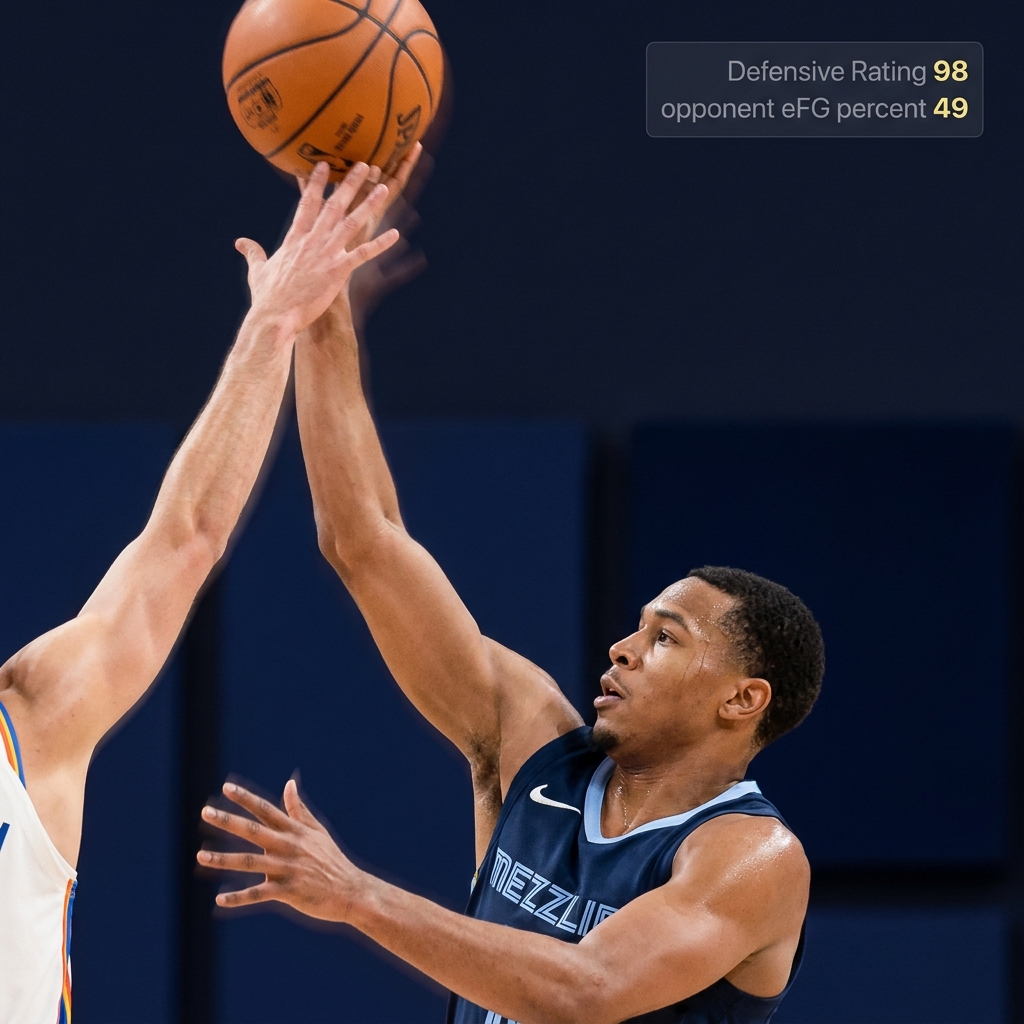
Defensive rebounding matters because missed shots that become opponent offensive rebounds create second-chance points and inflate the points allowed per 100 possessions. A defense can mask weak rebounding by forcing more turnovers or by limiting opponent eFG%.
Finally, free-throw rate and foul discipline control the number of free-throw attempts opponents take. Teams that give up fewer free throws reduce opponent scoring opportunities that do not show up in field-goal metrics, and that discipline helps stabilize a low Defensive Rating over a lengthy stretch.
Where the Memphis Grizzlies are in 2025-26: a data-driven snapshot
When you want to evaluate whether Memphis can be the top defense, start with the Grizzlies’ team page for the 2025-26 season, which lists their Defensive Rating and the Four Factor components for direct comparison to league leaders Memphis Grizzlies team page.
Rotation continuity and health are non-statistical drivers that show up in the numbers. If a core lineup plays more minutes together, defensive communication and matchup assignments often improve, which can reduce opponent eFG% and increase turnover creation. Conversely, injuries and frequent lineup changes typically increase variance in Defensive Rating from week to week.
grizzlies prediction
In simple terms, a realistic grizzlies prediction for claiming the No. 1 defense requires Memphis to be among the best in opponent eFG% and to create turnovers at a top rate while avoiding a rebounding or foul-rate collapse. That combination is challenging, and the team page data is the proper place to watch for measurable progress.
Decision checklist: when can you reasonably call a team the No. 1 defense?
Use this short checklist when deciding if a leader is truly the top defense rather than a temporary front-runner. First, a credible No. 1 candidate will sustain a top Defensive Rating on the NBA.com leaderboard for multiple weeks and against a range of opponents, rather than only after a favorable schedule stretch NBA.com team-defense leaderboard. You can also review the NBA advanced leaders page for additional sorted metrics NBA advanced leaders.
Checklist overview:
- Sustained rank: top 3 Defensive Rating on NBA.com for at least three weeks
- Balanced Four Factors: opponent eFG% and turnover rate both in the top quartile, with defensive rebounding and free-throw rate stable
- Consistent rotations: core lineup minutes are steady and injuries are not forcing frequent changes
- Quality of opponents: top rank holds against a schedule that includes several strong offensive teams
The No. 1 defense is the team leading the defensive rating leaderboard at a given time, and for the Grizzlies to reach that spot they would need sustained, top-level results across opponent eFG% and forced turnovers while keeping rebounding and foul rate steady.
Sample size and volatility matter. Short-term leads can be created by small-sample variance or a run of easier matchups, so check season summaries and historical aggregates for confirmation before calling a team the definitive No. 1 2025-26 NBA season summary and review how Funded Plays evaluations work for additional perspective.
Also consider external context like travel, compressed schedules, or sudden roster moves. These factors can temporarily depress or inflate Defensive Rating without signaling a structural change in team quality.
Common mistakes and how to avoid them when judging defenses
One frequent error is relying on raw points allowed rather than per-100 possession metrics. Points allowed per game depend heavily on pace, so they can mislead unless you convert to Defensive Rating or another per-possession measure. To avoid this, always look for per-100 metrics when comparing teams of different tempos.
Another mistake is ignoring the Four Factors. For example, a team that forces many turnovers but gives up high-quality shots might look good in one metric while being vulnerable in another. Use the Four Factors as a checklist to ensure you are seeing a balanced defense rather than a single strong trait that can be exploited.
Avoid overreacting to short-term trends. Teams can climb the leaderboard over a small set of games and then fall back once tougher opponents arrive. The best corrective is to cross-check the live leaderboard with season summaries and the team page breakdowns to see whether strength is persistent or temporary Memphis Grizzlies team page.
Examples, quick scenarios and the bottom line
Scenario one: a team leads the leaderboard for two weeks. If the lead is driven by a spike in turnover creation while opponent eFG% and defensive rebounding remain average, the checklist suggests caution (see the Funded Plays blog). Short-term turnover spikes often regress, so watch whether the team maintains low opponent eFG% in the following weeks before treating the lead as lasting.

Scenario two: Memphis narrows gaps midseason. If the Grizzlies improve opponent eFG% defense by limiting catch-and-shoot opportunities and raise their forced-turnover rate at the same time, the team can move into the top 10. To challenge for No. 1, those gains need to be sustained, and defensive rebounding and free-throw rate must not decline as a trade-off.
Bottom line: use the live NBA.com leaderboard to see who is currently first, but then run the Four Factors and check roster continuity before labeling any team the No. 1 defense for the season. For Memphis, the path to contention is clear conceptually, but it depends on simultaneous, sustained improvements across multiple defensive dimensions. Learn more at Funded Plays.
Defensive Rating measures points allowed per 100 possessions, which adjusts for pace and lets you compare defenses on an equal possessions basis.
The NBA.com team-defense leaderboard provides the live Defensive Rating ranking for the regular season and is the primary source for current standings.
They would need sustained improvements in opponent effective field goal percentage and a higher forced-turnover rate while maintaining rebounding and foul discipline.
References
- https://www.nba.com/stats/help/glossary/#defensive-rating
- https://www.nba.com/stats/teams/defense/?Season=2025-26&SeasonType=Regular%20Season&sort=DEF_RATING&dir=asc
- https://www.nba.com/news/power-rankings-2025-26-week-20
- https://www.basketball-reference.com/leagues/NBA_2026.html
- https://www.basketball-reference.com/about/factors.html
- https://www.basketball-reference.com/teams/MEM/2026.html
- https://www.basketball-reference.com/leagues/NBA_2026_ratings.html
- https://www.espn.com/nba/stats/_/view/team
- https://www.nba.com/stats/teams/advanced-leaders
- https://www.fundedplays.com/challenges
- https://www.fundedplays.com/blogs/how-fundedplays-evaluations-work
- https://www.fundedplays.com/blogs
- https://www.fundedplays.com