

What "best" means in greyhound racing bets
When people ask what is the best bet in greyhound racing bets, they usually want a single rule that works at every meeting. The reality is that "best" is conditional, not universal. A sensible choice depends on your objective, your bankroll rules, the operator product on offer, and race-specific data such as trap statistics and distance.
Operators and pool providers use different rules for place and exotic products, so the same dog and race can produce very different value depending on whether the market is fixed odds or a tote pool. For example, tote rules and pool mechanics change how Forecast and Tricast payouts form, and that affects whether an exotic looks attractive for a given stake Tote betting rules.
Responsible staking is part of choosing the right bet. Regulators advise setting a budget and avoiding loss chasing, which should guide how much you risk on any single selection, especially on higher variance products.
Core greyhound bet types explained
Which bet suits my goal?
There is no single best bet. Choose between straight Win or Each-way bets for lower variance, and selective exotics when race shape and box-by-distance data justify the extra variance, while always using disciplined staking and safer-gambling limits.
Start with the basics. A Win bet simply pays if the named greyhound finishes first. An Each-way bet combines a Win and a place portion and pays if the dog finishes in one of the operator specified places, though exact place terms vary by operator and field size; you should check the operator's place rules before staking Greyhound betting guide.
Exotics and pool bets name multiple finishing positions. A Forecast or Exacta requires the correct first and second in order, while a Quinella pays if you pick the first two in any order. Tricast and Trifecta require the correct first, second and third in order. These ordered versus any-order distinctions change difficulty and payouts and are governed by tote and pool rules on many venues Bet types explained.
Because exotics require multiple correct placings, they tend to have higher variance and lower hit rates than straightforward Win or Each-way bets. That characteristic makes exotics a poor fit for small bankrolls unless stakes are kept small relative to units Greyhound betting guide.

How to choose the right bet: a practical decision framework

Begin by stating your objective clearly. Are you aiming for steady, low-variance returns or are you willing to accept long losing runs for the chance of a larger payout? The answer should determine whether you prioritise straight Win or Each-way bets, or reserve a portion of your bankroll for selective exotics.
Always confirm the product terms before you bet. Each-way place terms, minimum field sizes for places, and whether Forecast and Tricast operate as tote pools can change the effective value of a stake, so check the operator details for the meeting Tote betting rules.
Next, bring in track-level data. Box-draw and box-by-distance statistics help reveal whether a trap position or early speed is an advantage at the venue and distance you are assessing. If box stats show a strong draw bias, that shifts implied probabilities and can make simple Win bets on certain traps more attractive than wide-exotic plays Greyhound Racing NSW box statistics.
Checklist to apply before each stake
1. Define the objective and unit size, and set a firm loss limit. 2. Confirm product terms on the operator page. 3. Pull the latest box-by-distance stats and recent sectional times. 4. Decide whether race shape favours a straight or an exotic. 5. Size the stake to match variance tolerance and unit rules.
How track draw and distance change the best bet
Official box-draw statistics demonstrate that trap, or box, position affects outcomes at many tracks, and the inside boxes often record higher win rates at specific venues. That means the same greyhound can be a stronger or weaker play depending on its trap and the track's characteristics Greyhound Racing NSW box statistics study.
Box-by-distance breakdowns add useful granularity. They show how often a trap wins at each distance, which helps separate a dog that performs well only at short sprints from one that handles longer trips. Consult the track's box-by-distance pages to see these patterns before staking Track and box statistics, or local track pages such as Meadows Track Statistics.
Quick data check before staking
Use the track's official stats page
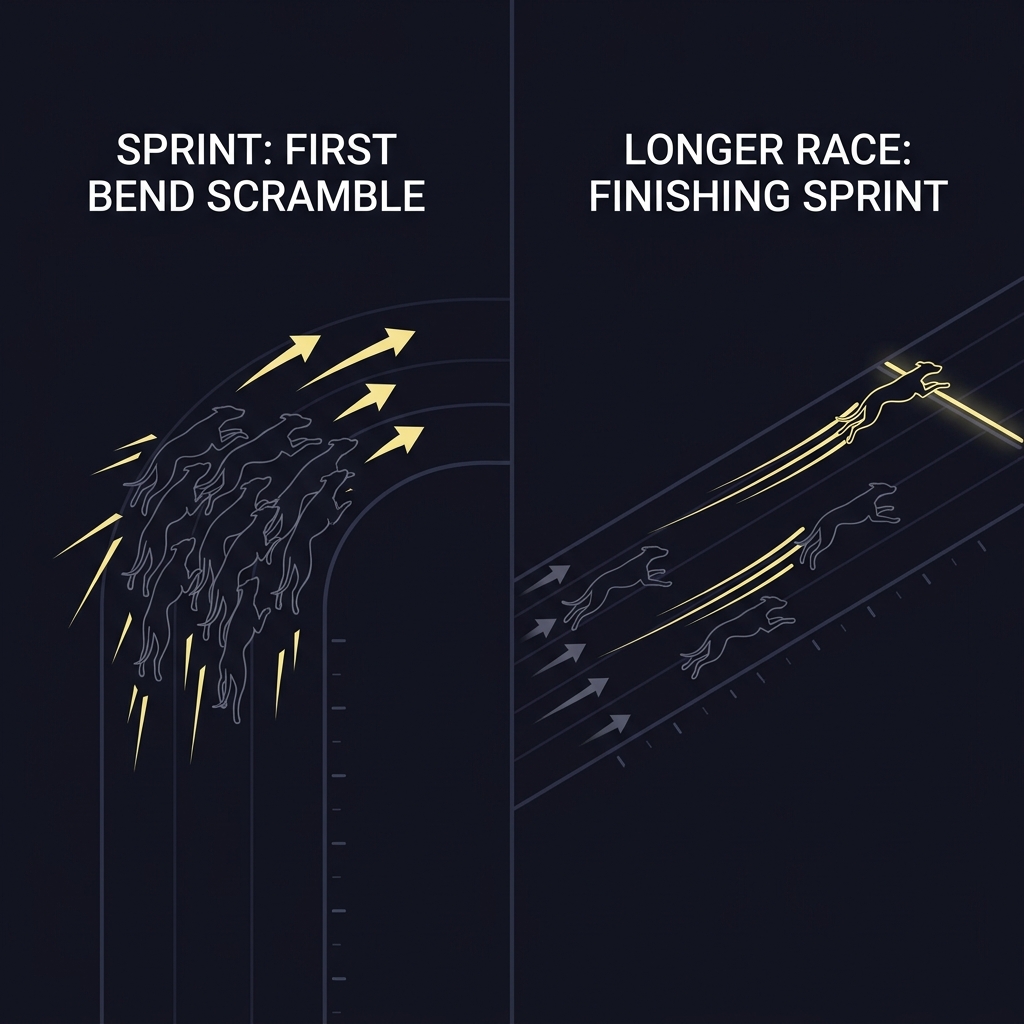
Sprint races with a short run to the first bend magnify early pace and draw effects, because dogs that break fastest and get the preferred running line reach the bend in prime positions. In those races, favouring inside speed or taking simple Win or Each-way positions can be wiser than complex exotics that rely on multiple placings Greyhound Racing NSW box statistics. See modelling work on ideal trajectories here.
Conversely, in longer trips where there is time to settle and recover ground, draw bias often weakens. That reduces the advantage of a single trap and can make selective exotics more attractive when combined with solid form lines Track and box statistics.
When to prefer straight bets over exotics (and vice versa)
Straight bets are generally preferable when your priority is lower variance and steadier results. If your bankroll is limited, backing a favourite with unit-based Win or Each-way stakes tends to conserve capital compared with backing exotics aggressively.
Try a challenge-style approach to practice staking and discipline
Set a unit stake for Win and Each-way bets and limit exotic exposure to a small fraction of your bankroll.
Exotics can pay well but require multiple correct finishing positions, so they have lower hit rates and can produce long losing runs. That makes them suitable primarily for bettors who can accept variance, or who deliberately allocate a smaller, speculative portion of bankroll to chase higher returns Greyhound betting guide.
Race factors that increase the appeal of exotics include a clear pace map, a small or weakened field where mid-pack dogs have shown improvement, or a strong trap signal for multiple finishing spots. Where these align, a carefully chosen Forecast or Quinella can offer value, but stakes should reflect the higher variance Greyhound Racing NSW box statistics.
Practical staking templates
1. Conservative: 1 unit Win or Each-way, 0.1 units total on exotics per meeting. 2. Balanced: 1 unit Win, 0.5 units Each-way, 0.2 units spread across selective exotics. 3. Speculative: reduced base units, increased small-exotic allocation, strict loss limit for the session. Always match these templates to your budget and avoid chasing losses, following regulator guidance on safer gambling. Visit Funded Plays.
Quick tools and checks to run before you bet
Before committing funds, pull three data points: the box-by-distance table for the specific track and distance, the greyhound's recent finishing positions and sectional times, and any posted track maintenance updates that might change running lines. These items form the minimal dataset for an evidence-based decision Greyhound Racing NSW box statistics.
Also confirm operator terms. Verify each-way place terms, whether Forecast and Tricast operate as tote pools at that meeting, and any minimum field-size rules that affect payouts. Operator pages contain these product details and they materially affect whether a bet is good value Tote betting rules.
Five-item pre-bet checklist
- Budget check, with a fixed unit and session loss limit
- Confirm product terms for the market
- Review box-by-distance for the track and distance
- Scan sectional times and last three runs for pace cues
- Adjust stake size based on variance and confidence
These checks are fast and repeatable. Habitual use limits impulsive decisions and aligns action with safer-gambling principles. See how Funded Plays evaluations work here.
Common mistakes and how to avoid them
Chasing a last-race finish without context is a common error. A first-up win from an inside box in a sprint does not guarantee repeat performance if the dog draws wide next time or the race distance changes. Always consider pace context and trap position rather than treating finishing position in isolation Track and box statistics.
Ignoring draw and distance data can turn a seemingly obvious selection into a poor bet. Use box-by-distance statistics to see where a trap tends to win and whether that aligns with your pick's historical performance at that trap and distance Greyhound Racing NSW box statistics.
Staking too large on exotics without rules often depletes a bankroll quickly. Exotics require special sizing and a disciplined fraction of the bankroll should be reserved for them. Regulators recommend setting budgets and avoiding chasing losses, which should be built into any staking plan Safer gambling guidance.
Practical examples and scenarios
Example A: Short sprint at a track with inside bias. At a venue where inside traps show high strike rates over the sprint distance, and where the favourite is drawn inside with strong early splits, a straightforward Win or Each-way on the inside speedster is often the most defensible approach. Relying on complex exotics that require multiple wide dogs to outperform their trap disadvantage is usually lower EV in that setting Greyhound Racing NSW box statistics.

Example B: Longer trip where stamina and boxed form matter. Over staying trips the draw bias often softens, and sectional times plus boxed form become more informative. If several runners have shown late pace and the favourite is vulnerable in the run home, a selective Tricast or a Forecast that includes a couple of well-supported outsiders can offer value, provided stakes remain proportionate to bankroll and variance Track and box statistics.
Stake sizing across these scenarios should reflect confidence and variance. In sprint-with-bias examples, increase unit size for straight bets and reduce exotic stakes. In staying-trip examples with mixed form, keep straight units steady and allocate a modest, speculative share to exotics.
Final checklist and where to go next
Recap the essentials. Match the bet type to your objective, confirm operator product terms, and consult box-by-distance stats for the specific track and distance before deciding. These steps concentrate on evidence and discipline rather than guessing. Visit the Funded Plays blog for more.
Practice the framework with small stakes or simulated funds. Treat the first weeks as data collection, track results, and adjust staking rules based on observed variance. This kind of disciplined record keeping helps reveal which market approaches suit your temperament and bankroll.
Finally, keep safer-gambling principles front of mind. Set budgets, enforce session loss limits, and avoid chasing losses. Responsible participation improves decision quality and preserves capital for long term testing.
For beginners, a straight Win or an Each-way bet with conservative units is usually simplest, because these bets require fewer correct outcomes and are easier to manage with clear staking rules.
Box-draw statistics reveal trap biases at specific tracks and distances; use box-by-distance data to prefer inside or outside runners and to decide whether exotics are worth the extra variance.
Practice with small stakes or simulated challenge-style accounts to test your framework and record results, focusing on consistent staking and disciplined bankroll rules.
References
- https://tote.co.uk/help/betting-rules/forecast-and-tricast
- https://www.timeform.com/greyhound-racing/guide-to-betting
- https://www.tab.com.au/info/bet-types
- https://www.thedogs.com.au/Statistics/Box
- https://www.grv.org.au/racing/track-and-box-statistics/
- https://www.gamblingcommission.gov.uk/for-the-public/keeping-yourself-safe-and-in-control/safer-gambling
- https://www.fundedplays.com/challenges
- https://pmc.ncbi.nlm.nih.gov/articles/PMC8468305/
- https://www.nature.com/articles/s41598-020-63678-1
- https://melbournegreyhounds.org.au/meadows-racing/meadows-track-statistics/
- https://www.fundedplays.com
- https://www.fundedplays.com/blogs
- https://www.fundedplays.com/blogs/how-fundedplays-evaluations-work