

What is fixed odds betting?
Quick definition
Fixed odds betting means the price for a specific outcome is set when you place the bet and the potential payout is known in advance. In fixed odds betting the bookmaker or operator accepts your stake at the displayed odds and the payout for that stake is fixed at acceptance.
The key elements are simple: a stated set of odds, a chosen stake and a defined payout. Once a bet is accepted at those odds, neither side changes the payout for that stake.
Key characteristics that distinguish fixed odds from other market types
Fixed odds markets contrast with arrangements where returns vary after the event or depend on pooled outcomes. In a fixed odds market you can calculate the return before risking money because the odds and payout are agreed at the time of acceptance.

Because the payout is fixed at acceptance, bettors focus on comparing offers and identifying value rather than reacting to post-acceptance pricing changes. This clarity is why many learners start with fixed odds as they study how odds translate to implied probability and expected value.
Fixed odds betting in practice: the user journey
Step-by-step: choosing a market and placing a stake
The typical user journey begins with selecting a market, picking an outcome and entering a stake on a bet slip. Platforms usually show the odds next to outcomes and provide a bet slip where you enter the amount you want to risk.
When you submit the bet the platform either accepts or rejects it. If accepted, the odds and the potential payout are locked for that stake and the interface normally issues a confirmation or a transaction record.

What happens after a bet is accepted
After acceptance, the accepted bet appears in your transaction history or on a bet receipt. That record shows the stake, the odds at acceptance and the fixed payout that will apply if the outcome occurs. Because the payout is predetermined, you can review your records to measure performance or to reconcile any disputes.
Practical platform features to check include clear bet confirmations, straightforward access to past bets and transparent settlement descriptions. These help you confirm the moment when a bet became fixed and the terms that apply.
How different odds formats show fixed odds payouts
Decimal, fractional and American odds: quick conversion guide
Odds are labels that describe the payout you will receive for a successful bet. Decimal odds present the total return per unit staked, fractional odds show the profit relative to stake, and American odds indicate how much you must stake or can win relative to a baseline. All three convey the same fixed payout idea in slightly different notation. For more on formats, see Investopedia's guide on betting odds.
Learn about structured challenge programs on FundedPlays Challenges
Try converting a few markets yourself using a small spreadsheet or an odds converter so you can see how the same fixed payout appears in different formats.
When you are learning, pick the format that makes the most sense to you. Decimal odds are often easiest to use for quick payout calculation because they show the total return per unit stake directly.
When to prefer one format for clarity
Choose fractional or American formats if those are the local convention or if they match how you think about profit and stake. For cross-market comparisons, decimal odds can make arithmetic simpler when converting to implied probability or when calculating returns across multiple selections.
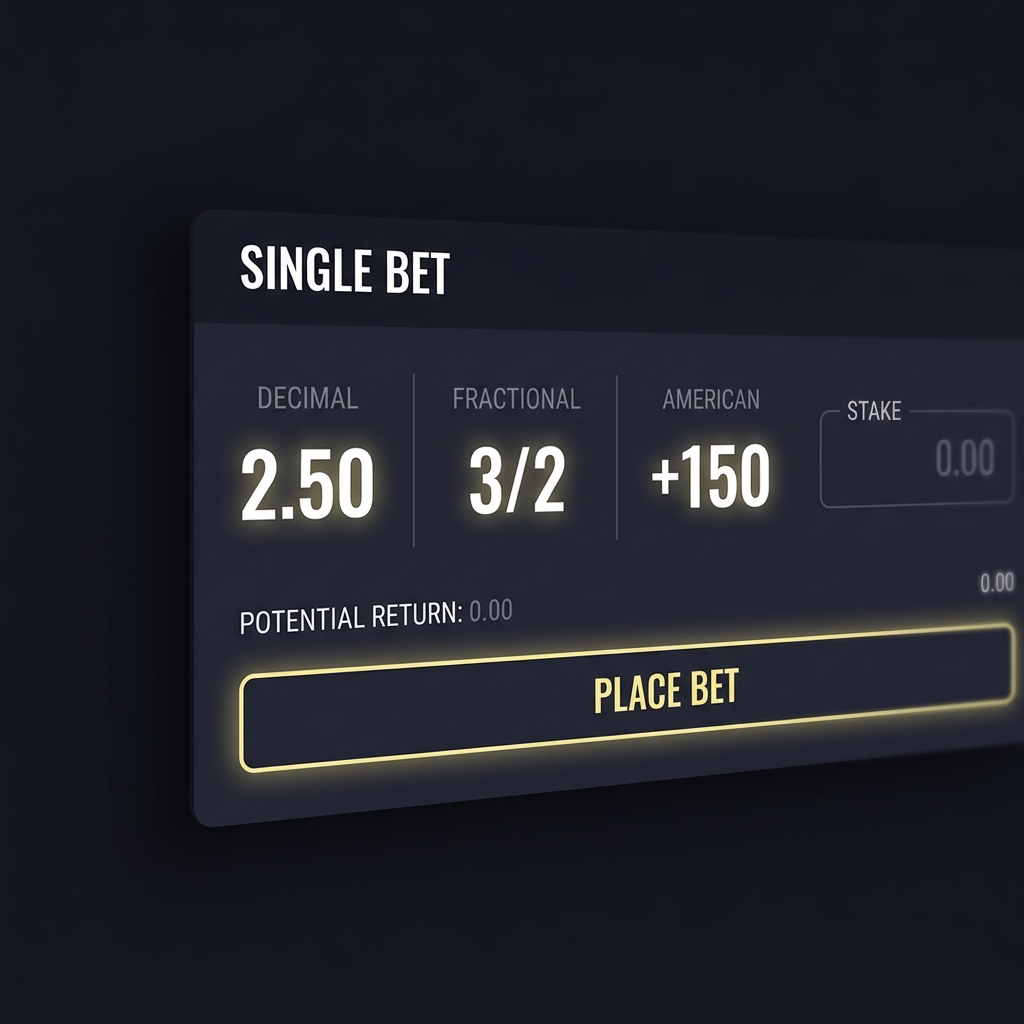
Whichever format you use, the payout remains fixed once the bet is accepted. The format only affects how the amount is expressed and how you perform the conversion to implied probability.
How odds relate to implied probability and pricing
Implied probability explained
Odds encode the market view of how likely an outcome is. Converting odds into an implied probability gives you a sense of the market price for an outcome. Thinking in terms of implied probability helps compare odds or judge whether an offer represents value relative to your own estimate. See the general entry on odds on Wikipedia for background on probability interpretation.
Implied probability is a mental model more than a precise measurement. It lets you say whether the price makes an outcome look more or less likely than you think, which is the basic test for value-based decisions.
The bookmaker margin and why odds do not always equal fair probability
Markets typically include a margin so the available odds do not sum to a perfectly fair probability distribution. That margin is the reason the odds you see may be slightly worse than an estimate of true likelihood, and why finding persistent value requires careful comparison and discipline. For practical reading of odds and formats, see a guide such as the one at Sportsline.
Keep in mind that the presence of a margin means you should look for situations where the offered odds are meaningfully better than your own estimate rather than assuming every small difference represents an edge.
Risk and bankroll impact of fixed odds betting
Short-term variance versus long-term expectation
Fixed odds betting involves variance, which can produce short-term losing streaks even when a strategy has a positive expectation. Understanding variance helps set realistic expectations about how results will look over time and why sample size matters.
Different strategies can have similar long-term expectations but very different short-term volatility. That variability is why focusing on stake sizing and drawdown control is important when you want to preserve capital and continue testing over time.
Fixed odds betting fixes the payout when a bet is accepted, so you know the potential return up front; this makes it easier to compare offers, convert odds to implied probability and manage stake sizing, but it does not remove variance or guarantee outcomes.
How stakes affect balance and drawdown
The stake you choose on each bet determines how much of your bankroll is exposed and how large potential drawdowns can become. Smaller, consistent stakes reduce the chance of ruin and keep results interpretable over a longer sample.
Practical bankroll management and conservative stake rules help mitigate the impact of variance and let you evaluate whether a perceived edge is real rather than a short-term anomaly.
Common strategies and approaches for fixed odds betting
Value-based staking and expected value thinking
A key strategic idea is value: bet when the offered odds imply a lower chance than your own reasonable probability estimate. Expected value thinking asks whether the average outcome over many bets is positive, and it focuses attention on decisions rather than lucky outcomes. Testing your probability estimates against outcomes over time is the practical way to learn whether your approach produces value. See how FundedPlays evaluations work.
Testing your probability estimates against outcomes over time is the practical way to learn whether your approach produces value. Keep stakes controlled while you test so a few failures do not end your ability to learn.
Simple staking plans versus proportional models
Many bettors use simple flat stakes or proportional plans where the wager is a fixed percentage of the bankroll. Proportional models adapt to your current balance and naturally reduce risk after drawdowns, while flat stakes keep variance predictable in absolute terms.
Neither approach guarantees success; both are tools to manage exposure. The right choice depends on personal goals, tolerance for volatility and the reliability of your edge.
Regulatory context and consumer protections
Where fixed odds markets are regulated and what protection looks like
Regulatory regimes and consumer protections differ by jurisdiction. Common safeguards include licensing of operators, clear terms and conditions, transaction records and formal dispute processes. Checking local rules helps you understand what protections apply to your activity.
Consumers should expect clear settlement rules and accessible transaction histories so they can verify accepted bets and outcomes. If those basics are absent, that is a practical red flag to avoid using the service.
Convert decimal odds and stake to implied probability and payout
Use decimal odds greater than 1
Key consumer safeguards to look for
Before participating, confirm that operators provide clear terms, age verification, robust transaction records and an established complaints process. Those elements make it feasible to trace what happened if a dispute arises and to follow up with relevant authorities where necessary.
When in doubt, prioritize licensed operators and read the terms carefully to understand acceptance rules, settlement procedures and any limits on stakes or payouts.
How to read and compare fixed odds across markets
Practical checklist for comparing odds and implied value
Start by comparing the same market across providers and convert the odds into an implied probability to see which offer is more favourable. Consider conversion into a common format, such as decimal odds, for reliable arithmetic and comparison.
Also check non-price factors: how acceptance is confirmed, settlement rules, minimum and maximum stakes and whether there are restrictions that affect how you would execute your strategy. These factors can matter as much as small price differences.
When market differences matter
Small one-off odds differences are often not worth chasing if they come with restrictive terms or poor record keeping. Focus on consistent edges and practical execution rather than tiny, short-lived discrepancies.
Comparing offers over time and logging outcomes helps distinguish persistent advantages from random advantages that disappear once markets adjust. For practical examples and updates see the Funded Plays blog.
Typical mistakes bettors make with fixed odds
Overbetting and poor stake sizing
Overbetting and chasing losses are frequent mistakes that amplify variance and shorten the runway you need to test a strategy. Reasonable stake rules and predefined limits prevent impulsive behaviour from undermining a plan.
Establish rules you can follow reliably, and treat them as part of the system rather than optional steps to ignore when frustrated.
Ignoring market margins and value hunting pitfalls
Failing to account for the bookmaker margin can create the illusion of value. Likewise, constantly chasing the latest perceived mispricing often leads to inconsistent records and poor samples. Keep a measured approach and log every bet so you can evaluate real performance.
Good habits include slow, repeatable testing, keeping stakes small while you measure, and avoiding systems that promise guaranteed returns.
Example scenarios: calculating payout and implied probability
Walk-through examples without using specific numeric claims
Conceptually, calculate your total return by applying the odds notation the platform uses. If you use decimal odds, multiply your stake by the decimal figure to get the total return. For fractional odds, add the stake to the profit fraction to find the same total return. For American odds follow the conversion rules that align with the direction of the odds.
To convert odds to an implied probability, interpret the odds format as a statement about relative likelihood and then translate that into a percentage. Doing the translation helps you compare the market price with your own assessment of likelihood.
How to confirm a calculation on your own
Use a basic calculator or spreadsheet to run conversions. Enter the odds in a single cell and apply a short formula to convert to implied probability and to compute returns for a chosen stake. Practice with hypothetical examples until the conversions become intuitive.

Keep practice separate from live funds until you are comfortable. A few rehearsals will reduce arithmetic mistakes and help you focus on decision quality rather than calculation errors.
Decision criteria: when fixed odds betting is appropriate
Assessing personal goals and tolerance for volatility
Decide whether the activity is primarily entertainment or a disciplined attempt to exploit an edge. Your risk tolerance and time horizon influence appropriate stake sizing and whether you should accept the short-term variance that comes with fixed odds betting.
If your objective is long-term performance measurement, choose conservative stakes and set clear review intervals. If your aim is entertainment, adjust stakes to match what you can comfortably afford to lose while staying honest about the difference in objectives.
Choosing fixed odds over alternatives
Fixed odds betting is a clear choice when you want known payouts and simple execution. Alternatives may include pooled formats or exchange style markets where returns can vary. Choose the market that suits your strategy and that you understand well.
Whatever you choose, align stake sizing and record keeping with your goals so you can judge outcomes objectively over time.
How to test and track your performance with fixed odds betting
Setting up a tracking spreadsheet or simulation
Build a simple tracking sheet with columns for date, market, selection, odds format, converted decimal odds, stake, outcome and running balance. Use simulated funds or minimal stakes while testing so you can measure without undue financial pressure. For examples and guidance see the Funded Plays blog.
Record ancillary notes about why you placed a bet and what you expected. These observations are often where learning appears most clearly when you review results after a meaningful sample size.
Key metrics to monitor
Track metrics such as ROI, strike rate, average odds, maximum drawdown and sample size. These numbers tell you whether observed results match your hypothesis and whether edge estimates are holding up under real conditions.
Be patient with sample size. Meaningful conclusions usually require time and consistent record keeping to separate signal from noise.
Practical checklist before placing a fixed odds bet
Quick pre-bet checklist
Before placing a bet, convert the odds to an implied probability, compare the market across providers, confirm the stake against your bankroll rules and verify settlement terms. A short checklist reduces impulsive decisions and keeps execution consistent.
Log the bet immediately and set a review date to assess outcomes and to extract learning points rather than relying on memory or emotion.
Red flags to stop and reassess
Stop and reassess if settlement terms are unclear, liquidity is unusually low or pressure is applied to make an immediate decision. Those are practical red flags that indicate the environment may not be suitable for disciplined testing or execution.
If you encounter repeated red flags, pause and review whether you should continue using that operator or market under your current rules.
Conclusion: key takeaways and responsible participation
Summary of main points
Fixed odds betting gives a fixed payout when a bet is accepted and that clarity makes it straightforward to calculate implied probability and to compare markets. The operator margin and variance mean discipline, testing and careful stake sizing are central to long-term evaluation.
Keep records, test with small stakes or simulations and treat outcomes as learning data rather than immediate proof of skill or failure.
Final guidance on responsible use
Prioritise licensed operators, read terms and conditions, and align your approach with clear rules for stake sizing and review. Responsible participation and disciplined testing protect your ability to learn and to decide whether this activity fits your goals.
It means the payout for a bet is set when the bet is accepted, so the return for that stake is known in advance.
Convert the published odds into a common format, such as decimal odds, then apply the standard conversion to express the chance as a percentage.
Use conservative stake sizing, keep records, test strategies with small stakes or simulations and set rules to limit drawdown.
References
- https://www.fundedplays.com/challenges
- https://www.fundedplays.com
- https://www.fundedplays.com/blogs
- https://www.fundedplays.com/blogs/how-fundedplays-evaluations-work
- https://www.investopedia.com/articles/dictionary/042215/understand-math-behind-betting-odds-gambling.asp
- https://en.wikipedia.org/wiki/Odds
- https://www.sportsline.com/guides/odds/