
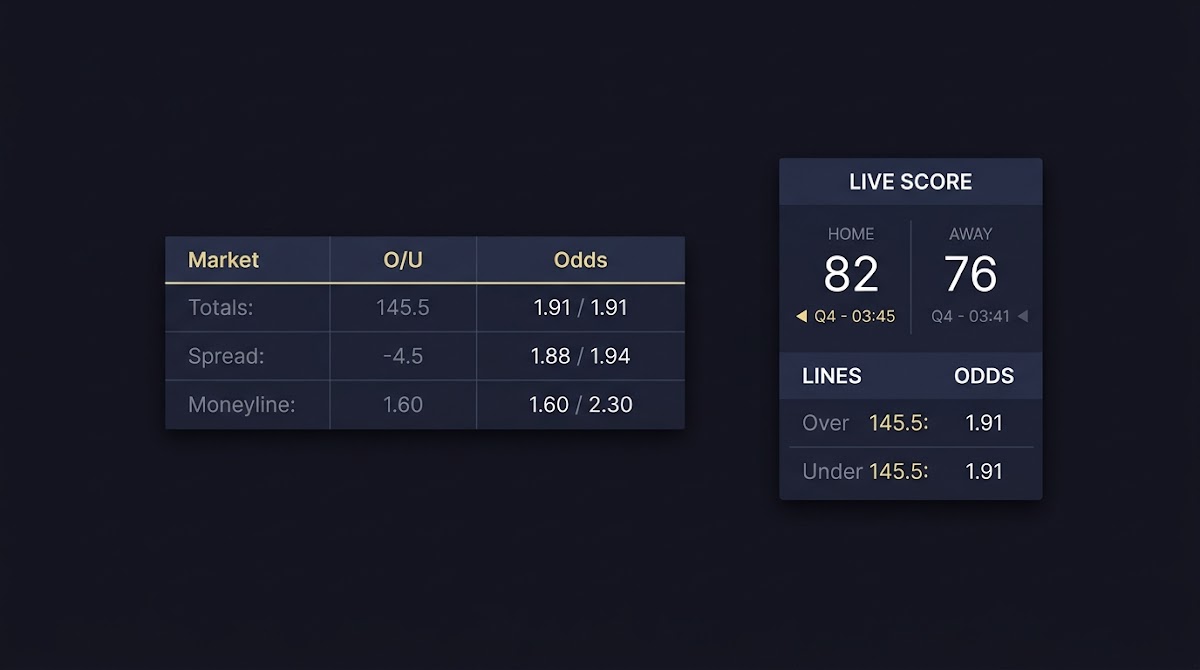
What expected value in totals markets means
Expected Value in Totals Markets starts with a clear definition: for a binary totals bet (Over or Under) expected value is the long-run average profit per unit staked based on your independently estimated probability that a side will win. A compact expression of that idea is EV = p × net_payout − (1 − p) × stake, where p is your modeled probability, net_payout is the return above stake for a win, and stake is the amount risked; this formula captures expected profit per unit stake and clarifies why positive EV implies a repeatable advantage over time Investopedia expected value definition.
Use this as a decision metric rather than a promise: EV is a probabilistic expectation, not a certainty. In practice, the key input is p, which must come from your model or judgement independently of the quoted market odds to avoid circular reasoning.
Explore FundedPlays Challenges for structured practice
Try the worked example later in this article and keep a simple line log so you can evaluate how often your model’s edges translate into real results; do not expect short-term guarantees.
Net payout and stake are mechanical but important. Net_payout equals the payout excluding your returned stake; for example, decimal odds of 2.50 yield a net_payout of 1.50 per unit staked. Writing these quantities down for each assessed line makes EV comparisons straightforward and repeatable.
How market odds hide the true probabilities: overround and de-vig methods
Odds formats vary. Decimal odds convert to a raw implied probability by taking 1 divided by the decimal odds. American odds require a small conversion step depending on sign, but both formats produce a preliminary market-implied probability that reflects the price offered to backers or layers rather than the bookmaker’s estimate of true chances.
Those raw implied probabilities always include the bookmaker’s margin, commonly called the overround, so the two sides will usually sum to more than 1. This is why you cannot compare your modeled p against raw implied probabilities without adjustment; removing the margin first prevents overstating your edge Pinnacle betting resources on margins.
There are two practical de-vig approaches to bring the market probabilities back to a neutral baseline. The simplest normalisation divides each implied probability by the total implied sum across both sides, then rescales so the two probabilities sum to 1. This proportional method assumes the bookmaker’s margin is applied evenly across outcomes and is quick to apply when you only have two-way totals markets. See the OddsJam no-vig calculator.

A second defensible technique treats the market prices as having a fixed overround and removes a constant margin share from each side before renormalising; this can be useful if you believe the bookmaker applies a fixed markup rather than proportional adjustments. Both methods are pragmatic approximations with different assumptions about how vig was distributed by the market and neither fully recovers a true underlying probability without further market or model insight Smarkets explanation of overround.
When you de-vig, track which method you used and why. Differences between de-vig methods are a source of persistent model risk, and logging helps you see whether one approach produces systematically better predictive results over time.
A step-by-step workflow to find plus-EV totals

Follow a repeatable checklist. First, capture the quoted odds in a reproducible format. Second, convert those odds to implied probabilities and remove the vig using your chosen de-vig method. Third, estimate a fair probability for Over or Under using your model. Fourth, compare your modeled p to the de-vigged market probability to calculate an edge and compute EV. Finally, decide whether to act and, if so, size the stake according to your risk rules.
Record every step: the original odds, the de-vigged market probability, your modeled probability, the computed EV, and the stake placed. Over time that log becomes the most informative dataset you have for tuning model assumptions and sizing rules Pinnacle betting resources on margins.
To make the workflow operational, use a simple spreadsheet or lightweight script that automates conversions and records results so manual errors are minimized. Keep input fields clear: event, line, decimal odds, implied probability, de-vigged probability, modeled p, net payout, EV, stake, and fill status. See the Funded Plays blog for implementation ideas.
Convert the market odds to implied probability and remove the vig, produce an independent model probability, compute EV using EV = p × net_payout − (1 − p) × stake, and size stakes conservatively with fractional Kelly while logging every trade to validate assumptions.
Before automating, test the whole loop manually for several lines to validate that your conversion and logging steps are error-free. Manual testing helps reveal common data-entry mistakes and clarifies where small rounding errors can change marginal EV decisions.
Modeling fair probabilities for totals: Poisson and Dixon-Coles basics
For soccer totals, Poisson-family goal models remain the standard starting point because they produce a full probability distribution over final scores, from which Over and Under probabilities follow naturally. The Poisson framework treats goal counts as count variables driven by expected scoring rates for each team, and summing outcomes above or below a line gives the totals probabilities used in EV calculations Dixon-Coles paper on football score modelling.
The Dixon-Coles approach builds on a Poisson baseline and adds simple adjustments to better fit low-scoring outcomes and short-term dependencies between teams. It is a defensible, compact model for practical forecasting, but modelers should be clear about its limits: small-sample teams, recent form shifts, and non-independent scoring dynamics can all reduce accuracy.
In practice, use Poisson-based output as a reasonable baseline for totals, then layer in simple adjustments such as home advantage, recent form multipliers, or manual overrides when there is clear extra information that the raw model does not capture.
Practical calculation: a worked example for an Over/Under line
Step 1, capture the market: suppose an Over 2.5 line shows decimal odds 1.95 for Over and 1.95 for Under. Convert decimals to implied probabilities: each side gives 1 / 1.95 = 0.5128, so raw implied probabilities sum to 1.0256, indicating an overround.
Step 2, remove the vig using proportional normalisation. Divide each implied probability by the total sum 1.0256 to get de-vigged probabilities of 0.5 for each side. Recording this step documents how you converted the market quote into the de-vigged comparison point Pinnacle on margin removal. You can also use a Vig & True Odds Calculator such as OddsIndex.

Step 3, model your fair probability. If your simplified Poisson-based model estimates the probability of Over 2.5 as 0.56, then your modeled p is 0.56 while the de-vigged market probability is 0.50. The model edge is 0.06 in probability terms.
Step 4, compute net payout and EV. With decimal odds 1.95 the net_payout is 0.95 per unit staked. Using EV = p × net_payout − (1 − p) × stake, and using stake = 1 unit, EV = 0.56 × 0.95 − 0.44 × 1 = 0.532 − 0.44 = 0.092 units expected profit per unit staked. That positive EV indicates a repeatable edge under the model assumptions and after removing market vig Investopedia expected value definition.
Step 5, decide and record. If your rules require an edge threshold of at least 0.03 EV per unit, this line meets that bar. Log the fill price, stake, and any execution notes so you can analyse realized performance against modeled expectations.
Sizing stakes: Kelly criterion and fractional Kelly in totals markets
Kelly links edge and payout to an optimal theoretical stake that maximises long-run growth of capital given your edge and odds. For a single binary bet, the full Kelly fraction can be calculated conceptually as the edge divided by the net odds, which gives the fraction of bankroll to risk when using full Kelly principles; many practitioners prefer to use fractional Kelly to reduce volatility and protect against model error Investopedia Kelly criterion guide.
Full Kelly is attractive in theory because it maximises geometric growth, but it can create large drawdowns if your edge estimate is noisy. Fractional Kelly-commonly one half or one quarter of the full Kelly suggestion-helps control variance while still increasing stakes with stronger modeled edges. Choose a fraction consistent with your temperament and the reliability of your model.
For example, if your calculated full Kelly suggests staking 6% of bankroll but you use half-Kelly, you would stake 3%; if you use quarter-Kelly, you would stake 1.5%. Conservative fractions slow bankroll growth but provide smoother equity curves and reduce psychological pressure during losing runs.

Decision criteria: thresholds, liquidity, and market movement
Set a minimum edge threshold to account for model uncertainty, transaction costs, and execution slippage. A common pragmatic threshold is to require a de-vigged model edge that exceeds your estimation uncertainty and any expected slippage before placing a trade; documenting how you estimated slippage helps make that criterion operational.
Liquidity matters. Thin or illiquid totals markets can move during execution, producing worse fills than quoted prices and eroding small edges. Prioritise markets and books where fills are reliable, or reduce your stake fraction when execution risk is elevated Investopedia on implied probability and market factors.
quick calculator for combining modeled probability and stake to estimate EV
enter decimal odds and probability as decimals
Log fills, partial fills, and missed opportunities. Record whether lines moved before execution and by how much; this record turns subjective impressions of liquidity into measurable data you can use to adjust thresholds and staking rules.
Common mistakes and pitfalls when computing EV for totals
Failing to remove the vig is the most common calculation error because raw implied probabilities overstate market fairness. Always normalise implied probabilities before comparing them to your modeled p to avoid inflated edge claims Smarkets explanation of overround. See no-vig calculators like TheRundown.
Overfitting a goal model to limited historical data is another major trap. Models that chase past idiosyncrasies will often predict poorly out of sample; use cross-validation, holdout periods, or simple parsimonious models to reduce overfitting risk Dixon-Coles foundational paper.
Miscomputing net payout or mixing stake conventions (decimal vs implied-return) creates arithmetic errors that flip EV signs. Standardise a single convention for net_payout and be explicit in your logs to reduce these clerical mistakes.
Risk management: drawdowns, variance, and realistic expectations
Stake sizing drives variance and drawdown. Using full Kelly can imply rapid bankroll swings if your edge estimates are noisy, while fractional Kelly reduces those swings at the cost of slower growth. Treat staking as a risk-management decision rather than a pure growth maximisation exercise Investopedia Kelly criterion guide.
Keep realistic expectations. Positive EV increases the probability of long-term profit but does not guarantee short-term wins. Maintain a record of drawdowns, win rates, and realized EV versus expected EV so that decisions remain data-driven rather than emotional.
Practical scenarios: soccer, basketball, and other sports differences
Soccer commonly uses Poisson-family models because goals are relatively rare and count-based distributions match observed scoring patterns. For high-scoring sports like basketball, Gaussian or other continuous approximations or team possession-based models become more appropriate because per-game scoring distributions differ substantially from soccer’s low-count profile Dixon-Coles on soccer modelling.
When moving models across sports, adapt the distributional assumption and the granularity of inputs. Higher-scoring sports reduce the relative variance of totals, which changes how sensitive EV is to small probability estimation errors and may lead you to different staking and threshold decisions.
Quick checklist before placing a totals bet
Use this short pre-bet checklist: 1) convert quoted odds to implied probability, 2) remove the vig and record the de-vigged market probability, 3) compute your modeled p and the edge, 4) calculate EV and confirm it meets your threshold, 5) choose a stake using your Kelly fraction, 6) record final fill details and notes.
Also note execution slippage and liquidity context on the bet record. Over time these fields let you measure whether theoretical EV converts into realized advantage in the markets you trade Investopedia expected value definition.
Limitations, ethics, and responsible participation
Models and EV calculations do not guarantee profits. Outcomes depend on the accuracy of your probability estimates, execution quality, and variance. Treat EV analysis as a disciplined way to prioritise decisions rather than a promise of results.
Follow simple responsible-participation rules: set bankroll limits you can afford to lose, use time limits for active trading sessions, and adhere to platform rules and local regulations. Transparent logs and conservative staking reduce the risk of chasing losses or overreacting to short-term noise.
Summary and next steps
Recap the workflow: convert odds, remove the vig, model a fair probability, compute EV, and size stakes conservatively. Maintain a consistent log of lines, fills, and realized outcomes to evaluate whether your edges persist in live markets. See Funded Plays.
Next steps are practical: implement the spreadsheet or simple script that automates conversions and recording, test the loop manually on a small series of events, and gradually introduce fractional Kelly sizing as you validate your model’s out-of-sample performance. Continuous, disciplined iteration is the most reliable path from theoretical EV to repeatable practical results. Read how Funded Plays evaluations work for further context.
Convert odds to implied probability, remove the bookmaker margin, estimate your fair probability, then apply EV = p × net_payout − (1 − p) × stake to find expected profit per unit staked.
Raw implied probabilities include the bookmaker’s margin so they sum to more than one; removing the vig prevents overstating an apparent edge and gives a neutral comparison point.
Full Kelly maximises long-run growth but increases volatility; most practitioners use a fractional Kelly (for example half or quarter Kelly) to reduce drawdowns and protect against model error.
References
- https://www.investopedia.com/terms/e/expectedvalue.asp
- https://www.pinnacle.com/en/betting-resources/education/how-to-calculate-betting-margins
- https://oddsjam.com/betting-calculators/no-vig-fair-odds
- https://help.smarkets.com/hc/en-gb/articles/115003237352-Understanding-overround
- https://www.fundedplays.com/challenges
- https://onlinelibrary.wiley.com/doi/10.1111/1467-9876.00065
- https://oddsindex.com/guides/vig-true-odds-calculator
- https://www.fundedplays.com/blogs
- https://www.investopedia.com/terms/k/kellycriterion.asp
- https://www.investopedia.com/terms/i/implied-probability.asp
- https://therundown.io/betting-calculators/no-vig-calculator
- https://www.fundedplays.com
- https://www.fundedplays.com/blogs/how-fundedplays-evaluations-work