
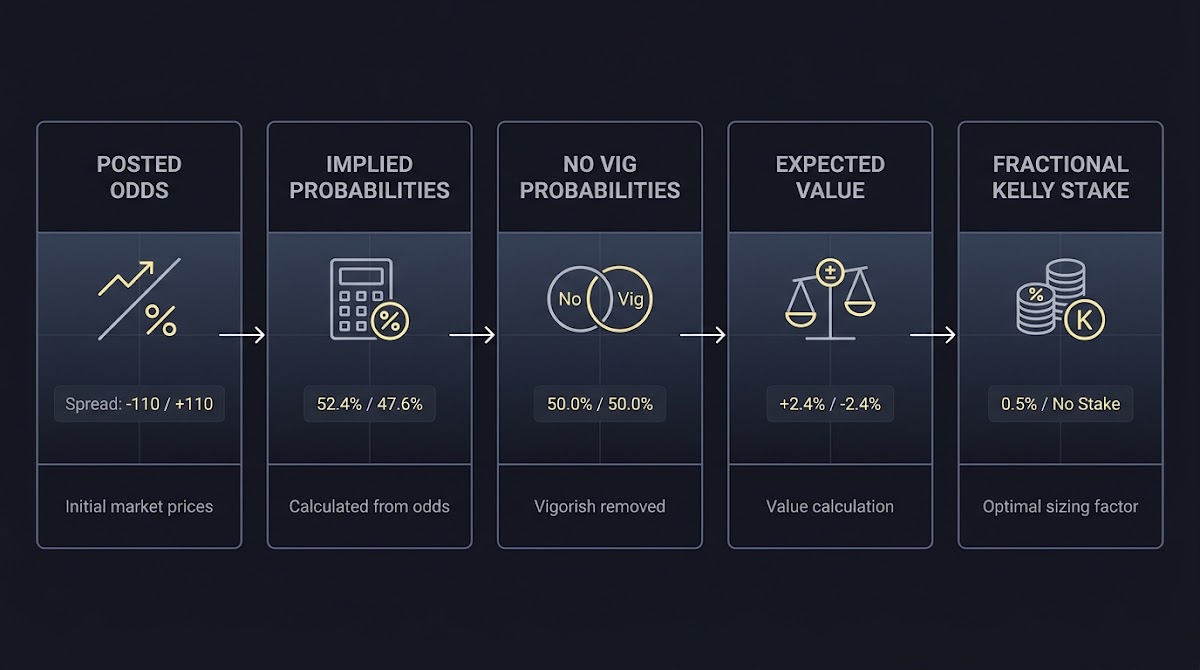
Expected Value in Spread Markets: definition and why it matters
Expected Value in Spread Markets is the probability-weighted average profit or loss you expect per unit staked on a point-spread wager, where a push returns the stake and contributes zero to the calculation; this definition is the foundation of any objective evaluation of a spread line and of decisions that follow from it Investopedia expected value article.
To use expected value in practice you must separate three outcome probabilities: p_win for where your selection covers the spread, p_loss for where it does not, and p_push for an exact tie where the stake is returned; p_push contributes zero to EV because the stake comes back to you Investopedia expected value article.
Yes, include a realistic p_push for spreads that can result in ties, because a push returns the stake and materially affects expected value and stake sizing.
Because market prices set by bookmakers include a margin, the raw implied probabilities you see from posted American odds overstate the available value and cannot be compared directly to your own model probabilities until the vigorish is removed Investopedia vigorish article.
When you read a point-spread market the right metric is expected value after you adjust the market probabilities to a no-vig baseline and fold in a realistic push probability where relevant; that corrected EV is what tells you whether a wager is theoretically profitable against your own probability estimate Unabated no-vig explanation.

At its core, EV lets you compare the market's implied chance to win against your own estimate on a common scale, measured per unit staked; a positive EV means your probabilities suggest a long-run edge versus the supplied market prices, after you account for the bookmaker margin Investopedia expected value article.
That comparison only works if probabilities are comparable, so converting American odds to implied probability and then removing the vig is a necessary pre-step for any serious EV calculation Unabated no-vig explanation.
What expected value (EV) means for a single spread wager
At its core, EV lets you compare the market's implied chance to win against your own estimate on a common scale, measured per unit staked; a positive EV means your probabilities suggest a long-run edge versus the supplied market prices, after you account for the bookmaker margin Investopedia expected value article.
That comparison only works if probabilities are comparable, so converting American odds to implied probability and then removing the vig is a necessary pre-step for any serious EV calculation Unabated no-vig explanation.
How pushes affect EV in point spreads
A push occurs when the final margin lands exactly on the listed spread and the house rules return the stake; because a push returns the stake its contribution to EV is zero, but omitting a non-zero push probability understates the chance of a neutral outcome and biases your EV estimate Investopedia expected value article.

League scoring patterns make some spreads more likely to produce pushes than others, so treating p_push as zero for an integer spread in a league with common scoring increments can be a material oversight NFL key numbers analysis.
When EV should guide your decisions
EV is the long-run metric for decision making: use it to compare alternative lines, to prioritize trades, and to frame stake sizing rules rather than as a prediction of short-term results Investopedia expected value article.
In practice, small estimated edges require more evidence and stronger record-keeping before they justify staking, because model error and transaction costs can easily turn an apparent advantage into an expected loss.
How bookmakers set spread lines and where the vig appears
Bookmakers express spread prices using American odds and attach a juice or vig that creates a margin between the fair probability and the market-implied probability; the vig is the reason the sum of implied probabilities typically exceeds 100 percent Investopedia vigorish article.
To see this in practice you convert posted American odds for each side of a market into implied probabilities and then note that the raw sum exceeds 100 percent by an amount equal to the bookmaker margin, which must be removed to recover fair, no-vig probabilities Unabated no-vig explanation.
American odds, juice, and implied probability
American odds encode the payout for a unit stake and translate into implied probabilities through standard formulas that differ slightly for favorites and underdogs; those implied probabilities are the building blocks for a no-vig conversion that follows Unabated no-vig explanation.
Why implied probabilities sum to more than 100 percent
Because bookmakers price both sides with a markup to manage risk and to ensure a house edge, the separate implied probabilities computed from posted prices exceed a fair total and must be normalized before direct comparison with a model probability Investopedia vigorish article.
Practical implications for comparing market lines to your model
If you compare your p_win directly to an unadjusted implied probability from a -110/-110 market you will normally be overrating the market chance to win, so your model must use no-vig market probabilities when deciding if a spread is +EV Unabated no-vig explanation.
Also check the sportsbook house rules that govern pushes, voids and settlement conventions, because those rules affect how you count p_push and how to treat unusual outcomes when computing realized returns sportsbook house rules.
Convert prices to no-vig probabilities: step-by-step method
Step 1 is to convert posted American odds into implied probabilities using the standard formulas: for positive odds the implied probability is 100 divided by (odds plus 100), and for negative odds it is the absolute value of odds divided by (absolute odds plus 100); these implied probabilities reflect the market price before any normalization Unabated no-vig explanation.
Step 2 is to remove the vig by scaling the two implied probabilities so their sum equals 100 percent, producing the no-vig probabilities you should use to compare with your handicapped p_win Unabated no-vig explanation.
Step 3 is a sanity check: reconvert the no-vig probabilities back into fair prices to confirm the odds implied by your normalization are internally consistent and to observe small rounding effects when comparing those fair prices to posted market prices Unabated no-vig explanation.
Convert American odds to implied probabilities
For example, the conversion rules are deterministic so you can implement them in a spreadsheet or script to avoid manual errors; do not forget to treat plus and minus odds with the right formula and to express probabilities as decimals or percentages consistently Unabated no-vig explanation.
Normalize probabilities to remove the vig
Normalization is a proportional scaling: divide each implied probability by the sum of the two implied probabilities and multiply by 100 to yield no-vig probabilities that add to 100 percent, which you can then compare directly to your own p_win estimate Unabated no-vig explanation.
Check: reconvert no-vig probabilities back to fair prices
To reconvert, take the no-vig probability for one side, invert the probability to an implied decimal price, and then translate that decimal back into American odds if needed; this round trip helps reveal rounding issues and makes spreadsheet outputs easier to read when matching market lines Unabated no-vig explanation.
Accounting for pushes and key numbers in spread markets
A push is defined by sportsbook settlement rules and typically occurs when the final margin exactly equals the posted spread; consult the applicable house rules to confirm whether pushes are returned or recorded differently under special circumstances sportsbook house rules.
In leagues like the NFL final margins cluster around specific key numbers because of scoring conventions, which makes p_push nontrivial when the posted spread is an integer near such key numbers NFL key numbers analysis.
When a spread sits on a common key number you should explicitly include a non-zero p_push in your EV calculation rather than assuming ties are negligible, because doing so changes the balance between p_win and p_loss and therefore affects stake sizing and decision thresholds NFL key numbers analysis.
Use the spreadsheet templates to evaluate spreads
If you use spreadsheets to evaluate spreads, copy the template from the Simple league example templates section and adapt the push estimate to your league and model assumptions.
House rules also specify how voids and canceled events are handled, and those settlement conventions affect realized ROI in edge calculations, so include those rules in your record-keeping plan when you log evaluated bets sportsbook house rules.
What constitutes a push and how house rules treat ties
Settlement language varies, but the common convention returns the stake on a push and records no win or loss for the bettor; that neutral outcome must be included in the p_push term of any EV formula to reflect real-world payouts sportsbook house rules.
Why pushes are nontrivial in league contexts like the NFL
Because NFL scoring tends to produce final margins clustered around a few scores, integer spreads that align with those scores result in elevated push probabilities relative to random continuous scoring models; that empirical pattern is why key number awareness matters when modeling EV NFL key numbers analysis.
How to estimate a realistic push probability
Estimate p_push empirically by analyzing the distribution of final margins for the league in question or by using published key number summaries as starting points, and then adjust for situational factors such as weather, tempo and injury news that change scoring dynamics.
When in doubt be conservative with p_push: assigning a modest non-zero push probability is better than assuming zero and will reduce the risk of systematically overestimating your edge.
EV per unit: the formula and a step-by-step worked calculation
The canonical formula for a priced spread at unit stake 1 is EV = p_win times net_win minus p_loss times net_loss, with p_push equal to 1 minus p_win minus p_loss and contributing zero to EV because a push returns the stake; this algebraic form makes the accounting for neutral outcomes explicit Investopedia expected value article.
To compute net_win and net_loss use the market price converted to a payout per unit: net_win is the profit if you win expressed in stake units, and net_loss is the stake you lose when the selection fails; these quantities follow directly from American odds after you standardize to a unit stake Unabated no-vig explanation.
compute EV per unit from probabilities and net payouts
Paste into a spreadsheet cell replacing field names with cell references
Use the stepwise approach: 1) determine market no-vig p_win and p_loss, 2) estimate your own p_win and p_push, 3) compute net_win and net_loss from the posted price, and 4) evaluate EV using the formula above; this sequencing keeps the arithmetic transparent and auditable Investopedia expected value article.
EV = p_win times net win minus p_loss times net loss
Express all probabilities on the same basis and compute net payouts consistently; for example net_win is zero for a push, so the EV formula naturally treats pushes as neutral when p_push is accounted for via the identity 1 = p_win + p_loss + p_push Investopedia expected value article.
Getting net_win and net_loss from price for a unit stake
From American odds convert to decimal or to a profit-per-unit convention: for positive odds the net_win equals odds divided by 100, while for negative odds the net_win equals 100 divided by the absolute odds; net_loss is typically one unit when you lose, but confirm any nonstandard settlement rules in the house rules Unabated no-vig explanation.
Worked example walkthrough without invented numbers
Rather than inventing a market price or a probability, outline the plug-in steps readers should follow: substitute your own no-vig market p_win, your model p_win, your p_push estimate and the net_win and net_loss you compute from the posted price, then evaluate EV to see if the result is positive.
Document the calculation row by row in a spreadsheet so you can trace each intermediate value back to either a market conversion or a model estimate; this traceability matters for debugging and later backtests.
Simple league example templates readers can apply
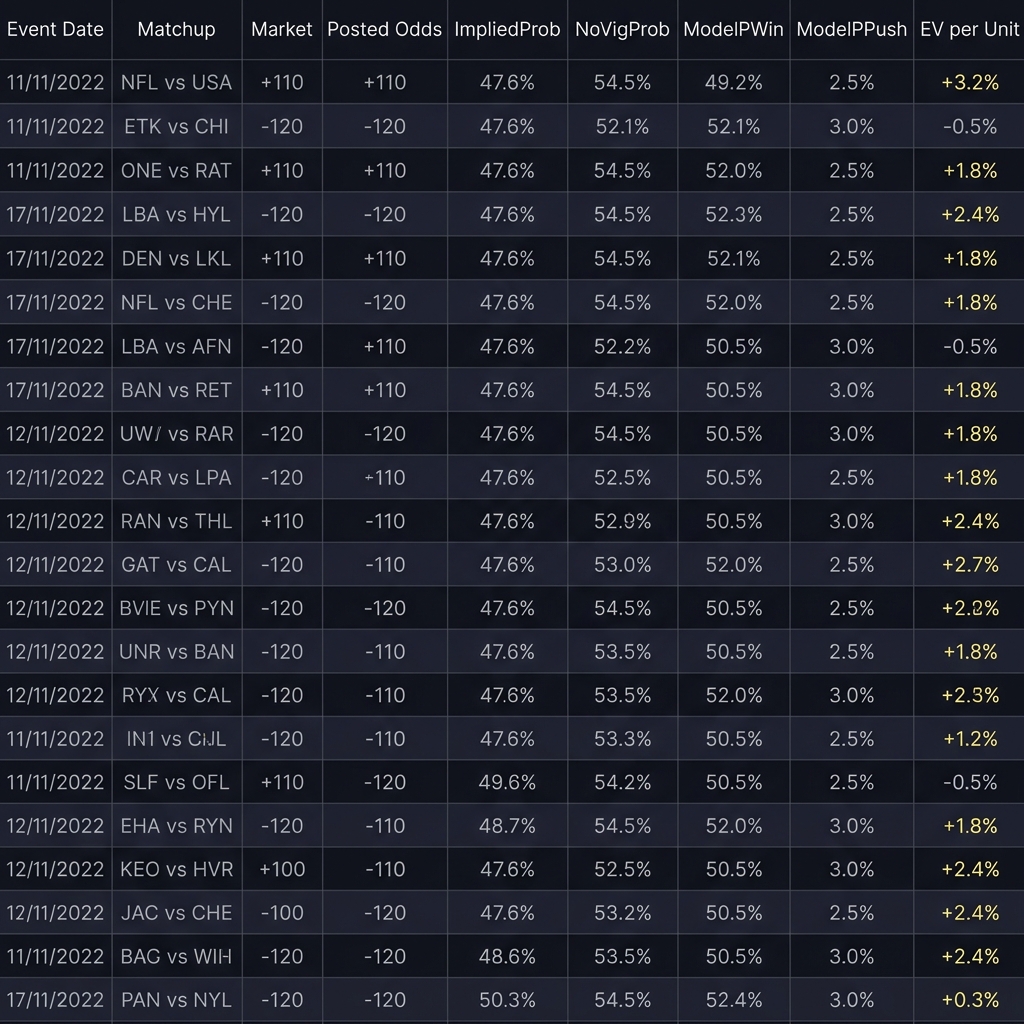
Template inputs you need for every evaluated spread: market price, converted implied probability, normalized no-vig probability, your handicapped p_win, estimated p_push, and stake unit; collect these inputs in a single row for each evaluated game so analysis and backtesting are straightforward Unabated no-vig explanation.
Use a consistent spreadsheet layout where each column has a clear label and a simple formula, and keep rounding minimal until the final EV cell to avoid small numerical bias when comparing to market lines Investopedia expected value article.
Template inputs you need for every evaluated spread are available in our Simple league example templates and can be adapted to other leagues.
Template: applying no-vig probabilities and push estimates
Checklist of required inputs for a template row: posted American odds, implied probability, no-vig probability, model p_win, model p_push, net_win, net_loss, stake, and a computed EV cell using the formula above; these columns let you filter, sort and backtest efficiently Unabated no-vig explanation.
Template: edge calculation and decision threshold
Include an edge column that subtracts the market no-vig p_win from your model p_win and another column that uses the EV formula to show dollar-equivalent expectation per unit; use both columns to decide whether the estimated advantage clears your minimum actionable threshold Unabated no-vig explanation.
How to format inputs for a spreadsheet or simple calculator
Put probabilities as decimals in dedicated cells, use named ranges where possible, and lock the normalization and EV formulas so they can be reused across rows for many games without copying errors; this reduces manual mistakes and speeds up evaluation.
Keep a notes column that records the reasoning for your p_push estimate so that later you can reconcile model assumptions with realized outcomes.
Decision criteria: how to identify a +EV spread opportunity
Call a spread +EV when your estimated p_win exceeds the market no-vig p_win by enough to overcome transaction costs, push probability and reasonable estimation error; the comparison must be done using the normalized, no-vig market probability rather than raw implied probabilities Unabated no-vig explanation.
Because small edges are more likely to be false positives, set a conservative minimum edge threshold tied to your typical model error and liquidity; use the EV per unit in combination with confidence intervals to decide whether to place a wager Investopedia expected value article.
Comparing your no-vig-backed probability to the market no-vig probability
Direct comparison is straightforward: if model p_win minus market no-vig p_win yields a positive edge and the resulting EV per unit is meaningfully positive after p_push is included, the wager passes the first test for actionability Unabated no-vig explanation.
Incorporating push-adjusted EV and minimum edge thresholds
Translate a percentage edge into an EV per unit and then into an expected return over your planned sample size; define minimum EV thresholds relative to your bankroll and typical bet size so you avoid chasing noise.
Trading off opportunity size versus confidence and liquidity
Larger apparent edges in thin markets may reflect pricing inefficiencies but can also carry liquidity and execution risk; weigh the size of the expected value against how confident you are in the model and how easily you can transact at posted prices.
Bankroll management: fractional Kelly for spread bets
The Kelly principle ties estimated edge to an optimal fraction of bankroll to stake, but full Kelly often produces large variance and drawdowns, so practitioners commonly apply a fraction of Kelly to reduce risk while retaining the link between edge and stake Investopedia Kelly criterion article.
Fractional Kelly reduces sensitivity to estimation error: for example many active managers use half-Kelly or quarter-Kelly as practical heuristics to preserve long-run growth potential while smoothing volatility Investopedia Kelly criterion article.
Why full Kelly is often too aggressive
Full Kelly is optimal only under idealized assumptions about edge estimates and independent bets, and overconfidence in a noisy model can lead to excessively large stakes and rapid drawdowns; recognizing estimation uncertainty motivates fractional adjustments Investopedia Kelly criterion article.
How fractional Kelly reduces variance
Using a fraction of the full Kelly stake scales the wager linearly with that fraction and substantially lowers the probability of large interim drawdowns while still capturing a portion of the long-run growth advantage implied by positive EV Investopedia Kelly criterion article.
Practical steps to implement fractional Kelly sizing
Compute your estimated edge from the EV per unit, calculate the full Kelly fraction based on your win probability and payoff, then multiply that fraction by your chosen scale factor, for example 0.25 or 0.5, and convert the fractional Kelly result into a stake size in currency units.
Always check that the resulting stake fits your liquidity constraints and record the fraction used so you can analyze how different fractions affect long-term performance.
Common mistakes and pitfalls when computing EV for spreads
One frequent error is using raw implied probabilities without removing the vig, which overstates market chance to win and can produce false positive EV calls; always normalize to no-vig probabilities first Investopedia vigorish article.
Another mistake is ignoring pushes, particularly on integer spreads in sports with common scoring increments, which biases the EV calculation and leads to mis-sized stakes NFL key numbers analysis.
A third pitfall is applying full Kelly to marginal edges or relying on a small sample of wins to validate a staking rule; estimation error and overfitting are common sources of poor long-term results, so prefer conservative fractions and robust record-keeping Investopedia Kelly criterion article.
Practical templates, checklists and a quick decision flow
Use this 6-step checklist each time you evaluate a spread: 1) record market price, 2) compute implied probabilities, 3) remove the vig, 4) estimate your p_win and p_push, 5) compute EV per unit, and 6) apply your staking rule and record the decision and rationale Unabated no-vig explanation.
Recommended spreadsheet column names: Date, Game, Posted Odds, ImpliedProb, NoVigProb, ModelPWin, ModelPPush, NetWin, NetLoss, Stake, EVperUnit, StakeSize, Result, RealizedReturn; formula cells should reference these columns so you can filter and aggregate later Investopedia expected value article.
Quick 6-step checklist to compute EV and decide
Follow the checklist above strictly and keep notes on assumptions for p_push and edge calculations so you can revisit them when outcomes differ from expectations; disciplined record-keeping is the most reliable path to improving handicapping skill.
Spreadsheet column layout sample
Place core calculations in locked columns and expose only inputs for manual edits; use named ranges and a summary sheet to track cumulative realized EV and ROI for ongoing monitoring.
Record keeping and minimum evidence before betting
Require a minimum confidence threshold and a documented rationale before placing real stakes, and log pre-game model outputs so your backtest uses the same information you had when you made the decision.
Advanced considerations: market efficiency, correlated bets and in-play spreads
Market efficiency varies by sport, market depth and timing; less liquid markets can produce exploitable pricing inefficiencies but also higher execution risk and larger bid-ask frictions that reduce realized EV Investopedia expected value article.
Correlated lines, such as multiple bets on the same game or on linked outcomes, require careful joint evaluation because naive summing of EVs ignores covariance and can understate aggregate risk.
In-play markets and line movement change no-vig probabilities dynamically; if you trade after significant movement re-evaluate the market no-vig baseline and your model inputs before assuming an unchanged edge Unabated no-vig explanation.
How to track, backtest and improve your EV estimates
Log these essential fields for each evaluated bet: date, market line, market price, no-vig market p_win, your p_win, p_push, stake, realized result and realized return; these fields let you compute realized EV and diagnose model bias over time Investopedia expected value article.
Basic backtest metrics to track include aggregated EV versus realized ROI, hit rate and mean stake size; use these diagnostics to calibrate your model and staking fraction rather than as proof of short-term success.
Iterate on your probability model using out-of-sample validation and holdout sets to reduce overfitting, and be explicit about how you update push estimates and situational modifiers to keep the model auditable.
Conclusion: integrating EV into a disciplined spread strategy
Remove the vig, explicitly model pushes where they matter, compute EV per unit with transparent arithmetic, and use fractional Kelly sizing to control variance; these four steps create a repeatable workflow for applying expected value to spread markets Unabated no-vig explanation.
Keep realistic expectations, maintain detailed records for backtesting, and treat small edges with caution until your model demonstrates consistent out-of-sample performance Investopedia expected value article.
Pushes return the stake and contribute zero to expected value, so you must include a non-zero p_push term when ties are possible to avoid biasing the EV estimate.
Bookmaker prices include a margin that inflates implied probabilities; normalizing to no-vig probabilities produces fair market chances that you can compare to your model.
Full Kelly is often too aggressive due to estimation error; many practitioners use a fraction of Kelly to reduce variance and limit drawdowns.
References
- https://www.investopedia.com/terms/e/expectedvalue.asp
- https://www.investopedia.com/terms/v/vigorish.asp
- https://unabated.com/articles/no-vig-odds-calculator-explained/
- https://www.actionnetwork.com/nfl/nfl-betting-key-numbers-3-7
- https://help.draftkings.com/hc/en-us/articles/115000465108-Sportsbook-House-Rules
- https://oddsjam.com/betting-calculators/no-vig-fair-odds
- https://oddsindex.com/guides/vig-true-odds-calculator
- https://therundown.io/betting-calculators/no-vig-calculator
- https://www.fundedplays.com/challenges
- https://www.fundedplays.com/blogs
- https://www.fundedplays.com/blogs/how-fundedplays-evaluations-work
- https://www.fundedplays.com
- https://www.investopedia.com/terms/k/kelly-criterion.asp