
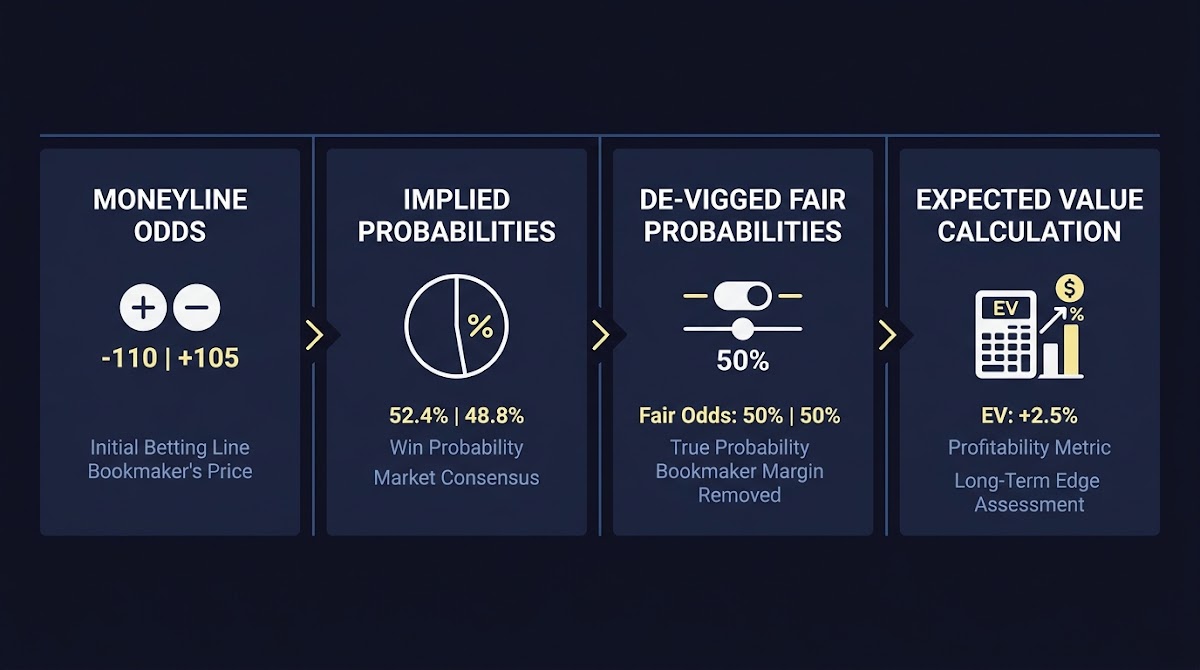
What Expected Value in Moneyline Markets Means
Expected value is the arithmetic average of payoffs weighted by their probabilities, and it is the central metric for deciding whether a moneyline price is favorable over many repetitions; this foundational definition is useful because it turns speculative judgment into a reproducible calculation, and readers can find a clear primer on the expected value concept in the Investopedia expected value guide Investopedia expected value guide.

In moneyline markets, quoted odds do not directly equal a fair estimate of an outcome probability because sportsbooks add margin, commonly called overround, which causes the summed implied probabilities to exceed 100 percent; this market feature biases raw EV calculations unless you remove it, as explained in Pinnacle’s margin guide Pinnacle betting resources on margin.
Put simply, a positive expected value, or +EV, means that across many similar bets you would expect a positive average payoff, whereas -EV outcomes imply a negative long-term expectation even when short-term wins occur; recognizing the distinction between variance and expectation is key when you evaluate single moneyline opportunities.
How American Moneylines Translate to Implied Probabilities
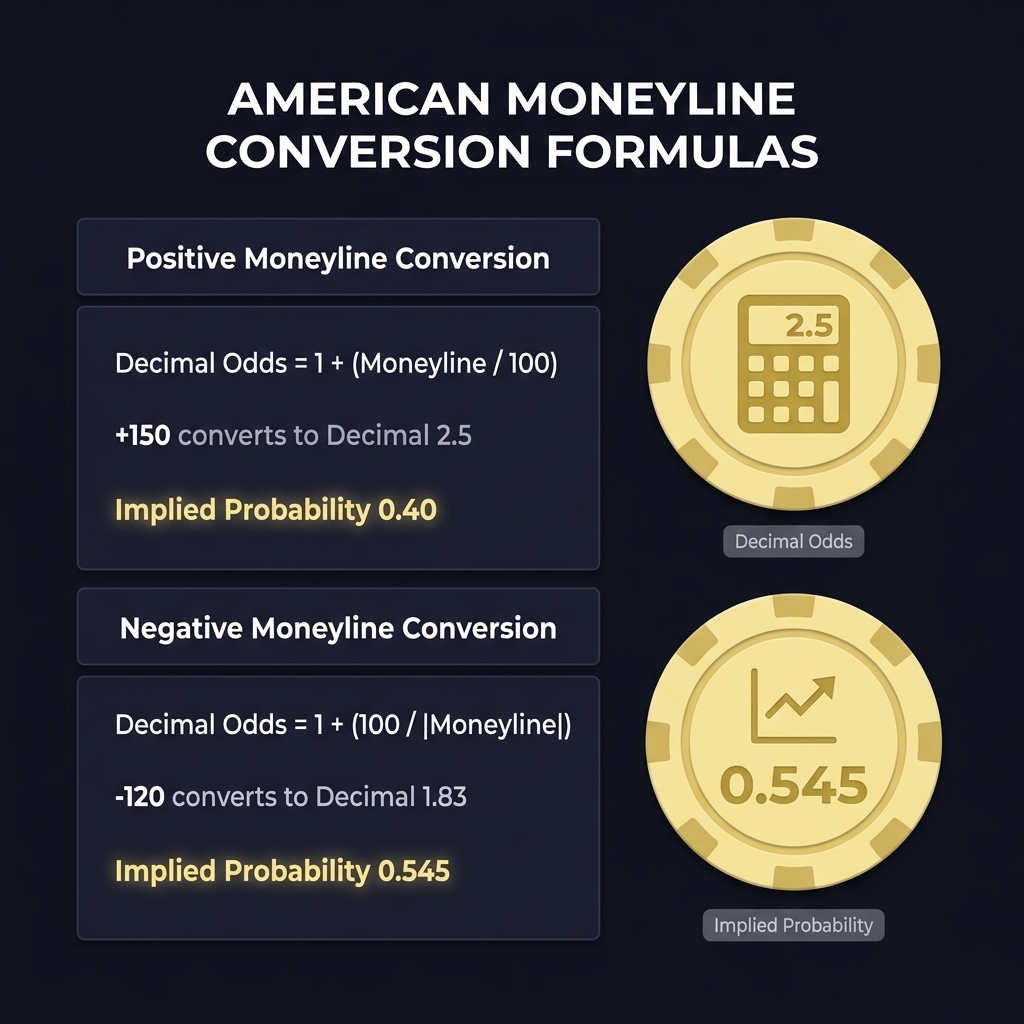
Before you can assess expected value you must convert American moneyline quotes into implied probabilities using the standard formulas: for a positive moneyline you use p = 100 / (ML + 100) and for a negative moneyline you use p = -ML / (-ML + 100); details on these canonical conversions appear in the Investopedia implied probability guide Investopedia implied probability guide.
Reproduce the moneyline conversions with the EV template described here
Download the EV calculation template or spreadsheet to reproduce these conversions and follow the worked steps below
To keep the math simple at this stage, use symbolic numeric examples where you label assumed numbers explicitly so you do not present market data as fact; after conversion, check whether the sum of implied probabilities is above 100 percent to quantify the overround before de-vigging.
When you convert multiple sides in a single market, expect the summed implied probabilities to exceed 100 percent by an amount equal to the bookmaker margin, and plan to remove that margin before interpreting any calculated expected value.
Why and How to Remove the Bookmaker Margin (De-vig)
Bookmakers set prices so their implied probabilities sum to more than 100 percent in order to secure a long-run edge; understanding and correcting for that overround is essential because raw implied probabilities will produce biased EV estimates if you do not adjust them, as Pinnacle explains Pinnacle betting resources on margin.
For two-way moneyline markets a common and practical de-vig approach is proportional re-scaling: compute each side's implied probability, add them to get the market total, then divide each implied probability by that total to rescale the pair to a combined 100 percent; this gives you a simple fair-probability estimate to use in EV calculations.
Be explicit when you report de-vig results: name the method you used, show the intermediate implied probabilities, and record the market total so others can reproduce your work and test alternative assumptions. DatawiseBets.
Proportional scaling is not the only option; other de-vig choices include margin subtraction, where a fixed percentage is subtracted from each side before normalizing, and consensus or market-based methods that use pooled prices to infer fair probabilities; each approach carries implicit assumptions about how margin was applied in pricing Pinnacle betting resources on margin, and detailed comparisons appear on OddsJam.

Multi-outcome events such as three-way soccer markets complicate margin allocation because you must choose how the overround is split across more than two outcomes, and no single method is universally accepted as superior; this is an active uncertainty in applied practice and a reason to document your choice.
As a practical habit, run your EV calculation with at least two de-vig methods and report the range of resulting EVs so you can see how robust your conclusion is to the de-vig assumption, as described on Outlier.bet.
Step-by-Step: Calculating EV for a Moneyline Bet
Input checklist before computing EV: market odds for each side, converted implied probabilities using the American-moneyline formulas, the chosen de-vig method and its rescaled probabilities, a defensible assumed true probability for the side you expect to win, the stake, and any execution costs or fees to include in payoff math.
Convert the moneyline to implied probability, remove the bookmaker margin to get fair probabilities, state your assumed true probability with justification, compute EV per unit stake, and check that the result remains positive after sensitivity tests and execution costs.
Template calculation: express payoffs in consistent units per unit stake, compute expected payoff by multiplying each outcome payoff by its assumed probability, and then sum those products to get EV per unit stake; a clear formula and worked template help turn judgment into numbers, and Investopedia’s expected value primer provides the basic framework for this computation Investopedia expected value guide.
Always label your assumed true probability explicitly, then run sensitivity analysis by varying that assumption across a realistic band to see how the EV sign and magnitude change; this reveals whether a small change in your belief flips a +EV call to -EV.
When documenting a single calculation, include the converted implied probability, the de-vig result, the assumed true probability, the stake, and the computed EV so a later review can reproduce the decision and test whether the assumption held up in actual results.
Bankroll Sizing and Staking: Practical Guidance
The Kelly criterion describes the fraction of bankroll that maximizes long-run growth under accurate edge estimates and is the theoretical reference for staking, but it relies on precise probability and variance inputs that are often uncertain in practice; readers can consult theoretical treatments of Kelly for deeper study Springer on the Kelly criterion.
Because edge estimates contain error, many practitioners use fractional Kelly, commonly half-Kelly or a smaller fraction, to reduce volatility and limit drawdowns while still preserving some of the growth properties of full Kelly.
Record-keeping is essential: track stakes, assumed edges, realized results, and rolling drawdowns so you can verify whether your staking rule is appropriate for your actual hit rates and variance.
Decision Criteria: When a Moneyline Bet Is Credible +EV
Set minimum practical edge thresholds that account for sportsbook hold and friction; because U.S. commercial sportsbooks have reported sustained positive hold at national and state levels, your required edge must be meaningfully above the de-vig-adjusted break-even point to cover execution slippage and market fees, as summarized in the American Gaming Association revenue tracker American Gaming Association revenue tracker.
Checklist before placing a bet: confirm liquidity is sufficient for your planned stake, estimate likely line movement between calculation and placement, account for any transaction costs, and decide whether your calculated EV margin still holds after these adjustments.
compute expected payoff per stake using de-vig and an assumed true probability
use decimal odds that reflect de-vig adjustments
When you take a candidate +EV bet to execution, save a pre-bet snapshot with the exact odds and timestamp so you have evidence if the market moves or the bet is disputed; this habit also supports later verification of model performance.
Typical Errors and Pitfalls to Avoid
A common mistake is failing to remove the bookmaker margin, which turns apparent edges into distortions; always check for overround and apply a de-vig method before computing EV Pinnacle betting resources on margin.
Another frequent error is overconfidence in small-sample edges or in a model that fits historical noise; avoid overfitting by reserving out-of-sample tests and by tracking realized EV versus expected outcomes over time.
Mitigations include explicit sensitivity analysis, conservative staking through fractional Kelly, and an explicit protocol for when to pause or recalibrate models if realized performance departs from expectations.
Real-World Market Considerations: Hold, Liquidity, and Line Movement
Empirical sportsbook hold affects the practical threshold for +EV because sustained positive hold at the market level means bettors need to find genuine pricing errors rather than rely on variance; public reporting on commercial sportsbook revenues helps frame how large that structural edge can be in aggregate American Gaming Association revenue tracker.
State-level reports, such as those that include Nevada’s sports pool win and hold data, illustrate that local market conditions and product mixes influence realized hold and should be considered when setting minimum edge requirements for actionable bets Nevada Gaming Control Board report.
Line movement can erode theoretical EV between the time you calculate and the time you can place a bet; measure typical slippage for your markets and factor that into whether a calculated edge is worth pursuing.
Practical Scenarios: Templates Rather Than Market Claims
Underdog template: placeholders for odds and assumptions let you document the steps. Start with the underdog moneyline, convert to implied probability, de-vig the market to get fair probability, set an assumed true probability for the underdog with a stated rationale, compute the expected payoff per stake, and then run sensitivity checks across a probability band to see when EV stays positive.
Favorite capture template: for a market favorite, convert the negative moneyline to implied probability, de-vig, and compare your model’s true-probability assessment against the rescaled fair probability; because favorites often offer smaller margins, execution costs and staking discipline are especially important for favorites.

Close market template: for contested markets with small gaps between sides, require a larger safety margin in assumed edge and prefer lower stakes or smaller fractional Kelly fractions, and always record the calculation inputs so you can re-run the analysis if the market moves.
How to Document Assumptions and Stress-Test Your EV Model
Minimum record fields to save per bet: market odds, converted implied probabilities, de-vig method and results, assumed true probability with rationale, stake, timestamp, and final outcome; keep these records to enable later verification and model checks. Funded Plays
Simple stress tests: vary the assumed true probability by a fixed range in both directions, switch de-vig methods, and recalculate EV to see how sensitive your conclusion is to reasonable changes in assumptions.
Save pre-bet screenshots and maintain a versioned model log so you can trace which model version produced a decision and why you changed parameters over time.
Tracking Performance: Records, Metrics, and When to Recalibrate
Track realized ROI, average recorded EV per stake, hit rate, run lengths, and drawdowns to evaluate whether your EV modeling and staking approach is delivering as expected.
Signals to revisit models include persistent realized EV materially below expected EV, structural market changes in hold or liquidity, or regulatory shifts that affect execution; when those signals appear, pause bets and run out-of-sample tests before resuming larger stakes.
Use rolling calibration windows and hold back a validation set to reduce the chance of overfitting and to maintain a disciplined review schedule.
Responsible Participation and Platform Boundaries
Work on EV is analytical and probabilistic, not a guarantee of outcomes; platforms that offer funded challenges operate as skill-based sweepstakes and do not guarantee earnings, so treat any model outputs as hypotheses to be tested under platform rules, see how Funded Plays evaluations work.
Follow local rules and platform terms, keep staking conservative relative to your bankroll, and remember that past expected value does not assure future realized results.
Conclusion: Practical Next Steps for Applying EV Analysis
To apply what you have learned, follow this condensed sequence: convert American moneylines to implied probabilities, de-vig the market to obtain fair probabilities, set and label an assumed true probability, compute EV per unit stake, and use conservative staking rules while keeping full records for later review, consistent with the standard odds conversion and EV framework Investopedia implied probability guide.
Immediate actions: pick one market you know well, run the full conversion and de-vig procedure, save a pre-bet snapshot, and simulate stakes with fractional Kelly to see how theoretical EV compares with realized outcomes over a modest number of trials, and review related writeups in the Funded Plays blog.
Keep expectations modest, document every assumption, and treat EV calculations as decision tools rather than guarantees of profit.
Use the standard formulas: for a positive moneyline p = 100 / (ML + 100); for a negative moneyline p = -ML / (-ML + 100). Always label assumptions and show conversions for reproducibility.
De-vig removes the bookmaker margin so quoted probabilities sum to 100 percent, producing fair probabilities suitable for EV calculations; without de-vig, raw EV estimates are biased.
Full Kelly is theoretically optimal if edge estimates are exact, but most practitioners use fractional Kelly to reduce volatility and limit drawdowns due to estimation error.
References
- https://www.investopedia.com/terms/e/expected-value.asp
- https://www.fundedplays.com/challenges
- https://www.pinnacle.com/en/betting-resources/education/how-to-calculate-margin-in-betting-odds
- https://www.investopedia.com/terms/i/implied-probability.asp
- https://link.springer.com/book/10.1007/978-3-642-04165-2
- https://www.americangaming.org/research/commercial-gaming-revenue-tracker/
- https://www.fundedplays.com
- https://www.fundedplays.com/blogs
- https://www.fundedplays.com/blogs/how-fundedplays-evaluations-work
- https://gaming.nv.gov/index.aspx?page=154
- https://oddsjam.com/betting-education/uncovering-true-outcome-probabilities
- https://help.outlier.bet/en/articles/8208129-how-to-devig-odds-comparing-the-methods
- https://www.datawisebets.com/blog/devigging-sportsbook-odds