

Why Evaluating Wrestling vs Striking Matchups Matters
Evaluating Wrestling vs Striking Matchups
Understanding how to evaluate wrestling and striking matchups is essential for defensible round calls and realistic pre-fight forecasts. A rules-first approach clarifies which actions judges prioritize and which statistical signals reliably map to those actions, helping analysts move from intuition to repeatable methods. This matters for anyone building predictions, scouting fights, or running structured practice challenges where the goal is consistent, rule-aligned judgment rather than anecdotal impressions.
Judges score rounds by effective striking and effective grappling above control-only actions, so analysts who foreground damage and submission threat in their models will better align with official criteria. The ABC Unified Rules make that hierarchy explicit and should be the baseline for any matchup framework ABC Unified Rules (PDF).
Finally, physical conditioning changes the balance between wrestling and striking as the fight progresses. Repeated high-intensity efforts wear on output and defense, so accounting for cardio and pace in pre-fight reads reduces late-round surprises and supports more robust predictions.
Practice the Rules-First Checklist
Try a structured practice challenge that applies this rules-first checklist to three sample fights each week, focusing on converting metrics to round-level judgments and documenting confidence levels.
Rules-first: How Judges Prioritize Striking, Grappling, and Control
Any matchup framework must begin with how judges are instructed to score rounds: effective striking and effective grappling lead, while time spent controlling position matters only when paired with offense that produces damage, dominance, or a submission threat. This hierarchy is stated clearly in the unified rules and must guide how analysts weight events in their models ABC Unified Rules and the UFC's published version Unified Rules.
Amateur rule sets mirror that priority, reinforcing that takedowns only earn decisive credit when they create immediate offensive impact rather than merely occupying position. Examining the IMMAF rules shows the same scoring logic applies at the amateur level, so scouting workflows can be consistent across pro and amateur contexts IMMAF rules.

Core Metrics to Compare Fighters: takedown accuracy, control time, and significant strikes
To compare fighter profiles objectively, use standardized metrics: takedown accuracy and attempts, control time on the ground, and significant strikes landed and attempted. The definitions used by event statisticians provide the baseline terms you need to collect consistent data for cross-fight comparisons UFC Stats definitions.
Rather than raw totals, normalize these numbers into per-minute rates and accuracy percentages to account for different fight lengths and activity levels; this reduces bias from single long fights or mismatches. For example, takedown accuracy and significant strikes per minute reveal how efficiently a fighter converts opportunities and maintains output over time.
Analysts should prioritize effective striking and effective grappling that create damage, dominance, or submission threat; takedowns only win rounds if they lead to immediate offensive impact.
Remember that each metric has limits: control time by itself does not equal scoring value unless follow-up offense occurs, and takedown counts must be paired with ground damage or submission attempts to reflect effective grappling in the scoring hierarchy UFC Stats definitions.
A practical scoring framework: mapping actions to round wins
Start with a three-step workflow: pre-fight profile assessment, round-level sequence mapping, and application of scoring priorities. The pre-fight stage identifies primary weapons and vulnerabilities, the round-level stage predicts likely sequences of clinches, entries, and exchanges, and the scoring stage applies the rulebook hierarchy to assign round winners in a defensible way ABC Unified Rules.
When weighting strikes against takedowns, prioritize outcome-oriented criteria: which actions produce damage, create dominant positions, or generate submission threat. If a takedown leads quickly to ground strikes or a clear submission setup, it should outweigh a modest striking advantage that produced no visible damage. Use the decision tree below for borderline rounds.
Decision tree for close rounds: if one fighter lands damaging strikes or forces sustained ground-and-pound, award the round; if a takedown occurs without follow-up offense, treat it as neutral unless it prevents the opponent from generating offense for a meaningful period. Apply conditioning and pacing cues to break ties in later rounds.
Takedowns that count: when wrestling creates scoring value
Takedowns increase scoring value when they transition into ground strikes or submission threats rather than settling into passive top control. Technical reviews show that winners commonly convert takedowns into damaging offense or submission opportunities, and these follow-ups are the primary mechanism by which wrestlers score rounds technical-tactical review.
Use simple criteria to judge a scoring takedown: presence of immediate follow-up strikes, visible effort to advance position toward a dominant hold, or a submission attempt within the sequence. If none of these are present and the top fighter simply holds position without offense, the takedown's value is limited according to scoring priorities ABC Unified Rules.

Common failure modes for takedown-heavy fighters include poor post-takedown offense, slow transitions from takedown to damaging positions, or opponents that quickly scramble to neutral positions. Logging these conversion patterns in scouting clips separates effective wrestlers from those who merely accumulate stats without scoring value technical-tactical review. See more on how we evaluate sequences at how Funded Plays evaluations work.
Striking efficiency at range: what separates effective strikers
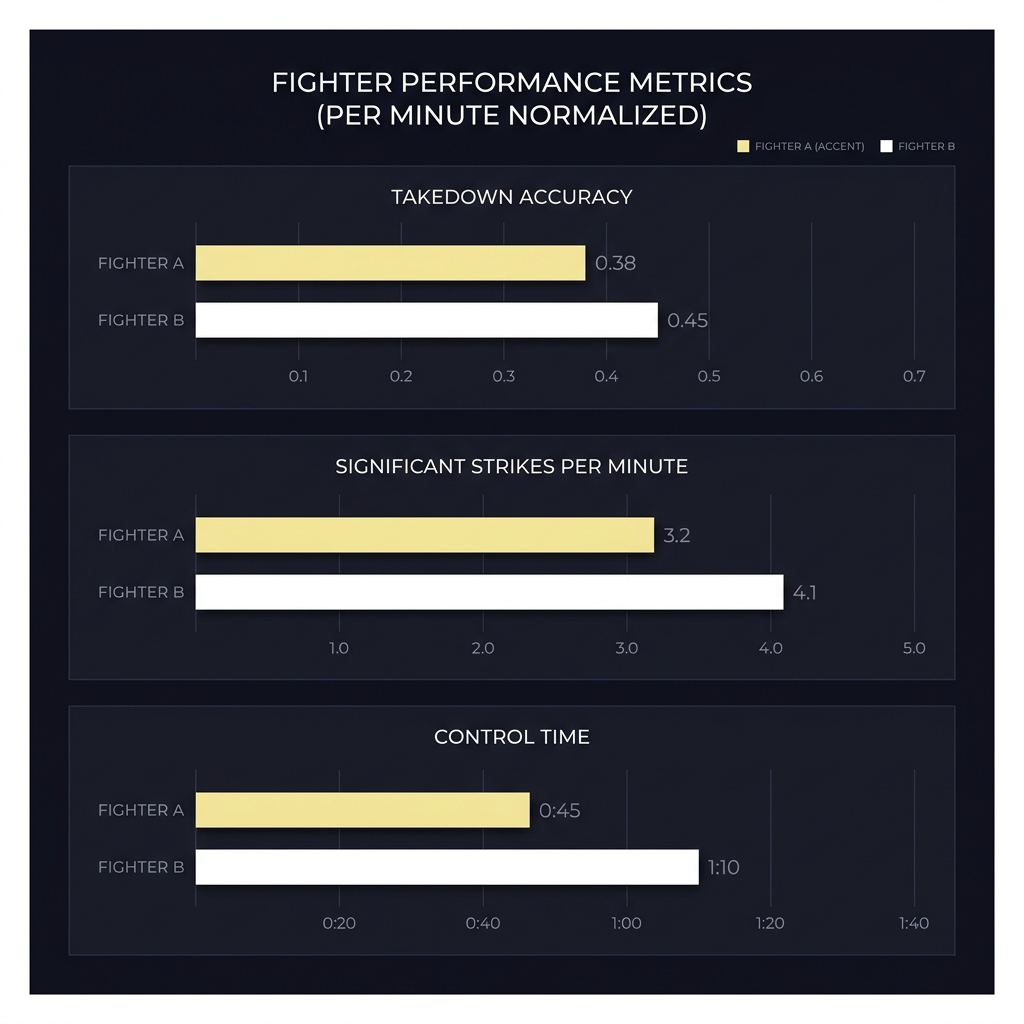
Effective range strikers display a mix of accuracy, conservative volume when vulnerable, and the ability to punish entry attempts with timing and counters. Significant strikes per minute and accuracy rates are the core measurable traits that correlate with scoring success at distance UFC Stats definitions.
Distance management tactics that reduce takedown success include lateral movement, level-change timing, and establishing single-shot counters at the edge of range. When a striker can consistently land clean strikes while avoiding clinch entries, judges see effective striking even if the striker is not the most active fighter on paper technical-tactical review.
Red flags for strikers are a drop in accuracy when pressured, a lack of counters on level changes, or tendency to overcommit on power shots that invite clinch work. Those patterns make them vulnerable to wrestlers who can convert pressure into damaging follow-up on the ground UFC Stats definitions.
Clinch, cage control and transition sequencing
Clinch and fence-control sequences are often the immediate preface to successful takedowns. Analysts should log how frequently clinch entries end in a takedown attempt or in a striker losing range control, because these sequences materially change round dynamics clinch sequencing study.
Effective clinch work contributes to scoring when it produces offense, whether through strikes, takedown setups, or visible suppression of an opponent's striking game. Conversely, neutral clinch time that lacks follow-up does not reliably win rounds under the rules hierarchy clinch sequencing study.
Log clinch-to-takedown sequences for clip review
Use one line per sequence
When reviewing footage, mark the chain of events: clinch entry, whether a takedown was attempted, and whether the sequence produced immediate striking or submission threat. That sequence-level logging separates mere ring presence from effective offensive transitions UFC Stats definitions.
Cardio, pace and late-round effects on wrestling vs striking
MMA performance requires repeated high-intensity efforts, and physiological reviews show that insufficient conditioning materially reduces output and defensive sharpness in later rounds. Accounting for cardio risk is critical when assessing how a stylistic edge will hold over a full fight physiology review.
Indicators of cardio vulnerability include noticeable drops in strike output, slower scramble speed, and declining success on takedown attempts as rounds progress. In pre-fight checks, prioritize fighters with consistent late-round performance or with recovery profiles that match the expected pace of the matchup physiology review.
Conditioning can convert a narrow stylistic advantage into a decisive late-round edge. For example, a wrestler who can maintain takedown efficiency in rounds three and beyond will find more opportunities to convert scoring takedowns when a tiring striker's defense degrades.
Takedown defense vs striking range: decision criteria for analysts
Use a short checklist to judge which skill will win a round: takedown success rate, takedown-to-damage conversion, striker accuracy at distance, and clinch denial. These factors together indicate whether a wrestler can both reach and convert entries, or whether a striker can keep the fight at range UFC Stats definitions.
Downgrade a takedown-heavy fighter when their conversion rate is low or when opponents consistently force scrambles that neutralize ground offense. Conversely, favor a striker when accuracy and lateral movement suppress repeated entry attempts and when sprawl effectiveness visibly reduces takedown success technical-tactical review.
Defensive indicators that reduce takedown threat include frequent successful sprawls, good hip positioning on entry, and reliable distance resetting. Log these in the scouting file as context flags rather than absolute blockers.
Common analyst errors and scoring pitfalls
A frequent mistake is overvaluing control time without pairing it to offense. Control metrics alone can mislead analysts; judges credit control only when it is accompanied by damage or a submission threat, so always pair control observations with follow-up attempts in your notes ABC Unified Rules (judging criteria).
Another pitfall is confusing activity with effectiveness. High activity numbers are not necessarily effective if accuracy is low or if the actions do not produce damage. Normalize per-minute rates and inspect clip sequences to see whether activity produced meaningful scoring events UFC Stats definitions.
Corrective habits: always pair control time with offensive follow-up, normalize statistics by time, and confirm key sequences with video review. These steps reduce bias from raw counts and make predictions traceable.
Matchup scenarios and sample readouts
Case A: Elite wrestler vs conservative counter-striker. Pre-fight, log takedown accuracy and the striker's counter timing. The wrestler must convert takedowns to ground strikes or submission attempts to win rounds under the rules hierarchy; if the counter-striker can consistently punish level changes and maintain range accuracy, judges will often credit the striker for effective striking technical-tactical review.
Case B: Aggressive striker with low takedown defense. Here, the striker's early volume and damaging counters can win early rounds, but if the wrestler limits damage and converts takedowns later, the stylistic advantage can flip. Conditioning and late-round takedown success are decisive in this archetype physiology review.
In both scenarios, map the likely fight phases and note which metrics are the primary tiebreakers: takedown-to-damage conversion for wrestlers and accuracy under pressure for strikers. These are the signals most aligned with how judges score rounds.
How to build a data-driven pre-fight gameplan
Gather a consistent set of sources: takedown charts, significant strike maps, clinch sequence clips, and per-round conditioning indicators. Event statistics provide standardized definitions for these fields and should be your starting point for data pulls UFC Stats definitions (see the Funded Plays blog for examples of how to organize pulls).
Translate the matchup readout into tactical priorities: for a wrestler, target early takedowns with immediate follow-up strikes; for a striker, emphasize lateral movement and counters at the edge of range. Document assumptions and alternative scenarios if core metrics fail to hold.
Build a short test plan: assign roles to clips, log three representative sequences per fighter, and run the decision tree after watching those sequences. That reproducible approach helps calibrate judgment and refine the model over time technical-tactical review. If you want a structured starting point, visit Funded Plays.
Practical in-fight indicators to watch round-by-round
Log these live indicators: successful takedown conversions, damage from ground strikes, strike accuracy in exchanges, and visible fatigue. These fields update pre-fight predictions and help maintain a defensible narrative for each round's scoring UFC Stats definitions.
Early-round cues that predict later advantages include repeated successful entries, consistent counters that reduce an opponent's willingness to initiate entries, and small but accumulating damage. If a fighter shows a clear drop in scramble speed or strike output, adjust expected outcomes for subsequent rounds accordingly physiology review.
Simple logging fields to record during live viewing: round number, takedown attempts and conversions, significant strikes landed, clinch sequences leading to takedowns, and a cardio flag for visible fatigue. Keep entries terse and time-stamped for quick aggregation.
Putting it together: a short scoring checklist and final decision rules
Five-point checklist: 1) Damage and effective striking, 2) Effective grappling that leads to ground strikes or submission threat, 3) Dominant position with follow-up offense, 4) Striking efficiency and accuracy, and 5) Conditioning and pace across rounds. Use this list to prioritize evidence when assigning a round ABC Unified Rules.
To convert a close read into a predicted winner, tally the checklist items per round and assign confidence levels. In borderline cases, favor the action that produced visible damage or submission threat, then document the judge variability risks tied to commission differences and ambiguous sequences UFC Stats definitions.
Always record assumptions and a confidence score for each predicted winner. That habit creates an audit trail and helps refine the framework as new evidence or data sources improve your inputs.
Common data gaps and open questions for analysts
Event data often lacks granular clinch-to-damage tagging and varies in how commissions emphasize judging criteria, which complicates cross-event comparisons. Analysts should treat such gaps conservatively and note where clips are required to confirm statistical impressions clinch sequencing study.
Open research questions worth tracking include quantifying the marginal value of fence clinch control versus center-cage striking in close rounds and standardizing clinch tagging to capture damage potential. Stay conservative when making firm claims where clip-level evidence is sparse ABC Unified Rules.
Maintain a running issues log in your database for sequences that are under-tagged by event stats and prioritize those clips for manual review. Over time this will reduce uncertainty and improve model performance.
Conclusion: a concise process for evaluating wrestling vs striking
Recap: start with the rules-first hierarchy, collect standardized metrics, map probable fight phases, and assign round winners by prioritizing damage and submission threat over mere control. Conversion of takedowns into offensive follow-ups is the key differentiator that aligns models with how judges score fights ABC Unified Rules.
Practice plan: review three fights each week using the five-point checklist, compare your round calls to official decisions, and document assumptions and confidence levels. That disciplined practice will improve consistency and help analysts understand the limits of event data and judge variability UFC Stats definitions.
Limits: no method guarantees outcomes. Use the workflow to create defensible, transparent judgments and continue refining assumptions as new evidence and clip-level tagging improve.
Judges prioritize effective striking and effective grappling that produce damage, dominance, or submission threat; mere positional control without follow-up offense carries less weight.
Key metrics are takedown accuracy and conversions, significant strikes and accuracy, control time paired with follow-up offense, and conditioning indicators like late-round output.
Yes, poor conditioning often reduces output and defensive quality in later rounds, allowing a wrestler or persistent pressure fighter to convert advantages that were narrow early in the fight.
References
- https://www.abcboxing.com/unified-rules-mixed-martial-arts/
- https://www.abcboxing.com/wp-content/uploads/2020/02/unified-rules-mma-2019.pdf
- https://www.ufc.com/unified-rules-mixed-martial-arts
- https://immaf.org/rules/
- http://ufcstats.com/help
- https://doi.org/10.1080/24748668.2024.000000
- https://www.fundedplays.com/challenges
- https://doi.org/10.1080/24748668.2025.000000
- https://www.frontiersin.org/articles/10.3389/fphys.2024.000000/full
- https://www.fundedplays.com/blogs/how-fundedplays-evaluations-work
- https://www.fundedplays.com
- https://www.fundedplays.com/blogs
- https://www.dca.ca.gov/csac/forms_pubs/publications/unified_rules_judging_criteria.pdf