

Why reliever availability matters for daily lineup and roster decisions
Day-of decisions in DFS and fantasy baseball turn on a handful of practical facts about who can actually be used when the game starts, and Evaluating Relief Pitcher Availability helps you place those facts into a repeatable process. Immediate workload, recent innings, and official roster status determine whether a reliever is realistically selectable for a given contest, and trusted daily sources synthesize those fields into quick availability signals you can act on, so you avoid late scratches and wasted roster slots by relying on current data rather than headlines RosterResource bullpen usage.
When a reliever is unexpectedly unavailable, the ripple effects are concrete: a lineup that planned on a high-leverage arm can lose projected points, a DFS pivot becomes necessary, and a season-long roster may need a waiver claim or bench adjustment. This is why short-term signals, such as the last 1 to 3 outings and days of rest, should be weighted higher for day-of calls than season-scale narratives about usage trends or rule changes Pitches - MLB Glossary.
Sign up for the daily reliever availability checklist
Sign up for a short checklist or daily alert list so you can verify reliever availability quickly before lock.
In practice, decisions split into immediate and longer horizon considerations. Immediate calls focus on whether a reliever is likely to take the mound in the next game, while longer horizon work looks at activation timelines and roster moves that change who will be available across days. Treating these as separate problems keeps day-of work tight and reduces the noise from season-long discussions.
For DFS players and daily fantasy managers, small confidence differences around reliever availability can change lineup construction dramatically. A confirmed fresh high-leverage reliever allows an optimistic build in late-game slates, while an uncertain arm should be treated as effectively unavailable unless dashboards and official notes confirm the opposite. Using clear availability rules reduces last-minute scrambling and improves reproducibility of decisions.

Key definitions and official status rules to anchor availability calls
Before you weigh pitch counts or recent workload, anchor your calls to the authoritative roster definitions the league provides. MLB s Injured List definitions and standard activation windows form the baseline for whether a pitcher can be used or returned to the active roster, so check the official glossary when a status note appears Injured List (IL) - MLB Glossary.
Accurate workload assessment depends on a clear definition of what a pitch is and how pitch counts are recorded. The standard stat definition of a pitch is the operational basis for short-term workload tracking, and using a consistent definition across sources avoids mismatches when you compare game logs and dashboard totals Pitches - MLB Glossary.
In practical terms, IL status interacts with activation windows and roster mechanics in two ways. First, a player on the longer IL automatically removes an option for immediate day-of use until active roster moves occur. Second, teams frequently align IL activations with off-days or roster flexibility, so activation timing can be conditional rather than instantaneous. Treat official IL notes as binding constraints and let them override informal workload signals when there is a conflict.
Core workload signals to track for short-term availability
Short-term availability is most reliably inferred from recent, measurable workload signals. The three core items to check are pitch counts from the last one to three appearances, innings logged in those outings, and the number of full days of rest since the last appearance. These short window signals are the best predictors of whether a reliever will appear in today s game, and daily dashboards routinely prioritize them for quick flags RosterResource bullpen usage.
Prioritize recent pitch counts and last-pitched date, confirm consecutive-day and IL status, consult a trusted daily bullpen dashboard, and apply a simple availability score with explicit thresholds to inform start or bench decisions.
When you pull those fields together, treat recent pitch counts and innings as high priority, consecutive-day appearances as medium priority, and longer-term factors such as season workload or historical injury patterns as lower priority for day-of calls. This ranking keeps the decision anchored in the immediate physical task at hand rather than longer narratives.
To make quick assessments, focus on measurable thresholds across the last 1 to 3 outings. A reliever who threw a large number of pitches in any of those appearances, or who logged a multi-inning outing the previous night, should trigger a caution flag even if the official status says active. Conversely, shallow, low-pitch outings across several days typically indicate readiness for another appearance.
How daily bullpen usage dashboards synthesize availability signals
Trusted daily dashboards like MLB Bullpen Usage Tracker report a small set of fields you can read in seconds: last-pitched date, pitches thrown in the last outing, and consecutive-day status. These three inputs are often presented together so you can form a quick availability judgment without sifting through play-by-play logs RosterResource bullpen usage.
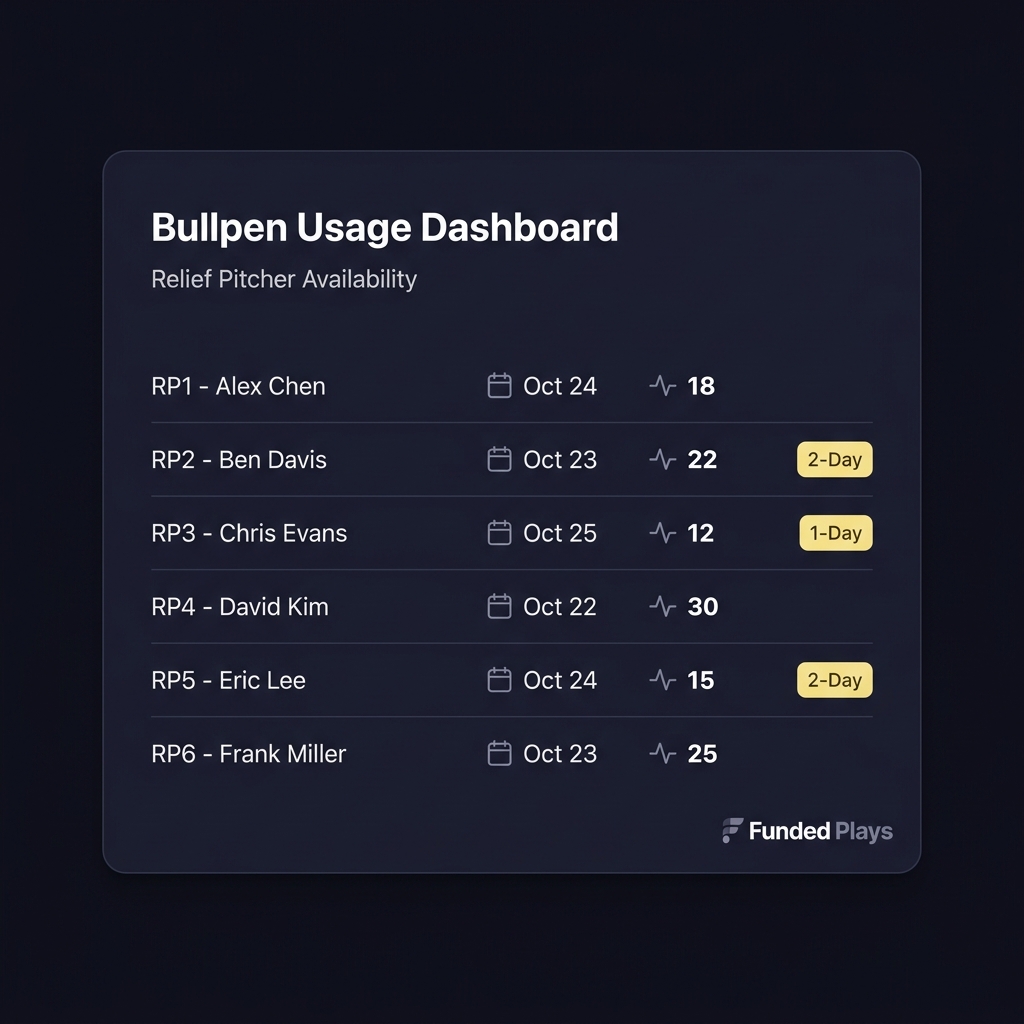
Dashboards commonly convert raw fields into practical flags such as fresh, caution, and unavailable. A fresh flag typically indicates a reliever who either did not pitch the previous day or threw only a short outing recently. A caution flag often denotes recent high pitch totals, multi-inning work, or two-in-three-day appearances. Unavailable is reserved for IL status, recent heavy workloads, or explicit team announcements.
Choose dashboard sources that publish their data fields and update frequency clearly. The most useful dashboards refresh daily and include the key fields above, plus a timestamp and notes for official IL or roster changes. A clear source reduces ambiguity when you are making a time-sensitive roster call before lock.
A simple availability score: a practical framework you can use
A reproducible availability score makes day-of calls transparent and consistent. The score should combine recent pitch counts across the last one to three outings, days of rest, whether the pitcher appears on consecutive days, IL or activation status, and a simple role context indicator. These inputs let you map a raw score to fresh, caution, or unavailable outcomes without complex modeling RosterResource bullpen usage.
Example inputs and suggested weights for a quick availability score are: recent 1-outing pitch count weighted 35 percent, recent 2-3 outing average weighted 25 percent, days of rest weighted 20 percent, consecutive-day flag weighted 10 percent, IL/activation status weighted 10 percent. Use these weights to generate a 0 to 100 score where higher values indicate greater availability. The exact weights are configurable, but the goal is a compact, repeatable calculation you can apply in seconds.

Sample thresholds could be simple bands: 75 and above equals fresh, 50 to 74 equals caution, below 50 equals unavailable. For DFS slates that reward late-inning value strongly you might accept a lower threshold for a bench or utility selection, while conservative season-long rosters should use a higher threshold to avoid repeated missed opportunities.
Role context matters. A reliever who routinely handles high-leverage innings will be used differently than a long reliever or an opener, so combine the numeric availability score with a role check before finalizing a roster action. Leverage context helps prioritize which available relievers are most likely to see the relevant innings.
Decision criteria and thresholds: when to start, bench, or leave alone
Translate the availability score into three clear roster actions: start, bench, or leave alone. Conservative thresholds prioritize confirmed readiness, moderate thresholds accept manageable uncertainty for higher upside, and aggressive thresholds favor upside at the cost of a higher scratch risk. Define these thresholds explicitly for the contest type you play to maintain consistent decisions.
Conservative action means starting only relievers with scores above 80 and no IL ambiguity. Moderate action accepts scores between 60 and 79 with cross-checks from dashboards and recent pitch counts. Aggressive action might use scores down to 50 for late-slate punts where replacements are limited and the upside outweighs scratch risk. Incorporate IL and activation notes as vetoes rather than inputs in close calls.
Slate size and replacement depth change how aggressive you should be. In single-game or small-slate contests a single unavailable arm can ruin a build, so favor conservative thresholds. In large-field tournaments with many lineups, accepting a few caution plays can be appropriate to chase unique constructions, provided you document the decision and monitor updates before lock.
How league rules and roster structure change availability patterns
The 13-pitcher maximum on active rosters structurally limits how many relievers a team carries, which in turn raises the frequency of consecutive-day usage, especially during schedule-dense stretches or doubleheaders MLB maintains 13 pitcher limit on 26 man rosters.

The 13-pitcher active roster constraint and its effects
With a maximum bullpen size, teams often must deploy relievers on consecutive days or use multi-inning looks to cover innings efficiently. This constraint makes short-term workload signals more important because a team s necessary usage pattern can force higher appearance frequency than ideal. Recognize that smaller bullpens increase the chance of rolling arms and plan availability thresholds accordingly.
Quick bullpen usage view for day of checks
Use this view to confirm immediate availability signals
How IL rules shape activation timing and usable pitchers
Injured List durations and activation mechanics change the pool of usable pitchers on any given day. Teams coordinate roster moves with activation windows and off-days, so IL notes often determine who is a practical option before workload data does. For day-of calls, treat IL entries as hard constraints and use dashboard confirmations to verify any reported activations Injured List (IL) - MLB Glossary.
Because roster constraints can force nonoptimal usage, monitor team-level patterns during dense stretches and adapt your availability thresholds upward when bullpen depth is compressed. Structural rules do not replace workload signals, but they amplify their importance because fewer players means fewer rotation options.
Typical pitfalls and false signals when judging reliever availability
One common mistake is over-relying on league-level narratives such as automatic injury increases tied to rule changes like the pitch timer. Institutional analysis found no clear league-wide link between the pitch timer and increased injuries, which reinforces that immediate workload and confirmed status should lead your day-of calls rather than macro assumptions Analysis Finds Pitch Timer Not Linked to Increase in Injuries.
Another false signal is assuming that a high-leverage reliever will always be used. Leverage indicates who is most likely to be chosen for critical innings, but it does not override workload limits or IL constraints. Always cross-check leverage-based assumptions against recent pitches thrown and last-pitched dates.
To reduce false positives, use a three-step cross-check: confirm the last-pitched date, verify pitch counts for the last one to three outings, and check for IL or official team notes. These basic checks remove most mistaken availability calls and keep your roster moves defensible and repeatable.
Role context: leverage index, matchup, and emerging multi-inning roles
Leverage Index remains a useful concept to anticipate which relievers are likeliest to be used in high-impact spots, and combining this with workload data refines your day-of expectations for usage Leverage Index - FanGraphs Library. See the Fantasy Baseball Reliever Depth Chart for additional depth charts and closer context.
Openers and multi-inning relief trends have changed bullpen construction for many teams. When a reliever regularly serves as a multi-inning option, safe thresholds for back-to-back usage may be different compared with a one-inning specialist. Use role context to adjust how you interpret consecutive-day flags or multi-inning outings in recent games.
In practice, treat leverage as an ordinal signal rather than a binary rule. A reliever with a high Leverage Index profile is more valuable when available, but the presence of heavy recent workload should downgrade that expected usage. Combine role context with your numeric availability score rather than letting one override the other.
Practical examples: day-of scenarios and how to apply the framework
Example 1, a reliever who threw 35 pitches last night. Start by checking the dashboard s last-pitched date and pitch count. A single 35-pitch outing the prior night usually produces a low availability score and a caution or unavailable flag for same-day usage, especially if the reliever s role is not routinely multi-inning. When in doubt, bench in season-long formats and avoid starting in single lineup DFS builds where a scratch is costly RosterResource bullpen usage and see team-specific trackers such as the Astros Bullpen Usage.
Example 2, a reliever on two consecutive days with low pitch counts. If the last two outings logged 10 and 12 pitches respectively and there are no IL concerns, a moderate availability score is reasonable and the reliever is often playable in DFS depending on slate depth. Confirm days of rest and role context before finalizing the call.
In both examples, document the time and source used to confirm availability. Record the dashboard name and the timestamp or page update so you can revisit the call if late news appears. This practice reduces confusion when you or a teammate needs to audit a decision after lock.
Monitoring trends and open questions for 2026 and beyond
Watch for continued evolution in multi-inning usage and role fluidity as teams refine their bullpen constructions. These tactical shifts will change safe thresholds for back-to-back appearances and multi-inning calls, and they should be monitored at the team level rather than assumed league-wide RosterResource bullpen usage.
Open questions to track include how quickly teams revert to specialists in high-leverage moments, whether openers remain a stable tactical choice, and how usage patterns shift during longer road trips or compressed schedules. Follow daily dashboards and team-level usage logs for the clearest early signals rather than waiting for broad analyses.
A quick day-of checklist and playbook
Five-step checklist: 1) Check last-pitched date, 2) Verify pitch counts for last one to three outings, 3) Confirm consecutive-day status, 4) Check IL and activation notes, 5) Review role and leverage context. These five items can be confirmed in under two minutes on a reliable dashboard and form the basis for a final start or bench call RosterResource bullpen usage.
When you record your call, note the time and source. If a reliever s status changes before lock, update your documentation and adjust lineups immediately. Favor confirmed status and immediate workload signals over generalized narratives when making the final call.
Conclusion: consistent, rule-based availability calls beat guesswork
Evaluating Relief Pitcher Availability is best done with a compact, rule-based process that prioritizes immediate workload and official status. Use definitions from the league, reliable daily dashboards, a simple availability score, and explicit thresholds to move from uncertainty to a clear roster action.
Consistency matters more than perfect prediction. By anchoring decisions to measurable signals and documented checks, you reduce the frequency of costly last-minute errors and make your process repeatable. Keep watching trusted dashboards and official notes to adapt as bullpen strategies evolve.
Confirm the last-pitched date and pitch count from the most recent outing; these two fields together are the best immediate indicators of day-of availability.
Yes. Official Injured List notes and activation status are binding for roster eligibility and should be treated as a veto in day-of availability calls.
Check dashboards and official notes at least once immediately before lock and again if any late transaction reports or team announcements appear.
References
- https://www.fangraphs.com/roster-resource/bullpen/usage
- https://www.mlb.com/glossary/standard-stats/pitches
- https://www.mlb.com/glossary/transactions/injured-list
- https://www.fundedplays.com/challenges
- https://insidethepen.com/bullpen-usage.html
- https://www.fundedplays.com/blogs/how-fundedplays-evaluations-work
- https://www.fundedplays.com/blogs
- https://www.fundedplays.com
- https://www.mlb.com/news/mlb-maintains-13-pitcher-limit-on-26-man-rosters
- https://www.hopkinsmedicine.org/news/newsroom/news-releases/analysis-finds-pitch-timer-not-linked-to-increase-in-injuries-in-major-league-baseball
- https://library.fangraphs.com/misc/leverage-index/
- https://www.espn.com/fantasy/baseball/flb/story?page=REcloserorgchart
- https://www.rotowire.com/baseball/bullpen-usage.php?team=HOU