

Why a returning player's injury status changes prediction value
Overview of how injuries affect availability and performance
Evaluating Players Returning from Injury begins with two simple facts: availability and role define short-term value. A player who is active but limited often creates a wider forecast range than one who was never injured, because minutes and opportunity can shift quickly after a layoff.
When a player returns, their baseline projection should start with availability, practice participation, and where they fall on the depth chart. Those objective signals are stronger than speculative reports and help separate true role changes from surface-level optimism.
How market prices and lineups adjust around returns
Market prices and lineup decisions typically move faster than coaching intent. Early bettors and fantasy managers react to roster listings and social chatter, which can create temporary mispricing if a player's snap share or role is uncertain. That volatility is an opportunity if you have a clear checklist for parsing the signals.

For forecasting, prioritize measurable inputs such as practice participation logs, official availability tags, and published snap counts once the player returns. These metrics provide far more reliable short-term guidance than headline-driven commentary.
How to read official injury reports, practice notes, and media updates
Types of official statements and what they actually mean
Official injury reports typically use a small set of tags that are shorthand for availability. Treat terms like questionable, limited, and out as signals about participation probability, not precise minutes. Cross-checking those tags with practice logs will give you a clearer picture of likely playing time.
Filtering noise from useful updates
Use a simple verification checklist: compare the official injury report, the team practice participation list, and any transaction wire entries before adjusting forecasts. Coach comments are often hedged; use them as context rather than definitive evidence of role.
Avoid rumor amplification on social feeds. Prioritize sources that list participation reps or game-day activations and keep track of timestamps so you can see how information evolved before the contest.

When evaluating recovery, focus on categories rather than medical minutiae, as described in return-to-sport reviews: soft tissue injuries often affect explosiveness and tolerance for volume, structural injuries can impose limits on contact or range of motion, and concussion returns usually require graduated tolerance for full game speed.
Medical concepts that matter for short-term performance
Track time since injury, treatment notes, and any documented reconditioning sessions. These temporal markers help indicate whether a player has passed the usual reconditioning window and whether lingering limitations might affect minutes or role.
A concise recovery checklist for monitoring readiness
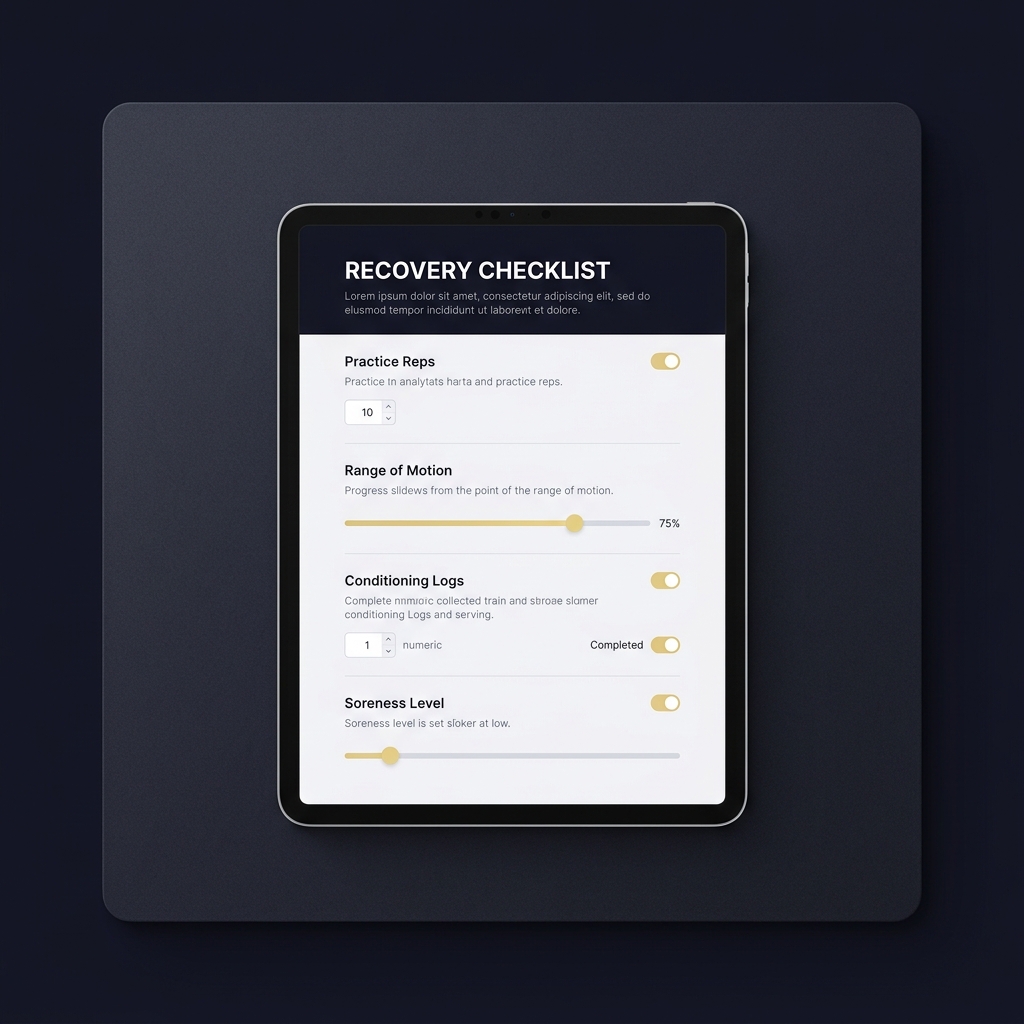
Use daily to log objective recovery signs
Use the tool above to record consistent measurements. Structured notes reduce the risk of mixing medical uncertainty with tactical coaching choices and make it easier to compare returns across players.
Game-level metrics and statistical signals that reveal readiness
Which in-game stats to expect to change on return
After a return, expect adjustments in snap share, usage rate, and minutes played first. For skill positions, target share and touches will reflect both role and scheme; for players returning from conditioning or lower-body issues, per-minute production may lag until conditioning normalizes.
How to use small-sample data cautiously
Small-sample returns can be noisy. When a player posts a single low-minute line, treat it as a partial signal rather than a model reset. Weight immediate box-score outcomes lightly and use tracking of snap trends across two to four games to confirm direction.
Clutch usage can mislead if a player accumulates end-of-game activity against weak competition. Break down minutes between competitive and garbage-time contexts to assess how meaningful the raw numbers are for forecasting.
A decision framework for adjusting selections and lineups
Step-by-step checklist to change a projection or lineup
Start with a prioritized checklist: confirm availability, verify role certainty via snap and target expectations, assess conditioning level, evaluate matchup context, and then map to your volatility tolerance. This order helps prevent premature overreactions when information is incomplete.
Use the checklist to produce a short decision note: confidence tier, primary uncertainty, recommended sizing, and a planned review checkpoint. That note will be your reference if new information arrives before game time.
Objective signals such as practice participation, snap counts, depth chart placement, and minutes trends are the most reliable early indicators of short-term readiness and should guide conservative adjustments.
For season-long contests, incorporate role durability into your sizing; for short-horizon picks, accept more volatility but size accordingly. When in doubt, a partial exposure with a clear fallback plan is often preferable to an all-or-nothing choice.
Decision tree for short-term versus season-long choices
Short-term decisions prioritize immediate minutes and matchup context. Season-long choices should weight projected role over time and the probability that conditioning or scheme adjustments will restore prior productivity. Explicitly separate these horizons in your decision record to avoid conflating tactical trades with strategic roster building.
Risk-adjusted projection methods and confidence intervals
Quantifying uncertainty for forecast adjustments
When evidence is limited, widen your projected range rather than shifting a point estimate dramatically. One practical method is to apply a confidence multiplier to standard deviations or to expand a model's error band by a fixed factor when sample size is small.
Simple Bayesian or multiplier approaches for small samples
Combine prior performance with limited new evidence by shrinking the influence of the single-game result toward the season or career mean. Use a simple weighting that gives the prior two to four times the weight of the new observation when minutes are below a typical threshold.
Defer to market signals when liquidity shows clear conviction, but only after your private assessment accounts for uncertainty. Markets can incorporate information you do not have, but they can also overreact to headline noise.
How to size exposure and manage bankroll after injury returns
Practical bankroll rules tied to confidence levels
Translate confidence tiers into conservative sizing templates; see Funded Plays for workflow examples. For example, label returns as high, medium, or low confidence based on availability, role certainty, and conditioning. Assign smaller position sizes to medium and low tiers and preserve capital for clearer opportunities.
Avoid compounding risk by stacking multiple uncertain returns in the same lineup. Instead, diversify exposure across independent outcomes or reduce line size when correlated uncertainties exist. This discipline preserves optionality and limits downside when multiple forecasts are wrong.
Practice disciplined decision workflows with FundedPlays Challenges
Try a disciplined checklist workflow on a simulated challenge to practice sizing and decision logging without risking capital
Adjusting position sizes in season-long contests and daily picks
In season-long formats, shrink your initial allocation to a recently returned player until you observe a trend of minutes and involvement. For daily picks, consider a tiered scaling where a full stake is only used when a player shows two consistent games of near-normal workload.
If new information contradicts your assumptions before an event, have a fallback plan: reduce exposure, swap to a higher-confidence option, or use partial hedges if the contest allows. Document the reason for any mid-course adjustments in your decision log.
Common evaluation mistakes and how to avoid them
Cognitive biases that skew return assessments
Watch for recency bias and the tendency to overfit to a single return performance. A standout comeback game can create false confidence, while a single underwhelming appearance can lead to premature downgrades.
Operational mistakes in data handling
Operationally, avoid mixing inconsistent time stamps, failing to record the source of an update, or using a single data feed for all decisions. Implement blind checks and minimum-sample rules to reduce overreaction to isolated events.
Peer review of your assumptions helps catch blind spots. A quick double-check from a colleague or a replay of the last practice report can reveal whether a role shift is real or imagined.
Practical scenarios and short case studies to practice evaluation
Three short, anonymized scenarios with stepwise reasoning
Scenario 1: A starter is listed as limited in practice after a soft tissue injury but is active on game day. Initial read: limited minutes likely, reduced explosiveness possible. Adjustment: partial exposure, prioritize matchups where volume matters more than explosiveness. Final decision: start smaller share and log the outcome for calibration.
Scenario 2: A role player has two full-contact practices after a structural repair and is activated with no practice limitations. Initial read: role likely restored but monitor first-game snaps. Adjustment: conservative full exposure with plan to reduce after one game if snap share is low. Final decision: start with moderated size and record minutes and touches to update priors.
Scenario 3: A player returning from concussion has graduated through acute steps but shows limited conditioning reps in the final week. Initial read: unpredictable minutes. Adjustment: wait for confirmation of sustained minutes across the first game; avoid large exposures. Final decision: sit or use minimal exposure until trend confirms readiness.
How to log decisions for later calibration
For each scenario, record the facts, your initial assessment, the action taken, and a timestamped outcome. Over time, this decision log will show where your priors were well calibrated and where you need to adjust weighting for specific injury types.
How to monitor returning players over the season
Signals that indicate recovery consolidation or backsliding
Track trends in snap share, minutes trend, workload per game, and performance per minute. Sustained increases in snap share across multiple contests indicate consolidation, while sudden workload spikes or renewed practice absences can signal backsliding or re-injury risk.
When to change a seasonal projection
Change a seasonal projection when you observe durable trend shifts in baseline minutes or role, not after a single game. Explicit triggers might include two consecutive games with a sustained snap share above prior expectations or a documented change in depth chart placement.
Maintain a watchlist for players with recurring contact or conditioning issues and schedule periodic reviews to reassess confidence. These checks preserve long-term portfolio stability and prevent reactive over-adjustments.
Communicating uncertainty: how to write concise notes and signals
Templates for brief internal notes
Use three-tier confidence labels: High, Medium, Low. For each label, add a one-line rationale that cites the primary evidence and the timestamp. This format keeps communication compact and comparable across analysts.
How to share confidence with teammates or followers
Avoid absolutes. Use probabilistic language and include the main uncertainty driver, such as limited practice reps or unclear snap expectations. When sharing publicly, note that assessments are time-stamped and subject to change as new information appears.
Document your sources for each note so readers or teammates can verify the basis for your confidence label and see how the evidence evolved over time.
Data sources and tools to consult for assessment
Public data feeds, tracking sources, and clinic summaries
Good data categories include official injury reports, practice participation logs, basic tracking data, and transaction feeds. Triangulate across these categories to reduce the risk of acting on incorrect or incomplete information; for higher-resolution tracking see industry resources on return-to-play implementations such as Kinexon.
When to pay for deeper medical or tracking data
Consider paid data when you need higher-resolution tracking or when small edges matter for a larger portfolio. For most practitioners, consistent use of official reports and practice logs provides sufficient signal to make disciplined choices; for methods and measurement frameworks see recent analyses of return-to-performance research assessing return to performance.
Always verify unusual or outlier reports through multiple independent feeds before materially changing exposure levels.
When to wait: signals that justify delaying action
Clear red flags that favor a wait-and-see approach
Wait when practice reps are limited late in the week, coaching language is vague about availability, or medical updates are inconsistent across feeds. These weak signals often precede reduced minutes or last-minute inactives.
How to set review checkpoints
Set time- or event-based checkpoints such as 24 hours before game time or after the final practice. Use partial exposure as an alternative to full commitment when you want to preserve upside but limit downside while information is incomplete.
Establish a standard review cadence so waiting becomes a tactical choice rather than an emotional reaction to uncertainty.
Summary checklist and practical next steps
One-page checklist for same-day decisions
Compact checklist: availability, practice participation, depth chart placement, snap trends, conditioning level, matchup context, sizing rule. Run through these items in order and record a one-line decision note with a confidence label and timestamp.
How to integrate the checklist into your routine
Make the checklist part of your pre-game workflow and attach it to each lineup change; see our write-up on evaluations for related process examples. After the game, revisit the decision with outcome data to refine your priors and update the checklist if necessary.
Consistently applying the checklist will improve calibration and reduce emotional overreactions to single-game outcomes.
Treat the first game as an initial signal but weight it cautiously; prefer at least two to four games or consistent snap trends before fully adjusting season-long projections.
Prioritize full-contact reps, consistent practice participation across the week, and official activation notes; these correlate most directly with likely snap share.
Use a tiered sizing approach: small for low confidence, moderate for medium confidence, and full only when availability, role, and conditioning are all clear.
References
- https://www.fundedplays.com/challenges
- https://pmc.ncbi.nlm.nih.gov/articles/PMC8320574/
- https://www.sciencedirect.com/science/article/pii/S2666061X22001328
- https://kinexon-sports.com/blog/return-to-play
- https://www.fundedplays.com
- https://www.fundedplays.com/blogs
- https://www.fundedplays.com/blogs/how-fundedplays-evaluations-work