
What home-ice advantage is and why it matters
Definition and short history in the NHL - Evaluating Home-Ice Advantage
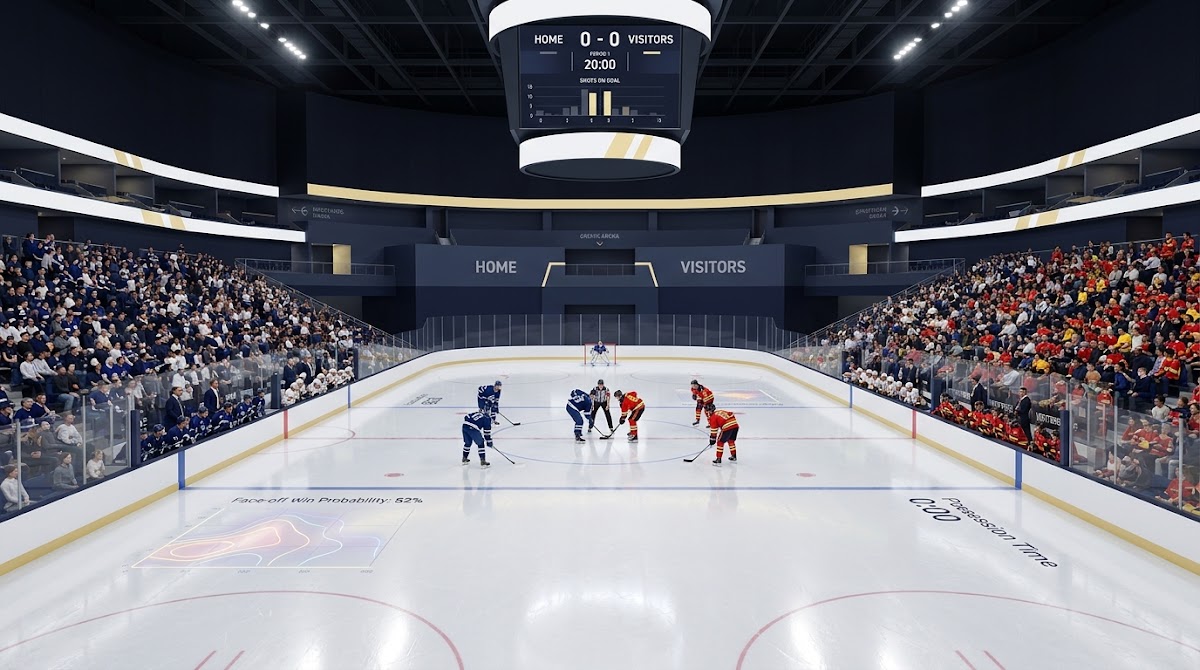
Home-ice advantage refers to a systematic venue-related edge that favors the home team over the visiting team, produced by structural rules, contextual conditions, and psychological factors. This edge shows up as modest but persistent differences in outcomes and shot quality between home and away sides, and season summaries through 2023-24 still register a small home benefit Hockey-Reference 2023-24 season page.
Historically, the size of the home-ice effect has varied by era. Specialized analytics that reestimate venue effects with shot-quality measures have documented a long-run decline in magnitude compared with earlier decades, arguing for season-by-season reassessment rather than assuming a fixed prior Evolving-Hockey update through 2023-24.
Why modelers and forecasters care
For forecasters, even a modest venue effect can meaningfully improve calibration and probabilistic accuracy because small systematic biases repeat across hundreds of games and can pull aggregate forecast scores in one direction or another. Including a well-calibrated venue feature can reduce miscalibration and log-loss in modern NHL systems when it is supported by current-season evidence Evolving-Hockey update through 2023-24.
That said, the practical importance is conditional: a small home-ice coefficient is often useful as a calibration adjustment, not a guarantee of different win probabilities on its own. Modelers should treat venue effects as one of several small, additive factors that improve long-run forecast quality rather than a single decisive input.
How NHL rules create structural home-ice effects
Last change and lineup matchups
The NHL rulebook gives the home team last change after stoppages, a concrete procedural mechanism that lets coaches control matchups by deploying lines favorable to specific opponents; this rule is a direct structural source of venue advantage in the modern game NHL official rules 2024-25. NHL article on arena traditions
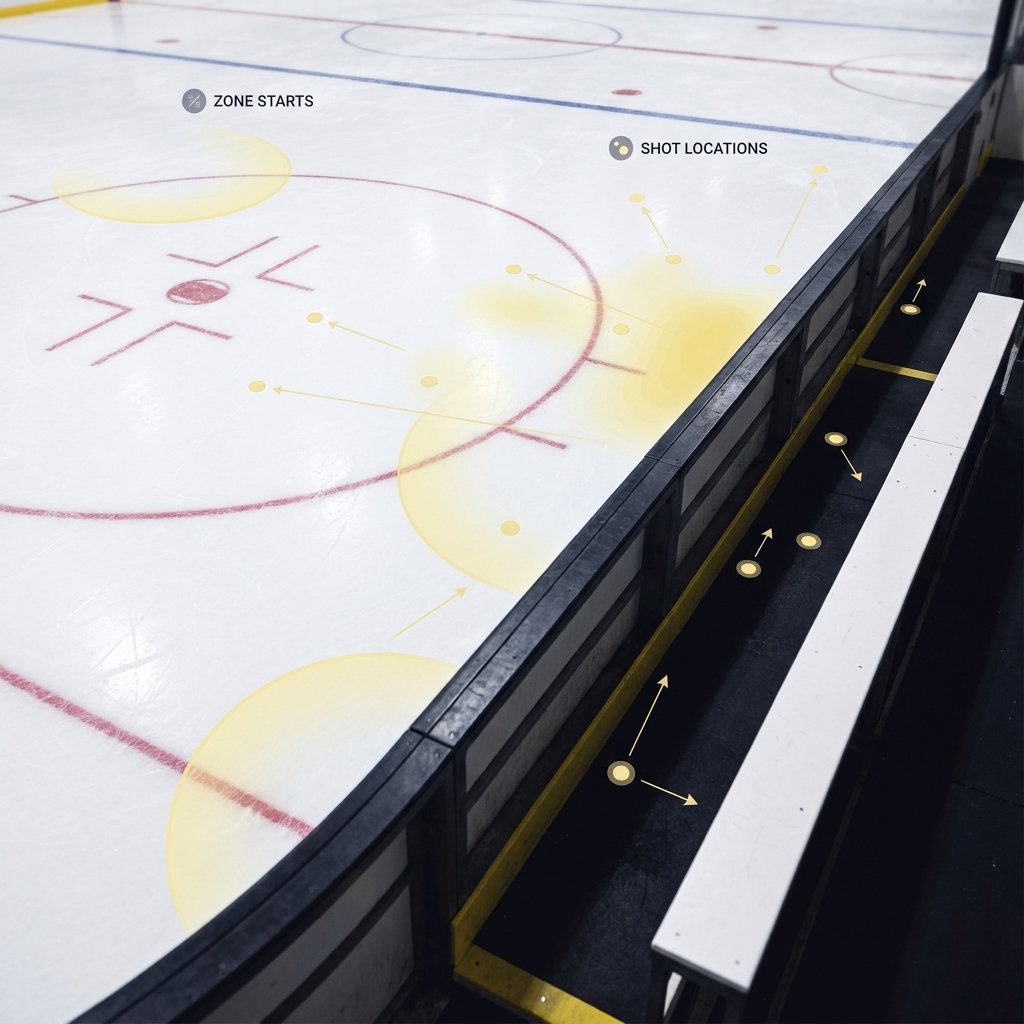
Last change enables controlled deployment on both offensive and defensive shifts. When a coach chooses matchups deliberately, the home side can protect weaker defensive pairings, shelter goaltenders from high-risk matchups, or counter an opponent's top forwards with a preferred checking line. Those tactical choices change on-ice player matchups, which in turn influence shot quality and scoring chances.
Faceoff and zone starts implications
A related set of procedural advantages includes faceoff positioning and subtle timing control over line changes and faceoff sets. While rules do not guarantee more offensive zone starts for the home side, small systematic differences in zone start distributions or matchup control after stoppages can translate into incremental differences in expected goals and possession quality over a season Hockey-Reference 2023-24 season page.
Modelers should treat these rule-derived mechanisms as plausible causal pathways that link venue to measurable on-ice variables such as zone starts, shift matchups, and resulting shot quality. The connection is mechanistic rather than deterministic: last change creates the opportunity for advantage, and coaches must still execute to realize it.
What to measure: metrics and data that work best
Why expected goals (xG) beats raw goals for venue effects
Expected goals, or xG, is a shot-quality adjusted measure that estimates the probability each shot will become a goal based on location, shot type, and context. Because raw goals are sparse and noisy, xG offers a more stable target for estimating venue effects and for attributing differences to shot quality rather than random scoring variance Stathletes explanation of xG.
Using xG reduces the noise inherent to match-to-match goal outcomes and lets modelers detect systematic shifts in shot-quality and volume that relate to venue. For example, a persistent excess of high-xG chances against the visiting team across a season is more informative than a few lucky or unlucky goal swings.

Other useful indicators: shot quality, zone starts, xG on special teams
Complementary covariates include shot location and type, pre-shot context (such as rebounds or odd-man rushes), zone starts that capture deployment balance, and special teams xG splits. These features help separate tactical deployment effects from other confounders and provide richer inputs for a venue coefficient to explain.
Practically, assemble play-by-play data with shot coordinates, faceoff locations, manpower state, and timestamped line deployments. Prefer current-season pipelines and reestimate parameters each season because pooled historical estimates can mask shifting magnitudes and rule-driven changes Evolving-Hockey update through 2023-24. See the Funded Plays blog.
checklist for a simple xG pipeline and season reestimation
Run reestimation each season
Statistical frameworks and model designs for estimating venue effects
Regression setups: team and season fixed effects
A practical estimation starts with linear regression on game-level or shift-level goal or xG differentials, including team fixed effects and season controls to absorb persistent team strength and year-specific baselines. These controls limit bias from team quality or league-wide scoring trends when isolating venue coefficients Evolving-Hockey update through 2023-24.
Alternative specifications include mixed effects models that pool information across teams while allowing team-specific deviations, and logistic models for binary game outcomes when modelers prefer to work directly on win probabilities. The chosen link function and level of aggregation should match the downstream forecast task.
Validation: effect sizes, calibration, and out-of-sample checks
Significance testing should emphasize effect sizes, calibration improvement, and out-of-sample performance metrics such as holdout-season log-loss rather than relying on p-value thresholds alone, consistent with established statistical guidance ASA statement on p-values.
Implement cross-validation across seasons or use a holdout season to measure whether adding a home-ice coefficient meaningfully improves probabilistic forecasts. Small but consistent gains in calibration or log-loss justify a conservative deployment; inconsistent or season-limited gains suggest hierarchical shrinkage or withholding the feature.
When and how much home-ice matters in practice
Seasonal and era variation
The magnitude of home-ice effect varies by season and has trended downward compared with earlier eras, so modelers should re-estimate venue coefficients each year rather than assume a static effect size Evolving-Hockey update through 2023-24.
Seasonal variation can be driven by rule changes, evolving coaching practices, and broader league trends in play style. Because the effect tends to be modest in modern seasons, detecting reliable signals requires careful controls and adequate sample sizes across the season.
Contextual amplifiers: crowd, travel, schedule compression
Evidence from seasons with COVID-19 restrictions showed reduced home advantage when crowd effects were curtailed, suggesting that spectator presence is a meaningful amplifier of venue effects in team sports including ice hockey systematic review of home advantage during COVID-19.
Other contextual modifiers include travel density, schedule compression, and time-zone effects. Where these factors are concentrated, venue coefficients may be larger; where they are minimal, the home-ice signal shrinks. Modelers should consider interacting venue indicators with travel or rest variables when sample sizes permit.
Decision criteria: when to include a home-ice feature in your forecast
Practical thresholds for model inclusion
Adopt these conservative rules before adding a home-ice feature: re-estimate the coefficient each season, require consistent out-of-sample improvement in calibration or log-loss on a holdout season, and ensure a minimum sample size for stability across teams and game states Evolving-Hockey update through 2023-24.
When estimates are noisy, use hierarchical shrinkage or small calibrated offsets rather than large raw adjustments. That approach preserves improvements identified in the data while reducing overfitting risk when the seasonal signal is weak.
Test a conservative home-ice adjustment in your next model run using the FundedPlays Challenges re-estimation workflow
Try adding a small, conservative home-ice offset in your next model test and evaluate it on a holdout season to see if calibration improves.
Communicating impact to stakeholders
When presenting results to product or decision teams, show effect sizes alongside calibration plots and a short narrative about seasonal dependence and uncertainty. Frame the feature as a calibration tool that produces modest expected gains rather than a decisive lever for single-game predictions Evolving-Hockey update through 2023-24.
Provide recommended deployment language that explains the conservative nature of the adjustment and the conditions under which it will be re-estimated or removed.
Common mistakes and pitfalls to avoid
Data and measurement errors
Do not rely on raw win-loss splits or raw goals alone: raw outcomes are noisy and can mislead when used without shot-quality adjustments. Using xG and shot-location features helps separate tactical deployment from luck or variance Stathletes explanation of xG.
Avoid pooling across long historical eras without accounting for rule differences and structural change, because era pooling can obscure recent trends and produce biased estimates when the game evolves.
Inference and interpretation traps
Avoid treating small p-values as the sole criterion for inclusion. Instead, prioritize effect size, plausibility given NHL mechanisms, and clear out-of-sample validation consistent with statistical best practices ASA statement on p-values.
Also beware of over-interpreting season-level fluctuations: small changes in estimated coefficients from one year to the next are common and may reflect sampling noise rather than durable shifts.
Practical examples and scenarios (how to apply estimates)
Worked scenario: estimating a home-ice coefficient with xG differentials
Start by constructing a season dataset of game-level xG for home and away sides, computing xG differentials as the dependent variable, and including team fixed effects and a season intercept. Estimate a linear model and hold out the most recent full season for validation; report the home coefficient with an interval and evaluate its impact on holdout-season log-loss and calibration plots Evolving-Hockey update through 2023-24.
When the holdout shows consistent calibration improvement, convert the xG-level coefficient into a probability-space offset for your game-level win model using a conservative mapping or a hierarchical shrinkage layer before deployment. If the holdout does not show improvement, keep the feature out and document the negative result. See how our evaluations work.

How to communicate modest improvements to product or decision teams
Report the home coefficient, its interval, and a short paragraph explaining season dependence and sample requirements. Include a calibration plot that contrasts model forecasts with and without the venue adjustment on the holdout season to make the practical gain tangible without overstating certainty Stathletes explanation of xG.
Use conservative phrasing that emphasizes conditional gains and plans for re-estimation rather than promises about prediction accuracy for individual games.
How to report and communicate uncertainty
Best practices for tables and narrative
When publishing estimates, always show point estimates and intervals and explicitly state that magnitudes vary by season. Present calibration metrics and, where possible, calibration plots to show probabilistic performance differences between models with and without the venue feature ASA statement on p-values.
Measure venue effects with xG and shot-quality controls, re-estimate each season with team and season controls, validate improvements out of sample using calibration and log-loss, and deploy conservative, shrinkage-based offsets when supported by the data.
For non-technical stakeholders, use plain language templates: describe the effect size, the uncertainty range, and the decision rule you used to include or exclude the feature, emphasizing that small improvements are valuable when they hold out of sample.
Explaining modest effects to non-technical stakeholders
Translate intervals into everyday terms. For example, explain that a conservative home adjustment is a small calibration tweak that slightly shifts predicted win probabilities and is rechecked every season. Avoid absolute language or claims about guaranteed accuracy improvements Evolving-Hockey update through 2023-24.
Provide a short monitoring plan: reestimate after each full season and retrain the mapping to probability space if league-level scoring or schedule patterns change noticeably.
Bottom line and recommended next steps
Quick checklist
Home-ice advantage is typically modest but real, season-dependent, and best estimated with xG and careful team and season controls. Prefer re-estimation each season, validate on a holdout, and deploy conservatively with shrinkage when estimates are noisy Evolving-Hockey update through 2023-24.
Checklist: re-estimate each season, prefer xG over raw goals, validate out of sample, report intervals and calibration, and deploy small calibrated offsets when supported by the data.
Where to look next
Monitor travel, schedule compression, and any rule changes that affect line deployment or faceoff procedures because these factors can modulate venue effects. Keep pipelines current so season-to-season comparisons remain valid and defensible Hockey-Reference 2023-24 season page. See ESPN team stat leaders here.
For practitioners building challenge-based forecasting products or evaluation programs, remember to document decision rules and uncertainty so that product teams and participants understand how venue adjustments are used and re-evaluated over time. Visit the Funded Plays homepage for program details.
Measure home-ice advantage using shot-quality metrics such as expected goals (xG), include team and season controls, and validate season-by-season with out-of-sample checks.
Evidence indicates that spectator presence amplifies home advantage, as seasons with limited crowds showed reduced venue effects.
Include it only after season-level re-estimation and consistent out-of-sample gains in calibration or log-loss; otherwise prefer conservative or no deployment.
References
- https://www.hockey-reference.com/leagues/NHL_2024.html
- https://evolving-hockey.com/blog/updating-home-ice-advantage-through-2023-24/
- https://www.nhl.com/info/official-rules
- https://www.stathletes.com/blog/what-is-expected-goals-xg-in-hockey/
- https://www.tandfonline.com/doi/full/10.1080/00031305.2016.1154108
- https://doi.org/10.1080/02640414.2022.XXXXXX
- https://www.fundedplays.com/challenges
- https://www.fundedplays.com/blogs
- https://www.fundedplays.com/blogs/how-fundedplays-evaluations-work
- https://www.fundedplays.com
- https://www.nhl.com/news/nhl-arena-traditions-fuel-home-ice-advantage-in-stanley-cup-playoffs
- https://moneypuck.com/teams.htm
- https://www.espn.com/nhl/stats/_/view/team