
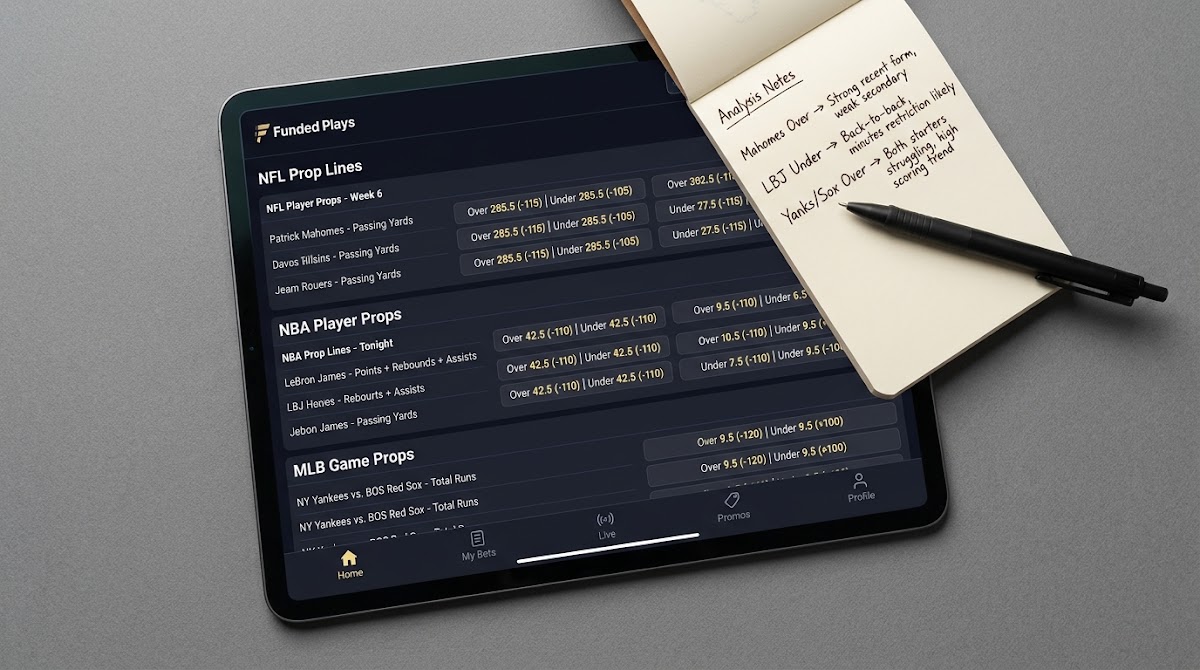
What are draftkings prop bets? Definition and context
A prop bet is a wager on a specific event within a game rather than the overall winner or final total. In everyday terms, props let you bet on particulars, like whether a player will score a certain number of points, how many passing yards a quarterback will have, or whether a team will reach a specific stat milestone. Player props, team props, and game props are common labels to describe these focused markets.
Player props typically cover individual performance: points, rebounds, assists, receiving yards, and similar measures. Team props may track team totals, margin brackets, or whether a team reaches a set threshold. Game props include events tied to the match as a whole, such as total combined points, whether both teams score in a quarter, or which half will have more scoring. Novelty props can also appear, covering non-traditional outcomes tied to events during a broadcast.
Simple definition
In short, a prop bet is a market focused on a specific outcome inside a contest rather than the match result. Using player props as an example helps beginners see the difference from main markets: instead of backing a team to win, you identify a measurable event about an individual or segment of the game and place a wager on that outcome.
How prop bets differ from main markets
Main markets like moneyline, spread, and totals focus on the overall game result or aggregated scoring. Prop bets slice a game into many smaller opportunities and let you express a view on more granular events. That specialization makes props useful when you have insight about a particular player role, matchup, or situational factor that may not affect the main market price.
Why people use prop bets
People choose props for several reasons: to leverage specific knowledge about a player or matchup, to find alternative value when main markets look efficient, or to make a game more engaging by focusing on a detail. Props also let players tailor stake size to discrete ideas and build combinations when appropriate. Because props are focused, they frequently carry more variance than a straight moneyline, so disciplined sizing and a repeatable edge matter.

How draftkings prop bets work: types, lines and odds
Prop markets are grouped by type, and each type uses a line and price to express how likely the bookmaker thinks an outcome is (see DraftKings' market rules: https://sportsbook.draftkings.com/help/general-betting-rules/market-rules). For example, a bookmaker will set a line for a player to score over or under a given number and assign odds that determine the payout if you win. Understanding how lines and odds relate to implied probability helps you compare your view to the market price.
Common categories are player props, team props, game props, and novelty props. Player props focus on individual performance metrics. Team props look at what a team does as a group. Game props cover total or segmented game outcomes. Novelty props are special-case events that may depend on broadcast or event-specific measures.
Try a structured challenge to practice disciplined prediction
Keep reading to see a simple three-step framework that helps you turn context and basic data into a disciplined decision for most prop offers.
Common types of prop bets
Player props can be over/under lines for a player's stat, anytime scoring markets, or categorical outcomes like “will register a touchdown.” Team props might include team total points or whether a team covers a particular in-game milestone. Game props often cover which half has more points or whether the game reaches certain combinations of scoring events.
What odds and lines mean for props
The line is the benchmark the market sets, and the odds translate that benchmark into a payout (see DraftKings' betting terminology: https://sportsbook.draftkings.com/help/glossary/betting-terminology). A shorter price on an outcome suggests the market sees it as more likely; a longer price implies lower probability but a larger payout if correct. Reading both the line and the odds gives you a sense of the market’s expectation and the reward for finding a different view.
How wagers are settled
Most prop markets are settled after official game or league statistics are confirmed. Bookmakers typically reference league-provided stats and will pay winning wagers according to the explicit settlement rules attached to each market (see DraftKings' general rules: https://sportsbook.draftkings.com/help/general-betting-rules/general-rules). Some props can be voided if a player does not participate or if the required statistic is not recorded; reading the settlement terms matters because different markets can use slightly different definitions for what counts as an official stat.
A practical framework to evaluate and choose prop bets
When you evaluate a prop, use a repeatable, three-step framework: define your edge, gather reliable data and context, and compare your estimate to the market price. That process emphasizes making a reasoned estimate and staking based on the difference between your estimate and the price rather than guessing or following tips without a method.
Step 1: Define your edge
Start by stating what specific advantage you believe you have. It could be a recent role change for a player, a favorable matchup, a weather or venue factor, or reliable minutes expectation that others may be overlooking. A clear statement of your hypothesis helps avoid hindsight bias when outcomes differ.
Once you have the hypothesis, turn it into a simple probability estimate for the prop outcome. Use recent performance, matchup history, and any situational notes to form that initial percentage. The idea is not to be perfectly precise but to have a defensible estimate you can test and refine over time.
Betting props starts with a clear hypothesis, a probability estimate based on data and context, comparing that estimate to the market-implied price, and sizing stakes to a disciplined bankroll rule; track results and refine over time.
Step 2: Use reliable data and context
Confirm your estimate by checking a few reliable data points: recent box-score trends, playing time patterns, matchup splits, and any confirmed injury or rotation news. Small sample sizes can mislead, so weigh season-long patterns against the most recent games and adjust the influence of each accordingly. Context matters: a player returning from injury or on a minutes restriction requires a different treatment than a fully available starter.
Step 3: Compare market prices
Translate your probability estimate into an implied market price and compare. If your estimate suggests a higher chance than what the odds imply, there may be value. Consider variance and how confident you are in the estimate before staking. A modest advantage with high uncertainty should be handled differently than a confident advantage in a stable role.
Bankroll rules and risk management for prop bets
Because many prop bets are specific and therefore higher variance, managing bankroll is essential. Size individual prop wagers as a fixed fraction of a tracked bankroll to limit the impact of streaks and to preserve the capital needed for future opportunities. The exact fraction depends on your risk tolerance and confidence in the edge, but the principle is to avoid large single wagers that can derail a plan.
Keep your rules simple and mechanical so emotion has less influence on stake decisions. A clear rule might cap single prop stakes at a small percentage of your tracked bankroll and reduce that percentage when you are uncertain about the estimate or when market liquidity is thin.

Sizing bets and volatility
Props often move quickly and can produce long streaks of losing or winning outcomes even when your process is sound. Because volatility is higher, many experienced players reduce nominal stake sizes compared with main markets. Position sizing should account for both the edge size and the expected variance of the market you are playing.
Using maximum loss rules
One practical safeguard is a maximum loss rule for a session or day. Set a loss limit that, if reached, triggers a pause and a short review of your recent plays and process. This prevents emotional chasing and preserves your ability to approach the next opportunity with a clear plan.
Tracking results
Track each prop you place with essential fields: date, market, line, odds, stake, result, and brief notes on the hypothesis. Over time you can measure hit rates, average edge when you played, and how different prop types perform for you. Good recordkeeping is the most reliable way to separate skill from luck and to find where you have a durable advantage.
Decision criteria: what makes a good prop bet?
A good prop combines a clear value opportunity with manageable risk and a repeatable basis for the view. Define value as situations where your probability estimate exceeds the implied probability from the market price. Favor markets where you can explain why that edge should persist, not situations that look like flukes.
Value vs probability
When your estimate shows the outcome is more likely than the market implies, that difference is the theoretical value. The size of the value and your confidence determine whether to play and how much. Small edges require more restraint and smaller stakes because variance can quickly erase gains even if the long-term math is favorable.
Leverage and correlation
Be mindful of correlated outcomes. Parlaying correlated props can increase variance and risk because several linked events are more likely to fail together. If you choose correlated props, reduce stake sizes to reflect the additional combined risk rather than treating each leg as independent.
Edge persistence
Edges that persist are usually tied to stable factors: a player’s defined role, predictable minutes, consistent matchup advantage, or a coach’s rotation habit. Temporary edges based on single-game anomalies or uncertain minutes are harder to rely on. Prioritize repeatable advantages and treat one-off opportunities with smaller stakes or as exploratory bets.
Common mistakes and traps when betting props
Some traps repeat across players of all experience levels. Chasing longshot payouts, ignoring explicit settlement and contest rules, and overreacting to short-term variance are common mistakes that erode long-term returns. Awareness and simple guardrails help avoid these pitfalls.
Chasing longshot payouts
Big payouts are tempting, but a focus on outsized returns often leads to playing markets where the implied probability is low and the true edge is unclear. Over time, consistently taking longshots with low expected value usually hurts results. Emphasize repeatable edges and moderate payoffs you can defend analytically.
Ignoring contest rules
Read settlement terms carefully. Different props may use different stat criteria or have special void rules. Mistakes around what counts as an official statistic, when a player must participate to qualify a market, or how overtime is handled can lead to unexpected losses or voided wagers. Clear rule-reading prevents these issues.
Overreacting to short-term variance
Small samples are noisy. Winning or losing several props in a short run is not proof of an edge or lack of one. Stick to your process, keep notes, and use tracked results over a meaningful sample to judge whether your approach is working. Make adjustments based on patterns, not single outcomes.
Practical examples and scenarios: applying the framework
Example 1: Player points prop. Suppose you believe a player will exceed a listed points line because their minutes have increased and they face a defense that allows higher scoring to their position. You would outline your hypothesis, estimate the probability the player tops the line, check recent minutes and matchup context, and then compare your estimate to the market-implied probability before deciding stake size.
Quick edge estimate for a single prop
Use as a quick guide not financial advice
Example 2: Over/under team stat. For a team total prop, consider pace, opponent defensive strengths at the specific stat, and whether key contributors are available. Translate these factors into a probability range and only play if your probability meaningfully differs from the published odds after adjusting for variance.
Example 3: When to use correlated props. If you are tempted to combine a player points line with a minutes-based prop for the same player, remember the two are linked. If minutes drop, both legs may fail together. Use smaller combined stakes or avoid linking heavily correlated events unless your model explicitly accounts for that dependence.
Template to evaluate a prop before staking: state your hypothesis in one sentence, list the three most relevant data points that support it, give a probability estimate, compute implied market probability from the odds, and decide stake based on your risk rules. Keeping this template short helps you act consistently and review plays afterwards. (See how our evaluations work: https://www.fundedplays.com/blogs/how-fundedplays-evaluations-work)
Quick checklist and next steps before placing a prop bet
Pre-bet checklist: 1) State your hypothesis clearly; 2) Check minutes/role and any game-time news; 3) Compare your probability estimate to the market price; 4) Size the stake according to your bankroll rules; 5) Confirm settlement and contest rules for the market. Following this list prevents many common errors.
Recording the wager: Log date, market, line, odds, stake, your estimate, and outcome. Add a short note on what you learned. Over weeks this record becomes the most valuable source for improving your model and discipline. (Read more on our blog: https://www.fundedplays.com/blogs)
Post-game review: After enough plays in a theme, review your hit rate and the average edge when you played. If the observed results deviate from expectation, diagnose whether the issue is a repeated mistake in estimating probabilities, a structural shift in roles or rules, or simply variance requiring more sample size.
Conclusion: safe, disciplined approaches to prop betting
Prop betting offers many ways to express specific views about players and games, but it rewards process more than luck. Use a clear framework to form probability estimates, compare them to market prices, and size stakes with disciplined bankroll rules. Tracking and routine review make skill visible over time.
Practice with a small, consistent staking plan, focus on repeatable edges tied to stable roles and context, and avoid emotional chasing. Treat the work as ongoing learning: refine your estimates, keep good records, and prioritize preservation of capital so you can continue testing and improving your process. (visit Funded Plays: https://www.fundedplays.com)
Prop bets are settled according to the explicit settlement rules attached to each market, typically using official league statistics; review the market terms before placing a wager.
Many players use a small fixed fraction of a tracked bankroll for single props, reducing stake size for higher-variance or less-certain opportunities.
Short-term streaks are noisy; consistent tracking over a meaningful sample is required to judge skill versus variance.
References
- https://sportsbook.draftkings.com/help/general-betting-rules/market-rules
- https://sportsbook.draftkings.com/help/glossary/betting-terminology
- https://sportsbook.draftkings.com/help/general-betting-rules/general-rules
- https://www.fundedplays.com/blogs/how-fundedplays-evaluations-work
- https://www.fundedplays.com/blogs
- https://www.fundedplays.com
- https://www.fundedplays.com/challenges