
Quick answer: what 1.25 odds mean and how a decimal to odds converter shows it
One-line summary - decimal to odds converter
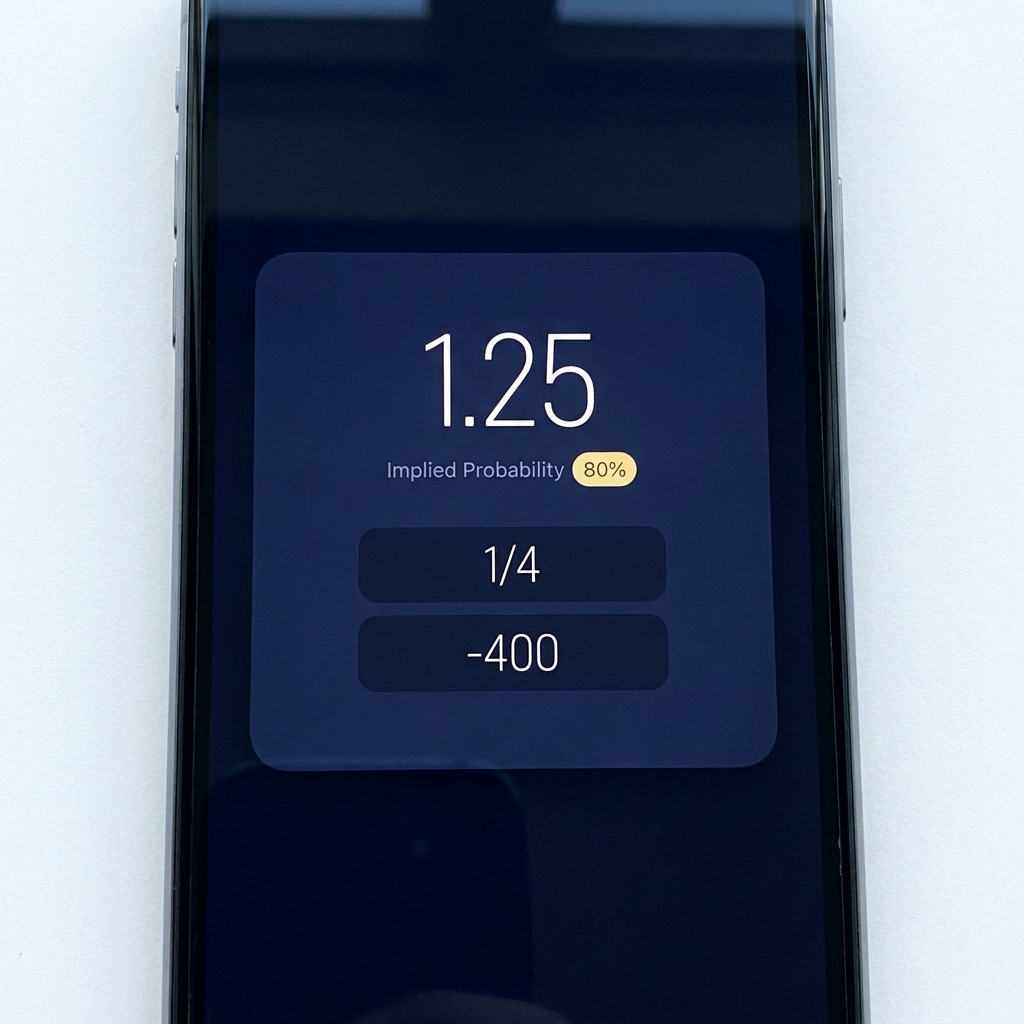
At 1.25 decimal odds the basic rules are simple: implied probability equals 1 divided by the decimal price, so 1 / 1.25 = 0.80 or 80%, and payout equals stake times the decimal with profit equal to payout minus stake.
This relationship is the core a decimal to odds converter automates when you enter 1.25, and a reliable converter will also show the fractional and American equivalents along with precise payout numbers for a chosen stake The Action Network odds converter.
Example in one line: a $20 stake at 1.25 returns 1.25 × 20 = $25, so profit is $5; the profit factor for 1.25 is always 0.25 × stake.
Explore Funded Plays Challenges
Please try a converter to check your own stake sizes and confirm payout numbers before you place or record any prediction.
Why this matters: the decimal format quotes total return rather than net profit, so confusing total return with profit is the most common calculation error for newcomers.
What decimal odds are and why they are widely used
Definition and how to read a decimal price
Decimal odds show the total return per unit stake, including the original stake, so the calculation is simply stake × decimal to get the payout amount. This makes decimal odds especially straightforward for quick payout math and for display in software or calculators Implied Probability: Formula and How to Use It.
Because the decimal number already includes stake, a quoted 1.25 means you get back your stake plus 25% of it as profit, not 125% extra on top of the stake. Keeping that distinction clear avoids the frequent error of treating the decimal as only profit.
Why decimal is common: international markets and many exchanges prefer decimals because the calculation is unambiguous and easy to show in tools. Converters and interfaces that target global users typically default to decimal display for that reason Pinnacle's guide to betting odds.

Contrast briefly with fractional and American formats: fractional odds express the net profit relative to stake, while American odds use a positive or negative number to indicate underdog or favorite status respectively. Converters handle these cross-format interpretations automatically.
How to calculate implied probability from decimal odds
The formula: 1 divided by the decimal price
Start with the exact formula implied probability = 1 / decimal. For 1.25 that is 1 / 1.25 = 0.8, which you present as 80% when communicating chance estimates to others How to Convert Betting Odds to Implied Probability.
Interpretation: 80% implied probability signals a strong favorite in market terms, but it is not a guarantee of outcome. Market quotes combine expectations about outcomes with any bookmaker margin, so treat the percentage as the market price rather than an absolute event probability.
1.25 decimal odds imply an 80% market-implied probability, return 1.25 times the stake for payout, and convert to fractional 1/4 and American −400; use a decimal to odds converter to verify precise payouts and rounding.
Rounding guidance: converters usually show a rounded percentage for readability, for example 80% instead of 79.95%, and will give more decimals if you request finer precision. When you need exact arithmetic for record keeping or simulations, use the converter's raw output or apply the 1/decimal formula and keep a few extra decimal places The Action Network odds converter.
Converting 1.25: decimal to fractional and to American (moneyline)
Decimal to fractional: subtract 1 then simplify
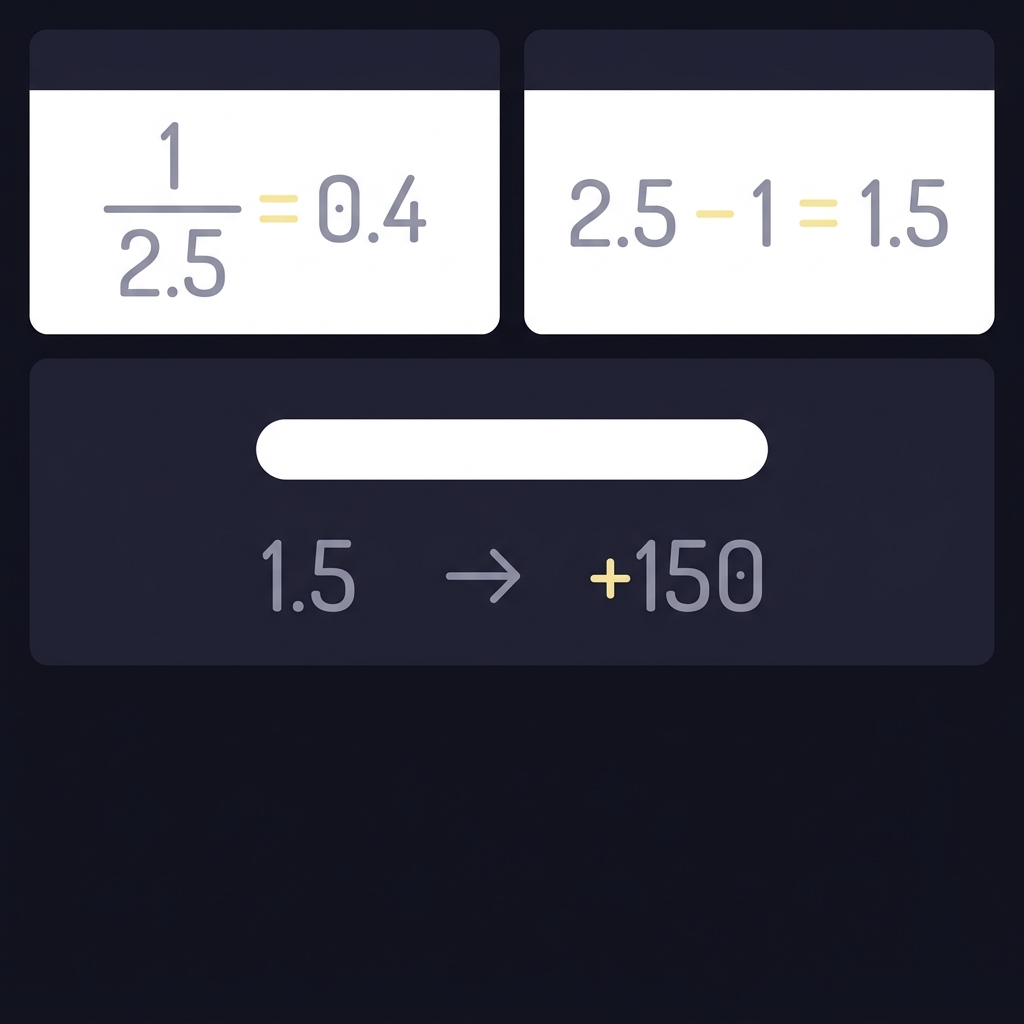
Conversion to fractional starts by subtracting 1 from the decimal to isolate the net profit portion: 1.25 − 1 = 0.25. Expressed as a fraction 0.25 equals 1/4, so the fractional odds are 1/4 Betfair's odds formats explanation.
Write that result as one to four or as 1/4 in typical fractional notation. Fractional odds present only the profit relative to stake, which is why the intermediate subtract-1 step is necessary for accurate conversion.
Decimal to American: formula for favorites
For favorites, convert decimal to negative American (moneyline) using the formula −100 / (decimal − 1). Applying that to 1.25 gives −100 / 0.25 = −400, so 1.25 in American form is −400 How to Convert Betting Odds to Implied Probability.
The negative sign indicates a favorite and the magnitude shows how much you need to stake to win $100 in profit at that price. Converters report both values side by side so you can compare formats without doing the arithmetic yourself.
Worked examples: stake, total return and profit at 1.25
Small-stake example
Algebraic form is useful for quick checks: payout = stake × decimal, profit = payout − stake. For a $10 stake at 1.25 you compute payout = 10 × 1.25 = $12.50 and profit = $12.50 − $10 = $2.50 Implied Probability: Formula and How to Use It or OmniCalculator.
That arithmetic scales linearly, so it is straightforward to project profits for any stake size and to feed those numbers into your prediction logs or simulation spreadsheets.

Larger-stake example and scaling
For a $40 stake the same rule gives payout = 40 × 1.25 = $50 and profit = $50 − $40 = $10, showing profit scales proportionally with stake and confirming the profit multiplier 0.25 × stake for 1.25 The Action Network odds converter.
Use these worked cases to verify a converter's output quickly: if the converter returns the same payout and profit values for your stake, its basic arithmetic is correct.
Why a market would price something at 1.25: favorites and overround
How implied probability links to market expectation
A market posting 1.25 expresses an 80% implied probability and therefore represents a strong expectation that the event will occur, but prices also reflect supply and demand and any margin charged by the house or platform What is overround and how does it work.
That means the quoted 80% is the market price; it does not translate automatically into a model-derived true probability unless you remove the market margin from every outcome in the market book.
If you care about value you must compare your own probability estimate against the market-implied number and allow for margin when judging whether a price shows positive expected value.
Bookmaker margin and overround explained
Overround arises because bookmakers set prices so that the implied probabilities across all outcomes sum to more than 100%, which creates a built-in edge for the house. This is why converters return implied probabilities from offered prices rather than 'true' probabilities adjusted for margin What is overround and how does it work.
If you care about value you must compare your own probability estimate against the market-implied number and allow for margin when judging whether a price shows positive expected value.
How to use a decimal to odds converter: tools, checks and quick tips
When to use a converter versus mental math
Use a converter when you need consistent formatting, precise rounding, or quick cross-format comparisons; use mental math for rapid, small checks like confirming payout and implied probability on the fly. A good converter will output implied probability, fractional odds, American odds, and payout for a given stake The Action Network odds converter or AceOdds odds converter.
Verification checks you should perform include recomputing implied probability with 1/decimal and confirming payout equals stake × decimal; if both match, the converter is doing the standard calculations correctly Implied Probability: Formula and How to Use It.
Quick checks to validate converter outputs
Verify with 1/decimal first
Quick tip on rounding: if you need to record or compare lines across sources, ask the converter to show at least two decimal places for probability and payout, or export raw numbers to a spreadsheet for reproducible rounding rules.
Common mistakes when reading 1.25 odds and how to avoid them
Confusing profit with total return
Frequent mistake: treating the decimal as the profit multiplier rather than total return. Remember that 1.25 returns stake plus profit, so profit = (decimal − 1) × stake; for 1.25 profit = 0.25 × stake Pinnacle's guide to betting odds.
Simple fix: always compute payout and profit separately, and if in doubt use a converter to check your math.
Misreading implied probability as a guarantee
Do not treat an 80% implied probability as a sure event; it is a market price that reflects expectations plus margin. Even events with high implied probability can fail, and the margin can conceal small edges that matter over many bets What is overround and how does it work.
Best practice is to combine your model or judgement with strict bankroll rules and to verify conversions before committing to a stake.
Practical scenarios: when 1.25 is a useful price to take or avoid
Situations where a strong favorite makes sense
1.25 may be a reasonable price when you have independent reasons to believe the true probability exceeds the market-implied 80%, or when you are managing risk with small, scaled stakes inside a disciplined challenge or simulation.
For participants in structured prediction challenges, such as funded simulation programs, small profit multipliers can still be sensible when your objective is consistency and drawdown control rather than high single-event returns.
When margin or value considerations argue against taking 1.25
Avoid taking 1.25 if you estimate the true probability is well below 80% or if the market overround makes small edges disappear after adjusting for margin. In those cases the absolute profit per stake is small and the opportunity cost of capital or bankroll usage can matter.
Always run a quick conversion and edge calculation with a converter to see the absolute profit per stake and to compare it against your alternative uses of the same bankroll.
Quick mental math checklist for converting decimals like 1.25 on the fly
Three-step mental check
Memorize three quick steps: 1) implied probability = 1 / decimal, 2) profit = (decimal − 1) × stake, 3) fractional = decimal − 1 simplified. For 1.25 this becomes 80%, 0.25 × stake, and 1/4 respectively Implied Probability: Formula and How to Use It.
When to rely on a converter: use the tool for precise rounding, for American conversions, and for bulk calculations across many lines or stake sizes The Action Network odds converter.
Different converters may round percentages and payouts differently; a small difference like 79.95% versus 80.0% is usually cosmetic, but make sure you know which rounding rule your records use when comparing sources The Action Network odds converter or Covers calculator.
For accounting or simulation work, standardize on a rounding rule and keep raw numbers where possible to avoid cumulative rounding drift over many events.
American odds show favorites as negative numbers; the magnitude indicates how much you must stake to win a fixed profit amount. For 1.25 the corresponding American odds are −400, which means risking $400 to win $100 in profit under that convention How to Convert Betting Odds to Implied Probability.
Converters present these numbers so you can match payout logic across regions and user interfaces without manual errors.
Checklist before you act: verify the math, check market margin, and scale bets
Three verification steps
Before staking: 1) recompute implied probability with 1/decimal and confirm the converter matches, 2) compute payout as stake × decimal and verify profit as payout minus stake, 3) check the market overround if you are assessing value rather than just the conversion Implied Probability: Formula and How to Use It.
These three checks prevent the most common errors and help you decide if a small-profit price like 1.25 fits your risk plan.
Simple scaling rule for bankrolls
When using low-margin prices, scale stakes conservatively because each bet yields limited absolute profit; discipline and consistent sizing matter more than chasing many small edges without an overall plan.
Use converters to preview absolute profits at your planned stake sizes so you can make an informed sizing decision quickly The Action Network odds converter.
Summary and next steps: using a decimal to odds converter responsibly
Key takeaways
Recap: 1.25 implies an 80% market-implied probability, yields profit equal to 0.25 × stake, converts to fractional 1/4 and to American −400, and converters automate all these steps for clarity and precision Implied Probability: Formula and How to Use It.
Remember that prices embed market margin and that converters show values from the market quote rather than adjusting automatically to a model's pure probability estimate What is overround and how does it work.
Where to learn more
Practice by entering a few stakes into a reliable converter and by comparing fractional and American outputs alongside the implied probability; that will build intuitive fluency with decimal prices and reduce calculation errors over time The Action Network odds converter.
For participants in structured prediction challenges, treat converters as neutral arithmetic tools and focus on disciplined sizing and verified record keeping rather than on chasing tiny quoted edges.
Divide 1 by the decimal price. For 1.25 this is 1/1.25 = 0.8 or 80 percent.
Subtract 1 from the decimal to get 0.25, which simplifies to the fractional odds 1/4.
Different converters use different rounding rules and display precision; small differences are usually cosmetic but check raw numbers for simulations.
References
- https://www.actionnetwork.com/odds-calculator/converter
- https://www.investopedia.com/terms/i/implied-probability.asp
- https://www.actionnetwork.com/education/odds-implied-probability
- https://www.pinnacle.com/en/betting-resources/betting-strategy/understanding-betting-odds
- https://support.betfair.com/app/answers/detail/a_id/405/~/odds-formats-explained
- https://www.pinnacle.com/en/betting-resources/betting-strategy/what-is-overround
- https://www.fundedplays.com/challenges
- https://www.aceodds.com/bet-calculator/odds-converter.html
- https://www.covers.com/tools/odds-converter
- https://www.omnicalculator.com/statistics/implied-probability
- https://www.fundedplays.com
- https://www.fundedplays.com/blogs
- https://www.fundedplays.com/blogs/how-fundedplays-evaluations-work