
Quick answer and what this article covers
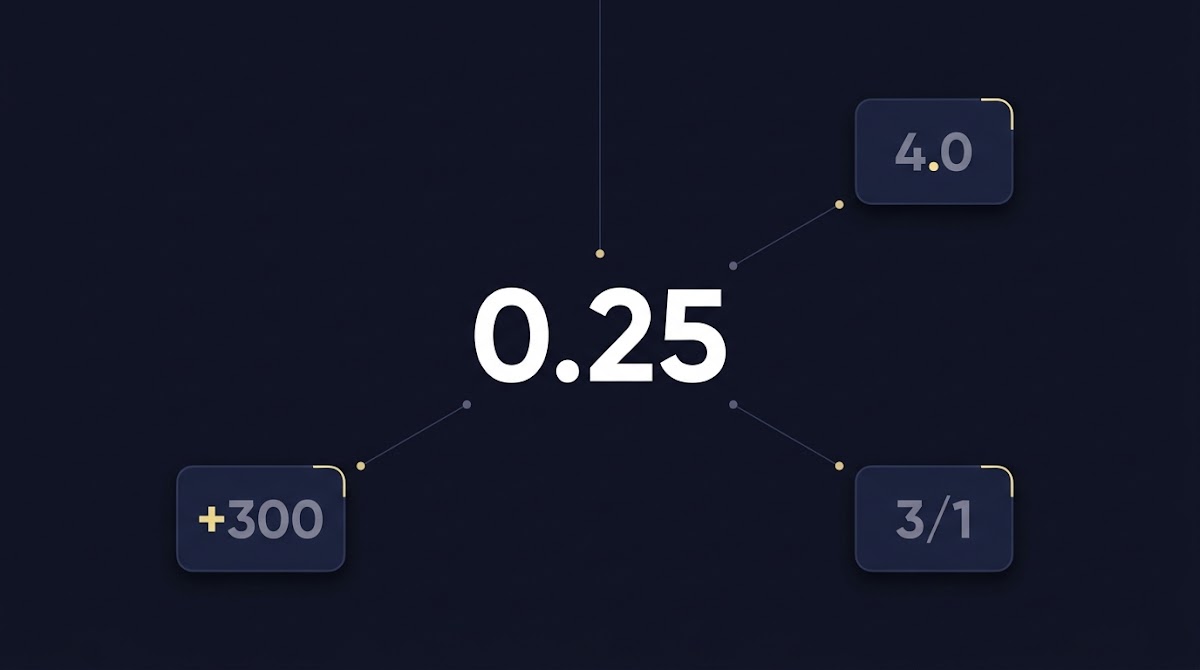
One sentence conversion: a probability of 0.25, treated as fair math, converts to decimal odds 4.0, fractional 3/1, and American +300 using standard conversion formulas described in odds references Decimal odds.
A 0.25 probability converts in fair math to decimal 4.0, fractional 3/1, and American +300; live market odds often differ due to bookmaker margin.
Roadmap: the short answer above gives you the conversion you likely needed; the rest of this article explains the definitions behind those numbers, shows the exact formulas and algebraic steps, gives clear payout examples, explains why bookmaker prices often differ because of margin, and lists common conversion mistakes to avoid. Read the sections you need or follow straight through for a complete refresher (see our blog).
Definition and context: probability, implied probability, and what '0.25' means
Probability 0.25 is a simple decimal fraction that equals a 25 percent chance of an outcome occurring. In betting and forecasting contexts that decimal is called an implied probability when you derive it from quoted odds, and many guides explain how implied probability links to odds formats to help compare rates and test models Implied Probability.
The core identity used for fair conversions is decimal = 1 / probability, which means you invert the probability to get the decimal price. This identity is the standard mathematical definition of decimal odds and is the basis for converting 0.25 into 4.0 in fair math Decimal odds.

Core conversion formulas: decimal, fractional and American odds
Decimal from probability: the formula is decimal = 1 / p. Applying that to p = 0.25 gives decimal = 1 / 0.25 = 4.0, which is the fair decimal price for a 25 percent chance; many references show this inversion as the straightforward way to move between a probability and a decimal price Decimal odds.
Fractional from decimal: fractional odds are commonly written as x/y where the implied probability equals y / (x + y). To derive a fractional representation from a decimal price, you can subtract one to find the 'profit' fraction and express it as x/1 for simple cases. The fractional relationship and notation are covered in odds reference material Fractional Odds: Definition and Examples and tools such as Stats Kingdom odds calculator.
American from decimal for positive prices: for decimal prices of 2.0 or greater, American (moneyline) odds for an underdog are positive and are commonly computed with the identity American = 100 * (decimal - 1). More formally, implied probability for a positive American price obeys p = 100 / (odds + 100), and inverting that gives the moneyline corresponding to a given probability Moneyline Bet.
Convert a probability like 0.25 into decimal, fractional and American formats
Use decimals with two significant figures for clarity
Practical check: put 0.25 into a reliable decimal to odds converter to verify it returns the same cross-format identities. Converters use the same identities described above, but you should confirm whether they show fair math or include a market margin when comparing against bookmaker quotes. For quick hand math, remember decimal = 1 / p, fractional = decimal - 1 in simple forms, and positive American approximates to 100 times the decimal profit.
Notes on signs and edge cases: these short formulas assume fair math and that decimal is at least 2.0 for the positive moneyline identity to give a positive number. For outcomes with probabilities above 50 percent the American sign convention flips and calculators use the appropriate negative formula; reliable guides explain both cases in detail Odds Converter - Convert fractional, decimal and American odds.
Fractional odds explained: why 4.0 equals 3/1

Interpreting fractional odds: fractional odds are written x/y and imply a probability y / (x + y). To check that decimal 4.0 corresponds to fractional 3/1, invert the fractional expression: a 3/1 quote implies an implied probability of 1 / (3 + 1) = 0.25, which matches the starting probability. This algebraic relationship is the usual verification used by analysts and simple calculators Fractional Odds: Definition and Examples.
Quick checks and cross format identities: a fast mental check is fractional = decimal - 1 for many straightforward cases, so decimal 4.0 minus 1 gives 3, which you read as 3/1. That identity is practical for quick conversions, though detailed calculators show the same results and clarify edge cases where fractional formatting differs by convention Odds Converter - Convert fractional, decimal and American odds.
American moneyline: how +300 comes from 0.25
Positive moneyline conversion formulas: for positive American prices the standard probability formula is p = 100 / (odds + 100). To find odds from a probability you invert that expression. Putting p = 0.25 into the inverted form gives odds = 100 / p - 100 = 100 / 0.25 - 100 = 400 - 100 = 300, which is quoted as +300; authoritative explanations of moneyline math document these identities Moneyline Bet.
When American odds use plus versus minus and caveats: the plus sign denotes how much profit a winning $100 stake would return on top of the stake; the negative convention is used for favorites where the stake needed to win $100 is quoted. Be careful when converting probabilities near the 50 percent mark, since sign changes and rounding rules can affect the displayed moneyline in practical calculators Implied Probability.

Payout examples: how much you win at decimal 4.0
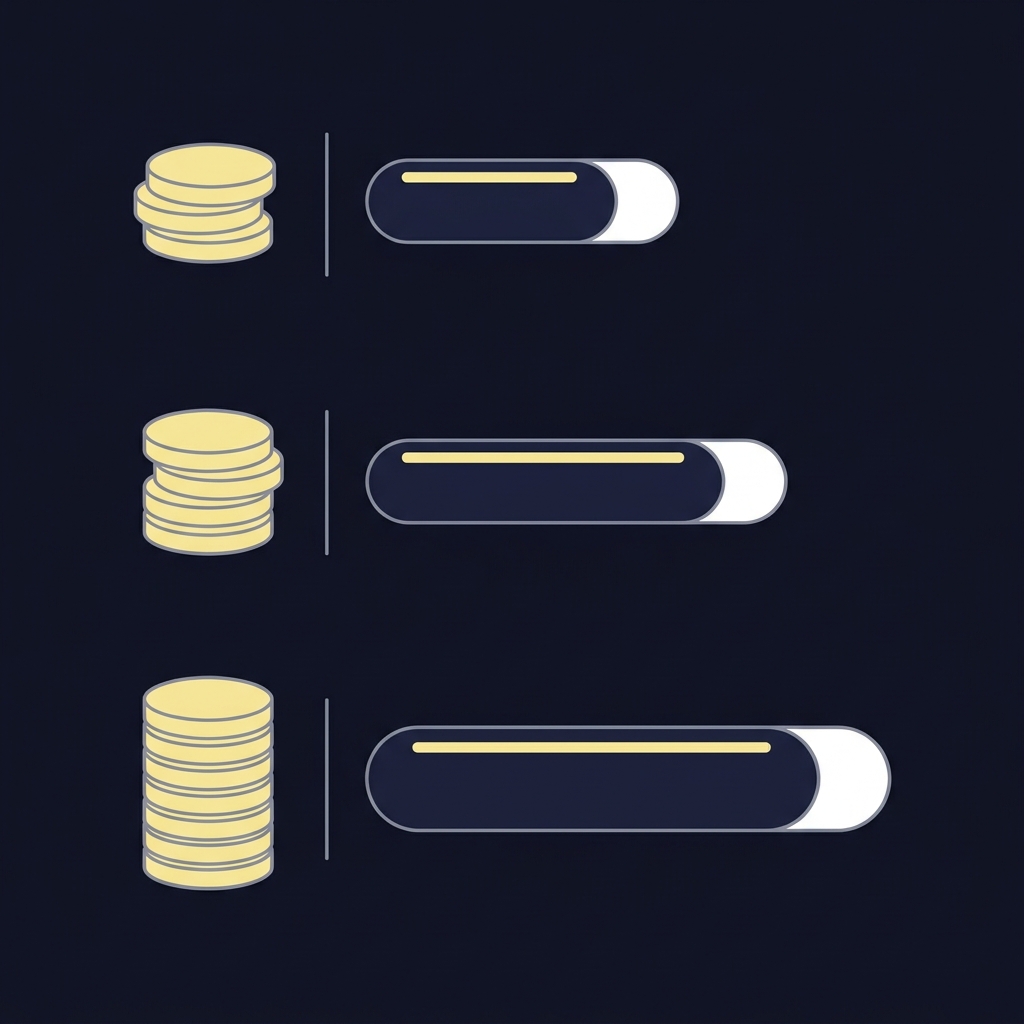
Stake, total return, and profit: decimal odds represent total return as stake multiplied by the decimal price. Using decimal 4.0, a $10 stake returns $10 times 4.0 = $40 total, which is $30 profit above the returned stake; this stake times decimal identity is the standard payout calculation for decimal odds Decimal odds.
Examples with common stakes: applying the same rule shows a $5 stake at 4.0 returns $20 total and $15 profit, while a $100 stake returns $400 total and $300 profit. These examples scale linearly with stake and are straightforward to verify with any decimal to odds converter or payout calculator.
Practical note: these calculations use fair math and do not factor in bookmaker margin, taxes, or platform fees. When you compare these payout numbers to live market quotes you may see different decimal prices that change the total return because market prices include vigorish or adjustments for liquidity and risk.
Bookmaker margin and overround: why market prices can differ from the fair conversion
What overround means: real sportsbook prices normally embed a margin so that the sum of implied probabilities across all outcomes exceeds 100 percent. That built-in margin, often called overround or vigorish, is why simple fair conversions such as 0.25 to 4.0 are a mathematical baseline but may not match quoted market prices Overround.
Double-check conversions before you act
Before acting on a conversion, double-check whether the tool or quoted price includes bookmaker margin, because many converters show fair math by default while markets often reflect a built-in overround.
How it changes implied probabilities: when bookmakers set lines they adjust each price slightly to ensure their overall book has a margin; as a result the implied probabilities you compute from market decimals will usually sum above 100 percent, and comparing fair math conversions to market quotes helps you see where the margin sits and how it affects value.
Common mistakes and pitfalls when converting odds
Inverting the probability incorrectly Many mistakes come from forgetting to invert probability when converting to decimal; remember decimal = 1 / p and verify with a quick check to avoid this error. For guidance on reliable calculators and typical pitfalls, refer to odds converter references Odds Converter - Convert fractional, decimal and American odds.
Misreading fractional notation Interpreting fractional odds as a simple ratio without applying the implied probability formula y / (x + y) leads to wrong chance estimates; when in doubt write out the denominator plus numerator and divide to check the implied probability.
Mixing fair math with market prices A common trap is to treat converter output as the market price; always confirm whether the converter shows fair prices or includes a bookmaker margin, since live markets typically embed overround and therefore change the effective implied probability Overround.
Practical scenarios and next steps
When to use a decimal to odds converter: converters are useful for backtesting models, teaching probability concepts, reconciling predictions with quoted prices, and checking potential payout outcomes in a neutral, fair-math framework. If you are practicing prediction strategies or evaluating performance in a simulated environment, fair conversions give a clear baseline to judge your forecasts against.
How to compare converter output to bookmaker odds responsibly: get the fair conversion for your model probability, then pull the market decimal and compute both implied probabilities. If the market implies a lower probability for an outcome you believe has higher chance, that discrepancy may indicate a potential edge, but remember markets include margin and you should adjust for overround before concluding a value opportunity Implied Probability (see our evaluation guide).
Safe practices: double check formulas manually for a few cases, use small stakes when testing live, keep records of conversions and outcomes, and follow responsible participation principles when practicing with challenge platforms or sweepstakes-style simulations. If you are using a funded challenge platform (see Funded Plays), read the program rules to understand how simulated bankrolls and performance metrics are calculated.
Invert the probability: decimal = 1 / 0.25 = 4.0, which is the fair decimal price for a 25 percent chance.
Fractional 3/1 corresponds to a 25 percent implied probability because 1 / (3 + 1) = 0.25.
Bookmakers embed margin called overround, so market prices often differ from fair conversions and implied probabilities may sum above 100 percent.
References
- https://en.wikipedia.org/wiki/Decimal_odds
- https://www.fundedplays.com/blogs
- https://www.investopedia.com/terms/i/implied-probability.asp
- https://www.en.wikipedia.org/wiki/Decimal_odds
- https://www.statskingdom.com/betting-odds-calculator.html
- https://www.covers.com/tools/odds-converter
- https://www.investopedia.com/terms/m/moneyline-bet.asp
- https://www.aceodds.com/bet-calculator/odds-converter.html
- https://www.thecalculatorsite.com/sports/odds-converter.php
- https://www.investopedia.com/terms/f/fractional-odds.asp
- https://www.investopedia.com/terms/i/implied-probability.asp
- https://www.fundedplays.com/challenges
- https://en.wikipedia.org/wiki/Overround
- https://www.fundedplays.com/blogs/how-fundedplays-evaluations-work
- https://www.fundedplays.com