

Quick answer: what +200 means and the decimal equivalent
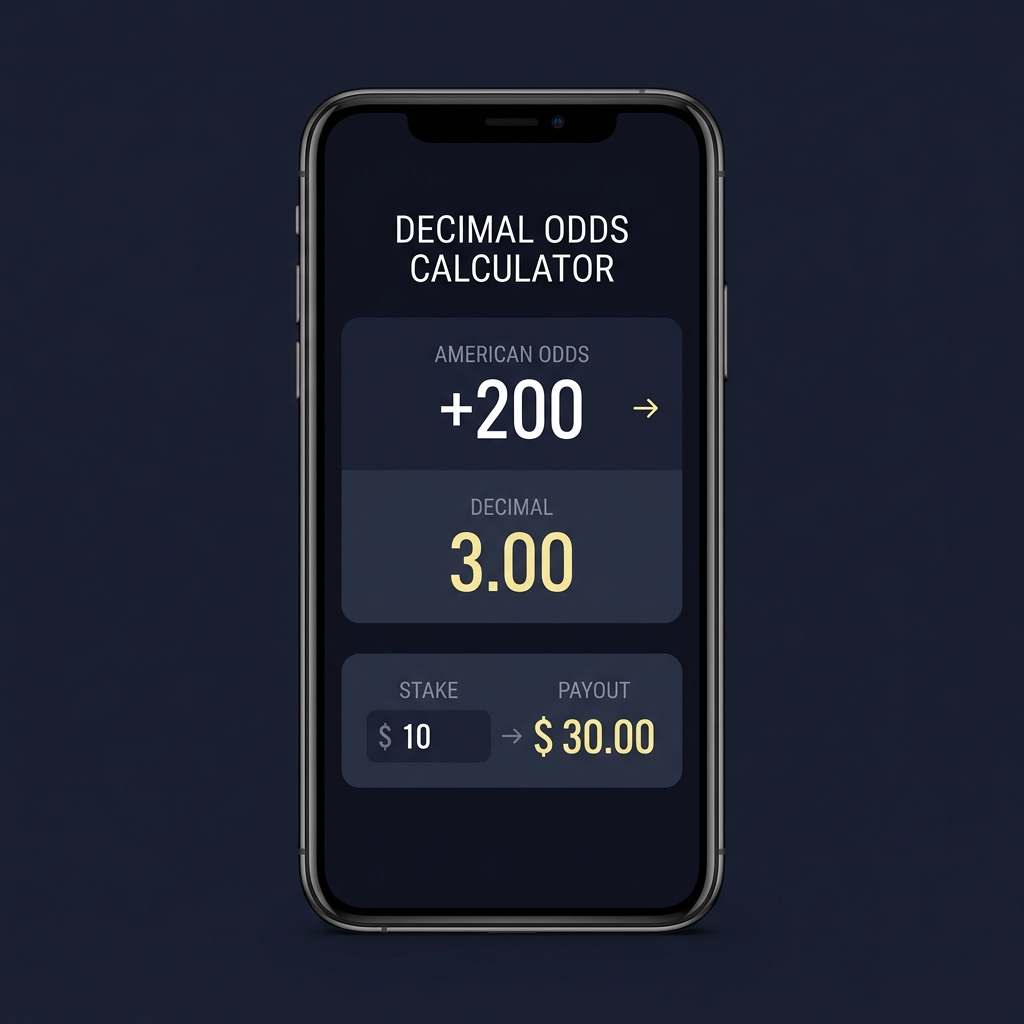
In plain terms, +200 American odds convert to decimal odds of 3.00 using the standard formula decimal = 1 + (A/100). That means a decimal odds calculator would show 3.00 for +200, and a simple money example is a $10 stake returning $30 total, which equals $20 profit plus the original $10 stake Wikipedia 'Odds (betting)'.
This one-line conversion helps you compare lines instantly: the decimal number tells you the total return per unit staked, while the +200 American format states the potential profit on a 100-unit stake.
Convert +200 in seconds
Try converting one simple example now: use decimal = 1 + (A/100) with A = 200 and check that a $10 bet becomes $30 total return.
How American (moneyline) odds and decimal odds differ
American, or moneyline, odds quote profit relative to a 100-unit stake. With positive American numbers like +200, the listed value expresses how much profit you would win on a 100-unit wager; this is the conventional moneyline presentation used in many U.S. contexts Investopedia on moneyline bets.
Decimal odds, by contrast, show the total return per unit staked, including the original stake. A decimal 3.00 means each unit you stake returns three units if the selection wins; that total-return framing is often clearer when calculating payouts quickly and when working across international formats Smarkets Help Centre on odds formats.
Both formats contain the same market information and map to the same implied probability: you can convert freely between them and check consistency using the formula implied probability = 1/decimal.

Step-by-step: convert +200 to decimal odds and compute implied probability
Start with the standard formula for positive American odds: decimal = 1 + (A/100). Plug in A = 200 and compute decimal = 1 + (200/100) = 3.00, which is the direct conversion most calculators and reference guides use Wikipedia 'Odds (betting)'.
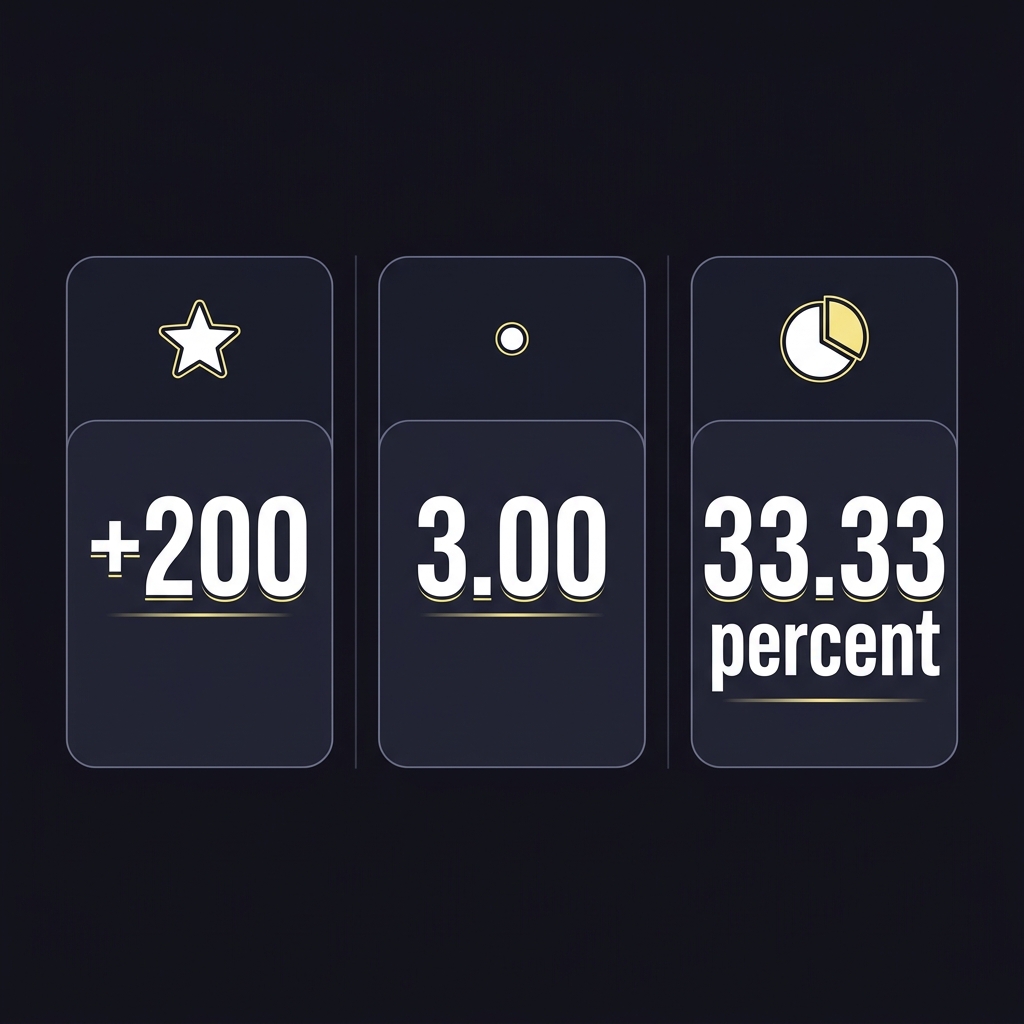
To get the implied probability from the American odds directly, you can use implied probability = 100 / (A + 100). For A = 200 that gives 100 / 300 = 0.3333, or 33.33 percent. The same result comes from 1 / decimal, since 1 / 3.00 = 33.33 percent Investopedia on implied probability.
Positive American odds of +200 convert to decimal 3.00 using decimal = 1 + (A/100). That decimal implies an implied probability of 1/3.00, or 33.33 percent, and a $10 stake at +200 returns $30 total (a $20 profit plus the $10 stake).
For a short algebraic note: the two probability formulas are equivalent because decimal = 1 + (A/100) implies 1/decimal = 1 / (1 + A/100) which simplifies to 100 / (A + 100). That equivalence is why decimal conversions and implied probabilities always align across references.
How to check conversions: calculators and manual checks
A decimal odds calculator is a handy tool when you want a quick, repeatable conversion across many lines or when comparing markets from different operators; try an online converter such as AceOdds odds converter, it automates decimal = 1 + (A/100) for positive American odds and shows the implied probability simultaneously.
For a manual double-check, reapply the conversion formula, compute the implied probability as 1/decimal, and verify a money example such as stake times decimal equals total return. These three checks catch most display or rounding issues without opening another site Covers odds converter.
quick decimal and probability check from American odds
use simple numbers for verification
Watch for rounding differences: some platforms round decimal odds to two decimal places or display truncated implied probabilities. A repeat manual check using the exact formula will show whether a platform rounded or adjusted the presentation.
Worked examples: stakes, returns and break-even win rates
Below are straightforward money examples using decimal 3.00, the result of converting +200; many free converters such as OddsJam produce the same outputs. For a $10 stake at decimal 3.00, total return = 3.00 * $10 = $30, which breaks down to $20 profit plus the original $10 stake. This demonstrates the total-return interpretation of decimal odds and matches the +200 profit framing when scaled to a 100-unit base for comparison Wikipedia 'Odds (betting)'.

For a $50 stake at decimal 3.00, total return = 3.00 * $50 = $150, for a $100 profit plus the original $50 stake. For a $100 stake, total return = 3.00 * $100 = $300, meaning $200 profit plus the $100 stake. These examples scale linearly because decimal odds multiply the stake for total payout, which makes quick comparisons simple and predictable Smarkets Help Centre on odds formats.
When tracking performance in prediction challenges, knowing the break-even rate helps you set realistic targets and evaluate strategy adjustments over many bets. It is a simple discipline metric rather than a promise of outcomes.
Decision criteria: when to convert or prefer one format
Prefer decimal odds when you need fast total-return math, such as multiplying stakes to get expected cash return or when working across international markets where decimal is standard; the decimal framing reduces the extra mental step of re-adding your stake to profit figures Smarkets Help Centre on odds formats.
American odds are still common in U.S.-focused reporting and when lines are framed as moneylines, so keep the simple mental rule: positive American odds like +200 indicate profit on a 100-unit stake, which you can translate quickly using decimal = 1 + (A/100).
Quick mental checks: read +200 as roughly 'triple your stake' when converted to decimal 3.00, and remember the break-even point is about one win in three for that price. These heuristics speed decisions when comparing offers or entering contests.
Common mistakes and how to avoid them
A frequent error is treating decimal odds as profit rather than total return. For example, reading 3.00 as a $3 profit on a $1 stake is incorrect; it is a $3 total return, so the actual profit is $2 on a $1 stake. Recompute profit as (decimal - 1) * stake to avoid this confusion Investopedia on moneyline bets.
Rounding and platform display differences can also mislead. Some sites round decimals to two places which may change displayed implied probability slightly; always reapply the exact formulas if precise probability or accounting matters.
Practical scenarios for prediction challenges and contests
When comparing contest entries or challenge lines on Funded Plays, convert all offerings to decimal or implied probability so you judge them on the same scale. If one feed shows +200 and another shows 3.00, convert one to the other to see whether the expected return or implied probability differs materially Smarkets Help Centre on odds formats.
In funded-style prediction challenges, implied probability and break-even rates help you track whether your hit rate meets the threshold for consistent performance. See Funded Plays evaluations for more on how evaluations are run. Use the conversion formulas for transparent record-keeping rather than relying on different display conventions.
Remember that conversions and implied probabilities do not guarantee future results. Outcomes in contests or challenges depend on your selections, discipline, and adherence to platform rules.
Summary and next steps
Key takeaway: use decimal = 1 + (A/100) to convert positive American odds and note that +200 becomes decimal 3.00, which implies a 33.33 percent probability using 1/decimal Wikipedia 'Odds (betting)'.
For practical next steps, verify a couple of lines with a decimal odds calculator or the manual checks described earlier, then practice with scaled money examples to ensure you and your tracking tools align. Visit the Funded Plays blog for related posts. If you want to learn more, a logical follow-up is negative odds conversion and using implied probability in portfolio-style performance tracking.
Use decimal = 1 + (A/100). For +200 plug in A = 200 to get decimal = 3.00.
Decimal 3.00 implies an implied probability of 1/3.00, which is 33.33 percent.
A calculator speeds conversions and reduces rounding errors, but simple manual formulas are reliable for quick checks.
References
- https://en.wikipedia.org/wiki/Odds
- https://www.investopedia.com/terms/m/moneylinebet.asp
- https://help.smarkets.com/hc/en-gb/articles/213146025-Understanding-betting-odds
- https://www.investopedia.com/terms/i/implied-probability.asp
- https://www.aceodds.com/bet-calculator/odds-converter.html
- https://www.covers.com/tools/odds-converter
- https://oddsjam.com/betting-calculators/odds-converter
- https://betting.betfair.com/betting/how-to/understanding-implied-probability-080414-579.html
- https://www.fundedplays.com/challenges
- https://www.fundedplays.com
- https://www.fundedplays.com/blogs
- https://www.fundedplays.com/blogs/how-fundedplays-evaluations-work