

What decimal odds are and how they work
Definition of decimal odds (decimal odds calculator)
Decimal odds show the total return you receive per unit stake, making quick payout calculations straightforward. If you enter a decimal value into a decimal odds calculator, the result tells you how much a successful unit stake returns, including the original stake. For example, a decimal D gives total return = stake × D, and profit = stake × (D - 1). For the general probability relationship, implied probability is 1 divided by the decimal odds.
This representation is useful because it avoids separate fractional profit calculations and is consistent across sports and markets. The mathematical basis for using 1/D as implied probability is standard in odds education and reference materials Odds formats overview.
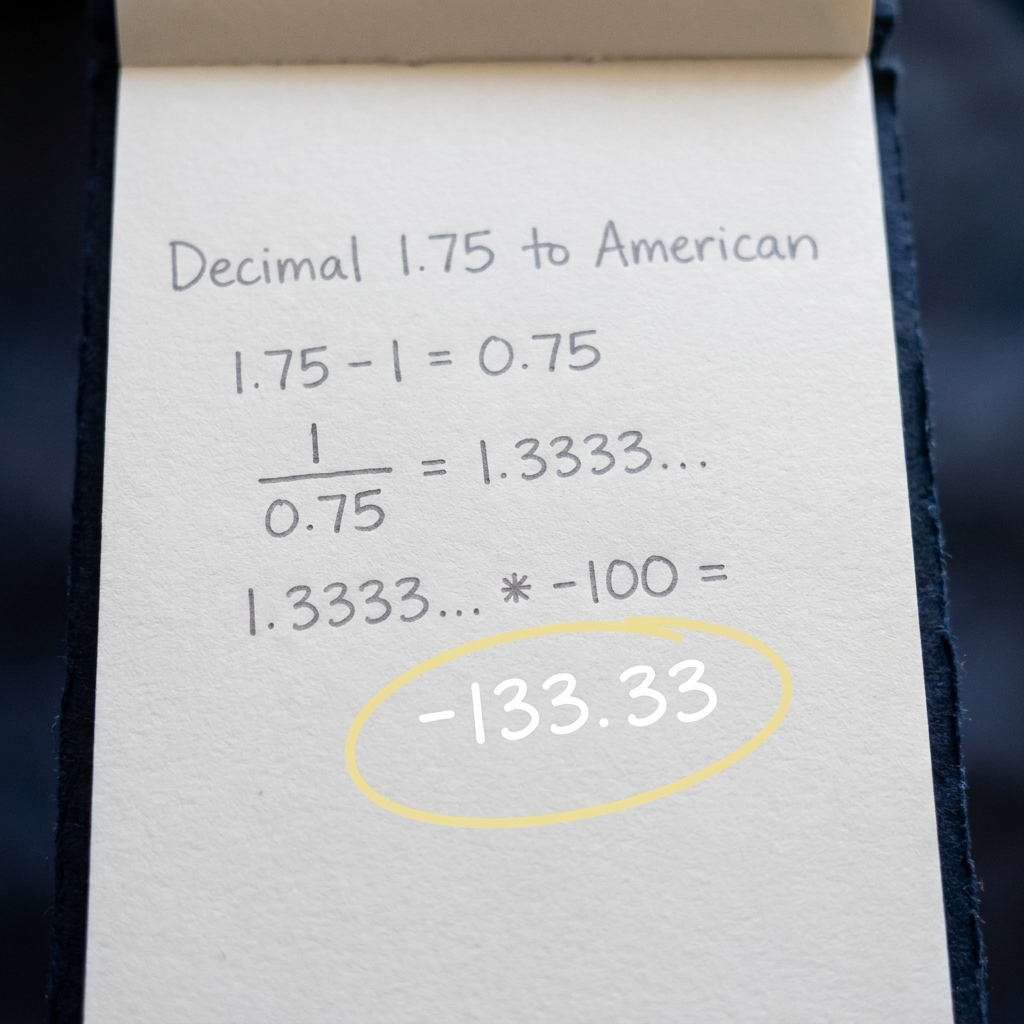
Decimal 1.75 converts to an exact fractional moneyline of approximately -133.333 using American = -100 / (D - 1) and is typically shown as -133 after rounding; it implies an approximate 57.14 percent chance and yields returns equal to stake × 1.75 with profit equal to stake × 0.75.
Worked example: take D = 1.75 and a stake of 10 units. Total return = 10 × 1.75 = 17.50 and profit = 10 × (1.75 - 1) = 7.50, illustrating the difference between return and profit in a single line.
How total return and profit are calculated
Write the one-line equations to keep the arithmetic clear: return = stake × D, profit = stake × (D - 1). These formulas let you compute outcomes quickly for any stake and any decimal odds value. Practical examples help fix the idea: with a $50 stake at D = 1.75 the return is 50 × 1.75 = 87.50 and the profit is 37.50, a simple multiplication that mirrors what most decimal odds calculators display Odds formats overview.

Decimal odds are popular because they map directly to total payout without extra conversion steps; they are especially handy when you compare different stakes or scale strategies across multiple selections. Keeping the stake variable explicit reduces confusion about whether numbers shown include the original stake.
How to convert decimal odds to American (moneyline) odds
Two-case formula: D < 2.00 vs D >= 2.00
Converting decimal odds to American (moneyline) odds uses two separate formulas depending on whether the decimal is below 2.00 or at least 2.00. For decimals less than 2.00, the American moneyline is negative and computed as American = -100 / (D - 1). For decimals of 2.00 or greater, the American moneyline is positive and computed as American = 100 × (D - 1). These two cases reflect the betting convention that decimals under 2.00 indicate a favourite and decimals 2.00 and above indicate an underdog, and they are the standard conversion rules used in educational resources and converter tools Odds converter tool and resources such as OddsJam.
Short numeric examples clarify the split: for D = 1.50 use American = -100 / (1.50 - 1) = -100 / 0.50 = -200, showing a negative moneyline for a favourite. For D = 2.50 use American = 100 × (2.50 - 1) = 100 × 1.50 = +150, a positive moneyline for an underdog. The sign convention helps interpret how much you must risk or how much you win on a fixed stake.
Why the formulas differ and when to apply each
The two-case approach exists because decimal odds below 2.00 imply a greater than 50% chance based on 1/D, so the American system represents that by stating how much you must risk to win 100, producing negative numbers. Decimals of 2.00 or greater imply a 50% or lower chance, so American odds are presented as a positive payout on a 100 stake. This convention keeps American odds intuitive for quick mental checks: negative values show the amount to risk to win 100, positive values show the amount won on a 100 stake; the conversion formulas follow directly from those interpretations and are standard across educational references Odds converter tool.
Step-by-step conversion for 1.75 - math explained
Plugging D = 1.75 into the formula
Follow the D < 2.00 case because 1.75 is below 2.00. Start with the formula American = -100 / (D - 1). Substitute D = 1.75 to get American = -100 / (1.75 - 1).
Compute the denominator: 1.75 - 1 = 0.75. Then divide: -100 / 0.75 = -133.333... This fractional moneyline is the precise mathematical result before rounding; conversion calculators and operator tools use the same arithmetic to produce a base value for display or rounding Odds converter tool.
Check the conversion and rounding now
Try the same arithmetic yourself: subtract 1 from the decimal, divide -100 by that difference, and check how your operator displays the rounded moneyline before placing any prediction.
Because moneylines are usually shown as whole numbers, the fractional result -133.333... is typically rounded to -133 for display. That rounding is the usual nearest-whole-number practice and it yields the commonly displayed moneyline of -133 for decimal 1.75 Moneyline definition and examples.
Rounding conventions and typical display values
Operators may round fractional moneylines up or down according to internal policies, and that choice explains why some displays might show -133 while others could show -134 in edge cases. The arithmetic we used gives the exact fractional value and the typical nearest-whole-number display is -133, which most converters use as the default presentation for 1.75 Odds converter tool.
Remember that a negative moneyline such as -133 indicates a favourite and tells you how much you must risk to win 100 units, namely risking 133 to win 100 on the rounded display. The underlying fractional calculation remains useful for precise probability checks before rounding.
Implied probability: what 1.75 means for chances
Decimal-implied probability calculation
Compute the decimal-implied probability directly as 1 divided by the decimal odds. For D = 1.75 the calculation is 1 / 1.75 = 0.571428..., which is approximately 57.14 percent. This is the straightforward way to interpret the chances implied by decimal odds and is commonly referenced in probability explanations Implied probability definition.
Using the exact decimal-based probability is helpful when you need precise percentages for modelling or when comparing outcomes across markets; decimals give you an immediate fractional probability that is easy to incorporate into spreadsheets or calculators.
Moneyline-implied probability and rounding effects
For a negative American moneyline A the implied probability uses the formula |A| / (|A| + 100). Apply this to A = -133 and compute 133 / (133 + 100) = 133 / 233 ≈ 0.5708, or about 57.08 percent. This value is very close to the decimal calculation and the small difference arises from rounding the fractional moneyline -133.333... to the rounded display -133 Moneyline definition and examples.
Comparing the two numbers, decimal-based 57.14 percent and moneyline-based 57.08 percent, shows why using the unrounded fractional conversion is the most precise method when exact probability is needed; rounding to whole-number moneylines introduces the tiny discrepancy you often see on operator displays.
Payouts and profit examples for common stakes
Worked examples: $10, $50, $100 at 1.75
Use return = stake × 1.75 for total payout and profit = stake × 0.75 for net winnings. For a $10 stake the return is 10 × 1.75 = $17.50, so profit is $7.50. For $50, return = 50 × 1.75 = $87.50 and profit = $37.50. For $100, return = 100 × 1.75 = $175 and profit = $75. These concrete examples mirror what a decimal odds calculator would display for the same inputs Odds formats overview.
basic stake-to-return calculator for the examples
use to cross-check arithmetic
Showing both return and profit side by side helps avoid a common misunderstanding: many people read the total payout and forget to subtract the stake. The examples above show both numbers explicitly so you can see how much you keep after the stake is returned, and they match the decimal definition of return and profit used throughout this guide Odds formats overview.
How to express return versus profit
Phrase payout outcomes clearly: say 'return: $17.50, profit: $7.50' rather than using only one number. This avoids confusion in conversation and record-keeping, and it aligns with how decimal odds calculators label results in most tools and educational pages Odds formats overview.
If you prefer to think in American-moneyline terms, remember that a displayed -133 indicates risking $133 to win $100 on the rounded moneyline, which is consistent with the decimal payout arithmetic when scaled to a $100 risk baseline Moneyline definition and examples.
How to interpret results and cross-check manually
After using a converter, verify the result manually by applying the formula: if the converter shows -133 for 1.75, confirm -100 / (1.75 - 1) = -133.333... and then check the rounding rule. For probability checks, compare 1 / D with |A| / (|A| + 100) using the rounded A to see the small expected difference; mismatches larger than rounding indicate an input mistake or a different conversion assumption Moneyline definition and examples.
Common mistakes when converting odds
A frequent error is to treat the decimal payout as profit rather than total return. Remember: return = stake × D, profit = stake × (D - 1). If you read a converter or a calculator and only copy the return into your ledger, you will overstate expected net winnings. This simple distinction stops many accounting mistakes and keeps records accurate Odds formats overview.
To avoid confusion, always write both numbers when you log a prediction: 'stake, return, profit' so that later calculations use net profit rather than total payout by mistake.
Forgetting rounding effects
Another common oversight is ignoring rounding when comparing implied probabilities across formats. Decimal-implied probability uses exact division 1 / D, while moneyline-derived probability uses |A| / (|A| + 100) and depends on how A was rounded for display. Expect a small difference and check the unrounded fractional moneyline when precision matters Implied probability definition.
When you see a larger-than-expected discrepancy, re-run the calculation and ensure the correct formula case was applied; mixing the D < 2.00 and D >= 2.00 formulas is a common source of error.
When to prefer decimal versus American formats
Audience preferences and regional norms
Decimal odds are compact and ideal for quick payout calculations in modelling or spreadsheet work, while American moneyline odds are common in many U.S.-focused displays and communicate stake-to-win relationships succinctly. Choose decimal for multiplier-based workflows and use American when you want immediate intuition about how much to risk to win 100 units Odds formats overview.
If you often compare markets across regions, keep both formats handy and practice fast conversions so you can move seamlessly between them without arithmetic errors.
Situations where each format is more helpful
Use decimal when aggregating multiple legs into parlay returns because returns multiply directly. Use American when sizing a single stake relative to a common baseline like a 100-unit stake, especially when communicating stakes in conversations or records. Either format is convertible exactly with the formulas in this guide, and knowing both reduces friction when moving between tools or platforms Odds formats overview.
Examples across sports and bet types
Pre-match moneyline example
A simple pre-match moneyline example uses the same arithmetic regardless of sport. If a selection shows decimal 1.75 pre-match, convert it the same way to about -133 and calculate returns with the same multiplication rules. The context-football kick-off, basketball tip-off, or tennis match-does not alter the conversions or the payout formulas, only the game you are predicting Odds formats overview.
That consistency is helpful when you build models across sports because you can standardise on decimals internally and convert to a displayed moneyline for user-facing summaries when needed.
In-play microseconds and odds display differences
In fast-moving in-play markets you may see odds update frequently and some displays truncate decimals or round differently to keep feeds compact. When converting rapidly changing numbers, apply the same formulas but be aware that a snapshot may differ slightly from the instant you place a prediction; re-check the live display before finalising any decision Odds converter tool.
For time-sensitive actions, use a converter that shows both fractional intermediate results and the rounded moneyline so you can understand the impact of the platform's display policy in real time.
How platforms display moneyline values and variations
Operator rounding and display rules
Platforms usually document their rounding and display rules in help pages or converter tool notes. Some state they round to the nearest whole number, others show truncated or market-specific rules for rapid feeds. These help pages and converter tools are the place to confirm exactly how a given platform will present moneylines for decimals such as 1.75 Odds converter tool.
If you rely on a platform for frequent conversions, add its rounding rule to your checklist so you know whether the displayed moneyline will be -133 or a different rounded value during your use of the service.
When in doubt consult the operator's converter or help centre for documented examples and exact behavior. Most reputable sources list their conversion formulas and show worked examples; those pages are the authoritative reference for how that operator reports odd values and rounding choices Understanding odds and probability.
Before you finalise a prediction, run this short checklist: confirm the decimal value shown, convert using the correct formula case, calculate implied probability as 1/D, verify the rounded moneyline if the platform displays one, and compute return and profit for your planned stake. These steps catch the common errors and ensure transparency in your records Odds formats overview.
If important stakes are involved, re-check the live display just before submitting to capture any in-play updates or last-second rounding differences.
Conversions do not guarantee outcomes and should be used only as a planning and record-keeping aid. Follow platform rules, manage stakes responsibly, and treat conversions as arithmetic tools to compare markets rather than predictive guarantees of success Moneyline definition and examples.
For structured practice and disciplined challenge-based participation, consider performing conversions and checks in a simulated setting before applying them with real risk.
Summary: key takeaways and next steps
Three quick recap points
Decimal 1.75 converts to an exact fractional moneyline of about -133.333 using the D < 2.00 formula American = -100 / (D - 1) and is typically displayed as -133 after rounding Odds converter tool.
Implied probability from decimal 1.75 is 1 / 1.75 ≈ 57.14 percent, and the rounded moneyline -133 gives a moneyline-implied probability of about 57.08 percent; the tiny difference comes from rounding Implied probability definition.
Use return = stake × 1.75 to compute payouts and profit = stake × 0.75 to compute net winnings; cross-check conversions with a reliable converter and the manual formulas to understand any rounding choices before placing important predictions Odds formats overview. For online converters, examples include AceOdds and Action Network's converter.

Use the formula for decimals under 2.00: American = -100 / (1.75 - 1), which gives a fractional -133.33 usually displayed as -133 after rounding.
Implied probability is 1 divided by 1.75, which equals about 57.14 percent.
Return is $50 × 1.75 = $87.50, so net profit is $37.50 after subtracting the stake.
References
- https://en.wikipedia.org/wiki/Odds#Odds_formats
- https://www.pinnacle.com/en/betting-resources/tools/odds-converter
- https://www.investopedia.com/terms/m/moneyline-bet.asp
- https://www.investopedia.com/terms/i/implied-probability.asp
- https://help.smarkets.com/hc/en-gb/articles/214361985-Understanding-odds-and-probability
- https://www.fundedplays.com/challenges
- https://www.fundedplays.com
- https://www.fundedplays.com/blogs
- https://www.fundedplays.com/blogs/how-fundedplays-evaluations-work
- https://oddsjam.com/betting-education/decimal-odds
- https://www.aceodds.com/bet-calculator/odds-converter.html
- https://www.actionnetwork.com/betting-calculators/betting-odds-converter