
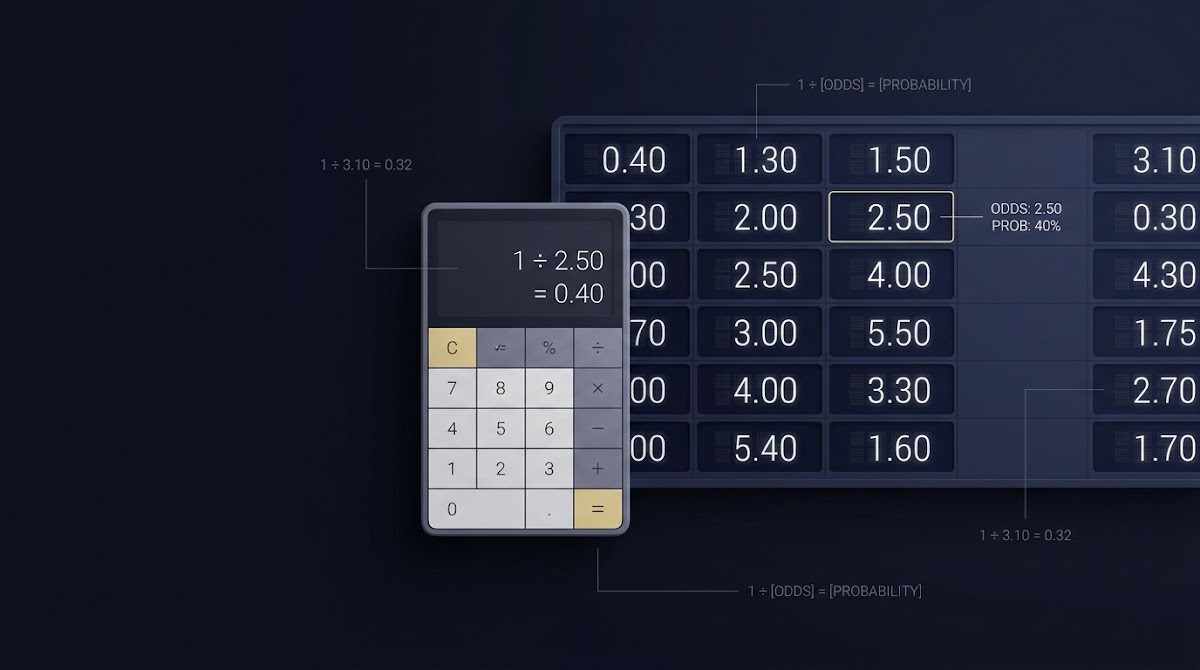
Quick answer: what a decimal odds calculator gives you
One-sentence definition
A decimal odds calculator converts an odds format into a decimal number that shows the total return for each unit you stake, so payout equals stake multiplied by the decimal and net profit equals stake times decimal minus one, a convention described in standard references Wikipedia on odds.
Convert odds quickly and accurately
Try a simple converter when you need quick, error-free results; calculators remove manual steps and reduce rounding mistakes while keeping the math transparent.
When to use a calculator vs manual math
Use a calculator when you have many bets to compare, when you need consistent rounding across a list, or when you are converting several formats at once; manual formulas are fine for a single quick check or to understand what the calculator does Wikipedia on odds. Try online tools such as Covers' odds converter Covers' odds converter.
Regional preference matters: decimal odds are common in Europe and Australia while American moneyline odds are more typical in the United States, but the underlying conversions use the same basic arithmetic Encyclopedia Britannica on odds.
How decimal odds work: the math behind the number
Payout vs profit explained
Decimal odds represent total return per unit staked; if the decimal quote is D and your stake is S, the payout equals S times D and the net profit equals S times D minus S, which simplifies to S times D minus one, a standard presentation you will see in reference material Wikipedia on odds.
For clarity: payout = stake × decimal; profit = stake × (decimal - 1). Use those two lines to move between total return and net gain without confusion Wikipedia on odds.
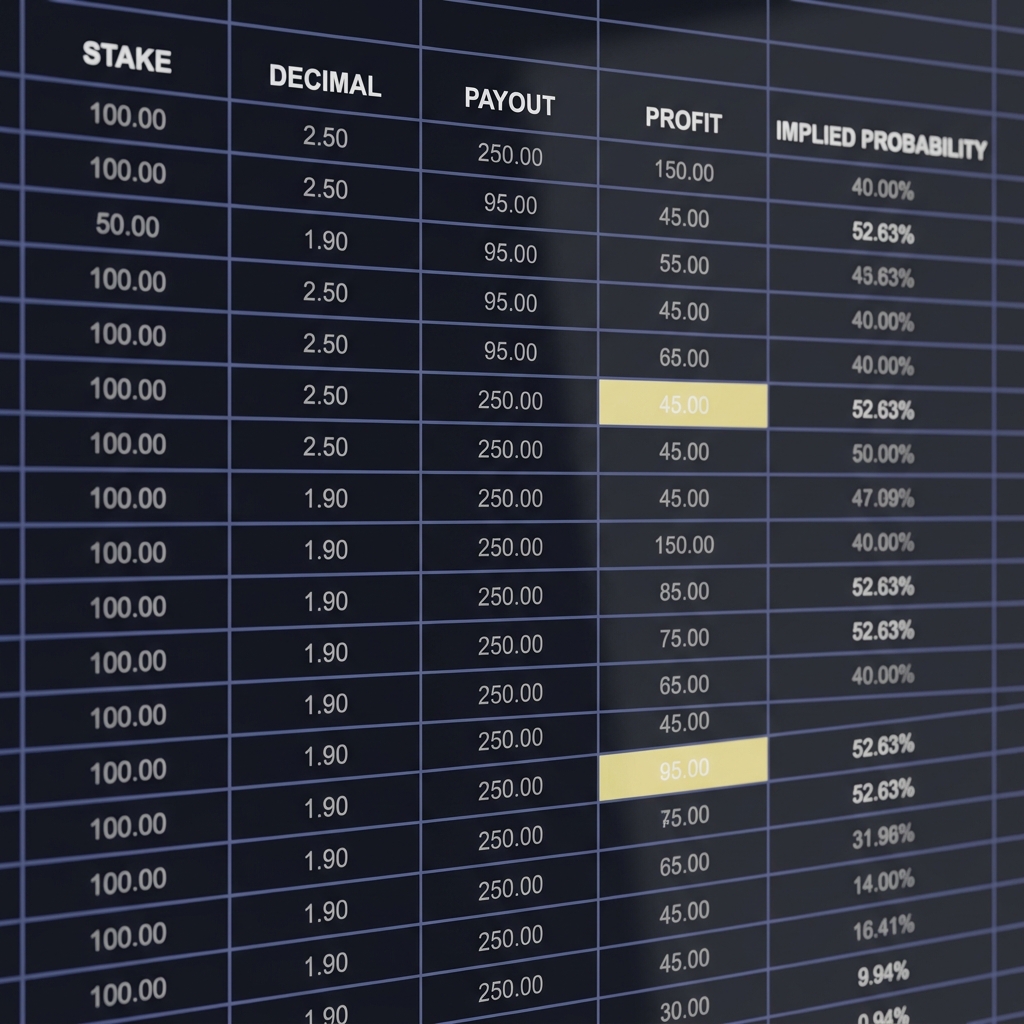
Keep the formulas short and memorized, they are the core of any decimal odds calculator: payout = stake × decimal, profit = stake × (decimal - 1). These relationships have not changed and remain the basis for odds displays Wikipedia on odds.
Example: a decimal quote of 2.50 means a 10 unit stake returns 25 units total and 15 units net profit. Work the arithmetic by hand once to confirm a calculator's result Wikipedia on odds.
From return and stake to decimal: the direct calculation
Derive decimal from known return and stake
If you know the total return and the original stake, compute the decimal price by dividing return by stake: decimal = return ÷ stake. This direct definition aligns with how exchanges and educational resources describe decimal odds Wikipedia on odds.
Example: if a 50 unit return came from a 20 unit stake then decimal = 50 ÷ 20 = 2.50, which implies the payout and profit formulas above hold. When you reverse the arithmetic you can also check your work by computing implied probability from the same numbers Wikipedia on odds.
Decimal odds equal total return per 1 unit staked; compute them directly from stake and return or convert American and fractional formats with fixed formulas to derive payout, profit, and implied probability.
Reverse: implied probability from return and stake
Implied probability under fair assumptions equals stake divided by return, which is the reciprocal of the decimal number; mathematically p = stake ÷ return or p = 1 ÷ decimal, a standard conversion used for probability estimates Investopedia on implied probability.
When showing probabilities, pick a rounding convention and apply it consistently so that small differences do not cause confusion across a list of markets Wikipedia on odds.
Convert American moneyline to decimal odds
Positive moneyline to decimal
For positive American moneyline odds written as +A, convert to decimal using decimal = 1 + A ÷ 100. This formula shows the total return per unit stake and is the accepted conversion method Wikipedia on moneyline.
Example: +250 becomes decimal = 1 + 250 ÷ 100 = 3.50, so a 10 unit stake returns 35 units total and 25 units net profit using the payout formula Wikipedia on moneyline.
Negative moneyline to decimal
For negative moneyline odds written as -B, use decimal = 1 + 100 ÷ B where B is the absolute value of the negative number. This produces the total-return decimal equivalent and is the standard reverse mapping Wikipedia on moneyline.
Example: -150 becomes decimal = 1 + 100 ÷ 150 = 1.67, which means a 10 unit stake returns 16.7 units total and 6.7 units net profit after applying the payout and profit formulas Wikipedia on moneyline.
Worked examples
Walkthrough 1: Convert +120 to decimal. decimal = 1 + 120 ÷ 100 = 2.20. For a 5 unit stake payout = 5 × 2.20 = 11 and profit = 5 × 1.20 = 6. These intermediate steps let you confirm a calculator's output Smarkets odds guide. You can also test conversions with AceOdds' converter AceOdds.
Walkthrough 2: Convert -200 to decimal. decimal = 1 + 100 ÷ 200 = 1.50. For a 20 unit stake payout = 20 × 1.50 = 30 and profit = 10 units. Showing each arithmetic step reduces input mistakes Smarkets odds guide.

Small note: U.S. users will often see moneyline displayed first, and converting to decimal can help compare implied probabilities across international sources Encyclopedia Britannica on odds.
Convert fractional odds to decimal
Fractional notation explained
Fractional odds are shown as a over b, written a/b, and indicate the net profit you receive per b units staked; the decimal equivalent includes the returned stake as well and is therefore larger by one unit Wikipedia on odds.
Conversion formula and examples
Convert fractional a/b to decimal using decimal = 1 + a ÷ b. This directly converts a net-profit quote into a total-return quote that fits the payout formula Smarkets odds guide.
Example: fractional 5/2 becomes decimal = 1 + 5 ÷ 2 = 3.50. For a 2 unit stake payout = 2 × 3.50 = 7 and profit = 5 units, matching the fractional intent Smarkets odds guide.
Implied probability from decimal odds
Formula and intuition
Under fair assumptions without bookmaker margin, the implied probability is the reciprocal of the decimal odds: p = 1 ÷ decimal or, expressed as a percent, p% = 100 ÷ decimal. This is the conventional method used when converting odds to probability Investopedia on implied probability.
Intuitively, if decimal is the total return per 1 unit staked, the share of that return that represents your original stake is 1 divided by the total return, which gives the implied chance expressed as a probability Wikipedia on odds.
Convert decimal odds to implied probability
Use decimal greater than 1
Example conversions: decimal 1.50 implies 100 ÷ 1.50 = 66.67% chance; decimal 3.00 implies 100 ÷ 3.00 = 33.33% chance. Use the formula above consistently for analytic work Investopedia on implied probability.
Remember that bookmaker margin means observed market probabilities will usually sum to more than 100% for a small market, the extra percentage is the overround that funds the book, and you should not treat summed implied probabilities as unbiased forecasts without adjusting for margin Victorian Responsible Gambling Foundation guidance.
Calculator logic: step-by-step for building a decimal odds calculator
Input options to support
A simple calculator should accept these inputs: stake plus decimal; stake plus return; American moneyline; fractional a slash b. Support each of these four entry paths so users can supply the data they already have rather than forcing a format change up front Wikipedia on odds. Many free converters exist, for example TheRundown's odds converter TheRundown. See Funded Plays evaluation notes on handling input formats.

For outputs show: decimal odds, total payout, net profit, and implied probability. Use a consistent rounding rule such as two decimal places for decimals and one or two decimal places for percent probabilities depending on context Wikipedia on odds.
Computation flow for each input type: if user supplies decimal and stake, compute payout = stake × decimal and profit = stake × (decimal - 1); if user supplies return and stake, compute decimal = return ÷ stake then derive payout and profit; if user supplies American moneyline, apply the plus or minus formula first; if fractional a/b is supplied, compute decimal = 1 + a ÷ b and continue. Validate inputs like nonzero stake and correctly formatted fractional strings before computing Smarkets odds guide.
Edge cases to handle: zero or negative stake should be rejected; malformed fractional strings need parsing with error messages; extremely large moneyline values may require numeric safeguards. Present clear error text so users can correct entries quickly Wikipedia on odds.
Rounding rules, presentation and bookmaker margin in practice
How to round decimal odds and probabilities
Common choices are two decimal places for decimal odds and two decimal places for percentage probabilities; pick a single rule and apply it everywhere in the calculator to avoid confusing small rounding differences across a sheet Victorian Responsible Gambling Foundation guidance.
When showing implied probabilities, indicate whether you are presenting fair probabilities or market probabilities that include bookmaker margin. If you show market probabilities, disclose that the overround will cause summed probabilities to exceed 100% Wikipedia on odds.
Interpreting quoted odds with margins
Example: three market prices might imply probabilities that sum to 104%, leaving a 4% overround. That extra percentage reflects the bookmaker margin and should be considered when converting market prices into model inputs Victorian Responsible Gambling Foundation guidance.
For modeling, reduce each implied probability proportionally to remove the overround and recover a normalized probability set if you want unbiased inputs to a model, or explicitly include margin as a modeling factor if your workflow requires it Wikipedia on odds.
Using a decimal odds calculator: step-by-step examples
Example 1: Known stake and decimal
Given stake S = 10 and decimal D = 2.25 compute payout = 10 × 2.25 = 22.50 and profit = 10 × 1.25 = 12.50. Then implied probability p = 1 ÷ 2.25 = 44.44% if you are showing fair probabilities Wikipedia on odds
Check: if you instead start with return R = 22.50 and stake S = 10, decimal = 22.50 ÷ 10 = 2.25 and stake ÷ return = 10 ÷ 22.50 = 0.4444, confirming the reciprocal relationship between decimal and implied probability Wikipedia on odds. Start with American moneyline +180. decimal = 1 + 180 ÷ 100 = 2.80. For a 25 unit stake payout = 25 × 2.80 = 70 and profit = 45. Then implied probability = 1 ÷ 2.80 = 35.71% if presenting fair probability Wikipedia on moneyline. Use rounding consistently: if you round the decimal to 2.80 and present implied probability to two decimal places you will show 35.71% which matches the precise reciprocal within rounding error Wikipedia on odds. Here are compact conversion examples you can copy into a sheet. Fractional 1/1 = decimal 2.00, implied probability 50%; fractional 6/4 = decimal 2.50, implied probability 40%; American +150 = decimal 2.50, implied probability 40% Wikipedia on odds. Copy-paste ready mapping: American +100 = 2.00, +200 = 3.00, -100 = 2.00, -200 = 1.50, fractional 2/1 = 3.00, 5/2 = 3.50. Use consistent rounding when pasting into a sheet Smarkets odds guide. You can paste a short table into a spreadsheet with columns Quote, Format, Decimal, Implied% and compute derived columns with simple formulas to keep everything reproducible and auditable for your prediction workflow Wikipedia on odds. A frequent error is treating the decimal as net profit rather than total return and forgetting to subtract one when moving to profit. Remember profit = stake × (decimal - 1) to avoid this slip-up Wikipedia on odds. Watch for wrong signs on moneyline entries, swapped fractional fields, or zero stake values. Validate inputs and show clear error messages so the calculator does not silently produce incorrect numbers Smarkets odds guide. Sanity checks: confirm implied probability equals stake divided by return, and that the decimal you compute returns the original payout when multiplied by the stake Wikipedia on odds. Professionals convert every market into decimal odds and implied probabilities to feed models because decimal odds directly represent total return per stake and are simple to aggregate across selections and markets Encyclopedia Britannica on odds. Implied probability is a key input for expected value calculations: EV = probability you assign × profit per unit minus probability of loss × stake. When you derive probability from decimal odds, ensure you correct for bookmaker margin if you want unbiased inputs to a model Wikipedia on odds. For performance tracking, store both the decimal odds and the normalized implied probability so you can aggregate realized returns against predicted chances and measure calibration across time Encyclopedia Britannica on odds. See Funded Plays homepage. Core formulas to copy: decimal = return ÷ stake; payout = stake × decimal; profit = stake × (decimal - 1); American +A -> decimal = 1 + A ÷ 100; American -B -> decimal = 1 + 100 ÷ B; fractional a/b -> decimal = 1 + a ÷ b; implied probability = 1 ÷ decimal Wikipedia on odds. To verify formulas and conventions consult established references on odds and implied probability. These resources explain the math and the practical meaning of overround and market pricing Investopedia on implied probability and the Funded Plays blog Funded Plays blog. A decimal odds calculator converts odds or return and stake into a decimal number that shows total return per unit staked, and derives payout, profit, and implied probability. For +A use decimal = 1 + A/100. For -B use decimal = 1 + 100/B. Then multiply stake by decimal to get payout and by decimal minus one to get profit. Bookmaker margin or overround causes implied probabilities derived from market odds to sum to more than 100%, so you should normalize probabilities if you need unbiased model inputs.Example 2: Moneyline to decimal to payout
More examples and quick conversion table readers can copy
Common quotes and their decimals
Small copy-paste conversion table
Common mistakes and how to avoid them
Forgetting the minus one
Rounding and input errors
How pros use decimal odds in modeling and performance tracking
Normalizing odds for analytics
Using implied probability in expected value calculations

Quick reference: cheat sheet, next steps and further reading
One-page cheat sheet
Where to learn more
References