

What Data Quality Problems That Can Ruin a Model means
When we talk about Data Quality Problems That Can Ruin a Model we mean defects in datasets that make a model look better during evaluation than it will perform in the real world. Good dataset quality covers relevance, representativeness, error management, and lifecycle monitoring, and those attributes shape whether an evaluation is trustworthy.
Regulatory and standards frameworks now expect teams to document dataset controls and subgroup checks as part of development and deployment, turning data quality into both an engineering and a governance obligation NIST AI RMF.

Many failures begin long before deployment, for example when validation contains information that would not be available at prediction time or when labels are inconsistent. These problems are especially harmful because they often inflate offline metrics, producing a false signal that the model is ready for production.
Framing data quality as a lifecycle activity helps teams prioritize work: profile datasets early, lock and version evaluation snapshots, and record known limitations so downstream teams and stakeholders understand the risk surface.
Common data quality problems that can ruin a model: an overview
At a high level, the most common failure modes are data leakage, label noise, concept or data drift, missing values, outliers, duplicates, and systemic bias. Each has different origins, from collection through processing and labeling, and each affects models in different ways.
Some issues, like leakage and label noise, tend to cause silent failures because they boost test scores without improving generalization. Others, like drift and bias, reveal themselves over time after deployment and need monitoring to detect.
Use this short prioritization when investigating an unexpected gap between offline and live performance: first rule out leakage and label problems, then profile for drift and missingness, and finally inspect duplicates and subgroup bias.
Data leakage: why it inflates metrics and how to prevent it
Data leakage occurs when features or preprocessing expose the model to target information or to future data that would not be available at prediction time, and that contamination reliably inflates offline performance in ways that fail in production Leakage in Data Mining (see research on code-level detection code-level detection research).
Common forms include target leakage, where a derived feature directly encodes the target, temporal leakage, where training incorporates future events, and preprocessing leakage, where statistics computed on the full dataset leak into training transforms. Each form undermines the validity of validation scores.
Preventive engineering controls are practical and repeatable, for example enforcing strict temporal splits, isolating preprocessing in versioned pipelines, and running feature and label audits before training. Treating split logic as code and testing it as part of CI reduces accidental leakage. See IBM's best practices on data leakage What is Data Leakage in Machine Learning?.
Run a feature and label audit using pipeline instrumentation
Run this audit before model training
Audit steps should include schema checks, checks for features derived from post-outcome data, and re-running transformations on a held snapshot to confirm reproducibility. Logging the audit results with dataset version metadata makes investigations faster if an issue appears later.
Label noise: effects on calibration and robustness and how to fix it
Noisy labels harm model calibration and generalization because learning algorithms fit incorrect examples, which distorts probability estimates and increases error on unseen data. The academic literature recommends noise-robust training and selective relabeling as effective mitigations Classification in the Presence of Label Noise.
Operational checks begin with label consistency sampling, where a random subset of labeled examples is re-annotated to estimate error rates and inter-annotator agreement. High disagreement signals the need for clearer labeling instructions or relabeling for edge cases.
When relabeling is expensive, consider algorithmic approaches such as loss correction, robust loss functions, or sample reweighting that reduce sensitivity to noisy examples. Track the effect of any correction by logging changes and comparing held-out metrics before and after relabeling.
Concept and data drift: detection, monitoring, and retraining triggers
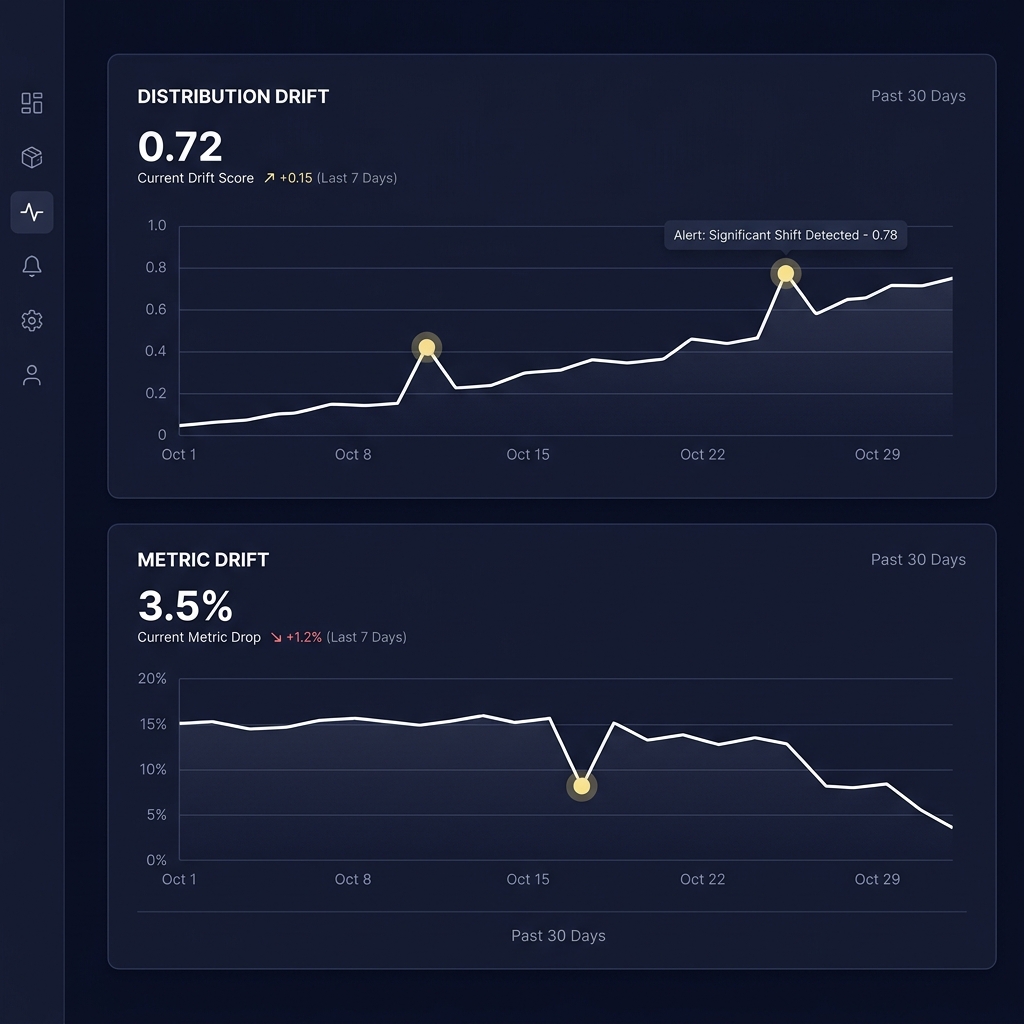
Concept drift refers to a change in the relationship between features and the target, while data distribution shift, or covariate shift, denotes changes in input distributions that can also affect performance. Both cause post-deployment decay unless actively monitored A Survey on Concept Drift Adaptation.
Detect drift with a mix of performance and distribution checks: monitor key error metrics, track population stability measures, and run streaming detectors that signal when input distributions move beyond expected bounds. Alerts should combine statistical signals with business context to avoid noisy triggers.

The most common causes are data leakage and label noise, because they inflate offline metrics; drift and biased or unrepresentative data are also frequent causes that degrade production performance over time.
Set retraining triggers that tie monitoring signals to operational actions, for example when subgroup error increases beyond a tolerance or when a population stability index crosses a threshold. Include guardrails such as holdout validation and rollback plans so retraining does not inadvertently worsen production behavior.
Missing values, outliers, and duplicates: profiling and remediation
Missingness, outliers, and duplicates distort learned decision boundaries and model expectations, so start by profiling patterns of missingness and checking for systematic gaps by subgroup scikit-learn outlier detection docs.
Decide whether to impute, drop, or use model-aware approaches based on the pattern of missingness. If missingness is random and sparse, simple imputation or indicator variables may suffice. If missingness is correlated with labels or with a subgroup, investigate collection processes and consider targeted relabeling or feature engineering.
Outliers can be detected with robust statistics or algorithmic detectors such as IsolationForest, and removal should be guided by whether the outlier represents valid but rare behavior or a corrupted record. For duplicates, use hashing, record linkage, and similarity thresholds to identify and deduplicate records before training.
Governance and compliance: dataset documentation, bias assessment, and lifecycle controls
Regulatory frameworks now require teams to demonstrate dataset relevance, representativeness, and documented controls across the model lifecycle, which elevates dataset documentation from a nice to have to an expected practice EU AI Act.
Practical documentation items include provenance, labeling instructions, known limitations, and subgroup performance checks. Keep a model of the dataset lifecycle that records collection dates, preprocessing steps, and who approved changes so reviewers can reconstruct decisions during audits or postmortems.
Register challenges and dataset snapshots on the FundedPlays Challenges page to document evaluation workflows
Run the governance checklist, register a dataset snapshot, and record known limitations to make future incident response and audits faster.
Bias assessment should be part of dataset documentation. Record subgroup metrics and remediation attempts, and log the rationale for any decisions to accept residual disparities. Treat documentation as an engineering artifact that evolves with the dataset, not as static legal text.
A compact data-quality checklist and pipeline controls to add now
Before training, run a short checklist: verify provenance and schema, enforce a temporal split, run a missingness and outlier report, audit label quality, and deduplicate records. These items cover the most common sources of silent failures.
Automated pipeline controls are essential: isolate preprocessing so transforms are reproducible, version datasets and feature code, and unit-test feature transforms to avoid accidental leakage. Log dataset snapshots and register them in a dataset registry for reproducibility.
Integrate these checks into CI so that dataset changes trigger tests and reviewers. A minimal dataset registry should include source pointer, version hash, snapshot date, and a short summary of known issues.
Detection techniques and open-source tools for dataset profiling
There are several tool types that help find problems early: data profilers for schema and distribution checks, drift detectors for streaming inputs, outlier detectors for anomalous records, and validation suites for end-to-end tests. Choosing a mix depends on your pipeline architecture.
Algorithmic detectors such as IsolationForest are practical for outlier detection, while streaming detectors and population stability measures work for drift. Combine these tools with alerting that includes relevant dataset context so operators can triage quickly scikit-learn outlier detection docs.
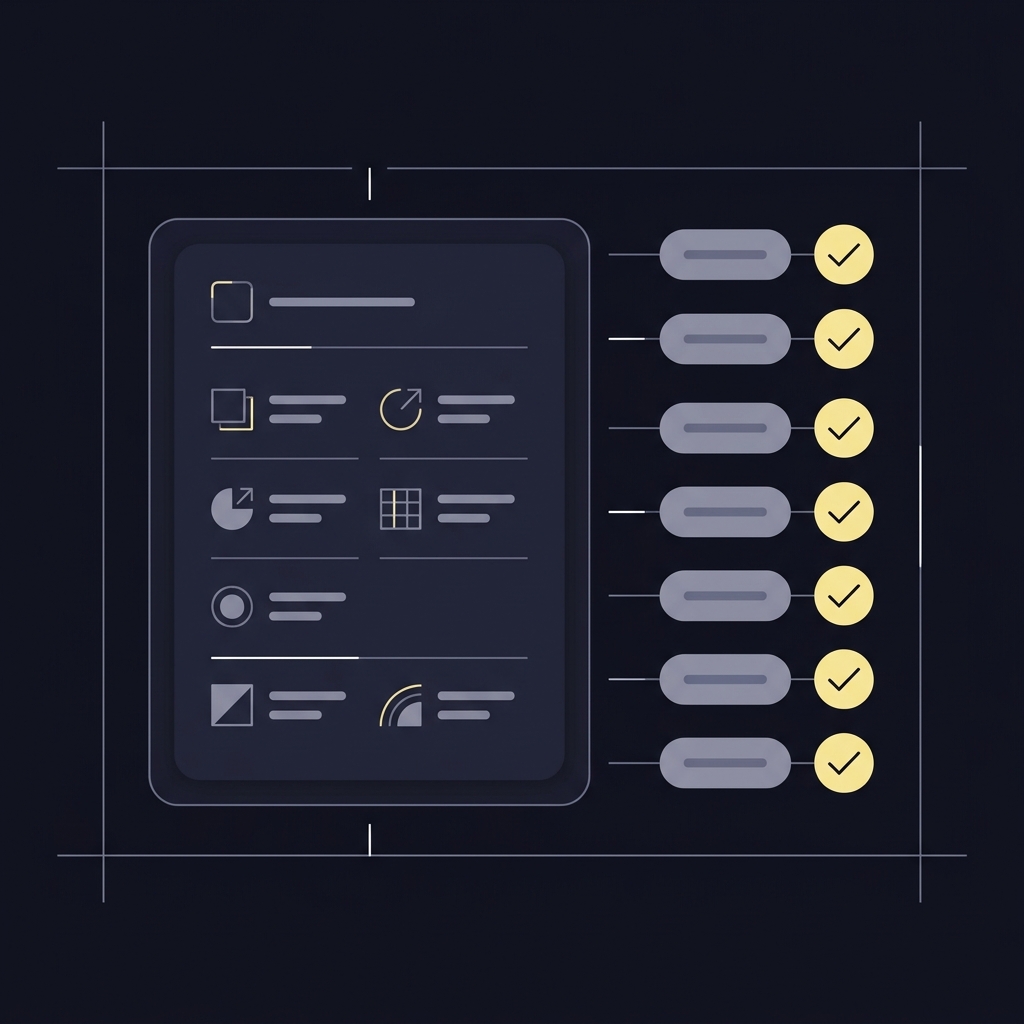
Integration advice: run lightweight profiling on each ingest, run deeper checks on snapshots used for training, and gate model training on passing a set of automated validation checks. Keep alerts actionable by associating a remediation playbook with each check.
Corrective actions: remediation patterns and retraining workflows
Choose remediation patterns based on the root cause. If labels are wrong, relabeling focused subsets often helps. If noise is systemic and relabeling is infeasible, use noise-robust algorithms or reweighting. Document actions and their impact on validation metrics Classification in the Presence of Label Noise.
Safe retraining workflows include a fresh holdout evaluation that was not used to select hyperparameters, canary deployments that limit exposure, and monitoring after rollout to catch regressions. Keep a remediation log that links dataset changes to model performance so you can learn over time.
When in doubt, prefer smaller, faster experiments that confirm the direction of improvement before committing to full retraining and rollout. That reduces risk and surfaces unexpected interactions early.
Decision criteria: when to retrain, rollback, or accept reduced performance
Establish quantitative signals to trigger action, such as sustained drift metrics, subgroup performance drops beyond an agreed threshold, or rising error rates that affect business KPIs. Tie these signals to governance gates that specify testing and approval steps NIST AI RMF.
Balance technical signals against business impact. If a small performance dip has negligible customer impact and retraining is costly, it may be acceptable to defer retraining with a mitigation plan. For material user-facing regressions, require a rollback or a fast patch release.
Governance workflows should combine automated checks with a human review for major dataset changes. That provides speed for routine fixes and care for high-impact updates.
Common mistakes and team-level pitfalls to avoid
Teams often trust unvalidated metrics, omit provenance metadata, or fail to unit-test preprocessing code, which builds brittle pipelines. These mistakes amplify when dataset ownership is unclear across teams Leakage in Data Mining.
Organizational fixes are straightforward: assign dataset ownership, enforce dataset change logs, and require peer review for dataset and label changes. Add unit tests for transforms and tie dataset changes to CI so errors are caught early.
Quick remediation steps include freezing the dataset snapshot used for the most recent successful release, running the audit checklist on that snapshot, and adding monitoring that would have detected the issue that slipped through.
Practical scenarios and short example workflows
Scenario A, temporal leakage from late-arriving features: imagine a feature that captures whether a transaction was later reversed. If that feature is included in training without guarding for time, validation will be optimistic. Detection steps include re-running preprocessing using only available timestamps and validating that features are computable at prediction time Leakage in Data Mining (see a Kaggle tutorial Data Leakage).
Remediation is to remove or re-derive the feature so it is computable in real time, re-run audits, and retrain with the corrected pipeline. Document the incident and add a unit test that prevents future reintroduction.
Scenario B, gradual concept drift after a product change: a UI change alters user behavior and slowly shifts the relationship between features and outcomes. Detect this with rolling performance charts and a population stability index. If confirmed, trigger a retrain with recent data and validate on a fresh holdout before a canary rollout A Survey on Concept Drift Adaptation.
Wrap-up: prioritized next steps and a one-page checklist
In the next 30 days, profile current datasets, lock evaluation snapshots, and add unit tests for feature transforms. In 60 days, integrate key checks into CI, add drift monitoring, and require dataset registration for training snapshots. In 90 days, mature retraining gates and governance documents for dataset changes, and run a bias assessment for critical use cases NIST AI RMF.
For stakeholder communication, summarize the problem, the immediate mitigation, and the timeline for permanent fixes. Keep reports factual and include dataset snapshots and remediation logs so reviewers can reproduce findings.
Start with temporal and feature audits: enforce temporal splits, replay preprocessing on a snapshot, and check for features derived from post-outcome data. Add unit tests for split logic and log dataset versions to make leaks reproducible.
Relabel when label errors affect a small, identifiable subset or when clearer instructions can fix systematic issues. Use robust loss functions or reweighting if relabeling is costly or labels are noisy at scale.
Track performance degradation, subgroup error increases, and distribution shifts via population stability indexes. Combine statistical thresholds with business impact before retraining.
References
- https://nvlpubs.nist.gov/nistpubs/ai/NIST.AI.100-1.pdf
- https://dl.acm.org/doi/10.1145/2020408.2020496
- https://www.fundedplays.com/challenges
- https://ieeexplore.ieee.org/document/6820153
- https://dl.acm.org/doi/10.1145/2523813
- https://scikit-learn.org/1.5/modules/outlier_detection.html
- https://eur-lex.europa.eu/eli/reg/2024/1689/oj
- https://www.fundedplays.com/blogs/how-fundedplays-evaluations-work
- https://www.fundedplays.com/blogs
- https://www.fundedplays.com
- https://www.ibm.com/think/topics/data-leakage-machine-learning
- https://pmc.ncbi.nlm.nih.gov/articles/PMC11935776/
- https://www.kaggle.com/code/alexisbcook/data-leakage