
What is a dark horse and how to read darkhorseodds
Definition and common usage
Start with an everyday image: a less-favored team or horse listed at much longer odds than the favorite, the outcome most people call a dark horse. In practical terms, a dark horse is simply an outcome priced with a low implied probability; that implied probability is what the quoted odds imply about how likely the outcome is to occur, and you can compute it directly from the posted odds Investopedia on implied probability.
Calling something a dark horse describes market pricing, not value. A low implied probability only says the market currently views the outcome as unlikely. Whether the price is a bargain depends on how that implied probability compares with your independent estimate of the true chance.
How to convert different odds formats to implied probability
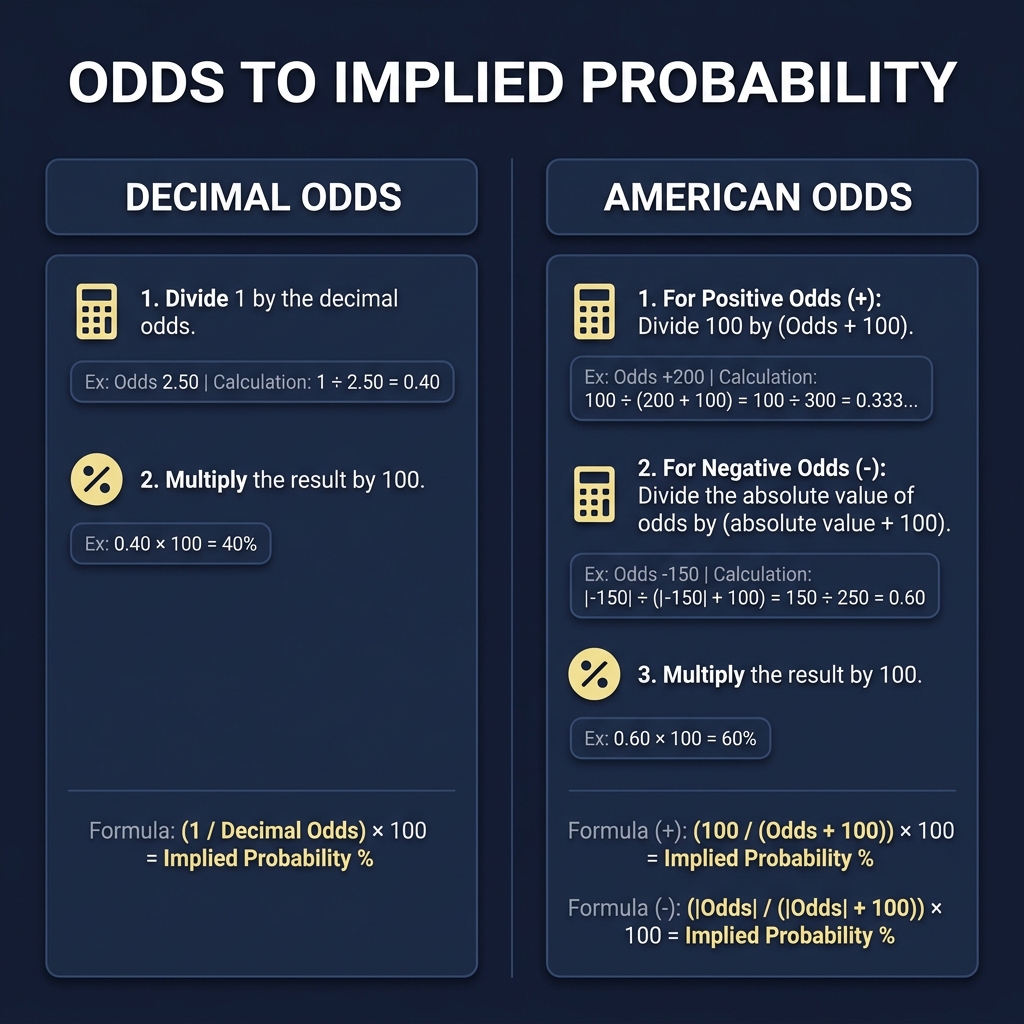
Think of conversion formulas as kitchen recipes: a short list of steps you follow every time. For decimal odds, the recipe is simple: implied probability = 1 divided by the decimal odds. For American odds, convert to decimal first or use the standard formula for positive and negative formats, then follow the same 1 over decimal rule. These conversions let you move from a quoted price to a usable probability number you can compare against your model.
Remember that posted odds normally include a margin or overround from the operator; that margin subtly inflates implied probabilities so the raw numbers from quotes do not always equal the pure market probability you should compare to your estimates Investopedia on expected value.
quick conversion from decimal odds to implied probability
Use this to convert decimal odds to a probability
As a brief example recipe: take a decimal price of 6.0, compute 1/6.0 to get an implied probability of about 0.1667, and adjust the number up slightly if you need to account for an obvious overround. Doing this conversion every time keeps your comparisons consistent and repeatable.
Why expected value matters when backing a dark horse
The expected value (EV) rule: when to place a bet
Expected value is the decision rule that converts probability beliefs into action: you place a wager only when your estimated true probability of an outcome exceeds the market's implied probability after adjusting for payout terms and margin. This is the foundation of positive expected value betting Investopedia on expected value.
Put plainly, positive EV means you expect to make money on average over many similar wagers, not that any one bet will win. That long-run interpretation is essential when evaluating volatile dark horses: a positive expected value over time still allows for frequent short-term losses.
How implied probability and payout terms feed into EV
When calculating EV mentally, think in words rather than symbols: EV is your estimated chance of winning times the net payout if you win minus the chance of losing times what you risk. The market's implied probability and the operator's payout rules enter directly into the 'net payout' and the comparison term; if those reduce the market price, you need an appropriately larger estimated chance to claim an edge.

Always treat overround and payout terms as part of the price you compare against. Missing that adjustment inflates apparent value and can turn a seemingly attractive darkhorse bet into negative EV when the math is done correctly.
What research says: the favorite-longshot bias and its implications
Key academic findings from racetrack and parimutuel markets
Decades of literature on parimutuel and other betting markets identify a consistent favorite-longshot bias, where longshots are overbet and underperform on average relative to their implied prices. This pattern shows up across many datasets and remains a foundational finding in the research Journal of Economic Perspectives on parimutuel markets. See the NBER working paper for related empirical work.
That evidence does not mean every longshot is a bad bet, but it does mean the default expectation should not be that longshots are mispriced in your favor. The distribution of outcomes and persistent market tendencies demand disciplined checks before backing dark horses.
Backing a dark horse can be sound only when you have documented positive expected value, conservative staking rules, and a disciplined process for estimating probabilities and tracking results.
Practical consequences for longshot bettors
If longshots are commonly overbet, a simple implication is that bettors need a demonstrable edge to overcome the market tendency. In practice, that means a reliable probability model, corroborating information, or a proven process before placing regular darkhorse wagers Journal of Economic Perspectives on favorite-longshot bias.
Market movement toward your price can be useful evidence that your estimate aligns with other informed participants, but it is not a guarantee. Movement can reflect new information or temporary noise, so use it as corroboration, not proof.
A step-by-step framework to evaluate darkhorseodds
Modeling your estimated true probability
Here is a numbered workflow you can follow every time you consider a dark-horse bet: 1) Convert the quoted odds to implied probability using the recipes above; 2) Build an independent probability estimate from form, matchup data, and any edge signals you trust; 3) Adjust the market probability for margin and payout terms; 4) Compare your estimate to the adjusted implied probability; 5) Only proceed if the expected value is positive; 6) Size your stake per your staking rule and log the decision for review.
Constructing an independent estimate need not be fancy. Use a checklist of objective factors, a simple probability model that weights recent form, matchup specifics, injury information and situational edges, or a combination of those approaches. The key is consistency and documentation so you can learn from outcomes.
Comparing estimates to implied probability
When you compare your model to the market, make the margin adjustment explicit. If the market shows an implied probability of 20 percent but the operator's payout terms imply a significant overround, you might need to require that your model be clearly higher by a set threshold before you act. This keeps you from confusing raw quoted probabilities with actionable value Investopedia on expected value.
Practical checks include scanning for late market moves that support your view, checking correlation across books where possible, and ensuring your reasons for believing in an edge are documented rather than emotional.
Rules for value thresholds and market scanning
Set explicit minimum edges you require to act, for example a relative percentage or an absolute probability gap; pick a threshold that makes sense with your staking rules and risk tolerance. Treat late price moves as corroboration: if a price drifts in your favor near close, that strengthens the case, but only if your initial model remains robust.
Finally, keep a decision journal that records the odds at the time you considered the bet, your estimated probability, the margin adjustment you made, and the staking decision. That discipline is how you separate luck from skill across many decisions Journal of Economic Perspectives on parimutuel markets. Additional reviews of the favorite-longshot bias can be found on ScienceDirect.
Sizing your stakes: Kelly, fractional Kelly and practical bankroll rules
How the Kelly criterion links edge to stake
The Kelly criterion ties stake size to your estimated edge and bankroll: it prescribes a fraction of your bankroll to wager proportional to the advantage you think you have, aiming to maximize long-run growth. That theoretical link makes it a natural starting point for disciplined sizing Investopedia on the Kelly criterion.
Kelly is intuitive: the larger your edge, the larger the fractional stake. For longshots, even a modest estimated edge can produce a surprisingly large Kelly fraction because the payout multiple is high, so be careful with estimation error.
Why many bettors use fractional Kelly and simple alternatives
Practitioners often use fractional Kelly, for example half-Kelly, to reduce volatility and the chance of large drawdowns. Fractional Kelly smooths the ride at the cost of slower theoretical growth, a trade-off that many bettors prefer when outcomes are high variance, as with dark horses Bell System Technical Journal on information rate.
Because probability estimates are noisy, apply conservative caps and fallback staking rules. A practical rule might be: compute full Kelly, take a fraction (such as 25 or 50 percent), and cap the wager at a fixed small percentage of bankroll. This combination guards against ruin from overconfident longshot bets.

Estimation error is the most common real-world danger: if your estimated probabilities are systematically too optimistic, Kelly sizes will be too large and risk rapid losses. That is why conservative fractional approaches and strict tracking matter.
Common mistakes and cognitive traps when backing dark horses
Typical biases: recency, gambler's fallacy and overconfidence
Bettors often fall prey to recency bias and overconfidence, overweighting recent memorable upsets or thinking a streak shifts true probabilities. Research on betting markets highlights these behavioral tendencies as contributors to overbetting longshots Journal of Economic Perspectives on favorite-longshot bias.
Gambler's fallacy and the desire for a big payoff can also push people toward impulsive dark-horse plays without proper EV checks. Treat these urges as signals to pause and run the checklist instead of acting on emotion.
Operational errors: ignoring margins or using improper stake sizing
Operational missteps include failing to convert odds correctly, neglecting the overround, and staking too heavily when the model's edge is small or uncertain. These are practical execution errors that turn a plausible edge into a net loss Investopedia on implied probability.
Use controls: precommit to a staking rule, require a documented positive EV before betting, and simulate strategies in paper trading or funded-simulation workflows to validate the process before risking real bankroll.

Use controls: precommit to a staking rule, require a documented positive EV before betting, and simulate strategies in paper trading or funded-simulation workflows to validate the process before risking real bankroll.
Practical scenarios: when backing a dark horse can make sense
Model-based edge examples
Scenario A: your probability model, tested across past events and documented, repeatedly shows a higher chance for certain types of underdogs than the market price implies. In that case, after adjusting for overround and payout terms, the persistent gap between your estimates and market probabilities can represent a positive expected value opportunity Investopedia on implied probability.
Verification steps include backtesting the model on out-of-sample events, tracking performance over dozens or hundreds of bets, and ensuring the edge is not driven by data snooping or tight fitting to past noise.
Recognizing market mispricings and late information moves
Scenario B: a late market move shifts the odds toward your earlier estimate. That movement can act as corroboration if the shift aligns with verifiable information, such as a confirmed lineup change or a major shift in publicly available signals. Treat such moves as one input among others, not a sole justification Journal of Economic Perspectives on parimutuel markets.
To separate signal from noise, require that late moves are consistent across multiple reliable sources or accompanied by concrete information you can verify. If the move appears to be thin-market noise, do not increase stake size solely because the price drifted favorably. For discussion of noise and information in betting markets see related work from KU.
Test your process with FundedPlays Challenges
Consider testing a documented process using a simulation or structured challenge before placing real-money dark-horse wagers.
Using paper-trading and funded-simulation workflows
Paper trading or simulated funded challenges let you apply your model, staking rules and checklist without risking real capital. This approach aligns with skill-evaluation workflows where the goal is to measure consistency and refine a process before committing funds.
Even with good simulation results, remember that live conditions can differ; continue logging, review performance, and adjust both the model and staking rules as more live evidence accumulates Investopedia on expected value.
Checklist and final takeaways: is the dark horse worth it?
One-page checklist to apply before every dark-horse bet
Use this compact pre-bet checklist: convert the quoted odds to implied probability; build or consult an independent probability estimate; adjust market probability for margin and payout terms; confirm a positive expected value; size the stake using your staking rule; log the bet and the reasoning for later review. If any step fails, skip the wager Investopedia on expected value.
When you keep the checklist short and repeatable, it becomes easier to follow under pressure. The checklist also forces discipline so that emotions and recency do not drive decisions at critical moments.
When to walk away
Skip backing a dark horse when you have no documented edge, the model's out-of-sample testing is weak, your stake sizing would breach conservative caps, or your reasons are emotional rather than evidence-based. Historical research shows longshots are often overpriced, so strict process and conservative sizing matter Journal of Economic Perspectives on favorite-longshot bias.
One-line takeaway: a dark horse can be worth backing only when you find demonstrable, documented positive expected value and size the stake conservatively.
Darkhorseodds are the market prices that imply a low probability for an outcome; convert the quoted odds to an implied probability to compare with your own estimate.
Not automatically; higher payout only matters if your estimated true probability exceeds the market's implied probability after adjusting for margins and payout terms.
Kelly offers a theoretical guide, but many bettors use a fractional Kelly or fixed caps to reduce volatility and guard against estimation errors.
References
- https://www.investopedia.com/terms/i/implied-probability.asp
- https://www.investopedia.com/terms/e/expectedvalue.asp
- https://www.fundedplays.com/challenges
- https://www.aeaweb.org/articles?id=10.1257/jep.2.2.161
- https://www.nber.org/system/files/working_papers/w15923/w15923.pdf
- https://www.aeaweb.org/articles?id=10.1257/jep.24.2.61
- https://www.sciencedirect.com/science/article/abs/pii/S0167268117301221
- https://www.investopedia.com/terms/k/kellycriterion.asp
- https://archive.org/details/bstj35-4-917
- https://www.fundedplays.com
- https://www.fundedplays.com/blogs
- https://www.fundedplays.com/blogs/how-fundedplays-evaluations-work
- https://web.econ.ku.dk/sorensen/papers/niaflb.pdf