
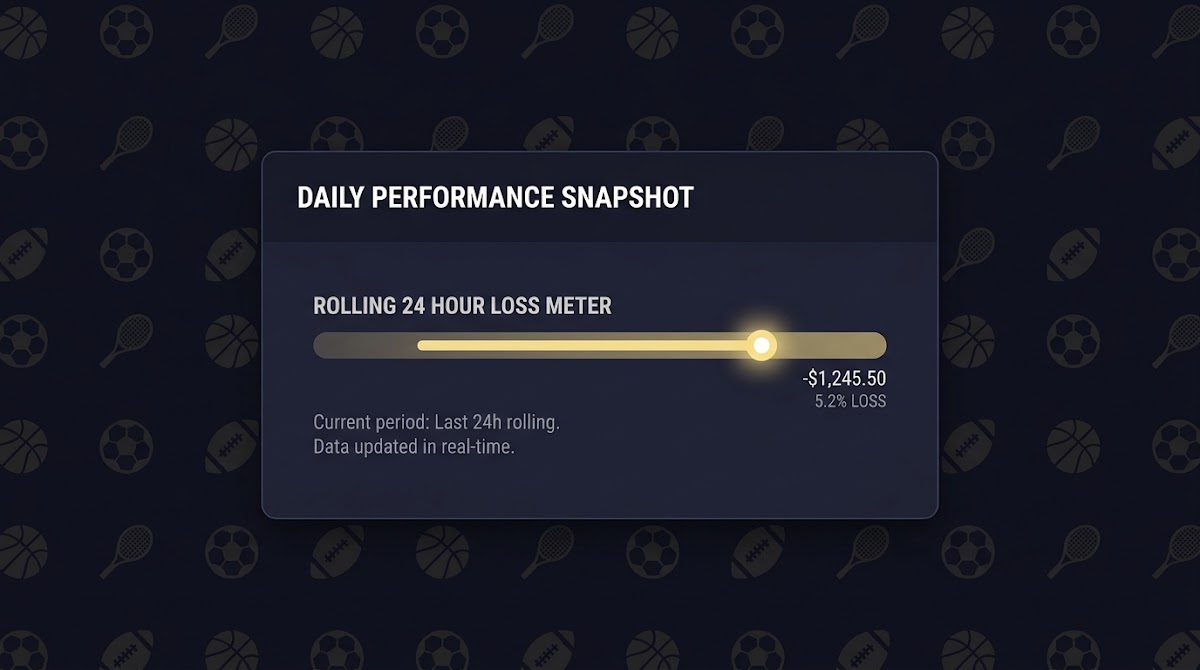
What daily loss limits are and why they matter
A simple pre-commitment checklist users can enable before an evaluation session
Use before starting a session to reduce impulse betting
A daily loss limit is a cap on allowable losses across a 24-hour window that evaluation platforms use to limit downside risk and discourage overtrading, and it helps keep sessions comparable for skill assessment. Responsible-play frameworks now emphasize giving users tools to set monetary and time limits, which supports the inclusion of daily loss caps in evaluation settings UK Gambling Commission guidance on remote customer interaction.
Put simply, a daily loss limit prevents a single bad session from erasing the learning value of a challenge by enforcing a hard stop on losses during a defined day. That makes results more about consistent forecasting and less about late-session risk taking, which preserves the integrity of funded-account evaluations.

One short example: if a participant sets a 24-hour cap of a fixed dollar amount or the operator applies a platform cap, once losses reach that level the remainder of the session is paused or suspended to prevent further erosion of the account balance.
Regulatory and industry context for daily loss caps
Regulators and industry reports have moved toward requiring or expecting pre-commitment and limit-setting tools to reduce harm and support safer participation. Standards and reports over 2023 to 2026 highlight operator responsibilities to provide limit tools and to support user choice in managing play AGCO Registrar's Standards for Internet Gaming.
In plain terms, the presence of daily loss tools is now seen as part of a well governed platform. Operators that publish clear limit features and allow users to pre-commit to monetary and time caps reduce both regulatory risk and player harm, while making evaluations easier to compare across participants.
Industry evaluations and state report cards also note that providing self-exclusion, deposit limits, and daily loss controls is a growing baseline expectation for platforms that run skill-based challenges and simulated funded accounts NCPG 2024 state of iGaming report.

How daily loss limits are implemented in practice
Platforms typically choose between a fixed dollar cap and a percentage-of-balance cap, and each approach has trade-offs. The fixed approach is simple to understand and enforces the same dollar exposure for all participants, while the percentage approach scales limits to account size and can mirror stop-loss percent rules used in trading Investopedia stop-loss explanation.
Fixed dollar caps work well for starter accounts where the evaluation goal is to test decision quality under a common exposure. Percentage caps are more common when accounts vary widely in size or when organizers want limits to track proportional risk.
Design limits that are transparent, measurable, and aligned with evaluation goals; combine a daily cap with an overall drawdown limit, scale thresholds to account size when needed, automate enforcement, and require concise decision logs to support review and refinement.
The 24-hour calculation window is often implemented as a rolling window that sums net losses across the previous 24 hours rather than resetting at midnight. That nuance matters because a rolling window can catch losses that span calendar boundaries and helps prevent players from timing big bets to avoid a cap.
Technically, platforms enforce the cap by tracking net PnL across the defined window and triggering session suspension or automated stops when the cap is reached. The enforcement method is usually automated for speed and consistency.
Core metrics: drawdown, maximum drawdown and stop-loss
Drawdown measures the decline from a peak balance to a subsequent trough and maximum drawdown captures the largest such peak-to-trough fall during a period. These metrics help quantify how far an account has moved away from its high and inform rules that prevent outsized daily declines Investopedia drawdown definition.
Tracking peak-to-trough values matters in evaluations because a single large drop can distort performance measurements and misrepresent skill. Maximum drawdown is therefore commonly used alongside daily limits to determine whether a participant should progress or be paused for review.
A practical metaphor: think of drawdown as the depth of a valley in a landscape. Limiting daily losses keeps the valley from becoming so deep that the path forward is unclear, which in turn preserves the signal that evaluations aim to measure.
Designing daily loss limits for funded-account evaluations
Designing limits requires balancing harm prevention with fair skill testing. Three design principles to follow are transparency, measurability, and alignment with evaluation goals. Make limits easy to understand, define numeric thresholds that are simple to compute, and tie the cap to what the evaluation aims to measure.
Transparency means publishing the cap, the 24-hour rule, and the enforcement action in plain language so participants know the boundaries before starting.
Try a practice session on Funded Plays Challenges
Review the sample rule set below and try a short practice session to see how self-imposed limits affect decision-making.
Measurability calls for defining whether the cap is a fixed dollar amount or a percentage of balance, and clarifying whether the window is rolling or fixed. Alignment means that limits should preserve the ability to demonstrate consistent forecasting across the challenge length without allowing outsized one-day swings to dominate results UK Gambling Commission guidance on remote customer interaction.
One practical pattern is to combine a daily cap with an overall maximum drawdown for an evaluation stage. For example, a platform could apply a daily cap to protect against acute losses and a stage drawdown threshold to prevent steady erosion over multiple days.
Tiered limits scaled to account size help preserve fairness. A starter account might have a simple fixed cap that is easy to understand, while higher tier accounts use percentage caps that keep proportional risk similar across different bankrolls.
Decision criteria: choosing thresholds and rule triggers
Choose thresholds using both quantitative inputs and qualitative considerations. Quantitative inputs include account balance, historical volatility of stake sizes, and expected average bet size. These inputs let you estimate how often a cap might be hit under normal behavior and calibrate the threshold accordingly Investopedia stop-loss guidance.
Qualitative factors include the desired user experience, the length of the evaluation, and regulatory expectations around pre-commitment and harm prevention. For instance, shorter evaluations often require tighter daily limits to keep the test meaningful across fewer sessions.
Decision tree bullets to consider when picking absolute versus percent caps include:
- If accounts are uniform in size, prefer a fixed dollar cap for simplicity.
- If accounts vary widely, prefer a percentage cap to scale risk.
- If the evaluation emphasizes short, high-frequency picks, tighten daily caps and enforce automated stops.
- If the platform must meet specific regulator expectations, choose the form that best supports clear user disclosures.
Monitoring, enforcement and documented logs
Automated enforcement protects both participants and platforms by ensuring consistent, immediate responses when a cap is reached. Platforms can implement immediate session suspension, prevent new positions, or place forced stop actions until the 24-hour window moves past the breach point UK Gambling Commission guidance on remote customer interaction.
Maintain a searchable decision log for each participant so both compliance teams and the participant can review what led to a breach. Logs should be concise but complete.

A practical log should include timestamp, stake or position, rationale for the pick, pre-set stop level, the outcome, and whether the pick contributed to a rolling 24-hour loss total. Keeping these fields consistent makes it easier to detect recurring patterns that lead to breaches Investopedia stop-loss documentation.
Manual review remains useful for edge cases, appeals, and training, but automated detection is the baseline for prompt enforcement and for creating reproducible audit trails.
Position sizing is a direct lever for controlling single-day risk. Using a consistent fraction of bankroll per pick smooths volatility and reduces the probability of large one-day drawdowns. Conservative sizing also preserves optionality during multi-day evaluations.

Keeping a trade or pick journal with short rationales reinforces discipline by converting decisions into data. Over time the journal reveals whether picks follow a repeatable process or whether emotion drives size and timing choices.
Common mistakes and pitfalls to avoid
Overtrading after a loss, often called revenge-betting, is a frequent path to breaching a daily cap. Players who double down to recoup losses increase both stake size and exposure, which makes hitting a cap more likely Investopedia drawdown guidance.
Another common error is misreading the calculation window. Mixing calendar day boundaries with a rolling 24-hour window can produce surprising results, such as thinking a reset occurred when it has not.
Immediate remediation steps after a breach include pausing activity for the remainder of the window, reviewing the decision log for the session, and updating self-imposed stop levels. Those actions help restore discipline and reduce the chance of a repeated breach.
Practical scenarios and sample calculations
Scenario A, starter account, fixed cap: imagine a starter virtual account with a 500 fixed daily cap. If a participant places a series of picks that produce a cumulative loss of 300, then a losing 250 pick would push the 24-hour total to 550, exceeding the cap and triggering session suspension. The platform would calculate net losses across the rolling window and stop new activity once the threshold is reached Investopedia drawdown definition.
Step-by-step for Scenario A: track each pick result, sum net losses in the last 24 hours, and compare to the fixed cap; when net losses exceed the cap, halt new positions and log the breach.
Scenario B, larger account with percentage cap: consider a larger evaluation account with a 20,000 balance and a 5 percent daily cap. The daily cap equals 1,000 in dollar terms. If the participant incurs a 700 loss in the morning and a further 400 loss later, the rolling sum reaches 1,100 and the cap is breached, even though individual picks were within usual size limits. Percentage caps scale with account size but still require active monitoring MSCI research on managing drawdowns.
When a limit is hit, typical platform responses are immediate suspension of new positions, automated notification to the user, and a record entry describing the trigger condition and the action taken.
Sample rule set and quick checklist for operators and participants
Sample rule text operators can publish:
- Daily loss limit: Net losses calculated over the previous 24 hours must not exceed the published cap. Exceeding the cap will temporarily suspend new activity for the affected account.
- Measurement: Net losses use realized result entries and are calculated on a rolling 24-hour basis unless otherwise stated.
- Enforcement: Automated suspension will prevent new positions and will be recorded in the participant log.
Operator checklist for publishing limits:
- Publish clear numeric caps and whether they are fixed or percentage based.
- Document whether the 24-hour window is rolling or calendar based.
- Log enforcement actions and make appeal steps available.
Participant pre-session checklist:
- Set a personal stop-loss that is tighter than the platform cap.
- Check bankroll ratio and pick sizing to ensure consistent position sizes.
- Start a session log entry for each pick with timestamp and brief rationale.
Measuring effectiveness and refining limits
Key metrics to track include frequency of breaches, average drawdown across participants, and changes in participant behavior after limits are introduced. These indicators show whether a cap is too tight, too loose, or working as intended MSCI guidance on drawdown monitoring.
A simple review cadence is monthly for new rules and quarterly once a pattern stabilizes. Use logged decisions to identify structural issues like frequent breaches linked to particular bet sizes or market conditions.
When metrics show repeated breaches concentrated in a subgroup, consider targeted adjustments such as tiered caps or additional educational prompts rather than blanket changes that affect all participants.
Daily loss limits protect participants from outsized single-day losses and help preserve the fairness and comparability of funded-account evaluations. They work best when paired with clear rules, automated enforcement, and user-facing pre-commitment tools that encourage disciplined play NCPG 2024 state of iGaming report.
Three starter actions for players: set a personal stop-loss before each session, use conservative position sizing tied to bankroll percentage, and keep a concise pick log. Three priorities for operators: publish transparent cap rules, automate enforcement and logging, and review performance metrics regularly to refine thresholds.
Limits are one element of responsible play and evaluation integrity. They reduce the chance of catastrophic single-day losses but do not guarantee results; outcomes still depend on participant performance and compliance with platform rules.
A daily loss limit is a predefined cap on net losses within a 24-hour window that pauses activity if exceeded to limit downside risk during evaluation sessions.
Use a fixed cap for uniform starter accounts and a percentage cap when account sizes vary; choose the form that aligns with fairness and the evaluation goal.
Record timestamp, stake, brief rationale, pre-set stop level, outcome, and whether the pick contributed to a rolling 24-hour loss total.
References
- https://daytraders.com/daily-loss-limits-explained
- https://www.gamblingcommission.gov.uk/for-gambling-businesses/guide/remote-customer-interaction-formal-guidance-for-remote-gambling-operators
- https://www.fundedplays.com/blogs/how-fundedplays-evaluations-work
- https://www.agco.ca/igaming/registrars-standards-internet-gaming
- https://www.ncpgambling.org/programs-resources/internet-responsible-gambling-standards/2024-state-report-card/
- https://www.investopedia.com/terms/s/stop-lossorder.asp
- https://www.investopedia.com/terms/d/drawdown.asp
- https://www.fundedplays.com/blogs
- https://aibm.org/policy/how-sports-betting-looks-in-america-and-where-policy-can-reduce-harms/
- https://www.gamblingcommission.gov.uk/for-gambling-businesses/guide/remote-customer-interaction-formal-guidance-for-remote-gambling-operators
- https://www.fundedplays.com/challenges
- https://www.msci.com/our-solutions/blog/managing-drawdowns-why-peak-to-trough-losses-matter
- https://pmc.ncbi.nlm.nih.gov/articles/PMC11823029/
- https://www.fundedplays.com