
Short answer: What +100 means for cricket odds
In plain terms, +100 in American odds corresponds to decimal 2.00 and indicates a nominal 50 percent implied probability before any bookmaker margin; that is the standard moneyline convention used in U.S. notation, and it is the starting point for judging value in cricket odds Wikipedia moneyline odds.
Practically, a $100 stake at +100 returns $200 total on a win - your $100 stake plus $100 profit - and you lose the $100 stake if the selection loses. That simple payout structure is how bettors convert prices into stakes and potential returns when they read a cricket odds screen Investopedia moneyline bet.
Short takeaway: +100 is not intrinsically a good or bad price. It is a nominal coin-flip price before removing the bookmaker margin; value depends on whether your fair, de-vigged probability exceeds the 50 percent threshold implied by +100.
How to convert +100 to implied probability and payout in cricket odds
Conversion is straightforward. First convert American +100 to decimal by adding 100 and dividing where appropriate; for +100 the decimal is 2.00. Then compute the nominal implied probability as 1 divided by the decimal, so 1/2.00 = 0.50 or 50 percent. This conversion and the implied probability concept are standard in betting education and probability guides Investopedia implied probability. A free implied-probability calculator is also available here.

Worked example: if you place a $100 stake at +100, the decimal 2.00 means a win pays 2.00 times your stake, giving $200 total back. Subtract your original stake to find profit: $200 minus $100 = $100 profit. If the selection loses, you forfeit the $100 stake. Those cash flows are the baseline math you use for expected value and staking decisions Investopedia moneyline bet. Tools such as OddsJam provide calculators for implied probability OddsJam implied probability.
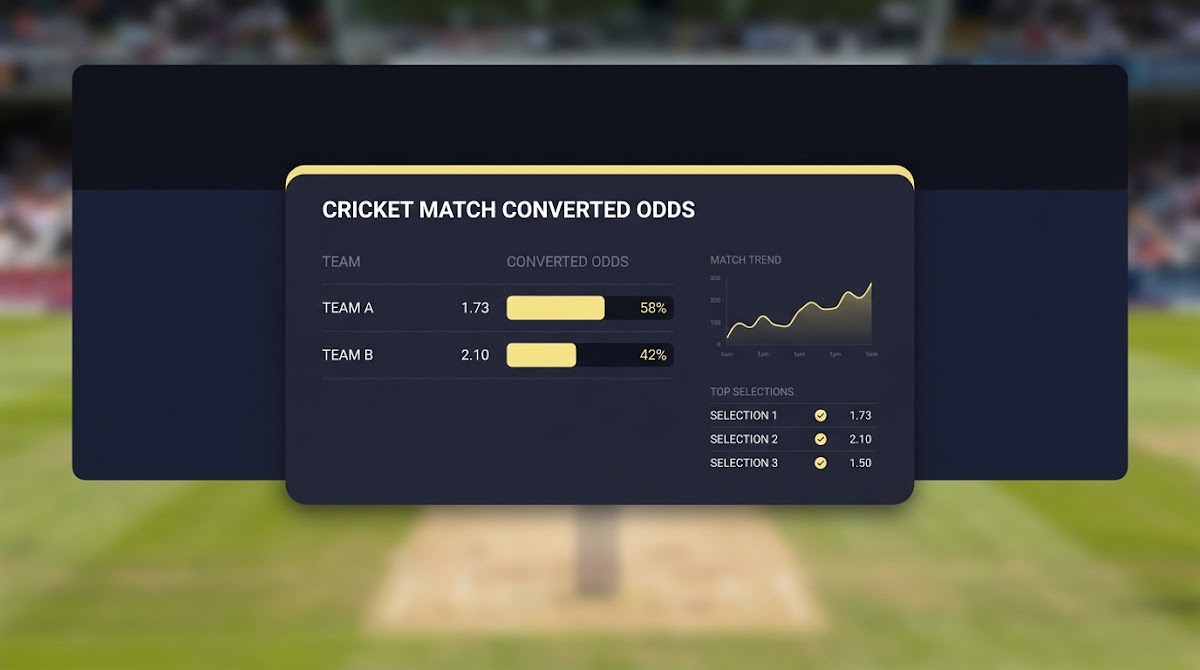
Visual conversion, in short: +100 -> decimal 2.00 -> implied probability 50 percent. Keep in mind that 50 percent is nominal and does not account for any vig or overround the bookmaker may have built into the market; treat it as the posted starting point rather than the fair probability. An odds converter can help when you switch formats, for example Covers odds converter.
Test a quick two-step conversion with your own numbers
Try these two quick steps with your own numbers: convert the moneyline to decimal, then compute implied probability, and use those figures when you later remove market margin to judge value.
Why bookmaker margin matters: overround and how to de-vig markets
Bookmakers set prices with a margin so the sum of implied probabilities in a market exceeds 100 percent; that aggregate excess is called the overround or vig and it means posted implied probabilities are biased by the house edge Overround explanation.
Because of the overround, the 50 percent implied by +100 on a posted board can be misleading. In a simple two-way market where both sides are shown at +100, the summed implied probabilities will be 100 percent before accounting for vig; when a bookmaker adds margin the two sides might appear at numbers that sum to, for example, 104 percent, meaning each side’s posted 50 percent is not the fair figure.
Simple de-vig method: translate each posted price to implied probability, sum those probabilities, then divide each posted probability by the total to get the de-vigged or fair share. For a two-way line both listed at +100 that sum to a slight overround after rounding, this process will reduce each side’s fair probability below the nominal 50 percent posted.

Why this matters: you should compare your model or estimate to the de-vigged probability, not the posted probability, when deciding whether +100 is a real value opportunity. The regulatory and player-education perspective on odds and fairness underlines why removing vig is a standard step before any staking decision UK Gambling Commission odds guidance.
Expected value at +100: how math decides if the bet is +EV
Expected value, EV, is computed as EV = (true win probability) * profit on a win - (loss probability) * stake. Apply that to +100 and a $100 stake: EV = p * $100 - (1 - p) * $100, where p is your de-vigged estimate of the selection’s chance to win. The EV concept and calculation are standard tools for evaluating whether a wager is profitable over repeated trials Investopedia expected value.
Numeric example: if your de-vigged model gives a 54 percent true win probability for a selection at +100, EV = 0.54 * 100 - 0.46 * 100 = $8. That positive EV means the wager would be profitable in the long run by $8 per $100 staked on average, assuming your probability estimate is accurate.
Not by itself; +100 is a nominal 50 percent price, and it becomes a good bet only when your de-vigged, model-based probability exceeds that threshold and yields positive expected value under disciplined staking.
Interpretation: a +100 wager is +EV only when your fair, de-vigged win probability exceeds 50 percent. If after removing the bookmaker margin your fair estimate is 50 percent or less, the long-run EV is zero or negative and the price offers no edge.
How +100 usually shows up in cricket markets
In cricket markets, +100 commonly appears where bookmakers view the contest as roughly balanced: match-winner lines between evenly matched sides, balanced handicaps, and some prop markets can all produce near coin-flip prices. That pattern of use is consistent with general guidance on odds and probability in regulated markets UK Gambling Commission odds guidance.
Cricket-specific variables change the true probability behind a posted +100. Toss outcome, pitch conditions, expected weather interruptions, team composition, and the format (T20, ODI, Test) all affect the real chance of either side winning and therefore affect whether +100 is fair or offers value.
Example context notes: a T20 match with similar squads on a neutral surface may reasonably produce posted +100 prices on both sides, while the same +100 in a Test with a bowler-friendly pitch might systematically understate the advantage to the bowler’s side if the market does not fully adjust.
Always bring your match-specific adjustments into the de-vigging and EV steps so you judge +100 against a context-aware fair probability rather than treating it as a generic coin flip.
A step-by-step checklist to judge whether +100 is worth a stake
1) Convert the posted +100 to decimal and nominal implied probability. 2) Collect both sides of the market and compute posted implied probabilities. 3) Sum posted probabilities to measure the overround. 4) De-vig by dividing each posted probability by the total to get fair probabilities. 5) Compare the de-vigged probability to your model or historical edge. 6) Calculate EV using your fair probability and the +100 payout. 7) Stake proportionally to edge with disciplined limits and tracking.

Staking rules: use proportional staking relative to your estimated edge and bankroll. If your edge is small, size bets smaller; if it is clear and repeatedly validated by your record, consider larger but still controlled stakes. Avoid putting a large fraction of your bankroll on a single +100 line unless your edge is well-supported by repeated evidence.
Checklist caveat: outcomes depend on skill, consistency, and correct application of de-vig and EV checks. There are no guaranteed wins; track results, refine your probability model, and keep strict rules about maximum stake per market.
Common mistakes and pitfalls when assessing +100
Ignoring the vig is the most frequent error. Treating the posted 50 percent implied probability at +100 as fair without removing bookmaker margin will bias your decisions and can make losing records look like skill when they are not Overround explanation.
Emotional overbets are another trap. A single win at +100 can create a false sense of skill if you round up stake sizes afterward. Bankroll preservation and disciplined staking protect you from over-interpreting short-term outcomes.
Format misreading also causes mistakes: a +100 in T20 does not carry the same underlying risk profile as +100 in a multi-day match. Always adjust your fair probability for format, pitch, and match conditions before calculating EV and staking.
Practical examples and scenarios: applying the checklist to real cricket lines
Worked example A: two-way match-winner listed as +100 for both sides. Posted implied probabilities are 50 percent and 50 percent, summing to 100 percent before bookmaker margin. If the bookmaker’s displayed prices actually sum to 102 percent after rounding, translate posted prices to probabilities, sum them to 102 percent, and de-vig by dividing each 50 percent by 1.02 to get a fair probability near 49.02 percent per side. Use that de-vigged figure when you compare to your model and compute EV Investopedia expected value.
Repeatable de-vig and EV steps to evaluate a +100 line
Use the same fields each time to stay consistent
Worked example A continued: if your internal model assigns a 51.5 percent fair probability to Side A after adjusting for pitch and team news, compare that to the de-vigged 49.02 percent. Calculate EV on +100 with your 51.5 percent: EV = 0.515 * 100 - 0.485 * 100 = $3. That positive but small EV suggests a modest proportional stake rather than a large wager.
Worked example B: a balanced handicap or prop priced near +100 might hide format-specific edges. For instance, a props market on whether a fast bowler will take a wicket could be priced at +100 based on standard game models, but if you expect a pitch that favors seamers and your model increases the probability to 58 percent, EV becomes 0.58 * 100 - 0.42 * 100 = $16 per $100 stake, a clearer edge that justifies a larger proportional stake subject to your bankroll rules.
In both examples, the numbers are illustrative. Apply the same conversion, de-vig, and EV math to each new line and keep a record of outcomes so you can validate whether your edge is real across repeated samples.
Conclusion: a disciplined approach to cricket odds at +100
Key takeaways: +100 equals decimal 2.00 and nominally implies a 50 percent chance, but the posted figure can mask bookmaker margin; always de-vig markets, compare the de-vigged probability to your model, and calculate EV before staking Investopedia implied probability.
Next steps for readers: practice conversions and de-vigging on a spreadsheet on our blog, log your decisions and results, and use proportional staking rules when you detect a repeatable edge. Discipline and tracking turn a one-off +100 line into a measurable decision process rather than a gut call.
In American odds, +100 equals decimal 2.00 and nominally implies a 50 percent chance; a $100 stake returns $200 total on a win and loses the stake on a loss.
Convert each posted price to implied probability, sum the probabilities to measure the overround, then divide each posted probability by the total to get de-vigged fair probabilities.
A +100 bet is worth making when your de-vigged, model-based probability exceeds 50 percent and the calculated EV is positive, combined with disciplined staking and proven repeatability.
References
- https://en.wikipedia.org/wiki/Odds#United_States
- https://www.investopedia.com/terms/m/moneyline-bet.asp
- https://www.investopedia.com/terms/i/implied-probability.asp
- https://therundown.io/betting-calculators/implied-probability-calculator
- https://oddsjam.com/betting-calculators/implied-probability
- https://www.covers.com/tools/odds-converter
- https://en.wikipedia.org/wiki/Overround
- https://www.gamblingcommission.gov.uk/public-and-players/guide-to-gambling/odds-and-probability
- https://www.investopedia.com/terms/e/expectedvalue.asp
- https://www.fundedplays.com/challenges
- https://www.fundedplays.com
- https://www.fundedplays.com/blogs
- https://www.fundedplays.com/blogs/how-fundedplays-evaluations-work